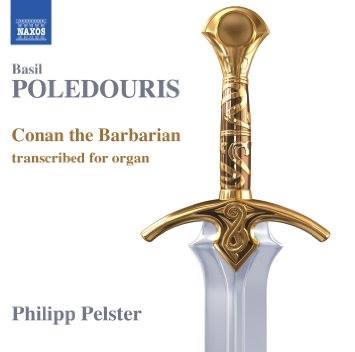
Tag: Basil Poledouris

  • Conan’s Great Movie Music Soundtracks

    Conan’s Great Movie Music Soundtracks

    In “Conan the Destroyer” (1984), one of Conan’s companions speculates, “I suppose nothing hurts you.”

    To which he replies, “Only pain.”

    Discriminating viewers may feel a little pain themselves watching these silly, cheesy and violent films, all of which were inspired by the writings of pulp master Robert E. Howard. Howard created the warrior Conan in 1932. The character became the center of a series of lucrative stories first published in “Weird Tales” magazine.

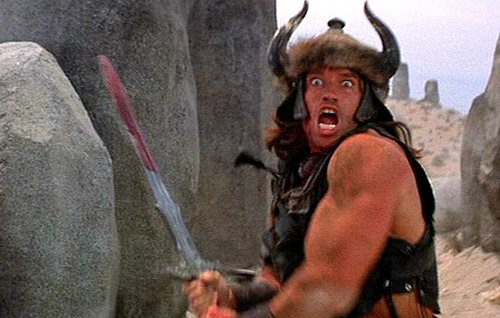
    In 1982, Conan made the leap to the big screen, under the guidance of director John Milius. The film, “Conan the Barbarian,” made Arnold Schwarzenegger, already a legend in the field of bodybuilding, an international superstar. While “Conan” isn’t exactly “Citizen Kane,” it does have its pleasures. The intensity of the violence can be a little disturbing, but the ponderous tone is a blast. “Conan” is a film that takes itself just seriously enough to make it occasionally hilarious.

    Another thing “Conan” had going for it was the fact that it was made on a blockbuster budget. The first-rate production values extended to the music by Basil Poledouris, who employed a full symphony orchestra to impressive ends. In fact, the “Conan” score is one of the strongest of the decade. It’s amazing that anyone would find so much inspiration in such a mediocre film, but Poledouris’ music intersperses Central Asia-style lyricism with brawny, thrilling action music.

    Sadly, the sequel, “Conan the Destroyer,” showed all-too-evident signs of penny-pinching, so that it often wound up feeling like a direct-to-video production. Poledouris was forced to make do with a smaller orchestra, which at times sounds like a television ensemble. Still, he gave it his all, and there’s something to be said for the fact that it is an original score, rather than a mere retread of the original.

    In 1997, Howard’s Kull of Atlantis was given the big screen treatment as “Kull the Conqueror.” Kevin Sorbo, TV’s Hercules, played the title role. The composer, Joel Goldsmith (son of Jerry Goldsmith), was asked to incorporate heavy metal riffs into his orchestral underscore. I haven’t actually seen this one, but for some reason I don’t feel like I’m missing anything.

    The astoundingly prolific Ennio Morricone – who has more than 500 motion picture and television scores to his name – has an uncanny knack for spinning garbage into gold. His music for “Red Sonja” (1985) lends the film an aura of ‘80s fun, perhaps more so than it deserves. This is the film that introduced Brigette Nielsen as the chain-mailed barbarian beauty. Schwarzenegger appears in the supporting role of Lord Kalidor.

    In the ‘80s, even bad films had great scores. I hope you’ll give “Conan the Barbarian” a chance this week, on “Picture Perfect” – music for the movies – this Friday evening at 6:00 ET, or enjoy it later as a webcast at http://www.wwfm.org.

    By the way, is it pronounced “Co-NAN,” as it was in the 1982 version, or “CO-nin,” as it was in the 2011 remake? Interesting meditation here:

    http://www.vulture.com/2011/08/conan_the_barbarian_has_change.html

    I pronounce it “Co-NAN” in the promo, and “CO-nin” in the show.
  • Australian Outback Film Scores Picture Perfect

    Australian Outback Film Scores Picture Perfect

    G’day! This week on “Picture Perfect,” we’re off to the antipodes for an hour of music from films set in the Australian bush.

    Ealing Studios shot several movies there – three independently, and then two in collaboration with MGM. The first was “The Overlanders” (1946), told in semi-documentary style, about a wartime push to evacuate Australia’s Northern Territory, with its 5000 settlers and a million head of cattle, before an anticipated Japanese invasion. The music was by John Ireland. Despite its excellence, it would prove to be his only film score.

    Ealing’s final independent Australian venture was “Bitter Springs” (1950). The film tells the tale of an Australian pioneer family, which encounters problems with the local Aboriginal people when its headstrong patriarch denies access to a watering hole.

    The thematic material was by Ralph Vaughan Williams, who left it to composer and conductor Ernest Irving to arrange and orchestrate what he felt needed for the various cues. Vaughan Williams wrote his friend and colleague to express his pleasure with the finished product. Irving would soon receive the dedication of Vaughan Williams’ Symphony No. 7, the “Sinfonia Antarctica” (itself derived from RVW’s film score to Ealing’s “Scott of the Antarctic”).

    Both of these films, “The Overlanders” and “Bitter Springs,” are essentially westerns set in the Australian outback. From a little closer to our own time, we’ll hear music from another film which was unapologetic in its use of American western motifs, “Quigley Down Under” (1990).

    The film starred Tom Selleck as an American cowboy, hired by an Australian rancher, played by Alan Rickman, allegedly to shoot dingoes; however, he soon finds that the rancher’s real purpose is to rid the land of Aborigines – a proposition Quigley naturally rejects, setting up the film’s conflict.

    The score is by Basil Poledouris, a composer who has achieved cult status for his work on films like “Robocop” and especially “Conan the Barbarian,” though he never really seemed to receive the recognition the deserved. He did, however, win an Emmy for his score to “Lonesome Dove.”

    (HOT TIP: We’ll be listening to Poledouris’ “Conan” scores next week!)

    Finally, we’ll have just a bit from John Barry’s haunting score to Nicholas Roeg’s “Walkabout” (1971), in which two British children find themselves stranded in the bush and survive only through the aid of a young Aborigine.

    We’re heading down under and out back this week, for “Picture Perfect” – music for the movies – this Friday evening at 6 ET. Listen to it then, or catch it later as a webcast at http://www.wwfm.org.

Tag Cloud

Aaron Copland (92) Beethoven (95) Composer (114) Film Music (123) Film Score (143) Film Scores (255) Halloween (94) John Williams (187) KWAX (229) Leonard Bernstein (101) Marlboro Music Festival (125) Movie Music (138) Opera (202) Philadelphia Orchestra (89) Picture Perfect (174) Princeton Symphony Orchestra (106) Radio (87) Ralph Vaughan Williams (85) Ross Amico (244) Roy's Tie-Dye Sci-Fi Corner (290) The Classical Network (101) The Lost Chord (268) Vaughan Williams (103) WPRB (396) WWFM (881)

DON’T MISS A BEAT

Receive a weekly digest every Sunday at noon by signing up here


RECENT POSTS