Tag: British Composer

  • Celebrating Albert Ketèlbey Light Music Luminary

    Celebrating Albert Ketèlbey Light Music Luminary

    He helped bring “light” into the world.

    This week on “Sweetness and Light,” we mark the sesquicentenary of the birth of Albert Ketèlbey.

    Along with Eric Coates, 11 years his junior, Ketèlbey was one of the foremost British light music luminaries. In fact, it’s been said that at his peak, in the 1920s, there was no more successful composer in England. His music was played by palm court orchestras at grand hotels, at luxurious restaurants, in tea shops and cinemas, on municipal orchestra concerts, and on recordings and radio.

    Nowadays, his music is much less frequently heard. Coates has his infectious marches and “By the Sleepy Lagoon,” while Ketèlbey often strays to exotic fairy lands, dabbling in a kind of “orientalism” that is now decidedly out-of-fashion – though for some reason, it doesn’t prevent us from enjoying works like Rimsky-Korsakov’s “Scheherazade.”

    Even in his day, Ketèlbey withstood the brickbats of jealous rivals and indignant critics. It must have been doubly exasperating when he became England’s first composer to earn a million dollars. Unquestionably, there is a certain “kitsch” factor to his output. His works have been described as both “reprehensibly demeaning” and “delightfully tacky.” But there’s also an element of naiveté, which can still charm those of us lulled by a nostalgia for our grandparents’ enthusiasms.

    And face it, he DID always have an ear for a good tune.

    It’s unlikely in our more culturally sensitive age that Ketèlbey’s music will ever make a huge comeback, but these twee picture postcards offer fascinating glimpses into simpler times in the world of musical entertainment. I hope you are able to set aside your cynicism and sophistication for an hour, as we salute Albert Ketèlbey on the 150th anniversary of his birth, on “Sweetness and Light,” this Saturday morning at 11:00 EDT/8:00 PDT, exclusively on KWAX, the radio station of the University of Oregon!

    Stream it wherever you are at the link:
    https://kwax.uoregon.edu/

  • Norman O’Neill: Frankfurt’s Forgotten Composer

    Norman O’Neill: Frankfurt’s Forgotten Composer

    Norman O’Neill was born 150 years ago today. Who exactly was he?

    O’Neill is probably the least known member of the Frankfurt Group – sometimes identified as the Frankfurt Gang – an informal collective of young musicians who came together at the Hoch Conservatory in Frankfurt-am-Main during the 1890s. The group also included Balfour Gardiner, Roger Quilter, Cyril Scott, and, the youngest of the bunch, the piano prodigy Percy Grainger.

    Later, though technically not “in” the Gang, other figures to become closely associated with it included Frederick Delius, Sir Thomas Beecham, and the composer Frederic Austin.

    The Hoch Conservatory of the day had a reputation for being one of the finest conservatories in Europe. Clara Schumann had been on the faculty there until 1892 – within a few years of the Frankfurt Group’s arrival.

    Two of the Gang attended twice. Cyril Scott arrived early, at the age of 12, and later returned for a second stint. Balfour Gardiner took a break to attend Oxford. Grainger was 13 at the time he was admitted. He was to remain at the conservatory for four-and-a-half years.

    What united this brilliant array of young talent in a foreign land? Well, there was shared language and culture, of course, but also a determination to break away from the predominant, Teutonic musical thinking of the time, and especially the place, to create a fresh “English” art.

    O’Neill, the son of Irish painter George Bernard O’Neill and Emma Stuart Callcott (daughter of glee composer William Hutchins Callcott), married pianist Adine Berthe Maria Ruckert. Ruckert, a pupil of Clara Schumann, was also a teacher. She would later become head music mistress at the St. Paul’s Girls’ School. Gustav Holst, who was director of music there, became a frequent visitor at their house.

    O’Neill himself studied with Arthur Somervell and Iwan Knorr. Back in London, he served as treasurer of the Royal Philharmonic Society and taught harmony and composition at the Royal Academy of Music.

    In 1934, he was on his way to a recording session when he stepped off the curb and was struck by a carrier tricycle. He developed blood poisoning and died less than three weeks later, on March 3, eleven days shy of his 59th birthday.

    O’Neill’s concert output includes symphonic suites, chamber music, and instrumental works. Most of these pre-date World War I. After the war, as music director of the Haymarket Theatre, he devoted himself largely to music for the stage.

    He achieved particular success with his music for J.M. Barrie’s “Mary Rose” (1920).

    If I understand correctly, he was the first British composer to conduct his own music on record, when he led selections for a stage production of Maurice Maeterlinck’s “The Blue Bird” (1910).

    O’Neill composed a lot of charming music that deserves to be resurrected, at the very least in new recordings. Even if no one else remembers him today, I will. Happy sesquicentenary to Norman O’Neill!

    Piano Quintet in E minor (1902-03)

    “La Belle Dame sans Merci,” after Keats (1908)


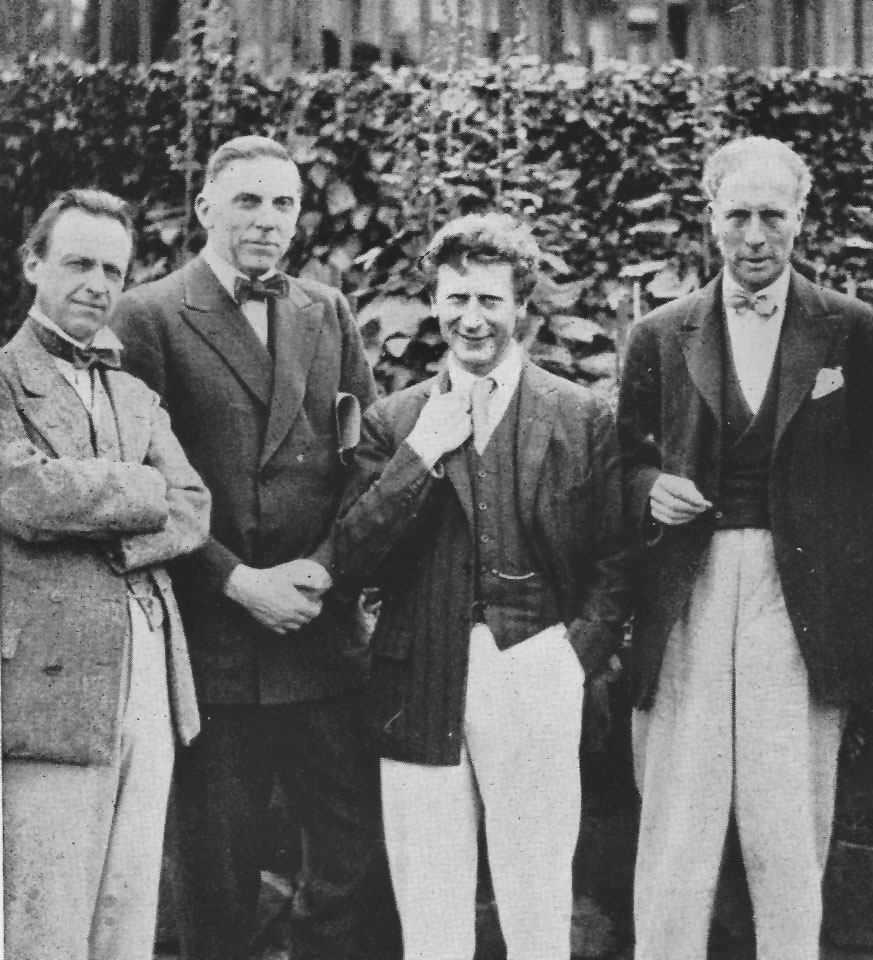
    Frankfurt Gang reunion: (left to right) Cyril Scott, Roger Quilter, Percy Grainger, and Norman O’Neill in 1930

  • Errollyn Wallen: New Master of the King’s Music

    Errollyn Wallen: New Master of the King’s Music

    Errollyn Wallen is the new Master of the King’s Music.

    Wallen, born in Belize, moved to London with her parents at the age of 2. She trained as a dancer, traveling to New York in her late teens to study with Dance Theater of Harlem. She then returned to the U.K. to pursue music at Goldsmiths, King’s College London, and King’s College, Cambridge. Wallen was the first Black woman to have her music performed at the Proms. At 66, she succeeds Dame Judith Weir, who was appointed to the post by Queen Elizabeth II in 2014. Wallen has been on the royal radar for some time, having been commissioned to compose works to mark the Queen’s Golden and Diamond Jubilees.

    The appointment of Master (and yes, the title applies for both men and women) used to be one for life; however, that was changed following the death of Malcom Williamson in 2003. Williamson, also born abroad (in his case, in Sydney, Australia), caused some displeasure at Buckingham Palace when he failed to meet important deadlines. The position was modified to encompass ten years. Williamson was succeeded by Sir Peter Maxwell Davies, an unusual choice, given the composer’s avant-garde and anti-establishment tendencies. But he seemed to get along well with the Queen. Weir was made Master in 2014.

    Wallen, the second woman to hold the post (and consecutively at that) will be expected to provide music for official and ceremonial occasions. King Charles is known to hold rather conservative musical tastes. Wallen’s compositions are very much of our time, which is to say, she often employs a broader palette, although she has also shown she has the ability to keep her music accessible and popular. Her works have been turning up more and more frequently on orchestral and chamber music programs even in this country. The Kansas City Symphony gave the U.S. premiere of her Violin Concerto in March. It will be played by the North Carolina Symphony in October. I’ve caught her “Concerto Grosso” on the radio a few times. Last year, Wallen was ranked as one of the top 20 most performed living classical music composers.

    In 2007, for her services to music, she was appointed a Member of the Order of the British Empire (MBE). In 2020, she became a Commander of the Order of the British Empire (CBE).

    Her arrangement of Hubert Parry’s sacred cow, “Jerusalem” for the 2020 Proms, for which she added a line to Blake’s text to acknowledge the Commonwealth, stirred controversy.

    Other composers to hold the post of Master of the King’s/Queen’s Music over the past century include Sir Edward Elgar, Sir Walford Davies, Sir Arnold Bax, and Sir Arthur Bliss.

    Congratulations to Errollyn Wallen!


    Concerto Grosso

    Cello Concerto, with introductory interview with the composer. The music itself begins at 16 minutes in.

    Controversial take on Parry’s “Jerusalem”

    Her website

    https://www.errollynwallen.com/

  • Madeleine Dring A Centenary Celebration

    Madeleine Dring A Centenary Celebration

    Madeleine Dring was born 100 years ago today.

    A precocious musician, she entered the junior department of the Royal College of Music on a scholarship at the age of 10. At first, violin was her primary instrument, but she also studied piano. At 14, she began composition lessons. Herbert Howells supervised her senior-level studies. She also took lessons with Ralph Vaughan Williams. She dropped the violin following the death of her teacher W.H. Reed, friend of Elgar. Reed was concertmaster of the London Symphony Orchestra for 23 years. She continued to study piano with Lilian Gaskell.

    Dring was also very fond of the theater. She studied mime, drama, and singing, later combining her enthusiasms by supplying music for stage, radio, and television. Her dance drama, “The Fair Queen of Wu,” was broadcast on BBC TV in the 1950s. She was also involved in several other television productions, as actor and/or composer, for “Waiting for ITMA,” “ITV Television Playhouse,” and ITV Play of the Week.”

    In 1947, she married Roger Lord, the London Symphony Orchestra’s principal oboist, and wrote of number of works for him. In general, she eschewed large-scale works in favor of shorter pieces. This allowed her to raise a child, and frankly, with all her interests, she was busy! She did compose a one-act opera, “Cupboard Love.”

    Dring died of a cerebral hemorrhage in 1977 at the age of 53. Some of her cartoons were included in a book, “Madeleine Dring: Her Music, Her Life,” published in 2000. It was partially funded by her husband to bring more attention to her music.

    Dring had a vivacious spirit and brought a lot personality to everything she touched. Once, when asked to supply some biographical information for a program note, she jotted, “Madeleine Dring was born on the moon and can therefore claim to be a pure-bred lunatic. Arriving on a speck of cosmic dust she came face to face with the human race and has never really recovered.”

    Happy birthday, Madeleine Dring!


    Trio for Flute, Oboe and Piano

    7 Shakespeare Songs: Take, O Take Those Lips Away

    Italian Dance

    Toccata

    Caribbean Dance

  • Doreen Carwithen Rediscovered?

    Doreen Carwithen Rediscovered?

    On the centenary of her birth, is Doreen Carwithen finally ready for her close-up?

    Carwithen has been lauded as the first female film composer. She was certainly the first to study in the Royal Academy of Music’s film program, instituted by J. Arthur Rank in 1946. Could she have been the first woman in the world to have made film music a career? In all, she composed scores for some 30 films, many of them shorts and documentaries, but six of them were features.

    Alas, her concert works, while well-received, were not embraced with particular enthusiasm by either programmers or publishers.

    Carwithen entered the Royal Academy as a cellist, who could also play violin and piano, in 1941. There, she enrolled in William Alwyn’s harmony class. Before long, he was also teaching her composition. Their mutual attraction was instantaneous, sparking a 30-year romance that culminated in their marriage in 1975.

    Unfortunately, at the time of their meeting, Alwyn happened already to be married. The affair proved deleterious to everyone – Carwithen, Alwyn, and Alwyn’s wife – with stress, depression, and physical health issues all around.

    When they finally did marry (after Alwyn’s doctor gave him a talking to, pointing out that he was killing everyone by not living honestly), Carwithen preferred to be recognized by her middle name. She had always disliked Doreen. Thereafter, she went by Mary.

    In 1961, as her career never really seemed to get off the ground, Carwithen began acting as Alwyn’s secretary and amanuensis. Increasingly, she shifted her focus to supporting and promoting his music at the expense of her own. After all, he was by that time a symphonist of stature, while she wasn’t gaining any traction.

    Following Alwyn’s death in 1985, she devoted herself purely to the preservation of his legacy. When she herself died in 2003, she left sketches for a string quartet (which would have been her third), a symphony, and a cello concerto. One can only imagine that, as a creative artist, Carwithen withered on the vine.

    Now it seems her time has come. Her overture, “Bishop Rock,” was performed at this year’s BBC Proms (alongside Grace Williams’ “Sea Sketches” and Ralph Vaughan Williams’ “A Sea Symphony”). On a separate concert, her Second String Quartet was also played. Another scheduled overture, “ODTAA (One Damn Thing After Another)” was not heard, as the Last Night of the Proms was cancelled because of the Queen’s death.

    I expect, with the increased interest in music by composers marginalized because of race or gender, that we’ll be seeing more recordings and concerts featuring Carwithen’s works.

    Here’s an interesting write-up that contains a lot of information about the composer, beyond that usually drawn from her Wikipedia page:

    History

    I’ve also been looking for an excuse to post this video of her Piano Sonatina for the last few weeks.

    “ODTAA (One Damn Thing After Another),” introduced by Sir Adrian Boult and the London Philharmonic in 1947

    Concerto for Piano and Strings, first performed at the Proms in 1952

    “Bishop Rock”

    String Quartet No. 1

    “Suffolk Suite” (1964)

    Carwithen wrote the score for the documentary “Elizabeth is Queen” (1953) at white heat. The film was released in theaters three days after Elizabeth’s coronation. The music under the opening credits is arranged from Walton’s “Crown Imperial.” Keep in mind, this is only reel one!

    https://www.britishpathe.com/video/elizabeth-is-queen-reel-1-1

    Carwithen and Alwyn were the focus of my film music show, “Picture Perfect,” this past Saturday on WWFM – The Classical Network. You can listen to the webcast by following the link below.

    https://www.wwfm.org/show/picture-perfect-with-ross-amico/2022-11-10/picture-perfect-november-12-william-alwyn-doreen-carwithen

    Happy birthday, Doreen Carwithen.

Tag Cloud

Aaron Copland (92) Beethoven (95) Composer (114) Film Music (119) Film Score (143) Film Scores (255) Halloween (94) John Williams (185) KWAX (229) Leonard Bernstein (99) Marlboro Music Festival (125) Movie Music (134) Opera (198) Philadelphia Orchestra (86) Picture Perfect (174) Princeton Symphony Orchestra (106) Radio (87) Ralph Vaughan Williams (85) Ross Amico (244) Roy's Tie-Dye Sci-Fi Corner (290) The Classical Network (101) The Lost Chord (268) Vaughan Williams (102) WPRB (396) WWFM (881)

DON’T MISS A BEAT

Receive a weekly digest every Sunday at noon by signing up here


RECENT POSTS