Tag: British Composer

  • Edmund Rubbra & My Easton Neighbor

    Edmund Rubbra & My Easton Neighbor

    Who knew that between the ages of 5 and 10 I lived next door to the world authority on the music of Edmund Rubbra? Who’d have thought that such a figure would have resided in Easton, Pennsylvania?

    Rubbra is a now-underrated British composer of rewarding symphonies and choral music, sometimes overtly inspired by his Roman Catholic faith. The music is full of fantasy and often dreamy melody, but by no means at the expense of architectural logic.

    Ralph Scott Grover joined the faculty of Lafayette College, in Easton, in 1965. He was the first head of Lafayette’s music department. His affection for Rubbra’s music yielded a book, “The Music of Edmund Rubbra,” published in 1993. He was also invited to write the Rubbra entry for “The New Grove Dictionary.”

    Grover himself was a composer of art songs, or so I’m told. I remember he and his wife would spend time each year visiting at Rubbra’s castle in the UK. Earlier, in 1980, he had also written a book titled “Ernest Chausson: The Man and His Music.”

    I find it amusing to reflect that as a boy I would be playing on the sidewalk, around a tree out front, not knowing the first thing about classical music – my grandfather, with whom I lived, was a product of the Great Depression and World War II, who spent most of his life working with his hands – and here I was, living next door to someone totally steeped in English music, which would later become one of my life’s passions.

    Mr. Grover died in 2002. I am happy to say that I met him again later in life, by which time I had already become quite knowledgeable about the subject. In fact, I know he listened to me on WWFM. I remember that he and his wife pledged their financial support during one of my shifts. Grover also expressed an affection for the music of Gerald Finzi, whom I also happen to adore, and was a member of the Peter Warlock Society.

    I do regret not having had more of a master-disciple relationship with him. By that time, I had already left Easton, and though he extended a non-specific invitation to visit, nothing ever came of it. We nearly missed one another entirely. I’m thankful we had the conversations we did, and that he saw that I had become something more than the goofy kid he scarcely regarded.

    Happy birthday, Edmund Rubbra (1901-1986). It is you I have to thank for this reminiscence.

    Here’s a sample of Rubbra’s music: “Overture Resurgam,” from 1975, inspired by a memory of the war and an example of the composer’s religious convictions translated to sound. In March 1941, Nazi planes bombed Plymouth and laid waste to much of the city, including the Church of St. Andrew. Only its tower remained intact. On the north door of the tower stood one word, “Resurgam” – “Risen Again.”

    The Symphony No. 4

    His orchestration of Brahms’ “Handel Variations”

    https://www.youtube.com/watch?v=OXHjZI6tWZw


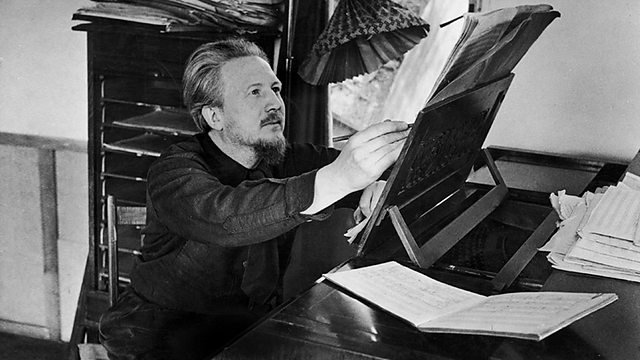
    PHOTO: Rubbra resurrected

  • Uplifting Friday Music April Foulds

    Uplifting Friday Music April Foulds

    April Foulds! Some uplifting music by John Foulds to brighten your Friday morning.

  • Joseph Horovitz Composer Dies at 95

    Joseph Horovitz Composer Dies at 95

    Though he composed his share of “serious” music, Joseph Horovitz was not afraid to go popular, light, or even ridiculous. In fact, my first exposure to his work was through the “Horrortorio,” composed for one of the Hoffnung Music Festival concerts. Gerard Hoffnung’s whimsical series enlisted top-flight English musicians to let down their hair and embrace their lunatic side, in skewering staid classical music conventions. The “Horrortorio,” a response to Hammer Films’ lurid resurrections of classic monsters, relates the wedding of Dracula’s daughter to Frankenstein’s son, in the context of a faux oratorio. Horovitz spoofs Baroque standards by Bach and Handel, William Walton’s “Belshazzar’s Feast,” and the Gilbert & Sullivan operettas.

    To a broader audience, he was perhaps best known for his theme music to “Rumpole of the Bailey,” the British television series starring Leo McKern.

    The composer’s family, Jewish, fled Vienna following the Anschluss and settled in England in 1938. Horovitz’s musical studies began at New College, Oxford, where he also pursued modern languages. Later, he attended the Royal College of Music, where among his teachers was Gordon Jacob. Then he was off to Paris for further studies with Nadia Boulanger.

    Horovitz was appointed music director at the Bristol Old Vic in 1950. He was also a conductor of opera and ballet, who toured widely.

    His alma mater, New College, Oxford, recently celebrated his 95th birthday with streamed performances of his 4th and 5th String Quartets.

    Among Horovitz’s other works were 16 ballets, including “Alice in Wonderland,” and several operas, including one based on the classic Garbo film “Ninotchka.” As an Edgar Rice Burroughs fan, I was also interested to discover that he composed the score for “Tarzan’s Three Challenges” (1963), with Jock Mahoney – at 44 the oldest Tarzan on film!

    In addition, he wrote nine concertos, including one for euphonium and a “Jazz Concerto” for piano, strings, and percussion.

    His children’s pop cantata, so-called, “Captain Noah and His Floating Zoo,” was widely embraced by amateur performers.

    Horovitz died on Wednesday. He was 95 years-old.


    “Rumpole of the Bailey”

    The first three videos in this playlist comprise his Sonatina for Clarinet and Piano

    The Euphonium Concerto

    “Alice in Wonderland”: Lobster Quadrille and Grand Waltz

    “Tarzan’s Three Challenges”

    The String Quartet No. 5

    The “Horrortorio”

    The notorious and uproarious Hoffnung Music Festival

    Joseph Horovitz speaks

  • Malcolm Arnold Tormented Genius

    Malcolm Arnold Tormented Genius

    “…[T]hou was a skellum,/A blethering, blustering, drunken blellum;/That frae November till October,/Ae market-dae thou was na sober.”

    Rabbie Burns wrote those lines about Tam O’Shanter. But they just as well could have applied to Sir Malcolm Arnold. Both men were, more or less, fond of the bottle, and both were driven by demons.

    Arnold, born 100 years ago today, began his professional career as a trumpeter with the London Philharmonic Orchestra. He was appointed its principal in 1943.

    During World War II, he registered as a conscientious objector. However, following the death of his brother, a pilot in the RAF, he was moved to enlist. At least for a time. While he never saw actual combat, serving instead in a military band, he quite literally shot himself in the foot so that he could return to civilian life.

    In 1948, he retired from orchestral playing to devote himself exclusively to composition. He possessed a rare melodic gift, which served him well in his light music and film scores. He won an Academy Award in 1957 for his work on “The Bridge on the River Kwai.”

    However, Arnold also had his dark side, as can be detected in certain passages of his symphonies. He was frequently cantankerous, often inebriated, and also highly promiscuous. He attempted suicide at least twice. He was treated for depression and alcoholism, rising above both, but in the early 1980s was given only a year to live. He actually lasted another 22, during which he completed his Symphony No. 9, among other works.

    Arnold died in 2006, one month shy of his 85th birthday. He was a brilliant composer, of great facility. When Malcolm Williamson was named Master of the Queen’s Music in 1975, Sir William Walton quipped that they had given the job to the wrong Malcolm. For a man with so many personal demons, Arnold wrote reams of perfectly delightful music.

    A good example, and one of my favorite Halloween pieces, is the programmatic overture “Tam O’Shanter” (1955). On market day, Burns’ antihero tarries at a pub, in defiance of his wife, then staggers out into the night. Under ominous skies, he detects the sound of bagpipes emanating from the ruins of an old church. Pressing his face to a chink in the mortar he espies “Auld Nick,” the Devil himself, “in shape o’ beast,” presiding over a coven of high-stepping witches and warlocks. When a particularly comely witch catches Tam’s eye, in his drunkenness, he roars, “Weel done, Cutty-sark!” (a reference to her short skirt). This brings the forces of darkness down up him, and there is a hell-for-leather sprint by horseback for a nearby river, since spirits are said not be able to cross running water.

    If you’re interested in the rest, you can read it for yourself here:

    http://loki.stockton.edu/~kinsellt/litresources/ayr/tam.html

    Then listen to Arnold’s musical response:

    Also, “Four Scottish Dances” (1957):

    From the film “The Belles of St. Trinian’s” (1954), in concert:

    On a more serious note, the Symphony No. 4 (1960), a plea for tolerance following the Notting Hill race riots of 1958:

    The Guitar Concerto (1959), played by Julian Bream:

    “Three Sea Shanties” (1943) for wind quintet:

    An interview by Bruce Duffie:

    http://www.bruceduffie.com/arnold2.html

    Happy centenary, Sir Malcolm Arnold, you tormented genius!


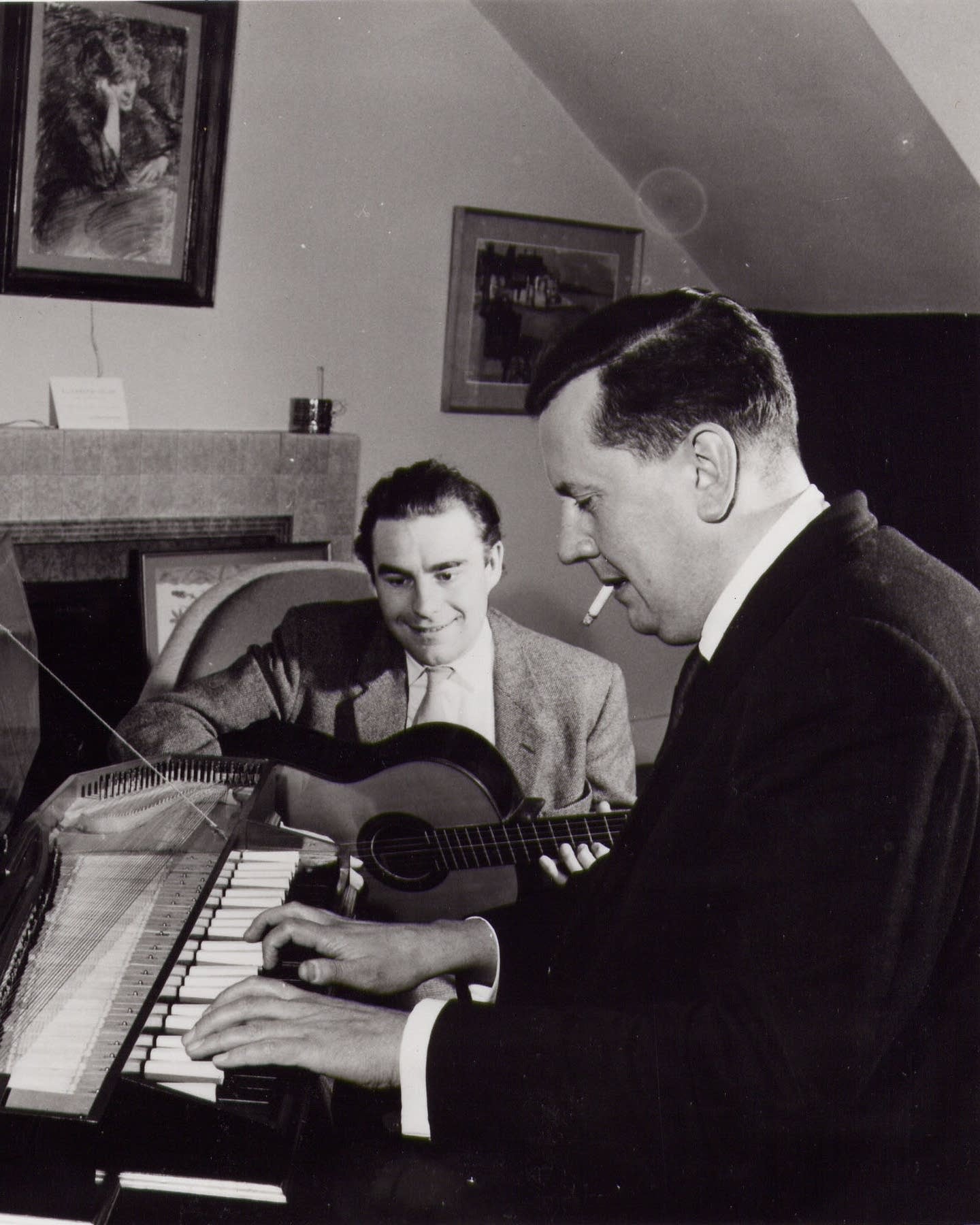
    PHOTO: Malcolm Arnold and Julian Bream

  • Is Elgar Still Relevant? A Reappraisal

    Is Elgar Still Relevant? A Reappraisal

    Is there a more out-of-fashion composer than Sir Edward Elgar?

    For many, Elgar is inseparable from “Pomp and Circumstance.” His ceremonial music conjures visions of Imperial England (and, of course, stateside graduation ceremonies), though anyone with a sensitive ear will detect the melancholy underpinnings of the artist.

    Elgar was a soulful composer, whose faith, love of country, love of wife, and love of animals enriched his existence and informed his music. That said, not all was peaches and cream. Of humble origins in a class-conscious society (his fiancée was disinherited for accepting his proposal), a Catholic in an overwhelmingly Protestant nation, and an autodidact who rose to England’s highest musical office (he served as Master of the King’s music for ten years), he was seldom wholly comfortable in his own skin. Haunted by feelings of inadequacy, this perpetual outsider yet managed to become his country’s most celebrated composer.

    He was also a grand procrastinator, often getting lost in his experiments as an amateur chemist and shirking his responsibilities in favor of slipping off to the races.

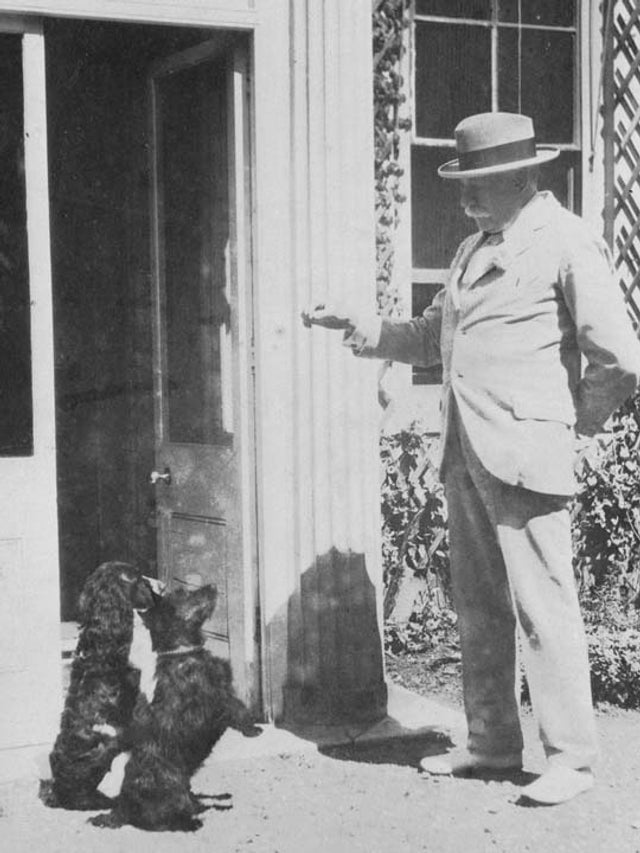
    Though he loved his wife devotedly (he wrote little of note after her death in 1920), he was deprived while she lived of the pleasure of the company of dogs, which he adored. A close friend’s bulldog, Dan, became an honorary pet, and as we know from Elgar’s letters and marginalia in his manuscripts, the spirit of Dan infuses a surprising number of his works. (Most famously, an episode in which Dan tumbled into the Thames is immortalized as one of the “Enigma Variations.”)

    After the death of his wife, Elgar was able to openly indulge his passion for dogs, even setting places for them at his table. One of these was a cairn terrier named Mina, who was the inspiration for a charming miniature, his very last work:

    Hilarious video of the “Enigma” variation inspired by Dan falling into the Thames – here associated with ants, bees, and birds!

    Elgar home movies, including footage of Mina and his spaniel Marco

    One of my favorite pieces of all time, the “Enigma Variations.” The “Nimrod” variation (beginning around the 11:19 mark) turned up in the movie “Dunkirk” a few years ago, so maybe Elgar isn’t as out-of-fashion as I think.

    Jacqueline Du Pré performing Elgar’s masterful Cello Concerto, written in the wake of World War I

    Elgar, colorized, conducting his greatest hit. “Land of Hope and Glory,” of course, is the trio section of his Pomp and Circumstance March No. 1. A happy coincidence that he was born during graduation season!

    https://www.youtube.com/watch?v=n3KLDKg9IVA

    Happy Birthday, Sir Edward Elgar!

Tag Cloud

Aaron Copland (92) Beethoven (95) Composer (114) Film Music (119) Film Score (143) Film Scores (255) Halloween (94) John Williams (185) KWAX (229) Leonard Bernstein (99) Marlboro Music Festival (125) Movie Music (134) Opera (198) Philadelphia Orchestra (86) Picture Perfect (174) Princeton Symphony Orchestra (106) Radio (87) Ralph Vaughan Williams (85) Ross Amico (244) Roy's Tie-Dye Sci-Fi Corner (290) The Classical Network (101) The Lost Chord (268) Vaughan Williams (102) WPRB (396) WWFM (881)

DON’T MISS A BEAT

Receive a weekly digest every Sunday at noon by signing up here


RECENT POSTS