Tag: British Composer

  • Richard Arnell Rediscovered Centenary

    Richard Arnell Rediscovered Centenary

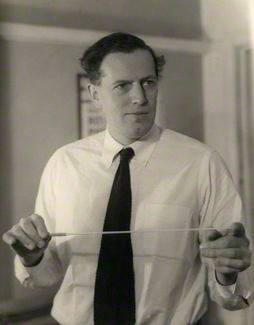
    Recollects his friend, Patrick Jonathan, of composer Richard Arnell, “He loved the ladies, and the ladies loved him. When he was in his late sixties I would sit in on his classes at LIFS (London International Film School) and then we’d go and have a ‘liquid lunch’ at a drinking club in Covent Garden called the Seven Dials. At this stage he wasn’t in the best shape… but he still had tremendous charisma and a stately bearing that made him stand out in a crowd.

    “One lunchtime we were drinking at this club and an older lady was working the tables, clearing up and cleaning up. She came to our table and asked Tony if he was empty. He didn’t understand and asked her to explain. She said she wanted to know if he was empty because she’d been told that she should go and pick up the empties!

    “Even at that age, he still had it…”

    I think you’ll agree, even now, Arnell still has it. Tune in this Thursday morning for a mini-marathon of his equally charismatic, though puzzlingly neglected music.

    At 8:00, I’ll be joined by Warren Cohen, music director of the MusicaNova Orchestra and champion of deserving though lesser-heard repertoire, who will help celebrate this outstanding English composer. Arnell flourished in the 1940s and ‘50s, before falling into relative obscurity. Even with the recorded revival of his symphonies in the 2000s, he still can’t truthfully be said to be a household name. Here’s hoping his centenary brings him further recognition.

    We’ve got an arsenal of Arnell, all cued-up and ready to go, this Thursday morning from 6 to 11 EDT, on WPRB 103.3 FM and wprb.com. I hope you’ll join me for an English breakfast, on Classic Ross Amico.

  • Elgar’s Graduation March The Story Behind The Music

    Elgar’s Graduation March The Story Behind The Music

    Is it by design that Sir Edward Elgar’s birthday coincides with graduation season? In reality, the composer of the “Pomp and Circumstance March No. 1” was a fairly introverted and often melancholy character. In academic circles, he felt inadequate as he was largely self-taught. He was a Catholic in a largely Protestant country. He married a woman “above his station,” for which she was disinherited. Is it any wonder that he preferred animals to the company of people? Yet this perpetual outsider went on to become his country’s most celebrated composer. Funny, how fate works sometimes.

    Happy birthday, Sir Edward Elgar (1857-1934).

    Rare footage of Elgar conducting:
    https://www.youtube.com/watch?v=R-AmryhlRpI

    At play with his dogs:
    https://www.youtube.com/watch?v=0y5LtycnkoM


    PHOTO: He overcompensated with the most impressive moustache in the land

  • Rubbra Resurgam Easton’s Unlikely Maestro

    Rubbra Resurgam Easton’s Unlikely Maestro

    Who knew that between the ages of 5 and 10 I lived next door to the world authority on the music of Edmund Rubbra? Who’d have thought that such a figure would have resided in Easton, Pa.?

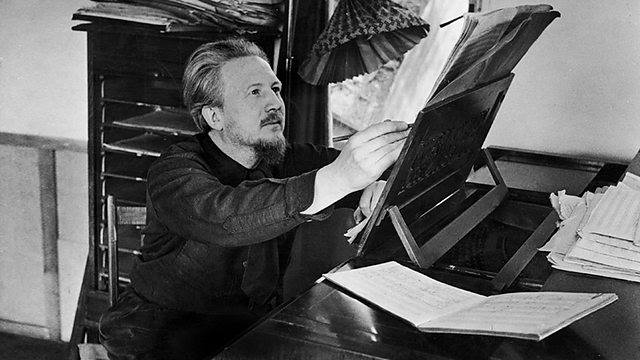
    Rubbra is a now underrated British composer of rewarding symphonies and choral music, sometimes overtly inspired by his Roman Catholic faith, always propelled by spontaneous melody and dreamy logic.

    Ralph Scott Grover joined the faculty of Lafayette College, in Easton, in 1965. He was the first head of Lafayette’s music department. His affection for the music of Rubbra resulted in a book, “The Music of Edmund Rubbra” (Scolar Press, 1993). He was also invited to write the Rubbra article for “The New Grove Dictionary.”

    Grover himself was a composer of art songs, or so I’m told. I remember he and his wife would spend time each year visiting at Rubbra’s castle in the UK. Previously, he had written a book titled “Ernest Chausson: The Man and His Music.”

    I find it amusing to reflect that as a boy I would be playing on the sidewalk, around the tree out front, not knowing the first thing about classical music – my grandfather, with whom I lived, was a product of the Great Depression and World War II, who spent most of his life working with his hands – and here I was, living next door to someone totally steeped in English music, which would later become one of my life’s passions.

    Mr. Grover died in 2002. I am happy to say that I met him again later in life, by which time I had already become quite knowledgeable about the field. In fact, I know he listened to me on WWFM. I remember that he and his wife pledged their financial support during one of my shifts. Grover also expressed an affection for the music of Gerald Finzi, whom I also happen to adore, and was a member of the Peter Warlock Society.

    I do regret not having had more of a master-disciple relationship with him. By that time, I had already left Easton, and though he extended a non-specific invitation to visit, nothing ever came of it. We nearly missed one another completely. I’m thankful we had the conversations we did, and that he saw that I had become something more than the goofy kid he scarcely regarded.

    Happy birthday, Edmund Rubbra (1901-1986). It is you I have to thank for this reminiscence.

    Here’s a sample of Rubbra’s music: “Overture Resurgam,” from 1975, inspired by a memory of the war and an example of the composer’s religious convictions translated to sound. In March 1941 Nazi planes bombed Plymouth and laid waste to much of the city, including the Church of St. Andrew. Only its tower remained intact. On the north door of the tower stood one word, “Resurgam” – “Risen Again.”

    PHOTO: Rubbra resurrected

  • Elgar’s Melancholy Genius & Dog Devotion

    Elgar’s Melancholy Genius & Dog Devotion

    For many, Sir Edward Elgar is inseparable from “Pomp and Circumstance.” His ceremonial music conjures thoughts of Imperial England (and Stateside graduation ceremonies), though anyone with a sensitive ear will detect the melancholy underpinnings of the artist.

    Elgar was a soulful composer, whose faith, love of country, love of his wife and love of animals enriched his existence and informed his music. However, all was not peaches and cream. A Catholic in overwhelmingly Protestant England, of humble origins in a class-conscious society (his fiancée was disinherited for accepting his proposal), Elgar was seldom completely comfortable in his own skin.

    He was also a grand procrastinator, often getting lost in his experiments as an amateur chemist and shirking his duties in favor of slipping off to the races.

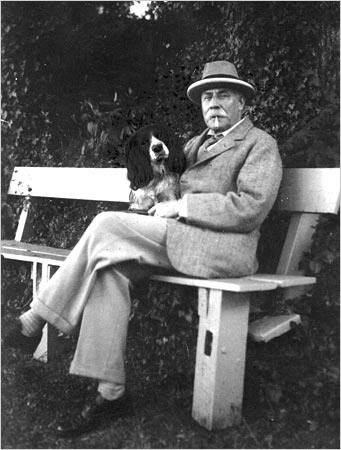
    Though he loved his wife devotedly, he was deprived while she lived of the pleasure of the company of dogs, which he adored. A close friend’s bulldog, Dan, became an honorary pet, and as we know from Elgar’s letters and marginalia scribbled in his manuscripts, the spirit of Dan infuses a surprising number of his works. (An episode in which Dan tumbled into the Thames is immortalized as one of the “Enigma Variations.”)

    After the death of his wife, Elgar was able to openly indulge his passion for dogs, right down to setting places for them at the table. One of these was a cairn terrier named Mina, who was the inspiration for a charming miniature, his very last work (performed here a mite under tempo):

    Happy Birthday, Sir Edward Elgar!

    PHOTO: Elgar with his spaniel Marco

Tag Cloud

Aaron Copland (92) Beethoven (95) Composer (114) Film Music (119) Film Score (143) Film Scores (255) Halloween (94) John Williams (185) KWAX (229) Leonard Bernstein (99) Marlboro Music Festival (125) Movie Music (134) Opera (198) Philadelphia Orchestra (86) Picture Perfect (174) Princeton Symphony Orchestra (106) Radio (87) Ralph Vaughan Williams (85) Ross Amico (244) Roy's Tie-Dye Sci-Fi Corner (290) The Classical Network (101) The Lost Chord (268) Vaughan Williams (102) WPRB (396) WWFM (881)

DON’T MISS A BEAT

Receive a weekly digest every Sunday at noon by signing up here


RECENT POSTS