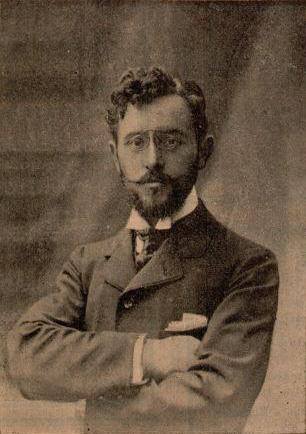
Today would have been the 100th birthday of Lukas Foss.
Foss was a multi-talented musician, who received considerable recognition in his lifetime, certainly, but I wonder if was as much as he deserves. Part of the problem is pinning him down. As a composer, it was always difficult to categorize him, as he drew from so many different styles. With Foss, you never knew what you were going to get. Serialism? Aleatory? Populism? Polystylism?
He was born Lukas Fuchs in Berlin in 1922. A piano prodigy, he began studies at the age of 6. In 1933, his family moved to Paris, where he also studied composition and flute. He arrived in Philadelphia in 1937. By then, the family had changed its name, and Foss entered the Curtis Institute of Music. At Curtis, he studied piano with Isabelle Vengerova, composition with Rosario Scalero, and conducting with Fritz Reiner.
Leonard Bernstein, a classmate, described him as an “authentic genius.” Bernstein would conduct first performances of several of Foss’ works. In return, Foss would conduct the premiere of Bernstein’s “West Side Story Symphonic Dances.” He also appeared as piano soloist in two recordings of Bernstein’s Symphony No. 2, “The Age of Anxiety,” both with Bernstein conducting.
In addition, he was one of four esteemed American composer-pianists on Stravinsky’s recording of “Les noces.” (The others were Aaron Copland, Samuel Barber, and Roger Sessions.)
Foss pursued further studies in conducting with Serge Koussevitzky, during summers at the Berkshire Music Center (Tanglewood), and composition with Paul Hindemith. He became an American citizen in 1942.
In 1953, he replaced Arnold Schoenberg as composition professor at UCLA. Later, in 1991, he taught at Boston University. He served as music director of the Buffalo Philharmonic (1963-70) and the Brooklyn Philharmonic (1971-88) and as conductor of the Milwaukee Symphony (1981-86).
As a young man, he was frequently categorized as one of the “Boston School” of composers. Other notable members included Bernstein, Irving Fine, Arthur Berger, Harold Shapero, Ingolf Dahl, and Louise Talma.
I met him once at a reception at the Academy of Music in Philadelphia, back in the 1980s, following a concert with the Curtis Symphony Orchestra, a student band, but one of a very high caliber. A significant number of seats in U.S. orchestras, including a disproportionate number of principal chairs, are occupied by Curtis graduates. Nearly half of the Philadelphia Orchestra is made up of Curtis alumni.
Foss hadn’t been Curtis’ first choice for this particular occasion. Bernstein was originally scheduled to appear, but this was toward the end of Bernstein’s life, and he was canceling concerts like crazy. The original program was to consist of Ives’ “Decoration Day,” Tchaikovsky’s “Francesca da Rimini,” and Sibelius’ Symphony No. 1. Sadly, when Foss took over, the Sibelius was swapped out for Brahms.
Nevertheless, it was great to have a chance to talk with him. Foss was living history, not least as friend and frequent collaborator of Bernstein, and a significant composer in his own right. Even so, in our few minutes of conversation, he impressed me as modest and low-key. Maybe it was because he had just been conducting for two hours.
I was a little awed at first and reluctant to approach him. But somebody urged me to go ahead, that he would really appreciate it. And so it proved. He had been lingering in a corner, looking a little aimless and nursing a glass of water. He seemed especially pleased that I knew his Bach record.
I first discovered Foss all the way back in the infancy of my record collecting, from a Turnabout LP on which he appeared as soloist and conductor of the Jerusalem Symphony Orchestra. The repertoire consisted of Bach’s Keyboard Concertos Nos. 1 & 5. Foss played them on a modern piano. To my knowledge, this has never been reissued on CD, but in my early teens, it sounded pretty good. It was probably among my first five or ten classical LPs.
Years later, I met his son at the opening of the reconstituted Charles Ives Studio at the American Academy of Arts and Letters in New York City. By then, Foss had already been gone for five years. He died in 2009 at the age of 86.
On October 3, JoAnn Falletta, music director of the Buffalo Philharmonic Orchestra – Foss’ former group – will honor him with a centenary concert at Carnegie Hall. The program is set to include some of his most attractive music.
https://www.carnegiehall.org/Calendar/2022/10/03/Lukas-Foss-Centennial-Celebration-0700PM
Happy birthday, Lukas Foss!
“Three American Pieces”
“Renaissance Concerto”
Bernstein conducts the premiere of Foss’ “Phorion,” including an interview with the composer. The concert is introduced by Milton Cross. The interview begins around the 13-minute mark.
Foss plays Bach in 1961 (not the same performance as on my LP)
Stravinsky’s “Les noces,” with Foss, Copland, Barber, and Sessions on pianos
An early recording of Bernstein’s “The Age of Anxiety”
In conversation with Bruce Duffie
http://www.bruceduffie.com/foss.html
Check out some additional nifty Foss photos in the comments section!