Tag: Centennial

  • Neville Marriner’s Centennial Top 10 Recordings

    Neville Marriner’s Centennial Top 10 Recordings

    In case you missed Saturday’s broadcast of “Sweetness and Light,” on which I celebrated the artistry and legacy of Sir Neville Marriner, today marks the centenary of the prolific English conductor’s birth.

    With the Academy of St. Martin-in-the-Fields, the chamber orchestra he founded in 1958, Marriner made over 500 recordings, most of the them for major labels, ensuring wide dissemination of his work. Ever-reliable, Marriner served up interpretively middle-of-the-road performances with elegance and polish. Occasionally, he would even surprise by turning out a world-beater.

    At the time I first encountered so many of his recordings, I was just learning the repertoire, and they were being played all the time on the radio (before the internet, the most efficient way to expand one’s musical horizons). So for me there is an added patina of nostalgia surrounding his work for a Golden Age when all was light and love.

    Here are 10 Neville Marriner recordings that have brought me joy. Keep in mind the images or record info I post pertains to the original albums. Much of the material has been reissued or repackaged over the years, often in greatly expanded programs. Great, as far as being able to hear and store more music, but there was an art back then to designing a concise album, in which all the elements complemented one another perfectly, so that there was a sense of balance, making for the optimal listening experience. I’d rather be served an exquisitely-planned 50-minute meal than belly-up to an 80-minute all-you-can-eat buffet.

    RALPH VAUGHAN WILLIAMS – As far as I’m concerned, everything on this album is benchmark. Concertmaster Iona Brown in “The Lark Ascending” is unalloyed bliss, the “Fantasia on a Theme by Thomas Tallis” is transporting, and the “Five Variants of Dives and Lazarus” is transcendent.

    GABRIEL FAURÉ – An enchanting blend of beauty and melancholy. “Masques et Bergamasques” may be my favorite (I actually prefer the “Pavane” in the version without chorus), but “Pelléas et Mélisande” is also achingly gorgeous. I could only find it posted as a YouTube playlist, so you’ll have to let the movements play through.

    DAG WIRÉN – Serenade for Strings – From the first CD I ever purchased off a clearance rack. I remember being confused as to why it had been priced so low, as the industry treated CDs like they were gold back then. The Serenade is part of an all-Nordic program that also features music by Grieg, Nielsen, and Sibelius. Sometimes all music has to do is be pleasant to keep you smiling and sane. I would have loved had Sir Neville included Lars-Erik Larsson’s “Pastoral Suite.” But the disc is a winner, as is. Since someone posted the entire album as a single file, I’ve cued the music to the appropriate start time.

    FRANZ JOSEPH HAYDN – Symphony No. 6 “Le Matin” – Marriner’s Haydn is full of grace and good humor. The Symphony No. 6 opens with a musical sunrise and seems to convey the cheer and promise of a new day. It’s part of an early trilogy of symphonies subtitled for the different day-parts. Even the evening storm in No. 8 is so pleasant. May all your days be as full of delight!

    GEORGE FRIDERIC HANDEL – Zadok the Priest – Benchmark! Especially for days when you are about to be coronated.

    JOAQUIN RODRIGO – Concierto Andaluz – My favorite of Marriner’s recordings with members of Los Romeros, the “Royal Family of the Guitar.” Spanish music for four guitars and orchestra? Give it!

    OTTORINO RESPIGHI – The Birds – You have a hard heart, sir or madam, if you cannot enjoy this. Marriner recorded it at least twice, but my allegiance is with the earlier release on EMI, with the “Three Botticelli Pictures.”

    VICTOR HERBERT – Cello Concerto No. 2 – The concerto that’s said to have inspired Dvořák to undertake his own cello masterpiece. Lynn Harrell is the soloist. The companion pieces may require a little bit of a sweet-tooth – this is the same Herbert responsible for all those operettas your grandmother loved – but personally I find the whole disc a delight. The highlight for me is the second movement of this concerto.

    WOLFGANG AMADEUS MOZART – Overtures – Whenever I needed a solid recording of a Mozart overture for radio broadcast, I knew I could count on Sir Neville. It’s not for nothing that he was hired as music director for the film “Amadeus.” He also recorded all the Mozart piano concertos with Alfred Brendel and contributed significantly to Philips Classics’ Complete Mozart Edition.

    SIR WILLIAM WALTON – Marriner made a series of recordings for Chandos Records of the film music of William Walton. Some of them feature spoken contributions by venerable Shakespearean actors. The complete “Henry V” he did with Christopher Plummer is superb, but I also enjoy the charming suite he documented (on a separate CD, so I’m cheating) of Walton’s early score for “As You Like It.” Again, I could only find “Henry V” posted as a YouTube playlist, so you’ll have to let it play through and probably skip some ads.

    https://www.youtube.com/playlist?list=OLAK5uy_kB3AXa2gS18AxjzY5uaoDcmMJXuXiE-Ok

    I know, I’m a dinosaur; I still consume physical media. If you do too and you want the most bang for your buck, again, many of these albums have been expanded or repackaged over the years on compact disc. In whatever form, the important thing is the music. So if you’re curious, do try to experience these performances in whatever way you can.

    Cumulatively, they’re the very thing to keep you sane, should you be one of those people (like me) who are always pulling out their hair to complete their tax forms by deadline and standing on line at the post office at 11:45 p.m.!

    Happy 100th, Sir Neville Marriner, and thank you!
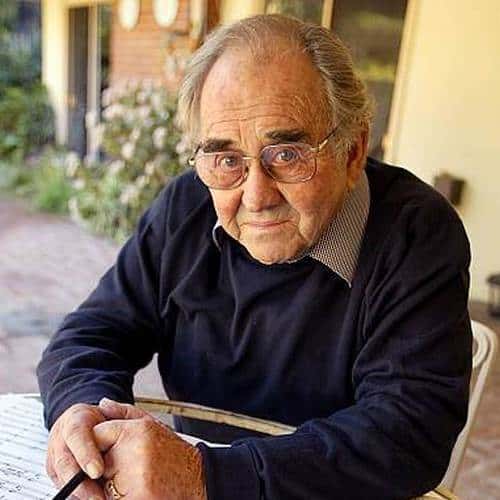
  • William Kraft A Centennial Celebration

    William Kraft A Centennial Celebration

    Whether as a composer, a performer, or a conductor, he was all Kraft.

    William Kraft, a triple threat, was born 100 years ago today.

    Born in Chicago in 1923, he was raised in Santa Barbara, and it was on the West Coast that he made his greatest mark for over 40 years.

    Already as a young man and freelance musician in Manhattan, he was rubbing shoulders with some of the most remarkable musicians of his day.

    He studied composition at Columbia with Otto Luening, Vladimir Ussachevsky, and Jack Beeson. Closer to home, he also took lessons with Henry Cowell. He learned orchestration from Henry Brant, percussion with Morris Goldenberg, and timpani with Saul Goodman, for 50 years principal timpanist of the New York Philharmonic. He also studied conducting with Rudolph Thomas and Fritz Zweig.

    After a brief stint with the Dallas Symphony Orchestra, he returned to California, where from 1955 to 1985, he served as percussionist with the Los Angeles Philharmonic. He later became its first composer-in-residence. For several seasons, he also served as regular guest conductor and assistant conductor. In 1991, he began teaching at the University of California.

    He organized and directed the Los Angeles Percussion Ensemble, a group that gave first performances and made first recordings of works by Alberto Ginastera, Lou Harrison, Ernst Krenek, Igor Stravinsky, and Edgard Varèse.

    Kraft was in charge of all percussion activities for Stravinsky in Los Angeles and appeared on some of the composer’s own recordings, including “L’Histoire du soldat.” As a soloist, Kraft performed in the American premieres of Karlheinz Stockhausen’s “Zyklus” and Pierre Boulez’ “Le marteau sans maître.”

    Also, as one of the more unlikely composers to score a success with the Boston Pops, Kraft was enlisted alongside Sir Peter Maxwell Davies, Oliver Knussen, Joseph Schwantner, and John Adams to write works to be premiered under the baton of John Williams. Come to think of it, these Boston Pops commissions would make a terrific album! (To my knowledge only Maxwell Davies’ “An Orkney Wedding with Sunrise” was ever recorded by them and issued commercially.)

    Kraft composed “Vintage Renaissance” for the Pops in 1989. The work incorporates two Renaissance melodies: “Danza” by Francesco de la Torre, and an anonymous “bransle” (pronounced “brawl”).

    Like Williams, Kraft sometimes worked in film, although his projects as composer tended to be a little less prestigious. He wrote music for the slasher flick “Psychic Killer” (1975), the risible “Avalanche” (1978), and Ralph Bakshi’s “Fire and Ice.”

    However, was also active in the music departments on more reputable fare, appearing as a percussionist on the soundtracks to “North by Northwest,” “None But the Brave” (scored by Williams), “Inside Daisy Clover,” “The War Wagon,” “A Man Called Horse,” “The Life and Times of Judge Roy Bean,” and “The Great Santini.” As a conductor, he led studio orchestras in recording the music for “Dead Again,” “Indochine,” and “Carlito’s Way.”

    Kraft was chair of the composition department at USC. He retired in 2002. He died as recently as February of last year at the age of 98!


    “Vintage Renaissance”

    Concerto for Four Percussion Soloists and Orchestra

    “French Suite”

    Bakshi’s “Fire and Ice”

    Kraft on percussion in Stravinsky’s “The Soldier’s Tale”

    An interview with Bruce Duffie

    http://www.bruceduffie.com/wm-kraft.html

  • Romeo Cascarino Centennial on WRTI

    On the 100th anniversary of his birth, @[100063618910416:2048:WRTI] celebrates Philadelphia composer Romeo Cascarino. Tune in throughout the day, at approximately 8:25am, 11:00am, and 4:15pm, to enjoy recordings of Romeo’s music. Listen locally at 90.1 FM or anywhere online at wrti.org.

    EDIT: Having just read the complete article, thank you, WRTI and Bruce Hodges, for the shout-outs. And for linking my show!

  • Lukas Foss A Centennial Remembrance

    Lukas Foss A Centennial Remembrance

    Today would have been the 100th birthday of Lukas Foss.

    Foss was a multi-talented musician, who received considerable recognition in his lifetime, certainly, but I wonder if was as much as he deserves. Part of the problem is pinning him down. As a composer, it was always difficult to categorize him, as he drew from so many different styles. With Foss, you never knew what you were going to get. Serialism? Aleatory? Populism? Polystylism?

    He was born Lukas Fuchs in Berlin in 1922. A piano prodigy, he began studies at the age of 6. In 1933, his family moved to Paris, where he also studied composition and flute. He arrived in Philadelphia in 1937. By then, the family had changed its name, and Foss entered the Curtis Institute of Music. At Curtis, he studied piano with Isabelle Vengerova, composition with Rosario Scalero, and conducting with Fritz Reiner.

    Leonard Bernstein, a classmate, described him as an “authentic genius.” Bernstein would conduct first performances of several of Foss’ works. In return, Foss would conduct the premiere of Bernstein’s “West Side Story Symphonic Dances.” He also appeared as piano soloist in two recordings of Bernstein’s Symphony No. 2, “The Age of Anxiety,” both with Bernstein conducting.

    In addition, he was one of four esteemed American composer-pianists on Stravinsky’s recording of “Les noces.” (The others were Aaron Copland, Samuel Barber, and Roger Sessions.)

    Foss pursued further studies in conducting with Serge Koussevitzky, during summers at the Berkshire Music Center (Tanglewood), and composition with Paul Hindemith. He became an American citizen in 1942.

    In 1953, he replaced Arnold Schoenberg as composition professor at UCLA. Later, in 1991, he taught at Boston University. He served as music director of the Buffalo Philharmonic (1963-70) and the Brooklyn Philharmonic (1971-88) and as conductor of the Milwaukee Symphony (1981-86).

    As a young man, he was frequently categorized as one of the “Boston School” of composers. Other notable members included Bernstein, Irving Fine, Arthur Berger, Harold Shapero, Ingolf Dahl, and Louise Talma.

    I met him once at a reception at the Academy of Music in Philadelphia, back in the 1980s, following a concert with the Curtis Symphony Orchestra, a student band, but one of a very high caliber. A significant number of seats in U.S. orchestras, including a disproportionate number of principal chairs, are occupied by Curtis graduates. Nearly half of the Philadelphia Orchestra is made up of Curtis alumni.

    Foss hadn’t been Curtis’ first choice for this particular occasion. Bernstein was originally scheduled to appear, but this was toward the end of Bernstein’s life, and he was canceling concerts like crazy. The original program was to consist of Ives’ “Decoration Day,” Tchaikovsky’s “Francesca da Rimini,” and Sibelius’ Symphony No. 1. Sadly, when Foss took over, the Sibelius was swapped out for Brahms.

    Nevertheless, it was great to have a chance to talk with him. Foss was living history, not least as friend and frequent collaborator of Bernstein, and a significant composer in his own right. Even so, in our few minutes of conversation, he impressed me as modest and low-key. Maybe it was because he had just been conducting for two hours.

    I was a little awed at first and reluctant to approach him. But somebody urged me to go ahead, that he would really appreciate it. And so it proved. He had been lingering in a corner, looking a little aimless and nursing a glass of water. He seemed especially pleased that I knew his Bach record.

    I first discovered Foss all the way back in the infancy of my record collecting, from a Turnabout LP on which he appeared as soloist and conductor of the Jerusalem Symphony Orchestra. The repertoire consisted of Bach’s Keyboard Concertos Nos. 1 & 5. Foss played them on a modern piano. To my knowledge, this has never been reissued on CD, but in my early teens, it sounded pretty good. It was probably among my first five or ten classical LPs.

    Years later, I met his son at the opening of the reconstituted Charles Ives Studio at the American Academy of Arts and Letters in New York City. By then, Foss had already been gone for five years. He died in 2009 at the age of 86.

    On October 3, JoAnn Falletta, music director of the Buffalo Philharmonic Orchestra – Foss’ former group – will honor him with a centenary concert at Carnegie Hall. The program is set to include some of his most attractive music.

    https://www.carnegiehall.org/Calendar/2022/10/03/Lukas-Foss-Centennial-Celebration-0700PM

    Happy birthday, Lukas Foss!


    “Three American Pieces”

    “Renaissance Concerto”

    Bernstein conducts the premiere of Foss’ “Phorion,” including an interview with the composer. The concert is introduced by Milton Cross. The interview begins around the 13-minute mark.

    Foss plays Bach in 1961 (not the same performance as on my LP)

    Stravinsky’s “Les noces,” with Foss, Copland, Barber, and Sessions on pianos

    An early recording of Bernstein’s “The Age of Anxiety”

    In conversation with Bruce Duffie

    http://www.bruceduffie.com/foss.html

    Check out some additional nifty Foss photos in the comments section!

  • Mario Lanza A Centennial Celebration

    Mario Lanza A Centennial Celebration

    Mario! Mario!

    Who would have dreamt that Alfredo Arnold Cocozza would grow up to become one of the biggest stars of the 1950s?

    Mario Lanza was born in South Philadelphia, in a row home on the 600 block of Christian Street, one hundred years ago today. It was the year the great Caruso died (on August 9th), and Lanza, famously, went on to play him in the movies. In fact, “The Great Caruso” became the highest-grossing M-G-M film of 1951.

    Legend states that Lanza was discovered by Serge Koussevitzky, traveling music director of the Boston Symphony Orchestra, after booking an adjacent hotel room so that he might be overheard practicing. Koussevitzky described Lanza as “Caruso redivivus” (Caruso reborn), and stated, “Yours is a voice such as is heard once in a hundred years.”

    Fresh-faced and forever young, Lanza is preserved in his everlasting vitality on records and celluloid. He died of an apparent pulmonary embolism in 1959 at the age of 38.

    Shortly before his own death in 1987, Enrico Caruso Jr. observed, “I can think of no other tenor, before or since Mario Lanza, who could have risen with comparable success to the challenge of playing Caruso in a screen biography… Lanza was born with one of the dozen or so great tenor voices of the century, with a natural voice placement, an unmistakable and very pleasing timbre, and a nearly infallible musical instinct.”

    On the one hundredth anniversary of his birth, celebrate Koussevitzky’s “voice of a hundred years.”

    Happy birthday, Mario Lanza.


    “Drink drink drink” from “The Student Prince”:

    At the time of his death, Lanza was preparing a return to the operatic stage as Canio in “Pagliacci” (seen here in “The Great Caruso”):

    “Parigi, o cara” from “La Traviata,” with Frances Yeend and Eugene Ormandy conducting, at the Hollywood Bowl in 1947. In the audience was Louis B. Mayer, who signed the 26 year-old tenor to a long-term movie contract.

    High-spirited tribute in Peter Jackson’s “Heavenly Creatures,” set to Rudolf Friml’s “The Donkey Serenade”:

    Lanza’s first gold record, “Be My Love”:

Tag Cloud

Aaron Copland (92) Beethoven (95) Composer (114) Film Music (123) Film Score (143) Film Scores (255) Halloween (94) John Williams (187) KWAX (229) Leonard Bernstein (101) Marlboro Music Festival (125) Movie Music (138) Opera (202) Philadelphia Orchestra (89) Picture Perfect (174) Princeton Symphony Orchestra (106) Radio (87) Ralph Vaughan Williams (85) Ross Amico (244) Roy's Tie-Dye Sci-Fi Corner (290) The Classical Network (101) The Lost Chord (268) Vaughan Williams (103) WPRB (396) WWFM (881)

DON’T MISS A BEAT

Receive a weekly digest every Sunday at noon by signing up here


RECENT POSTS