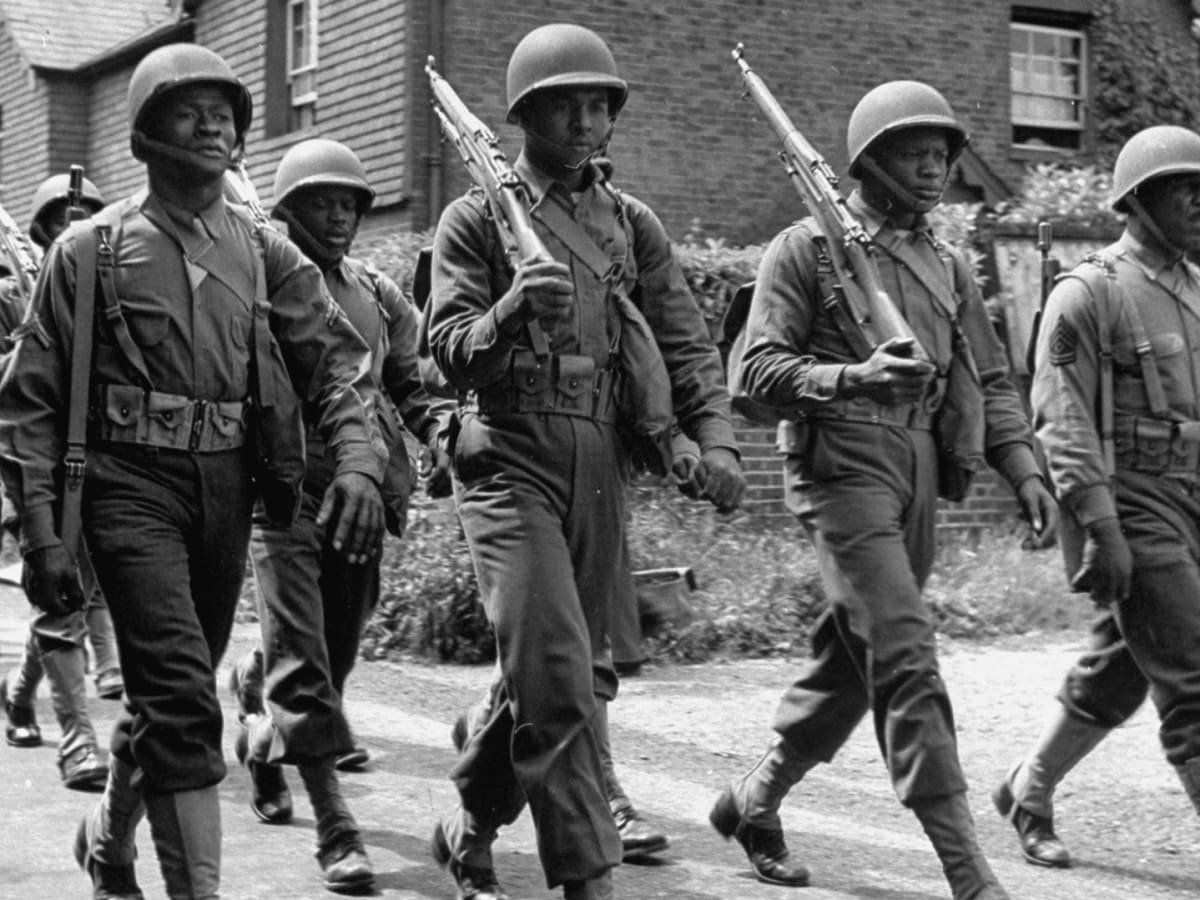
In common with many American composers, William Grant Still turned to patriotic themes during World War II. Only in his case, there is an added poignancy in his choice of subject matter, “In Memoriam, The Colored Soldiers Who Died for Democracy” (1943), since the black soldiers to whom the work is dedicated not only fought in segregated units, but also experienced inequality at home.
By nature, Still was not a political person, but because of the simple fact of his skin color, the association of race – of what it meant to live in and serve a country that wasn’t always fair to its minorities – is inescapable. The piece is about democracy and war, but the subtext, whether or not the composer intended it as such, is one of racial inequality, even for those who served with honor and gave everything for this country.
Still himself served in the U.S. Navy during World War I.
George Szell and the Cleveland Orchestra perform “In Memoriam, The Colored Soldiers Who Died for Democracy” in Kyiv in 1965:
Charles Ives was inspired by the Memorial to Colonel Robert Gould Shaw and the 54th Massachusetts Infantry Regiment, one of the earliest African American units in the American Civil War, when he composed “Saint-Gaudens on Boston Common,” the first movement of his “Three Places in New England” (1915). The 54th was also the subject of the film “Glory.”
I’ve been spending the afternoon with Charles Ives’ “Concord Sonata,” which I mentioned earlier today, in writing about Nathaniel Hawthorne. Then I discovered this, which I’d totally forgotten I owned. It’s “A Concord Symphony” – Ives’ sonata, brilliantly orchestrated by Canadian-born American composer Henry Brant.
Brant, the recipient of the Pulitzer Prize in 2002 for “Ice Field,” is probably best-known for his experiments with spatial music. Film music nuts will know him for his close association with composer Alex North. Brant’s bright, acerbic orchestrations lend zest to the soundtracks of “Spartacus,” “Cleopatra,” “Dragonslayer,” and so many others. In addition, he conducted the orchestra at the recording sessions for North’s rejected score to “2001: A Space Odyssey.”
Less well known is that he also worked as an orchestrator on film scores of Aaron Copland, Virgil Thomson (including “Louisiana Story,” for which Thomson was awarded the Pulitzer Prize), George Antheil, Marc Blitzstein, Douglas Moore, and Gordon Parks.
Brant says he wasn’t attempting to emulate Ives’ own orchestral style when searching for the right colors for “A Concord Symphony.” Rather, he approached the project in the manner Ravel or Schoenberg might have in their orchestrations of other composers’ works.
The effort of some 30 years (since he worked at it very sporadically), Brant’s treatment was completed in 1994. I think he did a terrific job. If you have difficulty getting into Ives’ sonata, give this a listen. It particularly pays dividends in the “Hawthorne” section (the second movement), lending some lift to the patriotic tunes (“Columbia, the Gem of the Ocean” and “Battle Cry of Freedom”) and the ragtime inflections.
My recording is on the Innova Records label (back of album pictured), with Dennis Russell Davies and the Royal Concertgebouw Orchestra. The link is to a concert performance from 2010, with Michael Tilson Thomas and the San Francisco Symphony.
In part to surreptitiously extend my Halloween celebration into November, and in part to vicariously wallow in secret Puritan guilt in the lead-up to Thanksgiving, I’ve been spending the past couple of weeks revisiting a volume of Nathaniel Hawthorne favorites. Some of these I’ve not read for close to 40 years. Very much to the author’s credit, I still remembered most of them fairly well.
Hawthorne is never over-the-top macabre enough to bring genuine shudders in the manner of Edgar Allan Poe, nor do I think that was particularly his aim. His allegory is always just a little too refined. And in the 21st century, sadly, I think we are all a little too much inured to the horrors of history, hypocrisy, and the human heart for many of these tales to pack much of a surprise.
That said, for me “The Birthmark” will always remain a masterpiece of dread. Furthermore, at his best, Hawthorne can be atmospheric and even witty, both in his phraseology and in his depictions of wackadoodle witches’ sabbaths and deviled-ham Satans.
But for the most part, even though the stories are short, I feel as if he tends to overstate his point, if not outstay his welcome. We get it, Nate. Next!
It was while reading “The Celestial Railroad” that I recalled this piano piece by Charles Ives, and that gave me the idea to share a few links to some Hawthorne-inspired classical music.
“The Celestial Railroad”
Ives revisited the material in his Fourth Symphony’s second movement, subtitled “Comedy”
He also devoted a movement to Hawthorne in his Piano Sonata No. 2, the “Concord Sonata.” Here’s the whole thing. “Hawthorne” begins at 16:26. As instructed, the pianist employs a 14 ¾ strip of wood on the keys, the better to achieve Ives’ tone clusters.
A suite from Howard Hanson’s “Merry Mount,” after “The Maypole of Merry Mount”
Lawrence Tibbett as Wrestling Bradford, from “Merry Mount”
A selection from Margaret Garwood’s “The Scarlet Letter”
An aria from Daniel Catán’s “La hija de Rappaccini” (“Rappaccini’s Daughter”)
A suite from Vaughan Williams’ opera “The Poisoned Kiss,” inspired in part by “Rappaccini’s Daughter”
With the birthday of Connecticut cranky Yankee, Charles Ives, the autumn of my content deepens, as golden leaves find parallel in the Golden Age of American music and a run of composer birthdays that stretch clear into early December (Howard Hanson, Aaron Copland, Virgil Thomson, Irving Fine, Morton Gould, etc.). As a radio programmer of so many years, I am sensitive to these types of patterns!
Ives, born on this date in 1874, was the first of our modern giants, and his influence has been the furthest reaching. While piling up acorns in the insurance business, he had the freedom to pursue his idiosyncratic muse. He composed in the evenings, on weekends, and on holidays, creating works of all stripes, tonalities, and quasi-tonalities, even atonality, navigating with remarkable certainty for some 30 years. And he did so in the relative isolation of a prophet, with very few performances to affirm his chosen course.
Ives retired in 1930, which allowed him to devote himself wholeheartedly to music. Ironically, by then, he found he was no longer able to compose. His wife recalled a day in 1927 when he came downstairs with tears in his eyes and confessed that everything sounded wrong to him. After that, he labored mostly at revision and publication.
By the time his works finally began to gain recognition, it had already been 20 years since he had stopped composing. At the time of his death, in 1954, he was still widely misunderstood and much of his music remained unperformed. Nevertheless, he had some important champions. He was a recipient of the Pulitzer Prize for Music in 1947, for his Symphony No. 3, “The Camp Meeting,” a work he had written in 1904. His reaction? “Prizes are for boys, and I’m all grown up.” He gave away the prize money, half of it to Lou Harrison, who had conducted the belated premiere.
Even in the 1960s, the world was still grappling with Ives. In 1965, Leopold Stokowski gave the first performance of the Symphony No. 4. At the time, the work’s complex, kaleidoscopic tempos and layered, shifting meters required multiple conductors, and Stokowski enlisted the aid of David Katz and a young Jose Serebrier. The performance took place at Carnegie Hall with the American Symphony Orchestra and the Schola Cantorum of New York.
The piece was composed between 1910 and the mid-1920s. The first two movements had been performed by members of the New York Philharmonic under the direction of Eugene Goossens in 1927. This was the only occasion on which Ives would hear any of the music performed live by an orchestra. (He died in 1954.)
Bernard Herrmann conducted an arrangement of the lovely third movement, the simplest and most conservative of the four (why, then, the need for an arrangement?), in 1933. The music as Ives wrote it was not heard until Stokowski’s complete performance.
The composer’s biographer, Jan Swafford, describes the work as “Ives’ climactic masterpiece.”
Stokowski recorded the symphony a few days after the premiere and led a televised studio performance, which can be seen here:
Stoky kicks off twenty minutes of spoken introductory material (including commentary from producer John McClure) at the 4:30 mark. The symphony proper begins 25 minutes in.
When’s the last time you saw anything like this on television?
Marveling at how out of step with musical convention his own compositions could be, Ives once famously remarked, “Are my ears on wrong?” Musicians are still scrambling to address this “unanswered question.”
Happy birthday, Charles Ives!
Ives’ “Hallowe’en” for string quartet and piano – watch out for that big drum!
Leonard Bernstein on the Symphony No. 2:
My preferred recording of the symphony, so beautiful (though not always entirely accurate, in regard to Ives’ intentions), with Bernstein and the New York Philharmonic in 1958:
The end of summer can be a time of reminiscence, sentiment, and undefined yearning. The limpid air, the lambent, silvery light of late August imbue one with a sense of nostalgia, swaddled in the gentle melancholy of an idyllic dream. How I feel for the young ‘uns straining against the inescapable vortex of another school year.
This Sunday night on “The Lost Chord,” we’ll hear music by four composers who indulged in musical reminiscences of childhood.
William Schuman grew up to become President of Lincoln Center – and one of our country’s most respected symphonists – but his “American Festival Overture” (1939) is permeated by a three-note call-to-play (“Wee-Awk-Eee!”) recollected from his boyhood.
Haskell Small’s “Visions of Childhood” (2011) is a piano cycle in the Robert Schumann “Kinderszenen” mode, again a mature artist reflecting on halcyon days. The suite falls into ten brief movements: “A Long Time Ago,” “Playing Rough,” “A Little Story,” “Feeling Lonely,” “School’s Out,” “Haunted House,” “Frolicking,” “Look at Me!,” “Roller Coaster,” and “Lullaby.”
Charles Ives may have been a radical innovator, but his music is often infused with a nostalgia for the New England of his youth. His Violin Sonata No. 4 (1906-1915, revised in 1942) bears the subtitle, “Children’s Day at the Camp Meeting,” a programmatic work that balances hymn tunes and rowdy boyhood high jinks.
Finally, as he entered his eighth decade, George Crumb embarked on a remarkably productive Indian Summer, which resulted in no less than seven volumes of “American Songbooks,” the last completed in 2011, when the composer was 82 years-old. Each volume consists of deeply personal treatments of folk songs and hymns Crumb recollected from his formative years in West Virginia.
We’ll hear selections from “American Songbook III: The River of Life” (2008). By employing his characteristic shades and cross-hatchings by way of an assortment of ear-tickling percussion effects, the composer provides his own commentary on the time-worn source material, lending it both unsuspected depth and an aura of timelessness.
It’s a far cry from “Kinderszenen.” I hope you’ll join me for “Nostalgia Isn’t What It Used to Be” – 20th and 21st century composers look back on childhood – this Sunday night at 10:00 EDT, on WWFM – The Classical Network and wwfm.org.