Tag: Christmas Music

  • Christmas Music from the English Renaissance

    Christmas Music from the English Renaissance

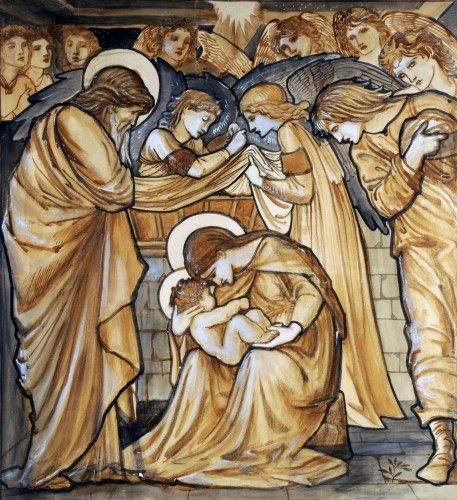
    With Christmas only days away, there’s still much to be done. Even so, this Sunday night on “The Lost Chord,” we pause to remember the story of the first Christmas, with music by a couple of English composers inspired by the Nativity.

    Alongside Sir Charles Villiers Stanford and Sir Edward Elgar, Sir Hubert Parry was one of the key figures of the so-called “English Musical Renaissance.” He influenced a whole generation of much better-known composers, including Ralph Vaughan Williams and Gustav Holst. We’ll hear his “Ode on the Nativity,” given its first performance on the same concert, at the Hereford Three Choirs Festival in 1912, as Vaughan Williams’ “Fantasia on Christmas Carols.”

    Vaughan Williams, the great-nephew of Charles Darwin, and an atheist in his youth, later softened into a kind of “cheerful agnosticism.” He dearly loved the King James Bible, and he especially enjoyed Christmas. Of course, he wrote much music on the subject. In fact, his very last composition was “The First Nowell.” He worked diligently at the piece, inspired by medieval pageants, during his final month, but died suddenly before its completion.

    However, even at 85 years-old, RVW retained a remarkable concentration. He managed to pound out the whole thing in short score in only a few weeks. Furthermore, he had fully orchestrated the first two-thirds. The finishing touches were applied by his assistant, Roy Douglas – he of “Les Sylphides” fame.

    If you like the “Fantasia on Christmas Carols,” I think you’ll really enjoy this. It’s pastoral music for a pastoral scene. Join me for “A Play in a Manger,” this Sunday night at 10:00 EST, on WWFM – The Classical Network and wwfm.org.

  • Rita Streich’s 100th & Forgotten Christmas Music

    Rita Streich’s 100th & Forgotten Christmas Music

    Today is the 100th anniversary of the birth of soprano Rita Streich. I’ve been listening to her recording of Josef Rheinberger’s “The Star of Bethlehem” a lot this year.

    Sadly, it’s the kind of music you don’t hear much on the radio anymore. Most of the grand and contemplative Christmas works (Franz Liszt’s “Christus,” Vaughan Williams’ “Hodie,” Saint-Saëns’ “Christmas Oratorio,” Casals’ “El Pessebre,” Charpentier’s “Messe de Minuit,” Respighi’s “Laud to the Nativity,” Schütz’s “Christmas Story”) – basically, those that aren’t “Messiah” – are slipping away, as playlists pander to an increasingly A.D.D. society. When the listenership is trained to expect little more than consumer-friendly arrangements of the less-demanding carols, and even Beethoven symphonies are broadcast less and less frequently in their entirety (except perhaps the shorter ones), what are you going to do?

    It all seems to have gone away so quickly.

    But of course, Streich sang the carols beautifully, too.

  • Christmas Music Countdown on Classical Network

    Christmas Music Countdown on Classical Network

    Well, that escalated quickly!

    It seemed like I had all of this Advent left, and now we’re down to two days.

    The way the holiday falls this year, this afternoon will be my final air shift before Christmas. I hope you’ll join me for a sleigh full of wintry pastimes, a feast of carols, and a crèche-load of Christmas cantatas – all in all, the perfect mix to accompany your last-minute yuletide frenzy.

    No need to shake the box. You know the gift is music, from 4 to 7 p.m. EST, on WWFM – The Classical Network and wwfm.org.

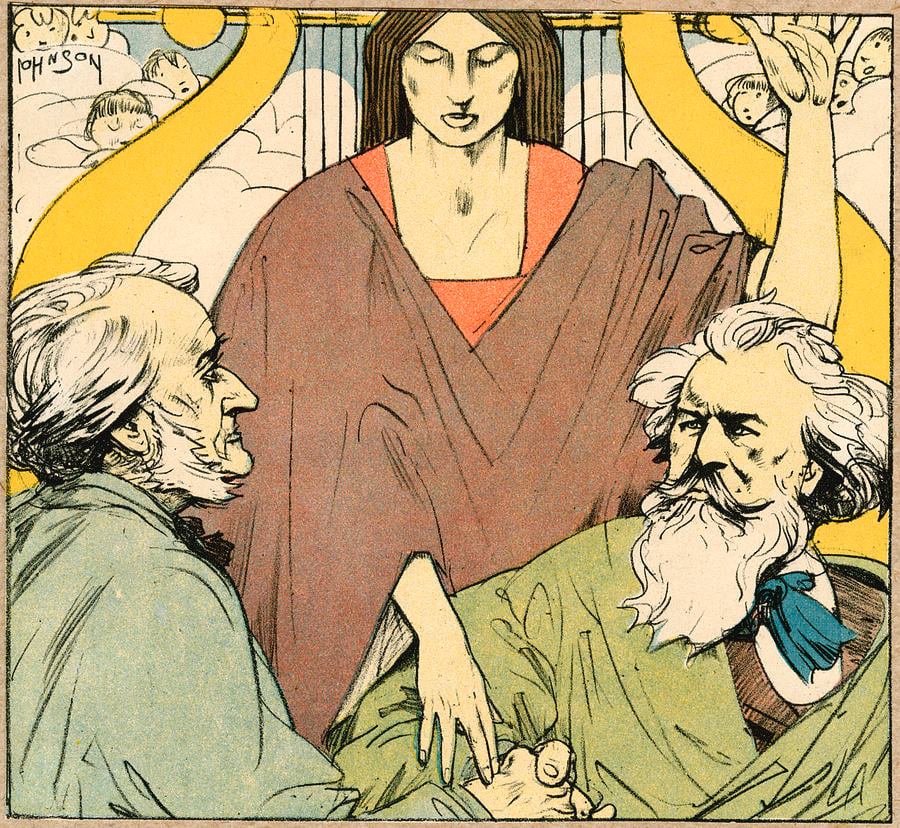
  • Wagner, Brahms: A Christmas Truce

    Wagner, Brahms: A Christmas Truce

    Brahms and Wagner may have been pitted against one another as exemplars of two conflicting schools of music at the height of the Romantic era, but Christmas is the season of peace on earth and goodwill toward men. With this in mind, we call a ceasefire on the War of the Romantics, if only for the next “Music from Marlboro.”

    Though Wagner could be counted on to behave badly on just about any occasion, he did manage to pull off one of the most romantic gestures in all of classical music.

    On Christmas morning, 1870, Wagner’s wife, Cosima – with whom he had become involved while she was very much married to conductor (and devoted Wagner advocate) Hans von Bülow – awoke to the tender strains of a new serenade.

    Wagner had arranged to have 13 musicians seated along the stairs of their Swiss villa for the first performance of “Triebschen Idyll, with Fidi’s birdsong and the orange sunrise, a symphonic birthday greeting.”

    Cosima was born on December 24, but she always celebrated on Christmas. Fidi was the nickname of the Wagners’ newly-arrived son, Siegfried. Of course, today we recognize the piece more simply as the “Siegfried Idyll.”

    The work had been intended to remain in the Wagner family – from its original title, it’s obvious that it’s loaded with personal significance – but when Wagner ran short of cash, as he often did, he decided that maybe he had better have it published, after all. Some of the material later found its way into the third of the “Ring” operas (also known as “Siegfried”).

    We’ll hear Wagner’s Christmas serenade performed at the 1971 Marlboro Music Festival. In the first chair will be Alexander Schneider, a violinist long associated with the Budapest String Quartet.

    It’s all-too-easy to dismiss Brahms as crusty and gruff. This is the man, remember, who once notoriously wrecked a party by declaring, “If there’s anyone here I’ve failed to insult, I apologize!”

    But Brahms could also be an old softy, with a very generous heart. He retained as especially childlike demeanor around Christmas. He always saw to it that the Schumanns were well-gifted and that his housekeeper’s family had their own tree.

    Brahms’ “Zwei Gesänge” (“Two Songs”) for voice, viola and piano, Op. 91, from 1863, was originally intended as a wedding present for his friend, violinist Joseph Joachim (who also played the viola), and Joachim’s bride, Amalie (who was a contralto).

    The second of the songs , “Geistliches Wiegenlied” (“Sacred Lullaby”), is a setting of Emanuel Geibel’s text, a cradle song sung by Mary, who requests that the angels silence the rustling palms because her Child is asleep. The viola quotes the Christmas melody “Joseph, lieber Joseph mein,” a sly reference on the part of the composer, who incorporates the carol’s text, so as to include Joachim’s given name.

    We’ll hear a performance from 2011, featuring mezzo-soprano Jennifer Johnson Cano, violist Hélène Clément, and, at the keyboard, Marlboro co-director Mitsuko Uchida.

    The balance of the hour will be devoted to a work by the long-lived Carl Reinecke, who became friendly with Brahms while an instructor at the Cologne Music School in the 1850s. Like Brahms, Reinecke was a frequent guest in the Schumann home. A prolific composer himself, Reinecke served as kapellmeister of the Leipzig Gewandhaus Orchestra from 1860 to 1895.

    We’ll hear his charming Octet for Winds, Op. 216, which was published in 1892. It was performed at Marlboro in 2010 by oboist Nathan Hughes; clarinetists Anthony McGill and Moran Katz; hornists Rodovan Vlatkovic and Jill Bartles; and bassoonist William Winstead.

    It’s a Christmas truce, on this week’s “Music from Marlboro.” The Marquess of Queensberry Rules need not apply, this Wednesday evening at 6, on WWFM – The Classical Network and wwfm.org.

    Marlboro School of Music and Festival: Official Page


    WAGNER AND BRAHMS: Gods and sinners reconciled
  • Classical Christmas Music Beyond the Carols

    Classical Christmas Music Beyond the Carols

    This time of year, with Christmas still weeks away, I’m never quite sure if I’m programming too much holiday music, or not quite enough. I walk away from an air shift feeling vaguely uneasy, as if I’ve served up a platter that is neither fish nor fowl.

    Of course, if I were putting together a playlist entirely for myself, it would be all-mistletoe all the time. But I’m confident that, as the Big Day draws nigh, I will cross the tipping point and everything will start to feel a bit more natural and perhaps more satisfying. In the classical music world, the demarcation seems to be Beethoven’s birthday (December 16).

    When it comes to Christmas, I think classical music stations tend to work against themselves. By the third week of December, listeners have already been subjected to countless arrangements of the same ten or 15 carols. Naturally, a kind of fatigue begins to creep in. 1000 years of Christmas music, and the scale tips in favor of “Hark! The Herald Angels Sing.”

    If stations were more creative in their programming for Christmas, balancing the secular with the sacred, and broadening the coverage to incorporate music from all eras, from the Middle Ages to the present – allowing for abundant interludes in the form of winter portraits or evocations of the seasons – it could make for a truly stimulating month, and perhaps the backlash wouldn’t be so extreme. There’s so much music that we never get to hear.

    Consider all this as preamble to today’s Noontime Concert on The Classical Network. Piffaro, The Renaissance Band will be joined by Les Canards Chantants and actors Mark Jaster and Sabrina Mandell for a program of 15th century Christmas music, titled “A French Noël.” David Osenberg will be your host and Piffaro artistic directors Joan Kimball and Robert Wiemken will provide commentary.

    I’ll be around at 1:40. At 2:00, we’ll cross the channel for Rutland Boughton’s “Bethlehem,” a choral drama adapted from the 14th century Coventry Nativity Play. Composed in 1915 and written very much in the English pastoral idiom, the work incorporates familiar carols, such as “O come all ye faithful” and “The Holly and the Ivy.”

    Taking a page from Richard Wagner, Boughton composed a cycle of five operas on Arthurian themes and started a Glastonbury Festival, in the style of Bayreuth. Alas, neither the operas nor the festival, as it was originally conceived, have endured.

    In Boughton’s “Bethlehem,” the shepherds bear gifts of a penny whistle, a hat, and a pair of warm mittens. The Three Wise Men hobnob with Herod, Zarathustra, and yes, Merlin. If you gravitate toward the music of Ralph Vaughan Williams, you’re bound to fall under the work’s disarming spell.

    It’s never too early to be Early. Join us for a Piffaro Noël, and then on to Coventry, from 12 to 4 p.m. EST, on WWFM – The Classical Network and wwfm.org.

Tag Cloud

Aaron Copland (92) Beethoven (95) Composer (114) Film Music (119) Film Score (143) Film Scores (255) Halloween (94) John Williams (185) KWAX (229) Leonard Bernstein (99) Marlboro Music Festival (125) Movie Music (134) Opera (198) Philadelphia Orchestra (86) Picture Perfect (174) Princeton Symphony Orchestra (106) Radio (87) Ralph Vaughan Williams (85) Ross Amico (244) Roy's Tie-Dye Sci-Fi Corner (290) The Classical Network (101) The Lost Chord (268) Vaughan Williams (102) WPRB (396) WWFM (881)

DON’T MISS A BEAT

Receive a weekly digest every Sunday at noon by signing up here


RECENT POSTS