Even the Christmas devil has his sensitive side. Enjoy the piano stylings of Krampus.
December 5 is Krampus Night. Season’s beatings!
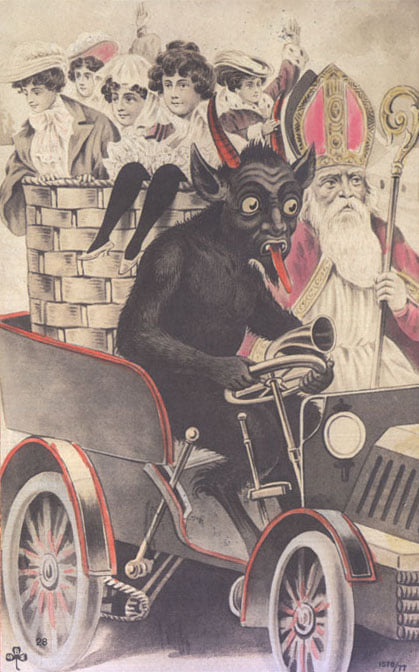
Even the Christmas devil has his sensitive side. Enjoy the piano stylings of Krampus.
December 5 is Krampus Night. Season’s beatings!
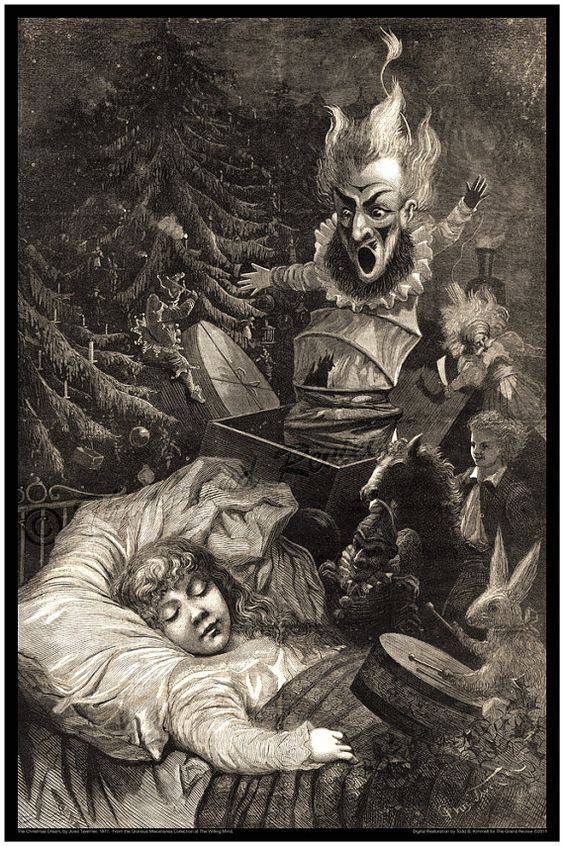
Sweet dreams, everyone! Merry Christmas!
“The Christmas Dream,” Jules Tavernier, 1871
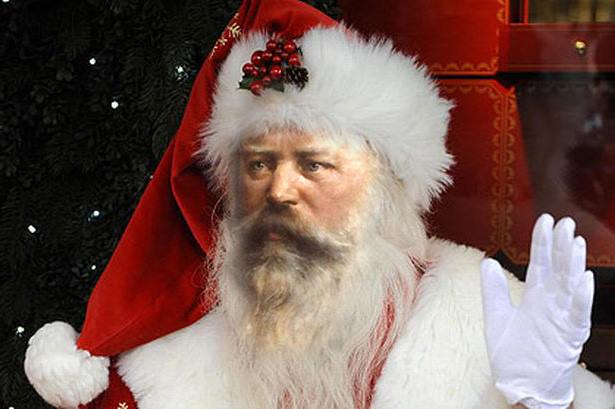
Despite his remarkable resemblance to a certain Mr. Claus, Brahms is probably about the last composer you’d think of cozying up to on Christmas. This is the man who infamously left a party, after all, with one of the all-time great exit lines: “If there’s anyone here I’ve failed to insult, I apologize!”
This week on “Music from Marlboro,” it’s a Brahms Christmas.
Actually, Johannes Brahms had a very generous spirit. He did not shoot cats with a homemade bow-and-arrow and work the sounds of their pain into his music, as his enemies suggested. What he did enjoy was Christmas shopping! On one occasion he gifted the Schumann boys some rather pricey toy soldiers. On another, he surprised his housekeeper’s sons with a Christmas tree. Sure, Brahms could be a bit of a hard nut sometimes, but he retained a certain child-like demeanor at Christmas throughout his life.
The second of his “Zwei Gesänge” (“Two Songs”) for voice, viola and piano, Op. 91, was written in 1863 for his friend, the violinist Joseph Joachim, and Joachim’s wife, Amalie. It had originally been intended as a wedding present, but Brahms resubmitted it the following year for the baptism of the couple’s son (who was named after him). Joseph was also well-versed on the viola, and Amalie was a contralto.
The work, “Geistliches Wiegenlied” (“Sacred Lullaby”), after a text by Emanuel Geibel, is a cradle song sung by Mary, mother of Jesus, who addresses the holy angels, requesting that they silence the rustling palms because her Child is sleeping. The viola quotes the Christmas melody “Joseph, lieber Joseph mein,” a sly reference on the part of the composer, who incorporates the carol’s text in order to include Joachim’s given name.
We’ll hear a performance from the 2011 Marlboro Music Festival, featuring mezzo-soprano Jennifer Johnson Cano, violist Hélène Clément, and, at the keyboard, Marlboro co-director Mitsuko Uchida.
The adult Brahms had no family of his own. He divided Christmas Day between his favorite tavern and coffee shop, but Christmas Eve was another matter. In his later years, he greatly enjoyed passing the night with friends – once he was done shopping, that is – as part of a kind of extended family.
Though he rarely spent Christmas with his longtime crush, Clara Schumann, Brahms thought of her every year, on at least one occasion writing her a nice Christmas letter in which he imagines sitting beside her at her breakfast table, conversing with her, and delighting in all of her last-minute holiday preparations.
Clara joined Brahms for the first performance of his “Variations on a Theme by Haydn,” in its original version for two pianos, at a private gathering in Bonn, in August of 1873. The first performance of the orchestral version took place three months later, with the Vienna Philharmonic conducted by the composer.
Brahms owed much of his interest in Haydn, who died 60 years earlier and whose music had pretty much fallen out of fashion, to his friend Karl Ferdinand Pohl, scholar-librarian of the Vienna Philharmonic. The theme that had so captivated Brahms is the famous “St. Anthony Chorale,” employed in the Wind Partita in B-flat, which at the time was attributed to Haydn.
This evening, we’ll have an opportunity to compare both versions of Brahms’ celebrated variations. First, we’ll hear them performed in 1976 by pianists Stephanie Brown and Cynthia Raim; then the great Pablo Casals will conduct the Marlboro Festival Orchestra, from 1969.
Of course, the theme is probably not by Haydn at all, but who are you going to believe, scholarship or Brahms? It is the Christmas season, after all. I’m willing to take it on faith. I hope you’ll join me for the next “Music from Marlboro,” this Wednesday evening at 6:00 EST, on WWFM – The Classical Network and wwfm.org.
In the meantime, feel free to enjoy this profile of Pablo Casals by Marlboro’s Frank Salomon:
Marlboro School of Music and Festival: Official Page

December 6. After all the press I gave Krampus yesterday, it wouldn’t be right to ignore his keeper, Saint Nicholas, on his special day.
Krampus, of course, is the demon who beats wicked children and hurls them into hellfire. Saint Nicholas, on the other hand, rewards the good. He is justly celebrated for his miracles and outstanding generosity. Let us all hoist an eggnog to the jolly old elf! Yay!
Except that – what’s that you say? – the historic Nicholas was not so jolly?
While it would be impossible to deny Saint Nicholas as having done a lot of good in the world, his personality could be a bit, shall we say, problematic. In fact, his modesty could be so extreme as to sometimes verge on the sociopathic. Among other things, he suffered fools grudgingly and became cantankerous if thanked.
Nicholas is one of those rare all-purpose saints, who seems to watch over everyone – sailors, merchants, archers, prostitutes, women seeking husbands, repentant thieves, wrongly condemned prisoners, travelers, pawnbrokers, students, and of course children. Is it any wonder he’s grouchy?
The historic Nicholas served as Bishop of Myra (part of modern day Turkey) in the 4th century. When his parents died, he gave away his inheritance to the poor.
To avoid uncomfortable scenes, he developed a reputation for secret gift-giving. In one famous incident, he rescued three daughters of an unfortunate man who could not afford a proper dowry. In that time and place, it would have made them unmarriageable, and with no opportunity for honest employment, they would have had no alternative but to enter into a life of prostitution.
Nicholas learned of their plight and under the cloak of darkness passed their house three times, each time tossing a purse of gold through a window. Some traditions say he dropped the purses down the chimney; others claim he left coins in stockings left out to dry. When the elated father tried to thank him, Nicholas responded gruffly that it is God he should thank. O-kayyyyy, Nicholas.
On another occasion, during a sea voyage, Nicholas’ ears were assailed by a cacophony of oaths and blasphemies lustily exchanged by the crew. When he tried to get them to mind their language, the sailors laughed and mocked him, and took to swearing with renewed vigor. Nicholas responded by praying for stormy seas, until the sailors dropped to their knees in repentance, effectively scared straight.
He was also wholly intolerant of pagans and heretics. He sent Arius, the father of Arianism, sprawling with a box on the ears, for his assertion that Jesus Christ is subordinate to the entity of God.
The creepiest Nicholas tale concerns the murder of three boys by a butcher during a time of famine. The butcher placed their remains in a barrel to cure, hoping to pass them off as ham(!). Not surprisingly, this didn’t go down well with Nicholas, who resurrected the three children. The episode is recreated most eerily by Benjamin Britten in his cantata, “Saint Nicholas.”
While he’s not a “Bad Santa,” exactly, he’s also not the jolly old elf Clement Moore, Thomas Nast and Coca-Cola would have us believe. He’s just your garden-variety, high-maintenance saint. To me, somehow, this makes him all the more lovable.
But, as was advised in “The Man Who Shot Liberty Valance,” when the legend becomes fact, print the legend. In the Clement Moore/Thomas Nast vein, here’s the “Santa Claus Symphony,” really an ambitious symphonic poem, by the Philadelphia composer William Henry Fry (1813-1864):
If Saint Nick were on Facebook, I am sure I would be flamed so bad right now I’d be wishing for a ride in Krampus’ wicker basket.
Here comes Krampus – and along with him, my most controversial post of the year. I always lose one or two followers over Krampusnacht. Apparently it’s hard for some folks to reconcile Christmas with an Alpine devil. But when it comes to the holidays, the Central European psyche holds nothing in reserve.
In the grand tradition of spare the rod, spoil the child (Proverbs 13:24), in Krampus the Old World really pulls out all the stops. On December 5, the eve of Saint Nicholas’ Day, it is the custom for an egregiously-horned, whiplash-tongued demon to emerge from his mountain lair, festooned in chains and cow bells, to accompany the Patron Saint of Children on his rounds. Saint Nick bestows small gifts to all the good boys and girls; the bad are handed over to Krampus.
Garden-variety naughtiness may earn the sting of a switch; but the especially ill-behaved are clapped in chains, taken for a short ride in a wicker basket, and then drowned in a stream or immolated by hellfire. With mounting anxiety a thousand times worse than the anticipation of a bad report card, a wee sinner pulls the sweat-soaked blankets over his head and begins to pray vociferously for a stocking full of coal.
It is with mixed emotions that I watch Saint Nick’s dark helper creep ever closer to the mainstream. It used to be that there were one or two books of vintage postcards, and they were out of print and difficult to get a hold of. Now Krampus has become something of a shadow industry. He’s even been the subject of a major motion picture, for crying out loud. I never thought I would see it, but The Man is trying to appropriate Krampus, just like he did rock ‘n’ roll. But you can’t keep a good demon down. As long as there are people fed up with Black Friday sales on Thanksgiving, there will always be plenty of fuel for a reactionary Black Christmas. And no amount of tinsel is going to change that.
If there is any classical music written for Krampus, I have yet to hear it. Therefore, as a kind of place holder on this Krampusnacht, I will offer a suite by Finnish composer Einar Englund for a film inspired by another bizarre legend, that of “The White Reindeer.” Don’t go into it expecting any Rankin-Bass Rudolph. This is Lapland, after all, the land of shape-shifting, vampiric livestock. This Rudolph sports teeth like The Abominable.
It’s also the birthday today of pianist Krystian Zimerman. He’ll be the soloist in Franz Liszt’s “Totentanz” (“Dance of Death”). Then, if time allows, we’ll have a diabolical sleigh-ride courtesy of Bernard Herrmann.
Oh yes! We’ll also mark the birthdays of Francesco Geminiani, Vítězslav Novák, Osvaldo Golijov, and José Carreras, with a little more Hanukkah music tossed into the mix, from 4 to 6 p.m. EST. Then stick around for “Music from Marlboro. We’ll embrace the saints at 6 – more about that in an upcoming post – on WWFM – The Classical Network and wwfm.org.
This year’s Parade of Spirits, Liberty Lands, formerly known as Krampuslauf, spills into the streets of Philadelphia’s Northern Liberties neighborhood on December 9. The event will benefit Delaware Valley homeless shelters.
Go ahead and unfollow me, if you must. You can stop your ears, but you can’t stop Krampus.
Aaron Copland (94) Beethoven (95) Composer (114) Film Music (149) Film Score (143) Film Scores (255) Halloween (97) John Williams (197) KWAX (232) Leonard Bernstein (105) Marlboro Music Festival (125) Movie Music (164) Mozart (91) Opera (215) Philadelphia Orchestra (90) Picture Perfect (174) Princeton Symphony Orchestra (110) Radio (90) Ross Amico (244) Roy's Tie-Dye Sci-Fi Corner (290) The Classical Network (101) The Lost Chord (269) Vaughan Williams (107) WPRB (397) WWFM (881)