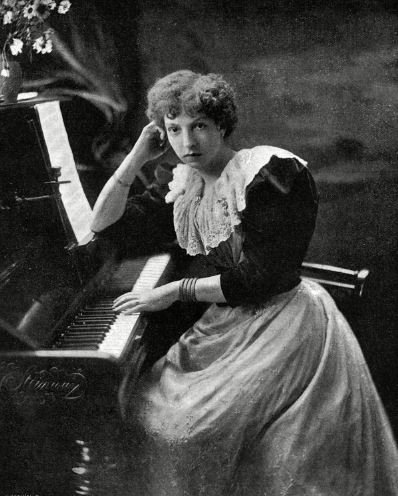
Cécile Chaminade, who shares her given name with the patron saint of music, was born on this date in 1857. Though assessed and recommended for study at the Paris Conservatory at the age of 10, her father forbade it, because he thought it beneath her class. He did, however, allow her to study privately. It was in this fashion that she continued with her piano lessons (her mother taught her when she was young), took up the violin, and studied composition with Benjamin Godard.
Georges Bizet, who heard her perform some of her own works before she was teenager, was among those who were impressed by her talents. Later, her pieces were championed by Isidor Philipp, head of the piano department at the Paris Conservatory.
In her early 20s, Chaminade began playing in a salon setting. This would be the prototype for her future appearances, at which she presented programs consisting solely of her own music.
She married a much older man, a music publisher, on the condition that they maintain separate residences. Due to her husband’s advanced age, it was rumored to have been a “marriage of convenience.” After he died, only six years later, Chaminade never remarried.
Her concerts in England were received with enthusiasm. If anything, she proved even more popular during a tour of the United States.
In 1901, she made gramophone recordings of seven of her compositions. She also made some piano rolls before and after World War I. She died in Monte Carlo in 1944.
For decades, then, she fell into obscurity, with the exceptions perhaps of her Concertino for Flute and Orchestra and whatever sheet music happened to turn up in Grandma’s piano bench.
Her reputation was revived largely through recordings, a trickle at first, but now appearing with more frequency.
Ambroise Thomas once commented, “This is not a composer who is a woman, but a woman who composes.” Chaminade said, “There is no sex in art. Genius is an independent quality. The woman of the future, with her broader outlook, her greater opportunities, will go far, I believe, in creative work of every description.”
In 1913, Chaminade was elected a Chevalier of the Légion d’honneur, a first for a female composer. Here’s some rare footage from the ceremony.
Happy birthday, Cécile Chaminade!
Concertino for Flute and Orchestra
Concertstück for Piano and Orchestra
Chanson, “Te souviens-tu?” (text by Benjamin Godard)
Piano works (linked individually in the information below the video)
Chaminade plays Chaminade