Tag: Debussy

  • Classical Music Beach Vacation Getaway

    Classical Music Beach Vacation Getaway

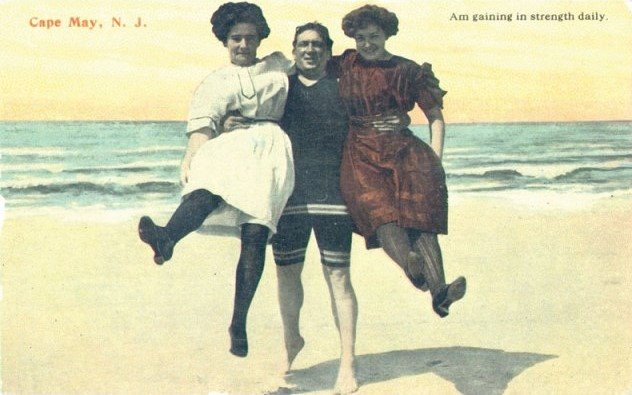
    With summer vacation winding down – and some even back to school already, poor dears – we’ll take one last trip to the beach. On today’s Noontime Concert on The Classical Network, it’s another program from the Cape May Music Festival.

    The New York Chamber Ensemble will present “Folk Dance in Chamber Music,” with repertoire including works by Béla Bartók, Luigi Boccherini, Astor Piazzolla, and Antonin Dvořák, alongside arrangements by Robert Beaser.

    Following the concert broadcast, stick around for Rick Sowash’s “Cape May Suite.” Sowash, who makes his home in Ohio, fondly recalls vacationing in South Jersey with his family.

    Then cast off with music by the Breton composer Jean Cras. Like Nikolai Rimsky-Korsakov and Albert Roussel, Cras was a navy man. Impressions of the sea saturate many of his works, a number of which were actually written in a ship’s cabin. We’ll hear his symphonic suite, “Journal de bord,” which, like Debussy’s “La mer,” attempts to convey the moods of the sea at different hours of the day.

    Rimsky-Korsakov had retired from active service by the time he came to write his Quintet for Piano and Winds. Even so, he had been appointed to the civilian post of Inspector of Naval Bands. We’ll hear a performance of Rimsky’s cheery quintet featuring members of the Munich Residenz Quintet and Wolfgang Sawallisch at the keyboard.

    I believe it was Igor Stravinsky who once said, “A good composer does not imitate; he steals.” No one is going to claim the Flemish composer Paul Gilson’s “De Zee” (“The Sea”) is one of the world’s great masterpieces, but clearly there is something to it for Debussy to have borrowed so shamelessly from it when he came to write “La mer.”

    Jacques Ibert served in the Navy during World War I. Before our time is out, we’ll travel to destinations around the Mediterranean – in Italy, North Africa, and Spain – with Ibert’s symphonic suite “Escales” (“Ports of Call”).

    You won’t have to join the Navy to see the world. We’ve got one in every port, this afternoon from 12 to 4 p.m. EDT, on WWFM – The Classical Network and wwfm.org.

  • Debussy’s Enduring Quartet Music from Marlboro

    Debussy’s Enduring Quartet Music from Marlboro

    Claude Debussy may have died 100 years ago (March 28, 1918), but his music hasn’t aged a bit. On this week’s “Music from Marlboro,” we celebrate Debussy’s birthday (August 22, 1862) – a more festive occasion, I think – with a performance of his String Quartet in G minor.

    Debussy’s quartet, composed in 1893, was very much of its time, but also ahead of its time. Its flights of fancy and free association mirror currents in contemporaneous French painting and poetry; but when it comes to change, music often has a tendency to be “la plus que lente.”

    Debussy’s bold rejection of German academicism likely caused more than a few whiskers to bristle. Ernest Chausson, its dedicatee, had personal reservations about the piece, and the premiere, given by the Ysaÿe Quartet, received mixed reviews. Poetry and sensuality dominate, with a kind of cyclic structure, reliant on a recurring motto, declared at the very outset, standing in for the rules of classical harmony. Wrote the composer, “Any sounds, in any combination, and in any succession, are henceforth free to be used in a musical continuity.”

    Debussy disliked the term “Impressionism,” by the way. Quel dommage!

    We’ll hear Debussy’s one-and-only quartet, performed by Marlboro musicians – violinists Joseph Lin and Judy Kang, violist Richard O’Neill, and cellist David Soyer – on tour at the Isabella Stewart Gardner Museum in Boston in 2002. For a complete schedule of this year’s tours, including stops in New York and Philadelphia, look online at marlboromusic.org.

    Maurice Ravel’s Piano Trio will be included on a Marlboro tour in March, alongside music by Haydn and Kodály. That’s a long time to wait, n’est-ce pas, so let’s give it a listen this evening, shall we?

    Ravel, who also composed a single string quartet, very much under the influence of Debussy, finally sat down to write his Piano Trio over the summer of 1914. By that point, it had already been gestating for at least six years. Progress was slow, but when war was declared in August, Ravel put on a burst of speed so that he could do his patriotic duty and enlist in the French army. He was rejected from the infantry and the air force on account of his diminutive size and precarious health, but he learned to drive a truck and cared for the wounded at Verdun and the Western Front.

    From 2016 Marlboro Music Festival, we’ll hear a performance with pianist Bruno Canino, violinist Robyn Bollinger, and cellist Jonah Ellsworth.

    I’m hoping to leave some good Impressions, on the next “Music from Marlboro,” this Wednesday evening at 6:00 EDT.

    Tune in a little early, beginning at 4 p.m., to enjoy more Debussy – alongside representative selections by fellow birthday celebrants Pierre Danican Philidor, Sir Alexander Mackenzie, and Karlheinz Stockhausen (gussied up somewhat by Pulitzer Prize winner Caroline Shaw) – on WWFM – The Classical Network and wwfm.org.

    Marlboro School of Music and Festival: Official Page


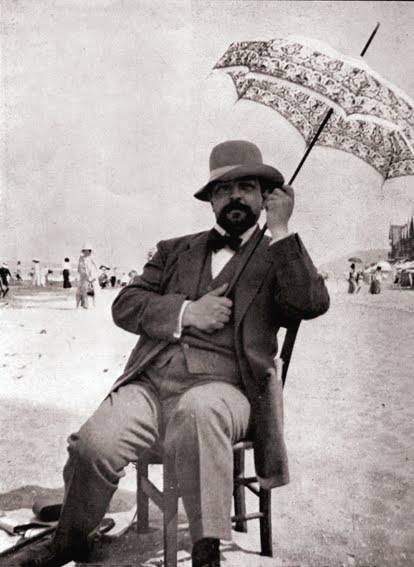
    PHOTO: Debussy at “La mer”

  • Debussy Bernstein Celebrations on The Classical Network

    Debussy Bernstein Celebrations on The Classical Network

    Of the two most trumpeted classical music anniversaries being observed this year, the centenary of the death of Claude Debussy has been far overshadowed by the centennial celebrations for the birth of Leonard Bernstein. I suspect this is because, in part, it’s a little perverse to celebrate somebody’s death.

    Be that as it may, this week on The Classical Network, as Lenny Mania builds to fever pitch, we’ll give Debussy his due on two Noontime Concerts, when flutist Mimi Stillman, artistic director the Philadelphia-based Dolce Suono Ensemble, will join WWFM’s David Osenberg.

    The programs will include music not only by Debussy, but also by some of his French contemporaries, as well as works by later composers Toru Takemitsu and Andrea Clearfield that bear his influence. In addition, there will be two world premieres, courtesy of Jan Krzywicki and Thomas Whitman.

    Both concerts take their names from Debussy’s own words: “Pleasure Is the Law” will air on Tuesday (today), and “Between the Notes” will follow on Thursday. Both will commence at 12 p.m.

    The broadcasts will frame Debussy’s birthday, which is tomorrow, August 22; NOT the anniversary of his death, which fell on March 25.

    Then we’ll shift focus between 1:30 and 4 this afternoon, as I present Bernstein’s recording of Harold Shapero’s beautifully executed – though absurdly neglected – “Symphony for Classical Orchestra,” in which the composer succeeds in fusing the seemingly disparate worlds of Beethoven and Stravinsky. Shapero is another one of those tragic figures (tragic for us) who worried so about the power of his own muse that ultimately he abandoned composition in order to devote himself to teaching.

    While Shapero’s symphony is clearly modeled on Beethoven’s 7th, the Swiss-born French composer Arthur Honegger alludes to Beethoven’s 6th, the “Pastoral,” in his own bucolic meditation “Pastorale d’été” (“Summer Pastoral”), which Bernstein will also conduct.

    Finally, with the fall of the Berlin Wall, Bernstein arranged for a performance of Beethoven’s Symphony No. 9 at the city’s Schauspielhaus, inaccessible to the West behind the Iron Curtain for over 40 years. For the occasion, musicians drawn from East and West Germany joined players from representative orchestras of America, Russia, France, and Great Britain – all of which maintained a post-war presence in the divided city – for a grandly symbolic statement on Christmas Day, 1989.

    Bernstein elected to swap out the word “freude” in the climactic singing of Schiller’s original text, already an ode to universal brotherhood, in favor of “freiheit,” to further underscore the entire enterprise as a grand celebration of freedom. It’s a performance that transcends criticism.

    I hope you’ll join us for observations of two of the year’s biggest musical anniversaries, today between 12 and 4 p.m. EDT. Bernstein Mania is also reflected in many of our specialty shows this week. The celebration will reach its glorious apex this Friday and Saturday, on WWFM – The Classical Network and wwfm.org.


    PHOTOS: Debussy at rest (left); Bernstein chips away at the Wall

  • Halloween Night French Music Ravel Debussy Alkan

    Halloween Night French Music Ravel Debussy Alkan

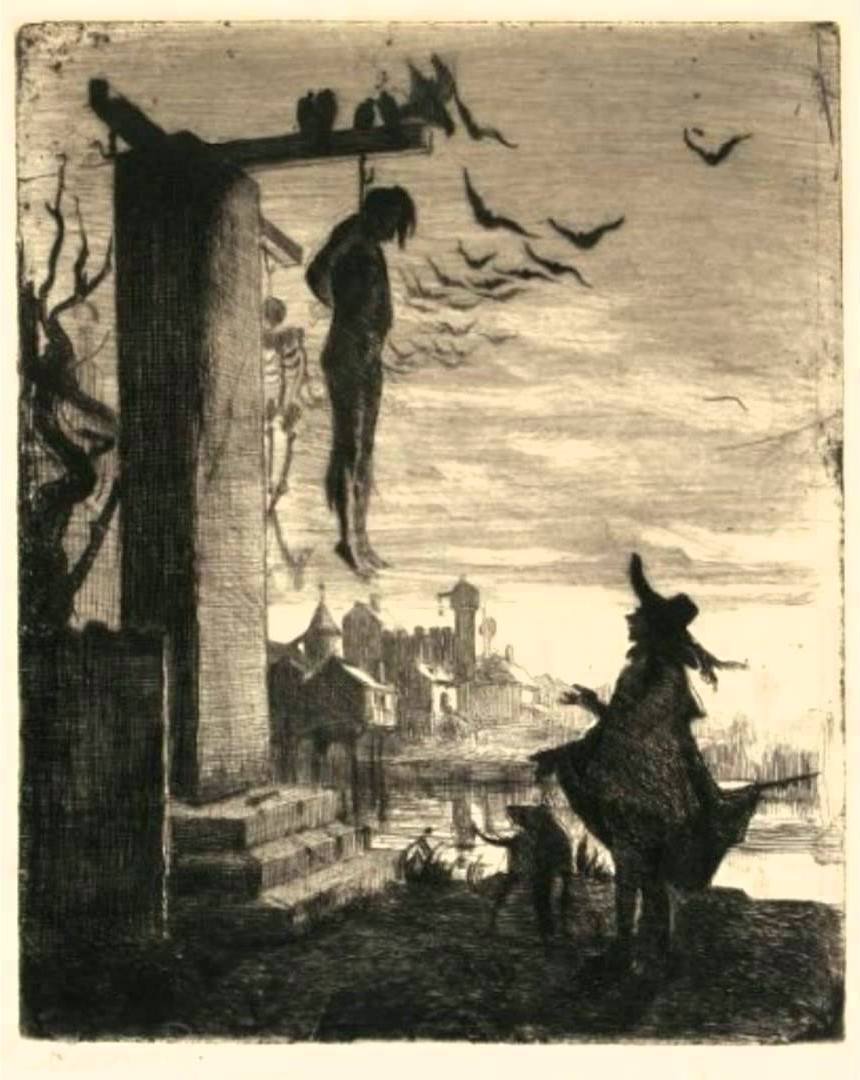
    Ah! ce que j’entends, serait-ce la bise nocturne qui glapit, ou le pendu qui pousse un soupir sur la fourche patibulaire?

    This Sunday night on “The Lost Chord,” we’ll have three works suitable for Halloween, all of them by French composers.

    Sir John Gielgud will join pianist Gina Bachauer for recitations of weird and sinister poems by Aloysius Bertrand, to preface the three movements of Maurice Ravel’s “Gaspard de la Nuit” (Gaspard of the Night).

    Claude Debussy was enthralled by the writings of Edgar Allan Poe, which he knew through translations by Charles Baudelaire. At the time of his death, he left incomplete sketches for two operas after Poe stories – “The Fall of the House of Usher” and “The Devil in the Belfry.” We’ll hear fragments of the former, conducted by Georges Prêtre.

    Finally, we’ll listen to the third of the “Etudes in Minor Keys,” subtitled “Scherzo Diabolico,” by Charles-Valentin Alkan. Alkan, a sometimes neighbor of Chopin and Georges Sand, shared a home with his illegitimate son, two apes and a hundred cockatoos. Franz Liszt is alleged to have commented, “Alkan had the finest technique I had ever known, but preferred the life of a recluse.”

    Best known is the legend surrounding the circumstances of his death: while reaching for a copy of the Talmud, which was positioned on a high shelf, the bookcase let go and crushed Alkan beneath it. It’s been suggested that he really collapsed while in the kitchen, but when the legend becomes fact, print the legend.

    I hope you’ll join me for “Jacques o’ Lanterns” – lurid music by French composers for Halloween – this Sunday night at 10:00 EDT, on WWFM – The Classical Network and wwfm.org.

  • Ella Fitzgerald Sings Debussy

    Ella Fitzgerald Sings Debussy

    A day after I marked Barbra Streisand’s 75th birthday with her rendition of Debussy’s “Beau Soir,” here’s Ella Fitzgerald, on the centennial of her birth, with her transfiguration of Debussy’s “Reverie.”

    Happy birthday, Ella.

Tag Cloud

Aaron Copland (93) Beethoven (95) Composer (114) Film Music (127) Film Score (143) Film Scores (255) Halloween (94) John Williams (190) KWAX (229) Leonard Bernstein (102) Marlboro Music Festival (125) Movie Music (142) Mozart (87) Opera (205) Philadelphia Orchestra (89) Picture Perfect (174) Princeton Symphony Orchestra (107) Radio (88) Ross Amico (244) Roy's Tie-Dye Sci-Fi Corner (290) The Classical Network (101) The Lost Chord (268) Vaughan Williams (103) WPRB (396) WWFM (881)

DON’T MISS A BEAT

Receive a weekly digest every Sunday at noon by signing up here


RECENT POSTS