Tag: Dvořák

  • Remembering Christoph von Dohnányi

    Remembering Christoph von Dohnányi

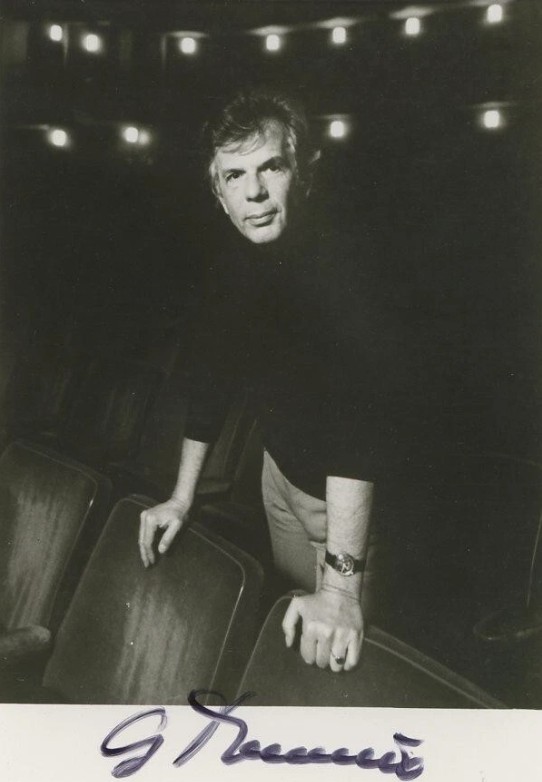
    For some reason, Christoph von Dohnányi didn’t come to Philadelphia much. I can recall he came through on tour once, probably with the Cleveland Orchestra. I’m sure he must have come through more than that, but if he did, I never heard him live. He was music director in Cleveland from 1984 to 2002 (having conducted the orchestra for the first time in 1981) – enough to keep anyone’s hands full, I suppose. But I knew him from his recordings, naturally.

    He had an interesting lineage. His grandfather was the eminent Hungarian composer, pianist, conductor, and educator Ernst von Dohnányi (born Ernő). His uncle, on his mother’s side (also his godfather), was the theologian and anti-Nazi dissident Dietrich Bonhoeffer. A number of his family members were part of the German Resistance movement during World War II. Several, including his father and uncle, were detained in concentration camps and executed when Dohnanyi was 15.

    The young Dohnányi set out on an academic career with an intention to study law, but in common with so many musicians who pursued that course, in the end succumbed to the siren lure of music.

    In 1951, he first came to the United States to study with his repatriated grandfather at Florida State University. The elder Dohnányi had actually met and played with Brahms.

    Christoph is now being widely lauded for having “restored” to the Cleveland Orchestra to its former excellence, following the lackluster tenure of Lorin Maazel, who succeeded George Szell (who of course made the orchestra). Maazel was appointed music director over the voluble protests of its musicians. Be that as it may (or may not; was the orchestra ever bad?), Dohnányi learned firsthand how difficult it was to emerge from the shadow of a legend. He once quipped, “We give a great concert, and George Szell gets a great review.”

    Dohnányi defined the difference between them: Szell, a notorious martinet (my words, not his), drilled the musicians mercilessly and drove them with a palpable sense of inner intensity. Dohnányi, on the other hand, assimilated the lessons he learned in the opera house, beginning as an assistant to Georg Solti in Frankfurt, not worrying so much about bar-lines, but following the example of singers in allowing the music to breathe.

    Eventually, he would become music director in Frankfurt. He also held posts at the opera houses of Lübeck and Hamburg. Later, he brought staged opera to Cleveland.

    Among his orchestra positions, he was chief conductor of the Staatsorchester Kassel and the WDR Symphony Orchestra Cologne. Following Cleveland, he was principal guest conductor, and then principal conductor, of London’s Philharmonia Orchestra. In 2004, he became chief conductor of the North German Radio Symphony Orchestra, a position he held until 2010.

    Of course, he guest conducted all the great orchestras of the United States (including Cleveland), as well as most of them in Europe, and also the Israel Philharmonic. Throughout, he remained active in opera.

    Although wholly devoted to music, he was not a flashy conductor and preferred to keep a low profile. He acknowledged that he was a strong leader, but he was never one for razzle dazzle.

    Dohnányi died on Saturday. Today would have been his 96th birthday. R.I.P.


    Interestingly, I note that I don’t have all that many of Dohnányi’s recordings in my own collection, although I have had dealings with many of them over the course of my career in radio. Of the ones I do own, I have great affection for his first recording of Mendelssohn’s “Die erste Walpurgisnacht,” with the Vienna Philharmonic Orchestra and Chorus. He’s the conductor on favorite recordings of the Busoni Piano Concerto (with Garrick Ohlsson) and the Philip Glass Violin Concerto (with Gidon Kremer). I also have the recording of Alban Berg’s “Wozzeck” he made with his wife, Anja Silja. I’m sure there are more, but not many. The comparative neglect is attributable to my deficiency and not his.

    Dohnányi made a number of recordings of the works of Antonin Dvořák (including the Symphonies Nos. 6, 7, 8 & 9, the Piano Concerto, and the “Slavonic Dances”). These received heavy air play for decades, especially by a certain host who shall remain nameless, during my years at the local classical music radio station. Since today is also Dvořák’s birthday anniversary, here’s a link to his recording of the Symphony No. 7.

    He was also a champion of Hans Werner Henze. Thanks to Mather Pfeiffenberger for directing me to this link to orchestral fragments (Adagio, Fugue and Maenads’ Dance) from “The Bassarids.” In 1965, Dohnányi conducted the premiere of Henze’s “Der junge Lord” (which he also recorded).

    https://www.youtube.com/watch?v=lJd8EQZc7XY

    Of course, he was widely acclaimed for his Brahms. Here’s a live performance of Brahms’ 1st in Hamburg, from 2007:

  • Dvořák’s Hiawatha Melodrama Premiere

    Dvořák’s Hiawatha Melodrama Premiere

    If, like me, you’re of the opinion that Dvořák never wrote a bad note, or if you are a particular fan of the “New World” Symphony, you might be interested to tune in this week to hear the “Hiawatha Melodrama.”

    Dvořák composed what is now commonly numbered his Symphony No. 9 (for decades it was known as the Symphony No. 5) in 1893, while he was director of the National Conservatory of Music in New York City. The work was influenced by Native American music and African American spirituals. The composer intimated that certain sections were inspired by his reading of “The Song of Hiawatha.” In fact, he intended the famous Largo as a sketch for a later opera or cantata on the theme, and the third movement scherzo was suggested by a dance at Hiawatha’s wedding feast.

    Beginning in the early 1990s, cultural historian Joseph Horowitz and Dvořák scholar Michael Beckerman began experimenting with presentations involving portions of Longfellow’s text with music from Dvořák’s symphony. These developed into a 35-minute work, which achieved its final form in 2013. (In musical terms, a melodrama is the marriage of music with spoken word.) The arrangers also lifted passages from Native American-influenced music from Dvořák’s Sonatina, Op. 100 (the composer sketched the theme for the Larghetto on his starched cuff during a visit to Minnehaha Falls in Minnesota), and his “American Suite.”

    We’ll hear the world premiere recording, on the Naxos label, featuring as the narrator bass-baritone Kevin Deas.

    To round out the hour, I’ve programmed selections from “Hiawatha’s Wedding Feast,” one of three cantatas that comprise “Scenes from the Song of Hiawatha,” by the English composer of African descent Samuel Coleridge-Taylor. Coleridge-Taylor composed the work five years after Dvořák completed his “New World” Symphony.

    “Hiawatha’s Wedding Feast,” became a cultural phenomenon. By the time it was taken up by Sir Malcolm Sargent, it was given annually, from 1928 to 1939, in a costumed, semi-ballet version, featuring close to a thousand performers. Unfortunately, this was among the works the composer had sold outright, his heirs thereby missing out on the royalties. By the time of Sargent’s advocacy, the short-lived Coleridge-Taylor had already been dead for 16 years.

    The recording, released on the Argo label back in 1991, is one of the earliest of rising star Bryn Terfel.

    I hope you’ll join me for “Indian Summer” – works inspired by Longfellow’s “The Song of Hiawatha” – on “The Lost Chord,” now in syndication on KWAX, the radio station of the University of Oregon!


    PHOTO: “Hiawatha and Minnehaha” by Jacob Fjelde, Minnehaha Park, Minneapolis

    https://www.mnopedia.org/thing/hiawatha-and-minnehaha-jacob-fjelde?fbclid=IwY2xjawG4EvFleHRuA2FlbQIxMAABHU_hRqi-NEDWZvDwbK9LRjzlO644UCOZdko1iRKOgcOVXyGBnvaENyeWWg_aem__TMot1CSAzR_xCmofrsP5Q


    Clip and save the start times for all three of my recorded shows:

    PICTURE PERFECT, the movie music show – Friday at 8:00 PM EST/5:00 PM PST

    SWEETNESS AND LIGHT, the light music program – ALL NEW! – Saturday at 11:00 AM EST/8:00 AM PST

    THE LOST CHORD, unusual and neglected rep – Saturday at 7:00 PM EST/4:00 PM PST
    Stream them, wherever you are, at the link!

    https://kwax.uoregon.edu/

  • Columbus Day Music From Dvorak to Weill

    Without wishing to throw my austere explorer’s hat into the ring on the whole Columbus Day controversy, this is an interesting article in the Washington Post about the origins of the now-reviled holiday and its significance to Italian-American history. Don’t like it? Thank American “nativist” backlash against Italian immigrants and violence against Italian-Americans – and a Hail Mary pass (my dad’s people may have been Italian, but my mother was Irish) by President Benjamin Harrison to stem anti-immigration sentiment. Hey, if things had played out differently, Americans could just as easily have been arguing about Giovanni da Verrazzano.

    The greatest irony is the article’s concluding observation. There is nothing at all incendiary in the fairly objective tone of the piece (which the Post has published as an “opinion”), but the comments are full of passionate vitriol.

    What’s all this got to do with music? Whether due to personal interest or in pursuit of a paycheck, there are plenty of composers who wrote works inspired by, or commissioned to celebrate, Columbus: Leonardo Balada, Antonin Dvořák, Manuel de Falla, Alberto Franchetti, Philip Glass, Victor Herbert, Arthur Honegger, Darius Milhaud, Richard Wagner, Sir William Walton, and Kurt Weill are just a few that spring to mind.

    No political message intended; I simply find the article – and some of the music – interesting.

    Well, at least, to my knowledge, nobody raises hell anymore about Amerigo Vespucci (for whom “America” is named) – except perhaps Kurt Weill and Ira Gershwin.

  • Zdeněk Mácal NJSO Conductor Dies at 87

    Zdeněk Mácal NJSO Conductor Dies at 87

    Zdeněk Mácal, former music director of the New Jersey Symphony Orchestra, has died. Macal led the orchestra from 1993 to 2002. Together, they made some distinguished recordings, including a Grammy Award winning album of Dvořák’s Requiem and Symphony No. 9 “From the New World.”

    Mácal fled communist Czechoslovakia for West Germany with his family after the Soviet Union and Warsaw Pact members crushed the liberal Prague Spring movement in 1968.

    He found work at the WDR Symphony Orchestra Cologne and NDR Orchestra of Hanover. He also conducted in the U.K., Australia, and the U.S., making his American debut with the Chicago Symphony Orchestra in 1972.

    Following an advisory position in San Antonio and a principal conductorship with Chicago’s Grant Park Music Festival, he became music director of the Milwaukee Symphony Orchestra in 1986. From Milwaukee, he came New Jersey to take over the NJSO.

    He returned to his homeland only after the communist regime was toppled in 1989. From 2003 to 2007, he served as chief conductor of the Czech Philharmonic Orchestra.

    Mácal died in Prague late yesterday. He was 87 years-old.


    From Dvořák’s Requiem, with Princeton’s Westminster Symphonic Choir the New Jersey Symphony Orchestra

    An interview with Bruce Duffie

    https://www.bruceduffie.com/macal.html

  • Czech Center NY Celebrates Martinů

    Czech Center NY Celebrates Martinů

    Among its multifarious attractions, Czech Center New York always seems to have something interesting musical going on.

    I remember traveling in to have a look at the original manuscript of Dvořák’s “New World” Symphony, brought back to the U.S. for the first time since the composer returned home with it to Bohemia in 1895. The Czech Center reception followed a performance of the piece by the Czech Philharmonic at Carnegie Hall, the venue at which the symphony received its world premiere, by the New York Philharmonic, in 1893. At the time, Dvořák was serving as director of the National Conservatory of Music of America, then located at 47-49 West 25th Street.

    It certainly was a memorable evening, as afterward I got to meet Jiri Bělohlávek, the orchestra’s chief conductor, and Véronique Firkušný, daughter of the late pianist Rudolf Firkušný. Furthermore, I actually shook hands with the composer’s grandson, who spoke no English but was his spitting image.

    This year, the Czech Center has shifted its focus to composer Bohuslav Martinů and the 80th anniversary of his arrival in New York. Martinů – still the sleeping giant of Czech music, when compared to Dvořák, Smetana, or even Janáček – arrived here from France, which he fled just ahead of the Nazi occupation. Rudolf Firkušný was one of the musicians who came to Martinů’s aid in the U.S. No doubt in gratitude, Martinů dedicated this Third and Fourth Piano Concertos to him.

    The commemoration is being marked by concerts, commentary, masterclasses, and online exhibitions. Here’s what’s been posted so far.

    The Year of Bohuslav Martinů in New York:

    https://new-york.czechcentres.cz/en/program/rok-bohuslava-martinu-v-new-yorku-opening

    Things to come:

    https://new-york.czechcentres.cz/en/blog/2021/02/80-let-od-cesty-martinu-z-evropy-do-ameriky

    Véronique Firkusny and conductor Jakub Hrůša:

    https://new-york.czechcentres.cz/en/program/bohuslav-martinu-v-new-yorku-80-vyroci-prijezdu?fbclid=IwAR0q5lRLbqyvG9zUn4wh28w4MqtyJ_AMCjPtwcon0PSisfA_V8m_YthAhas

    Works of Bohuslav Martinů / The Czech Way:

    https://new-york.czechcentres.cz/en/program/dila-bohuslava-martinu-v-podani-ceskych-interpretu

    Works of Bohuslav Martinů / The American Way:

    https://new-york.czechcentres.cz/en/program/dila-bohuslava-martinu-v-podani-americkych-interpretu

    I’ve been a Martinů nut since I first heard his “Rhapsody-Concerto” for Viola and Orchestra played by Joseph de Pasquale and the Philadelphia Orchestra back in the 1980s. It’s a puzzle to me why he is not more frequently performed here in the U.S. For anyone who loves Dvořák, there is much to enjoy in Martinů’s music. He’s Dvořák for a mechanized age. I think Dvořák himself, being so fond of trains, would have admired it.

    If nothing else, check out this stylish video – complete with double-breasted suits, booze, and cigarettes – an invigorating performance of Martinů’s “Bergerettes,” courtesy of Czech Center New York.

    FUN FACT: Martinů taught at Princeton University, commuting from New York, from 1948 to 1951.

    More about Czech Center New York here:

    https://new-york.czechcentres.cz/en/about-us

    Dvořák’s “New World” Symphony returns to New York:

    https://www.bohemianbenevolent.org/news/making-history-new-world-symphony-manuscript-in-bnh

    Martinů’s “Rhapsody-Concerto”

    And a work for theremin!

Tag Cloud

Aaron Copland (92) Beethoven (94) Composer (114) Film Music (117) Film Score (143) Film Scores (255) Halloween (94) John Williams (185) KWAX (228) Leonard Bernstein (99) Marlboro Music Festival (125) Movie Music (132) Opera (197) Philadelphia Orchestra (86) Picture Perfect (174) Princeton Symphony Orchestra (106) Radio (86) Ralph Vaughan Williams (85) Ross Amico (244) Roy's Tie-Dye Sci-Fi Corner (290) The Classical Network (101) The Lost Chord (268) Vaughan Williams (99) WPRB (396) WWFM (881)

DON’T MISS A BEAT

Receive a weekly digest every Sunday at noon by signing up here


RECENT POSTS