Edvard Grieg was a gentle, generous soul. But he was also something of a rebel-artist who established a personal and national identity outside the dominant Austro-German tradition. As Norway’s most important composer, he provided inspiration not only to Scandinavians, but to artists all over Europe and the United States.
His personality and achievements engendered much affection and loyalty. Tchaikovsky dedicated his “Hamlet Fantasy Overture” to him. Liszt performed his piano concerto. Antonin Dvořák was a friend, and Frederick Delius worshiped him.
This week on “The Lost Chord,” we’ll hear works dedicated to Grieg by some of his composer friends and admirers.
The American composer Edward MacDowell never actually met Grieg, though they shared a certain musical affinity. He contacted the Norwegian to ask permission to dedicate to him his Piano Sonata No. 3, which he subtitled the “Norse.” Grieg was full of compliments about the piece, and he enthusiastically accepted. The two men enjoyed an admiring, though unfortunately short-lived correspondence, since both were already nearing the end of their lives. MacDowell died in 1908, at the age of 47; he was already in the throes of the illness that would claim him at the time Grieg passed in 1907, at the age of 64.
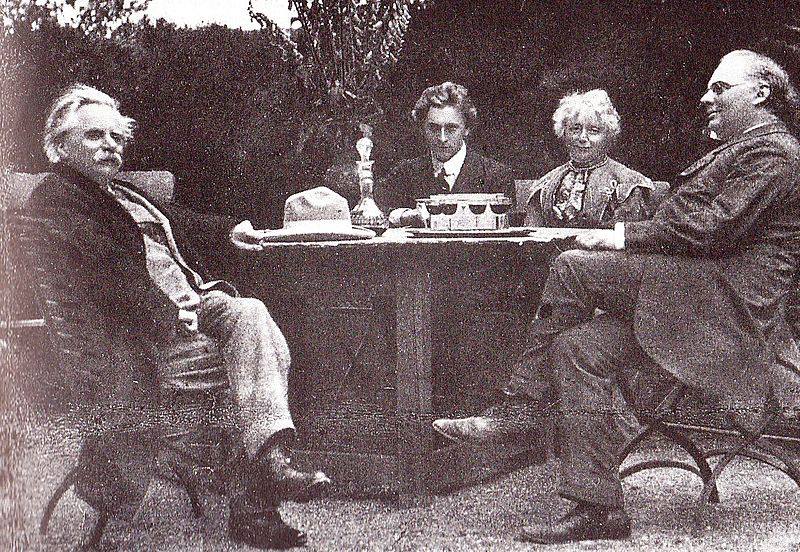
Though Julius Röntgen was born in Leipzig, by his early 20s he had settled in Amsterdam. He went on to become one of the most important figures in Dutch music, establishing the city’s music conservatory and participating in the founding of the Concertgebouw. Röntgen was successful in becoming a good friend not only of Johannes Brahms (no mean feat), but also Grieg, whom he visited in Norway 14 times. The result was a number of works he composed on Norwegian themes. Röntgen dedicated his suite “Aus Jotunheim,” inspired by a hike he had taken with the composer through the Norwegian mountains, to Grieg and his wife, Nina, on the occasion of their 25th wedding anniversary.
Finally, Grieg encountered the tireless Australian pianist Percy Grainger only toward the end of his life, but he was convinced he had found his ideal interpreter. He invited Grainger to perform his Piano Concerto in A Minor under his own direction. Sadly, Grieg died before it could come to pass. Nevertheless, Grainger continued to champion Grieg’s music for the rest of his life. Also, he dedicated a number of folk-inspired works to the memory of the Norwegian master. We’ll hear two historical recordings: one of Grainger playing music of Grieg and then another of the pianist playing one of his own such works.
I hope you’ll join me in celebrating Edvard Grieg with music written for him by composer friends and admirers. That’s “Griegarious,” on “The Lost Chord,” now in syndication on KWAX Classical Oregon!
——-
Clip and save the start times for all three of my recorded shows:
PICTURE PERFECT, the movie music show – Friday at 8:00 PM EDT/5:00 PM PDT
SWEETNESS AND LIGHT, the light music program – Saturday at 11:00 AM EDT/8:00 AM PDT
THE LOST CHORD, unusual and neglected rep – Saturday at 7:00 PM EDT/4:00 PM PDT
Stream them, wherever you are, at the link!
——-
PHOTO: (left to right) Grieg, Grainger, Nina Grieg & Röntgen at Grieg’s home, Troldhaugen, in 1907
Tag: Edvard Grieg
-
If Fjord in a Morning Mood for Lyric Peace, Don’t for-Gynt Grieg
Yay, it’s Edvard Grieg’s birthday today! I’ll have something interesting to listen to in the car. I love Grieg’s stuff, and I take it down from the shelf far too seldom. Did the guy ever write a bad note?
Celebrated as Norway’s greatest composer, Grieg embraced his native folk music, lovingly elevated it, and infused it with an intriguing delicacy, melancholy, and yes, lyricism. Like listening to a Nordic Schubert, you never know when a cloud will break across the fjords. Or perhaps, more to the point, a sunny jaunt across a field of wildflowers will be disrupted by an encounter with a troll.
The most common criticism leveled against Grieg is that he was essentially a miniaturist. You may as well attack Chopin for being a sloppy orchestrator.
From his letters, we know that Grieg himself was frustrated by his propensity for shorter works. “Nothing that I do satisfies me,” he wrote, “and though it seems to me that I have ideas, they neither soar nor take form when I proceed to the working out of something big.”
Claude Debussy was only too happy to kick him while he was down. He famously derided Grieg’s output as so many “pink bonbons filled with snow.” Yet it has been convincingly demonstrated that Debussy owed more than a bit to his Norwegian colleague in the writing of his String Quartet in G minor and in some of his own piano miniatures. What is it about Grieg that so galled the Gauls?
Myself, I could listen to Grieg all day. In fact, I think I will.
————–If fjord in a “Morning Mood” for lyric peace, don’t for-“Gynt” Grieg! 😉
Neeme Järvi conducts the four “Symphonic Dances.” I used the second of these as signature music for an overnight show, back when I was starting out in community radio.
Emil Gilels plays a selection of the “Lyric Pieces.” Gilels hedged when asked to make the recording, fearing that no one would buy it. Of course, it went on to become one of the great piano classics.
Then husband-and-wife team Augustin Dumay and Maria João Pires whip up a fair amount of unsuspected passion in the Violin Sonatas. Here’s the full album.
“The First Meeting,” sung by Barbara Bonney
Six Songs, Op. 48
“Solveig’s Song” from “Peer Gynt”
“Peer Gynt” with creepy puppets
Arturo Benedetto Michelangeli shatters the stereotype of Grieg as “regional” composer with a volcanic performance of the Piano Concerto in A minor.
————–
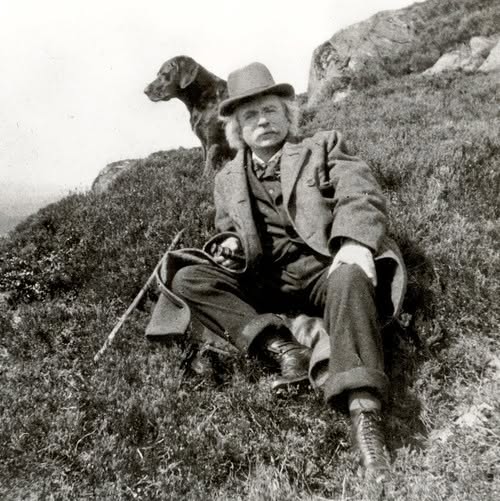
PHOTO: Grieg is great! Happy birthday, master! -

Grainger Plays Grieg Rare Footage Surfaces
This rare footage turned up online within the past week or so of Percy Grainger playing music by his friend, Edvard Grieg. Since it’s Father’s Day and I’ve got to be out the door to meet my stepdad for brunch, and since it also happens to be Grieg’s birthday, I thought it would be an easy post, and a fascinating one, if you should choose to follow the link.
If you are ever in the vicinity of White Plains, NY, I highly recommend a visit to the Percy Grainger Home & Studio, the house in which Grainger lived for 40 years. Be sure to contact them in advance, as the house is open only on certain days and by appointment.
I went into great detail about my own highly enjoyable visit on the last of April. If you missed it, hopefully this link will take you to the May 1 post, in which I share my impressions.
Happy birthday, Edvard Grieg!
IMAGES: (left) detail from screenshot of Grainger playing Grieg’s “To Spring,” from the Lyric Pieces, Op. 43; photo of Grieg inscribed to his friend, one of the many treasures on display at the Percy Grainger house
-

Carl Goldmark’s Rustic Wedding Symphony
I’ve always been a fan of Carl Goldmark’s “Rustic Wedding Symphony.” It’s always made me happy. Apparently, I’m in good company, as it also received the imprimatur of Johannes Brahms, Goldmark’s walking companion, who thought it the best thing the composer ever wrote.
This week on “Sweetness and Light,” the work will form the centerpiece at a June wedding.
The “Rustic Wedding Symphony” has been recorded a number of times, but you don’t really seem to hear it much anymore. We’ll enjoy a performance by the Utah Symphony conducted by Maurice Abravanel.
The work falls into five movements: “Wedding March,” “Bridal Song,” “Serenade,” “In the Garden,” and “Dance.” It’s unusual for me to devote so much of a “light music” program to a symphony, but really, it’s like serving up 40-minutes of smiles.
We’ll also have a party favor in the form of Edvard Grieg’s “Wedding Day at Troldhaugen,” from his delectable “Lyric Pieces” – Troldhaugen being the composer’s home outside Bergen, Norway. Peter Katin, who released all of Grieg’s “Lyric Pieces” over three discs, will be the pianist.
Nothing rustic about Charles-Marie Widor: for 63 years, Widor was organist at the Church of Saint-Sulpice in Paris. We’ll conclude with the Toccata from his Symphony No. 5, a work frequently performed at ceremonial functions, whether they be related to Christmas, graduations, or – for our purpose – weddings. It’s been especially popular at royal weddings, so it’s apt that we hear it performed by Simon Preston on the organ of Westminster Abbey.
Say “I do” to “Sweetness and Light,” a program of music calculated to charm and to cheer, this Saturday morning at 11:00 EDT/8:00 PDT, exclusively on KWAX, the radio station of the University of Oregon!
Stream it, wherever you are, at the link:
Clip and save the start times for all three of my recorded shows:
PICTURE PERFECT, the movie music show – Friday at 8:00 PM EDT/5:00 PM PDT
SWEETNESS AND LIGHT, the light music program – Saturday at 11:00 AM EDT/8:00 AM PDT
THE LOST CHORD, unusual and neglected rep – Saturday at 7:00 PM EDT/4:00 PM PDT
Stream them, wherever you are, at the link!
“Hungarian Wedding Procession,” Gustav Prucha, 1930
-
Norway’s Stage Halvorsen Grieg and Theater Music
If all the world’s a stage, then why not Norway? This week on “The Lost Chord,” I hope you’ll join me in vicariously treading the boards with incidental music by two of the country’s most prominent composers.
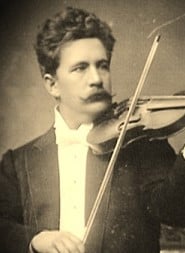
Following a lengthy apprenticeship as a violinist, in the course of which he performed in orchestras all over Europe, Johan Halvorsen (1864-1935) developed an interest in conducting. In 1893, the same year he was appointed principal conductor of the Bergen Philharmonic, he worked as conductor of the theater orchestra at Bergen’s National Stage. In 1899, he became conductor of the newly-opened National Theater in Kristiana, a post he would occupy for the next three decades, until his retirement in 1929.
Following his retirement, Halvorsen largely concentrated on writing symphonies and his popular Norwegian Rhapsodies. Until then, his work in the theater, understandably, brought many opportunities to write for the stage. In fact, he composed music for more than 30 plays.
One of those was “Askeladden,” or “The Ash Lad,” a children’s comedy, based on Norwegian folk tales. Askeladden is an unprepossessing young man who succeeds where others fail, generally winning the hand of a princess and half the kingdom. Halvorsen actually composed the music for this particular play in his retirement. In fact, it is his last orchestral score.
Norway’s best-known composer, of course, is Edvard Grieg (1843-1907). Grieg’s suite from the play “Sigurd Jorsalfar,” or “Sigurd the Crusader,” is actually rather famous, yet we seldom have an opportunity to hear the complete incidental music. Sigurd I, King of Norway, reigned from 1103 to 1130. His reign is regarded by historians as a golden age for medieval Norway.
Sigurd became the subject of a play by Bjørnstjerne Bjørnson, for which Grieg provided music in 1872. The familiar suite was given its premiere 20 years later. Bjornson’s play concerns the brothers, Sigurd and Øystein, joint rulers of 12th century Norway, and the beautiful Borghild, whose love for Øystein is unrequited, but who herself is loved by Sigurd. The composer does his best to lend a third dimension, or at least some pageantry, to the historical tableaux.
Your ticket is reserved for Norway, incidentally. I hope you’ll join me for “A-fjordable Theater,” on “The Lost Chord,” now in syndication on KWAX, the radio station of the University of Oregon!
Clip and save the start times for all three of my recorded shows:
PICTURE PERFECT, the movie music show – Friday at 8:00 PM EST/5:00 PM PST
SWEETNESS AND LIGHT, the light music program – ALL NEW! – Saturday at 11:00 AM EST/8:00 AM PST
THE LOST CHORD, unusual and neglected rep – Saturday at 7:00 PM EST/4:00 PM PST
Stream them, wherever you are, at the link!
Tag Cloud
Aaron Copland (94) Beethoven (95) Composer (114) Film Music (150) Film Score (143) Film Scores (255) Halloween (102) John Williams (198) KWAX (233) Leonard Bernstein (105) Marlboro Music Festival (125) Movie Music (165) Mozart (91) Opera (215) Philadelphia Orchestra (90) Picture Perfect (174) Princeton Symphony Orchestra (110) Radio (90) Ross Amico (244) Roy's Tie-Dye Sci-Fi Corner (290) The Classical Network (101) The Lost Chord (269) Vaughan Williams (107) WPRB (397) WWFM (881)