The greatest pieces of music are universes in themselves. Just when you think you know everything about a given work or its composer, along comes a fresh interpretation, or you listen to a cherished recording in a different frame of mind, and you’ll notice details you never heard before. Even so, it is sometimes tempting to crave more.
A composer dies. Over the years, we absorb his canon. We think, wistfully, why couldn’t he have composed eight symphonies, as opposed to seven (Sibelius)? Or ten, as opposed to nine (Mahler and Beethoven)? Sibelius, Mahler and Beethoven all left behind tantalizing sketches of unrealized projects.
This Sunday night on “The Lost Chord,” we’ll have a remarkably vivid piece of wishful thinking.
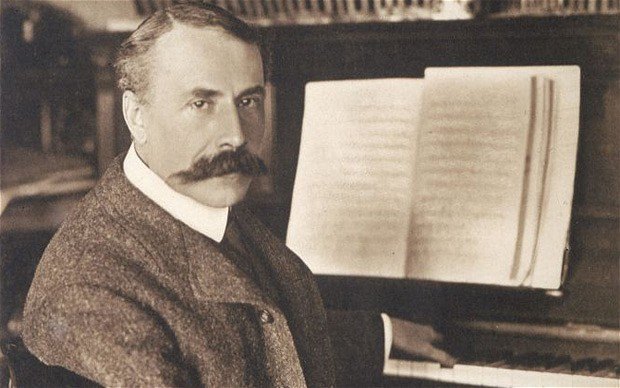
Sir Edward Elgar produced no major works following the death of his wife in 1920. It was his friend and champion, George Bernard Shaw, who, in an attempt to keep one of England’s greatest composers from withering on the vine, persuaded the BBC to commission from Elgar a Third Symphony.
Elgar, who died in 1934, worked at the piece during the last year of his life, jotting down his ideas – some merely a few bars in length, others, pages in full score. As his health deteriorated, he realized he would never be able to complete the work, and he made contradictory remarks concerning his intentions over the fate of the sketches.
Another of his friends, the violinist W.H. Reed, passed many hours playing through what existed of the piece, with the composer at the piano. After Elgar’s death, Reed published 40 pages worth of sketches into a memoir, which kept the work at the periphery of the public consciousness.
Several attempts have been made over the decades to make something more of the sketches, but musicians and musicologists have always been stopped short by the Elgar estate.
The composer Anthony Payne became interested in the fragments in 1972. For many years, he worked at a realization of the piece, again meeting resistance from Elgar’s heirs, until it became apparent that, due to the publication of the sketches in Reed’s book, the material would soon fall into the public domain. The family opted to capitalize on what control it had left and finally authorized Payne’s efforts.
His realization was given its premiere in 1998 and granted broad exposure through performances by major orchestras, particularly in England and the United States (including the Philadelphia Orchestra), and the piece has been recorded at least four times.
The formal title is “Edward Elgar: The Sketches for Symphony No. 3 Elaborated by Anthony Payne,” or the “Elgar/Payne Symphony No. 3,” for short. You’ll have a chance to hear it tonight.
I hope you’ll join me for “No Payne, No Gain,” this Sunday night at 10 ET, with a repeat Wednesday evening at 6; or that you’ll listen to it later as a webcast at wwfm.org.
Also, of perhaps related interest, here’s an article about Payne’s completion of Elgar’s “Pomp and Circumstance March No. 6″:
http://www.telegraph.co.uk/culture/music/classicalmusic/3654077/Finishing-touches.html
PHOTOS: A Payne on Elgar’s side