Tag: Ennio Morricone

  • Spagvemberfest Spaghetti Western Movie Marathon

    Okay, Halloween is past. It’s All Saints’ Day. Not only that, but it also happens to be the start of Spagvemberfest!

    What’s that, you say? Why, it’s a month-long challenge to view a spaghetti western a day.

    What exactly is a “spaghetti western?” It’s a term bestowed by American film critics on Italian-produced oaters. Characteristically, they are filmed by Italians, often in Spain, sometimes in the American southwest. They likely feature an international cast, with a recognizable rising or fading star as their lead or leads. All the voices are dubbed in post-production, often to humorous effect. The characters are motivated by revenge or a lust for gold. In terms of morality, only a few degrees tend to separate the hero and the villain. Often there is an adherence to the conventions of the American western, however with the intent of deflating the western myth. There is certainly a preponderance of stylized violence. And if it’s worth watching, it probably features Somerville, New Jersey’s own Lee Van Cleef (pictured).

    Admittedly, the genre is an acquired taste. I don’t know about you, but I’m really going to need this, as we begin the inexorable slide toward the holidays.

    https://forum.spaghetti-western.net/t/the-what-why-and-how-of-spagvemberfest/5650?fbclid=IwAR3gOp6QeqZL0POxKDcTqf5PTsjOmzcZCa8Eof8zlo_nVjYhPz0M-YECdc4

    Wholly by coincidence, I’ll be doing my part by presenting a heaping helping of spaghetti western scores for the birthday of composer Ennio Morricone on my radio show, “Picture Perfect,” on Friday, November 10, at 8 p.m. EDT.

    You can listen to it here:

    https://kwax.uoregon.edu/

    And just in case you don’t get the “Hey, amigos” reference in the ad…

  • Ennio Morricone Rome Mural Celebrates Maestro

    Big Ennio is watching you!

    Ennio Morricone mural dedicated in Rome yesterday on what would have been the composer’s 94th birthday.

  • Ennio Morricone Bittersweet Genius

    Ennio Morricone Bittersweet Genius

    There is something just so innately Italian about the music of Ennio Morricone. So often in his works the smiles and tears commingle. He really caught the bittersweet essence of what it is to be alive. If he had lived a hundred years earlier, he might have been one of the great opera composers. When he’s not in badass spaghetti western mode, that is.

    Happy birthday, Ennio Morricone, wherever you are.


    “Cinema Paradiso”

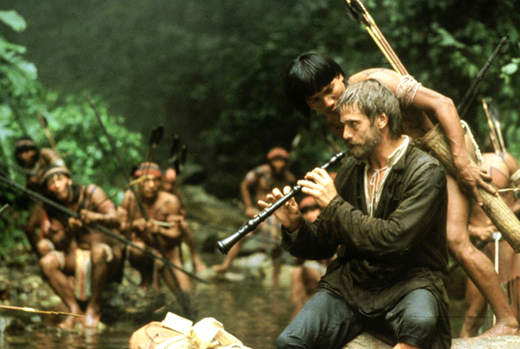
    “The Mission”

    “Once Upon a Time in the West”

    And, just so I don’t take the gas pipe, “The Ecstasy of Gold” from “The Good, the Bad and the Ugly”

    Which I would request to be played at my funeral, if not for “Navajo Joe”

  • Westerns from the Old World

    Westerns from the Old World

    Before American composers like Jerome Moross and Elmer Bernstein made the western distinctly their own, the task of scoring the genre fell largely to European émigrés. This week on “Picture Perfect,” we’ll take a look at some outside perspectives on how the West was won.

    Literally the godson of Richard Strauss, Max Steiner came from Vienna, where he studied with Johannes Brahms and Robert Fuchs. In Hollywood, he wound up scoring such classics as “King Kong,” “Gone with the Wind” and “Casablanca.”

    Among his over 300 film projects were a number of westerns. One of these was “They Died with Their Boots On” (1941), which starred Errol Flynn as George Armstrong Custer and Olivia de Havilland as Libby, the woman who becomes his wife. Steiner’s score features familiar folk material, some old-fashioned faux “Indian” music, and one of his characteristically lush love themes.

    Born in Ukraine in 1894, Dimitri Tiomkin was a pupil of Alexander Glazunov. He came to revolutionize the sound of the American West, when he wrote the music for “High Noon,” the first of his “ballad” scores. Advanced word, based on an early screening for the press, was that the picture would be a failure. However, Tiomkin had such faith in the theme song, sung in the film by Tex Ritter, that he hired Frankie Laine to record it, and the record became a world-wide hit. In fact, his score is largely credited with having saved the film.

    Tiomkin was recognized with two Academy Awards: one for Best Original Song, and one for the score itself. It was the first time a composer won two Oscars for his work on the same movie. It also changed the way western scores were done. In the 1950s, Tiomkin became THE western composer of choice. He produced a number of subsequent ballad scores, including that for “Gunfight at the O.K. Corral” (1957). Asked how it was that a composer from Ukraine could write so convincingly for the American West, Tiomkin quipped, “A steppe is a steppe is a steppe.”

    Another unexpected source of classic western music, Franz Waxman was born in Upper Silesia. He arrived in the U.S. by way of Germany. Nonetheless, as part of the composer’s varied and prolific output, he did indeed score a number of films in the genre, including “The Furies” (1950), a peculiar noir-western hybrid. Walter Huston, in his final film, plays a cattle baron who remarries and throws his empire into jeopardy. Barbara Stanwyck is his strong-willed daughter.

    Hungarian-born composer Miklós Rózsa scored many films with historical settings – “Quo Vadis,” “Ben-Hur,” and “King of Kings,” among them. However, to my knowledge, his only western was “Tribute to a Bad Man” (1956). James Cagney stars as a rancher who doles out some frontier justice.

    Finally, we’ll hear music by Ennio Morricone, from arguably the most operatic of all spaghetti westerns, “Once Upon a Time in the West” (1968). As a reaction to Tiomkin’s ballad scores and the neo-Coplandisms of Elmer Bernstein and the rest, Morricone brings his own quirky sensibility to bear on the classic western iconography. Get ready for indelible motifs for harmonica and banjo, but also an unexpectedly moving elegiac arioso, underscoring the close of the American West with the arrival of the railroad.

    Better wind your pocket watches. Old World composers go west this week on “Picture Perfect,” music for the movies. The train arrives this Saturday evening at 6:00 EDT, on WWFM – The Classical Network and wwfm.org.

  • Ligeti Morricone Arcane Opera and Spaghetti Westerns

    Beautifully arcane, and it plays to my enthusiasm for Ligeti and spaghetti westerns!

    Here’s Barbara Hannigan in “Mysteries of the Macabre,” a distillation of three coloratura arias from “Le Grand Macabre,” sung by the character of Gepopo, the chief of secret police. In case you’re curious, the text is semi-nonsense.

    In London

    In Berlin

    In New York in a semi-staged production of the complete opera

    Trailer for the New York Philharmonic performances

    BONUSES:

    Act I car horn prelude

    Act II doorbell prelude

    Equally operatic and absurd, “The Good, the Bad and the Ugly”


    “I am in a prison: one wall is the avant-garde, the other wall is the past, and I want to escape.”

    György Ligeti

Tag Cloud

Aaron Copland (93) Beethoven (95) Composer (114) Film Music (126) Film Score (143) Film Scores (255) Halloween (94) John Williams (189) KWAX (229) Leonard Bernstein (101) Marlboro Music Festival (125) Movie Music (141) Mozart (87) Opera (203) Philadelphia Orchestra (89) Picture Perfect (174) Princeton Symphony Orchestra (107) Radio (87) Ross Amico (244) Roy's Tie-Dye Sci-Fi Corner (290) The Classical Network (101) The Lost Chord (268) Vaughan Williams (103) WPRB (396) WWFM (881)

DON’T MISS A BEAT

Receive a weekly digest every Sunday at noon by signing up here


RECENT POSTS