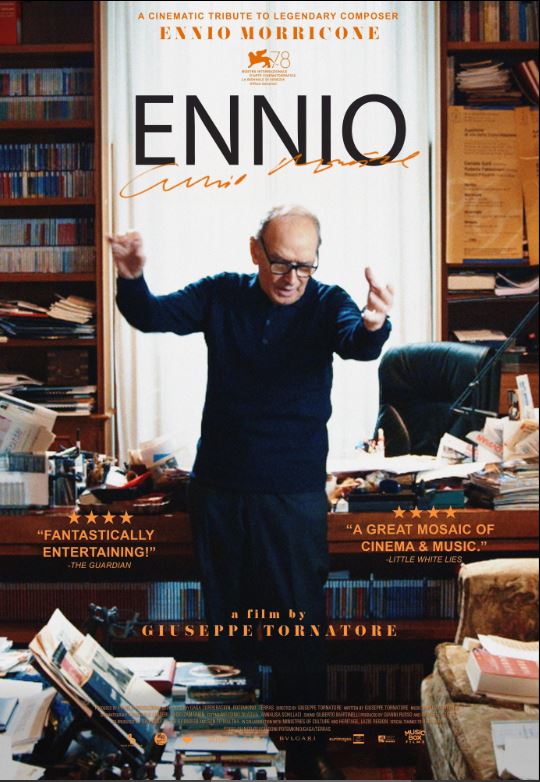
The streaming platform Kanopy is highlighting Giuseppe Tornatore’s epic Morricone documentary, “Ennio” (2021), among its featured offerings for November.
There was something about the then-young filmmaker that struck a chord with the composer when he agreed to write the music for “Cinema Paradiso” in 1988. The movie went on to win an Academy Award for Best Foreign Language Film and of course the music became one of Morricone’s most beloved scores. Morricone scored every one of Tornatore’s films thereafter. Whenever he pondered retirement in an interview, he was always careful to mention that he might be tempted back by another Tornatore project. His final film score was for Tornatore’s “Correspondence” in 2016.
I posted some observations on the documentary after watching it in March. You’ll pardon me if my “review” wound up being almost as long as the movie!
Brian De Palma is an extraordinarily adept filmmaker, who has been criticized for his adherence to “genre trash.” He has always been attracted to suspense and crime thrillers, usually of an especially violent nature, many of them tinged with horror.
This week on “Picture Perfect,” with Hallowe’en right around the corner, we’ll hear music from four of De Palma’s films.
It’s hardly surprising that such an admirer of Alfred Hitchcock would also hire Hitch’s signature composer. Bernard Herrmann scored two films for De Palma – “Sisters,” in 1973, and “Obsession,” in 1976.
“Obsession” is a spin on Hitchcock’s “Vertigo.” A botched rescue attempt results in the death of a businessman’s kidnapped wife. Years later, he encounters someone who could be her doppelganger. The film stars Genevieve Bujold, John Lithgow, and a very tan Cliff Robertson.
“The Fury,” from 1978, is a supernatural thriller based on a novel by John Farris. Two teenagers, endowed with powers of telekinesis and extra-sensory perception, are targeted by researchers who plan to harness them for their own nefarious ends. For a time, Kirk Douglas has fun as a former CIA agent, and John Cassavetes is a particularly slimy villain. Cassavetes’ comeuppance makes for one of the most memorable movie endings of its era – and we’ll leave it at that!
Critic Pauline Kael praised the music, which is by none other than John Williams – hot off his third Academy Award, for “Star Wars” – characterizing it as “as elegant and delicately varied a score as any horror film has ever had.”
Of course, “The Fury” was not the first De Palma film to deal with telekinesis. His adaptation of Stephen King’s “Carrie,” from 1976, became one the decade’s landmark horror films. It broadened King’s popularity and propelled De Palma into the A-list of Hollywood directors. It also essentially launched the careers of Amy Irving, John Travolta, and Nancy Allen, among others. Sissy Spacek was nominated for an Academy Award for her performance in the title role, as was Piper Laurie as Carrie’s overbearing, fundamentalist mother.
The music was by Pino Donaggio. The director had wanted to continue his collaboration with Herrmann, but the composer died before the film could be completed. Donaggio, though classically trained, made his fortune writing popular songs. His biggest hit was “You Don’t Have to Say You Love Me,” which was recorded by Dusty Springfield and treated to a well-known cover by Elvis Presley. Donnagio went on to become a regular De Palma collaborator, providing the music for seven of his films.
Finally, we’ll turn our back on horror, to listen to music from a successful period crime thriller, loosely based on the real-life exploits of Eliot Ness and his fellow prohibition agents – “The Untouchables,” from 1987. Kevin Costner plays the by-the-book federal agent who is given a valuable lesson in street smarts by an Irish beat cop played by an Academy Award winning Sean Connery. (“He pulls a knife, you pull a gun. He sends one of yours to the hospital, you send one of his to the morgue. That’s the Chicago way, and that’s how you get Capone.”) Capone is played, incidentally, by a baseball bat wielding Robert De Niro.
The score is by Ennio Morricone. Morricone, of course, was propelled to fame through his work on Sergio Leone’s spaghetti westerns. He applies some of that same mythmaking skill to this big screen adaptation, which had previously been published as a memoir and developed into a popular television series starring Robert Stack. The high point of the film must be the director’s nail-biting homage to Sergei Eisenstein, a slow motion shoot-out around a baby carriage as it teeters down the stairs of Chicago Union Station.
Start your weekend with a step in the right direction, with music from the films of Brian De Palma, on “Picture Perfect,” music for the movies, now in syndication on KWAX, the radio station of the University of Oregon!
Clip and save the start times for all three of my recorded shows:
PICTURE PERFECT, the movie music show – Friday at 8:00 PM EDT/5:00 PM PDT
SWEETNESS AND LIGHT, the light music program – ALL NEW! – Saturday at 11:00 AM EDT/8:00 AM PDT
THE LOST CHORD, unusual and neglected rep – Saturday at 7:00 PM EDT/4:00 PM PDT
With just a little over a week left in August, summer has nearly run its course, but there’s still time for a quick European vacation. This week on “Picture Perfect,” we glance across the pond for an hour of music from foreign films with summer settings.
“A Summer Story” (1988), based on a tale of John Galsworthy, tells of a young London lawyer and a farm girl who fall profoundly in love at the turn of last century. Georges Delerue provides the poignant score.
The juxtaposition of “Igmar Bergman” and “comedy” may seem like something of an oxymoron, but the dour Swede’s “Smiles of a Summer Night” (1955) proves to be a witty examination of the folly of the human heart. Frequent Bergman collaborator Erik Nordgren wrote the music.
Director Yves Robert adapted the memoirs of Marcel Pagnol, who spent his childhood summers in the south of France, into two lovely films, “My Father’s Glory” and “My Mother’s Castle” (both 1990). We’ll hear music composed for both by Vladimir Cosma. Pagnol’s experiences in Provence marked him for life, informing the films and writings of his maturity, including “The Baker’s Wife,” and “Jean de Florette.”
Finally, we’ll have a generous sampling from one of Ennio Morricone’s most beloved scores, that for “Cinema Paradiso” (1988). “Cinema Paradiso,” set in a post-war Sicily where it seems always to be summer, is a nostalgic paean to the shared experience of film and the significance it holds in our lives. It won a special jury prize at the Cannes Film Festival and was honored with an Academy Award for Best Foreign Film.
Join me for summer overseas this week, on “Picture Perfect,” music for the movies, now in syndication on KWAX, the radio station of the University of Oregon!
Clip and save the start times for all three of my recorded shows:
PICTURE PERFECT, the movie music show – Friday at 8:00 PM EDT/5:00 PM PDT
SWEETNESS AND LIGHT, the light music program – ALL NEW! – Saturday at 11:00 AM EDT/8:00 AM PDT
THE LOST CHORD, unusual and neglected rep – Saturday at 7:00 PM EDT/4:00 PM PDT
What did I learn from watching “Ennio” (2021), director Giuseppe Tornatore’s epic love letter to his regular musical collaborator, the late Ennio Morricone? A lot, actually. At some points, perhaps even too much.
I always knew the composer was a little exasperated by his continued association in many people’s minds with “spaghetti westerns.” Of course, he’d written music for dozens of them, but they were a mere fraction of his overall output of some 500 film and television scores. What I didn’t know is that, according to him, both he and Sergio Leone disliked the music for his revolutionary score to “A Fistful of Dollars.” You know, the one that changed movie music forever, certainly that for westerns and especially Italian westerns. The artists seemed to like it well enough in the moment, but by the time they got around to working on the sequels, they were over it. Good thing Ennio pushed through to compose the music for “The Good, the Bad and the Ugly,” which is quite simply one of the most recognizable film scores ever written. Right up there with “Psycho” and “Jaws” in terms of instant identification by your average person on the street.
Morricone and Tornatore’s working relationship began with “Cinema Paradiso,” which the composer agreed to score at a time when he was one of the most famous in the world (with 350 of his scores already written) and the director was only just starting out. Decades later, when Morricone talked retirement, he specifically cited Tornatore’s films as being among the few projects that could ever entice him back. Sort of like John Williams with Steven Spielberg. But to my knowledge, Williams never was so divided about his occupation or so vocal about his reservations.
If you’re a filmmaker and you hire Ennio Morricone, in the names of all saints in Heaven, do not tell him what to do! Unquestionably, he has his own ideas. Send him a script and let him watch the movie, and then get out of the way. Otherwise, like Oliver Stone, you’ll get a taste of his testiness and understand in no uncertain terms that you are an idiot.
Not that Morricone is at any point discourteous to anyone. He just has strong convictions about what a specific film requires. He has his vision, and he is unwavering in the drive to realize his musical ideas.
We also learn how sensitive he is. He talks with palpable ambivalence, describing his longtime struggle to come to terms with his chosen profession. He so desperately craved the approval and acceptance of his father, his teacher, and his colleagues in the world of classical music. Even all these years later, his emotional and psychological struggles are evident.
According to Roland Joffé, when he first showed him “The Mission,” Morricone dissolved into tears, he found it to be so moving. He asked Joffé what he could possibly want from him. The movie required no music, he said; it was perfect as it was. Then he went home, and later the motif for “Gabriel’s Oboe” popped into his head. The score went on to become one of Morricone’s most recognized and revered. He was robbed of the Academy Award for Best Original Score that year when the Oscar went to “Round Midnight,” the soundtrack of which consisted mostly of preexisting classics by established jazz artists. It could be argued that it didn’t even belong in the same category. But Herbie Hancock, who provided what little original music there was in the film, accepted the award, and he was and remains an outspoken Morricone admirer.
Morricone would be nominated for – and lose – the Oscar five times before the Academy finally gave him an honorary award in 2007. Then he went on to win a competitive Oscar in 2016, at the age of 88, for his music for Quentin Tarantino’s “The Hateful Eight.” That he would remain so long underappreciated by the Academy is unfathomable. But he did live through an era when the competition was much stronger than it is now (“Round Midnight” aside).
The most revelatory parts of the documentary come in the first half hour, when we learn about Morricone’s early years, following in his father’s footsteps as a working musician, as opposed to an artist, earning the family bread using the cheapest secondhand trumpet his dad could find, playing gigs in orchestras and dance bands. Then his pursuit of excellence as a classical musician, and a composer, studying with Goffredo Petrassi. And after that, wandering further into avant-garde experimentation, first in Darmstadt, the epicenter of plinks, planks, and plunks, and then with the group he himself formed, Il Gruppo di Improvvisazione Nuova Consonanza (G.I.N.C.) .
The documentary does a great job of showing how these influences carried over into his music as an arranger for pop singers, and it’s hilarious, once it’s pointed out, to grasp just how crazy – and inspired – his choices were, in terms of including extramusical effects in these hit songs. So the spaghetti western sound of whip cracks, whistles, and nonsense choruses did not develop in a vacuum. At a point, Morricone brings some pretty hardcore avant-garde experimentation to bear on his film scores, with the G.I.N.C. improvising in some 40 films, until the suits finally pull him aside and say, Hey, Ennio, enough already!
There’s lots of great, rarely-seen footage of young Morricone in his nerd glasses, looking, as someone describes, all the world like a Peanuts character. But there’s so much, it seems like an awfully long time passes before we finally get to the spaghetti westerns that made him so famous. At that point, of course, even the most casual Morricone fan will sit up and take notice.
Then there will likely be a dip in interest, except perhaps for diehards and fans of international cinema, as there are discussions of films many Americans will be unfamiliar with, save perhaps something like “The Battle of Algiers,” which was regarded as significant enough that it made it to U.S. theaters. But many of the directors Morricone worked with were major players in world cinema, and a number of these are included among the talking heads.
One of the weaknesses of the documentary is its assumption that its audience really knows its stuff, to the extent that many of those who offer their onscreen commentary are not really identified beyond their names. So you have to fill in the blanks a little bit, in terms of who was a director or a work associate or a fan from another genre of music you might not be so familiar with. Again, if you’re really into Morricone and world cinema in general, you will likely recognize just about everyone, but I was relieved when there was finally some footage that explained who Alessandro Alessandroni (Morricone’s whistler and guitarist) and Edda dell’Orso (who provided the haunting vocalises for classic scores like “Once Upon a Time in the West”) are.
Also, are there any subtitles in this movie? For a documentary about a figure of international appeal, with so many of the onscreen participants speaking different languages, you would assume that there would be English subtitles. That well may be the case, but if so, for some reason they were not showing up on my print (I streamed it on Prime), so I wound up having to resort to closed captioning.
What comes across loud and clear, in whatever language, is that Tornatore loves Morricone. And why wouldn’t he? He enjoyed the privilege of being favored by one of the greatest geniuses of his art form. However, it is possible he loves him just a little too much. He is so close to his subject, he can’t seem to look away. While unquestionably a feast for Morricone admirers, the film, I’m sure, could be tightened by a good half hour. The running time is 150 minutes, nearly as long as “The Good, the Bad and the Ugly” itself (which I rewatched the next night). There’s a lot of repetition in the commentary of the talking heads, and I wonder if some of them even had to be there at all.
Perhaps partly it was a question of securing funding, or at any rate audience identification. If you can get Bruce Springsteen to come on and say he loves Morricone, great, but he really offers nothing substantial, certainly no insights. And then once you’ve got him to participate, you’ve got to have him in there enough to make it worthwhile. There are several such witnesses included. I found it much more interesting when the guy from Metallica shows up to offer a few remarks and we see him play “The Ecstasy of Gold” in concert. That was awesome. Really, between that and Morricone’s own concert footage, anyone will walk away understanding that the composer himself enjoyed the status of a rock star. At the end of his life, he toured everywhere, selling out arena after arena all over the world.
Tornatore began filming the documentary while Morricone was still alive, so we’re very lucky to have so many clips of the composer recollecting everything, including his work on so many of his major scores. For a guy who worked so much (there were years when he composed more than 20 scores), he seems to remember every musical phrase. Most shocking admission by the composer: that he hates melody! But I think we can take that with a grain of salt. These segments are gold.
And by the time we get to “Days of Heaven,” anyone who lived through the era realizes what a golden age it was. In the late ‘70s and 1980s, Morricone quietly revivified even American movies.
The verdict: “Ennio” is definitely worth seeing, most of all for Morricone fans; then for those that love the movies in general; and then for anyone who is curious about the fascinating path an artist’s career can take, and how expertly Morricone navigated the then-divergent fields of classical, avant-garde, popular, and film music. He really was forward-looking in his embrace and mastery of different forms, anticipating the now common practice of hurdling barriers that used to stand impenetrable between genres.
The trailer is superb. Whoever edited it should have put together the movie.
“Ennio,” a solid three out of four stars. Indispensable for lovers of Morricone and, more broadly, film music, and an interesting watch, if a long one, for everyone else.
Before American composers like Jerome Moross and Elmer Bernstein made the western distinctly their own, the task of scoring the genre fell largely to European émigrés. This week on “Picture Perfect,” we’ll take a look at some outside perspectives on how the West was won.
Literally the godson of Richard Strauss, Max Steiner (born on this date in 1888) came from Vienna, where he studied with Johannes Brahms and Robert Fuchs. In Hollywood, he wound up scoring such classics as “King Kong,” “Gone with the Wind” and “Casablanca.”
Among his over 300 film projects were a number of westerns. One of these was “They Died with Their Boots On” (1941), which starred Errol Flynn as George Armstrong Custer and Olivia de Havilland as Libby, the woman who becomes his wife. Steiner’s score features familiar folk material, some old-fashioned faux “Indian” music, and one of his characteristically lush love themes.
Dimitri Tiomkin (born in Ukraine on this date in 1894) was a pupil of Alexander Glazunov. He came to revolutionize the sound of the American West, when he wrote the music for “High Noon,” the first of his “ballad” scores. Advance word, based on an early screening for the press, was that the picture would be a failure. However, Tiomkin had such faith in the theme song, sung in the film by Tex Ritter, that he hired Frankie Laine to record it, and the record became a world-wide hit. In fact, his score is largely credited with having saved the film.
Tiomkin was recognized with two Academy Awards: one for Best Original Song, and one for the score itself. It was the first time a composer won two Oscars for his work on the same movie. It also changed the way western scores were done. In the 1950s, Tiomkin became THE western composer of choice. He produced a number of subsequent ballad scores, including that for “Gunfight at the O.K. Corral” (1957). Asked how it was that a composer from Ukraine could write so convincingly for the American West, Tiomkin quipped, “A steppe is a steppe is a steppe.”
Another unexpected source of classic western music, Franz Waxman was born in Upper Silesia. He arrived in the U.S. by way of Germany. Nonetheless, as part of the composer’s varied and prolific output, he did indeed score a number of films in the genre, including “The Furies” (1950), a peculiar noir-western hybrid. Walter Huston, in his final film, plays a cattle baron who remarries and throws his empire into jeopardy. Barbara Stanwyck is his strong-willed daughter.
Hungarian-born composer Miklós Rózsa scored many films with historical settings – “Quo Vadis,” “Ben-Hur,” and “King of Kings,” among them. However, to my knowledge, his only western was “Tribute to a Bad Man” (1956). James Cagney stars as a rancher who doles out some frontier justice.
Finally, we’ll hear music by Ennio Morricone, from arguably the most operatic of all spaghetti westerns, “Once Upon a Time in the West” (1968). As a reaction to Tiomkin’s ballad scores and the neo-Coplandisms of Elmer Bernstein and the rest, Morricone brings his own quirky sensibility to bear on the classic western iconography. Get ready for indelible motifs for harmonica and banjo, but also an unexpectedly moving elegiac arioso, underscoring the close of the American West with the arrival of the railroad.
Doublecheck your train tables and wind your pocket watches. Old World composers go west this week on “Picture Perfect,” music for the movies, now in syndication on KWAX, the radio station of the University of Oregon!
Remember, KWAX is on the West Coast, so there’s a three-hour difference for those of you listening in the East. Here are the respective air-times for all three of my recorded shows (with East Coast conversions in parentheses):
PICTURE PERFECT, the movie music show – Friday on KWAX at 5:00 PM PACIFIC TIME (8:00 PM EASTERN)
SWEETNESS AND LIGHT, the light music program – ALL NEW! – Saturday on KWAX at 8:00 AM PACIFIC TIME (11:00 AM EASTERN)
THE LOST CHORD, unusual and neglected rep – Saturday on KWAX at 4:00 PM PACIFIC TIME (7:00 PM EASTERN)
Stream all three, at the times indicated, by following the link!