Tag: Erich Wolfgang Korngold

  • Korngold’s Hollywood Composers

    Korngold’s Hollywood Composers

    Errol Flynn writes a ballet? Charles Boyer composes a tone poem? Claude Rains writes a cello concerto!

    This week on “Picture Perfect,” we’ve got three examples from Hollywood’s Golden Age of movies about fictional composers. These, of course, required music allegedly written by the characters, and this was provided by two-time Academy Award-winner Erich Wolfgang Korngold.

    Korngold is probably best known to movie buffs as the composer for Flynn swashbucklers such as “The Adventures of Robin Hood” and “The Sea Hawk,” but his filmography is more varied than one might at first suspect. No matter what the subject, Korngold could be counted on to bring that opulent fin de siècle gloss, developed in a Vienna steeped in Mahler and Strauss.

    We’ll hear music from “Escape Me Never” (1947), a slightly preposterous melodrama about two composer brothers who become rivals in love; “The Constant Nymph” (1943), about a would-be romantic bond between a composer struggling to find his true voice and an admiring girl on the verge of womanhood who develops deeper feelings for him; and “Deception” (1946), about a cellist reunited with his former love, who had believed him killed during the war, and the vindictive composer who attempts to shatter his psyche through grueling rehearsals of his latest concerto.

    “Deception” was Korngold’s last, wholly original score, though he was lured back to Hollywood for one final project, “Magic Fire” (1955), a biopic of the composer Richard Wagner, for which he adapted selections from Wagner’s operas. Furthermore, Korngold makes an appearance onscreen (!) as conductor Hans Richter. The film was subject to heavy cuts prior to its U.S. release and was not a success.

    Hollywood seldom gets it right when it comes to portraying the process of the composer, but Korngold, true to his name, did his best to spin gold from corn, producing some appropriately grand utterances, albeit condensed to only a few minutes of screen time. Quite a task for this figure who made his greatest mark in opera.

    Join me for these examples of Korngold as ghostwriter, on “Picture Perfect,” this Friday evening at 6 ET, or enjoy it later as a webcast at http://www.wwfm.org.

    Follow the link to hear Korngold improvise on themes from “The Flying Dutchman” (with entertaining stills):

    https://www.youtube.com/watch?v=h4bNEw1nu3I

    PHOTO: Paul Henreid in “Deception.” He wore a special jacket to accommodate the arms of two professional cellists who stood behind him as he emoted. On the film’s soundtrack the concerto was performed by Eleanor Aller Slatkin, the mother of Leonard Slatkin.
  • Medieval Movie Scores Chivalry Lives

    Medieval Movie Scores Chivalry Lives

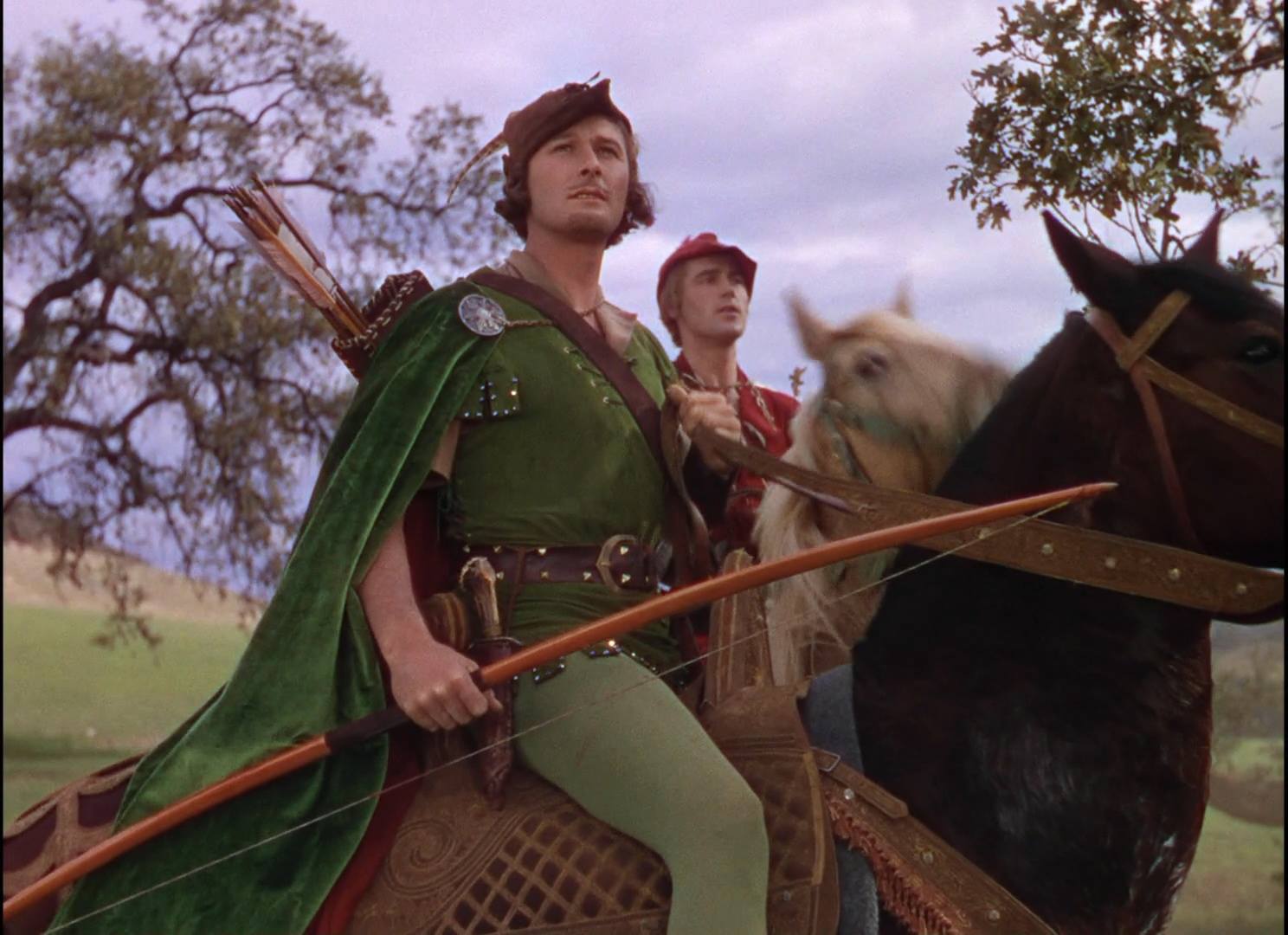
    Chivalry is not dead this week on “Picture Perfect,” as we listen to music from movies set in the Middle Ages. The term “chivalry” conjures images of knights in armor, of courtly behavior, of bravery, honor, courtesy, moral virtue and willingness to defend the weak. For the average filmmaker and moviegoer, that likely translates into spectacle and adventure.

    We’ll hear scores that celebrate or circumvent the code, with selections from “The Warlord” by Jerome Moross, “El Cid” by Miklós Rózsa, “Lionheart” by Jerry Goldsmith and “The Adventures of Robin Hood” by Erich Wolfgang Korngold.

    As always, we go on a crusade for great film music this week, on “Picture Perfect,” this Friday evening at 6 ET. If you miss it, you can enjoy it later as a webcast at http://www.wwfm.org.

    Robin is a bold rascal:

  • Erich Wolfgang Korngold: Hollywood’s Prodigy

    Erich Wolfgang Korngold: Hollywood’s Prodigy

    Today is the birthday of one of my favorite composers, Erich Wolfgang Korngold (1897-1957). I don’t know, maybe it has something to do with watching those Errol Flynn movies on television as a kid – you know, the ones that inspire you to take down the curtain rods and start dueling around the house.

    Korngold was one of music’s great child prodigies. His ballet-pantomime “Der Schneemann” (“The Snowman”), composed at the age of 11, was performed at the Vienna Court Opera before Emperor Franz Josef. His early piano and chamber works were picked up by Artur Schnabel. His “Sinfonietta” (a full-scale symphony in all but name) was performed by Felix Weingartner and the Vienna Philharmonic when he was 15. At one performance, Korngold shared a box with Richard Strauss.

    Several of his operas are knock-outs. The double premiere in Hamburg and Cologne of “Die tote Stadt” (“The Dead City”) in 1920 made Korngold, at the age of 23, one of the leading opera composers of his time.

    Several factors contributed to an enormous shake-up in Korngold’s reputation. One was the fact that his musical language never really developed. His earliest works are as finely crafted and as fully realized as those written at the end of his life – most impressive, except that what seemed strikingly modern when he was a teen later seemed hopelessly romantic and passé.

    Another was that Korngold followed theatrical impresario Max Reinhardt to Hollywood for a big screen adaptation of “A Midsummer Night’s Dream.” This led to further offers from Warner Brothers, under terms he couldn’t refuse. In the meantime, the Nazis rolled into Austria, effectively sealing off his return home.

    For decades, Korngold’s reputation among “serious” music aficionados suffered. His Violin Concerto was famously derided by one critic as “more Korn than Gold.” But that all began to change in the 1970s, with the issue of an album on the RCA label, featuring music from Flynn’s “The Sea Hawk,” “Captain Blood” and “The Adventures of Robin Hood,” that proved there was indeed a market for classic film music. Ironically, the very projects that had dragged him down in the eyes of some served to jumpstart his posthumous revival.

    With the advent of compact disc, with labels searching for worthwhile though underexposed repertoire to lure consumers who had already replaced their entire record collections, Korngold’s reputation again began to soar. While he will never be regarded as the next Mahler or even Richard Strauss, it’s fairly obvious at this point that his place in “serious music” is secure.

    Still it is with affection that many remember his film scores, which he regarded as operas without words. It was Korngold who brought Old World opulence to New World popular culture. His efforts earned him two Academy Awards.

    This week on “Picture Perfect,” we’ll have two scores by Korngold as part of our second installment celebrating the films of 1939, which film historians frequently refer to as “Hollywood’s greatest year.” The first installment aired in February, and featured music from “The Wizard of Oz,” (Harold Arlen & Herbert Stothart) “Of Mice and Men” (Aaron Copland), “Gunga Din” (Alfred Newman) and “Goodbye, Mr. Chips” (Richard Addinsell).

    This week’s episode will include Korngold’s “Juarez,” an historical drama about Mexican resistance against the French army of Napoleon III, which starred Paul Muni, Bette Davis and Claude Rains, and “The Private Lives of Elizabeth and Essex,” with Davis and Errol Flynn, as Elizabeth I and Robert Devereux, 2nd Earl of Essex, respectively. The latter features plenty of Korngold’s signature pageantry.

    The show will also include two scores by Alfred Newman, for “Wuthering Heights” and “The Hunchback of Notre Dame.”

    A third installment, focusing on the indefatigable Max Steiner – who worked on 13 films in 1939 – will air in the fall. So no more brickbats from you “Gone With the Wind” fans, please!

    Join us on the second leg of our journey to celebrate the 75th anniversary of “Hollywood’s greatest year,” on “Picture Perfect,” Friday evening at 6, or enjoy it later as a webcast at http://www.wwfm.org.

    PHOTO: Erich Wolfgang Korngold (right) works with a score mixer laying down the tracks for “Juarez.” That’s Paul Muni onscreen.

  • Passover Korngold’s Hollywood Psalm

    Passover Korngold’s Hollywood Psalm

    The Jewish celebration of Passover begins at sunset. One of my favorite composers, Erich Wolfgang Korngold, wrote this “Passover Psalm” in 1941, on a commission from Rabbi Jacob Sonderling. Sonderling, rabbi of Fairfax Temple in Los Angeles, which he founded, invited a number of prominent composers to write music for the synagogue.

    Korngold, who was one of the most celebrated opera composers of his youth, lived out the war years in Hollywood, where he revolutionized the art of film scoring. He was the recipient of two Academy Awards, for his music to “Anthony Adverse” (1936) and “The Adventures of Robin Hood” (1938).

    The “Passover Psalm” and “Prayer,” both written for Sonderling, are the only sacred works Korngold ever composed.

    https://www.youtube.com/watch?v=5cpvsi4TFto

Tag Cloud

Aaron Copland (92) Beethoven (94) Composer (114) Film Music (116) Film Score (143) Film Scores (255) Halloween (94) John Williams (185) KWAX (228) Leonard Bernstein (99) Marlboro Music Festival (125) Movie Music (131) Opera (197) Philadelphia Orchestra (86) Picture Perfect (174) Princeton Symphony Orchestra (106) Radio (86) Ralph Vaughan Williams (85) Ross Amico (244) Roy's Tie-Dye Sci-Fi Corner (290) The Classical Network (101) The Lost Chord (268) Vaughan Williams (99) WPRB (396) WWFM (881)

DON’T MISS A BEAT

Receive a weekly digest every Sunday at noon by signing up here


RECENT POSTS