Tag: Eugene Ormandy

  • Ormandy’s Lost American Legacy Rediscovered

    Ormandy’s Lost American Legacy Rediscovered

    Eugene Ormandy was born Jenő Blau in Budapest in 1899. In 1927, he became a naturalized American citizen and wound up directing the Philadelphia Orchestra for 44 years.

    In that capacity, he championed much contemporary music and works by his adopted countrymen – a fact eclipsed by his reputation as a superb interpreter of the 19th century classics.

    In fact, for many years, much of his American legacy dropped out of print. In the late 1990s, Albany Records attempted to rectify the situation by reissuing some of Ormandy’s recordings of lesser-heard American music. The series only made it to three volumes, but each one of them is a treasure.

    This week on “The Lost Chord,” we’ll hear two selections from these invaluable anthologies. Both are by Pulitzer Prize winners whose music has sadly fallen out of fashion.

    William Schuman was the very first recipient of the Pulitzer Prize for Music, in 1943, for his “Cantata No. 2, A Free Song.” At the height of his fame, he was also President of Lincoln Center. He was considered such an important figure in American culture, he was even brought on to “What’s My Line?” (Those were the days.)

    We’ll hear Schuman’s “Credendum – Article of Faith,” composed in 1955. The work was written in response to the first ever commission by the U.S. government for a symphonic work.

    Two years later, the Pulitzer was awarded to Norman Dello Joio, for his “Meditations on Ecclesiastes.” His symphonic suite “Air Power” was adapted from 22 individual scores composed for the CBS television series about the history of aviation. The series ran from November 1956 through the spring of 1957. (Dello Joio would collect his prize in April.) The individual sections were used to underscore segments on the early days of flight, with their barnstormers and daredevils, air battles and war scenes.

    I hope you’ll join me for these rarely-heard recordings of American music. Ormandy flies American, on “All-American Ormandy,” on “The Lost Chord,” now in syndication on KWAX, the radio station of the University of Oregon!


    Remember, KWAX is on the West Coast, so there’s a three-hour difference for the Trenton-Princeton area. Here are the respective air-times of my recorded shows (with East Coast conversions in parentheses):

    PICTURE PERFECT, the movie music show – Friday on KWAX at 5:00 PACIFIC TIME (8:00 PM EST)

    THE LOST CHORD, unusual and neglected rep – Saturday on KWAX at 4:00 PACIFIC TIME (7:00 PM EST)

    Stream them here!

    https://kwax.uoregon.edu/


    William Schuman on “What’s My Line?” (1962):

    https://www.youtube.com/watch?time_continue=10…

    “Air Power,” narrated by Walter Cronkite (1956):

    https://www.youtube.com/watch?v=gKXKTh50USM


    PLEASE NOTE: Ormandy’s recording of Dello Joio’s “Air Power Suite” will be reissued on Friday, November 17, as part of Sony Classical’s impending 88-CD box, “Eugene Ormandy/The Philadelphia Orchestra: The Columbia Stereo Collection.”

    Schuman’s “Credendum” was reissued in 2021, as part of Sony’s 120-CD box (all mono), “Eugene Ormandy: The Columbia Legacy.”

    Both Sony releases have been newly-remastered.
  • Ormandy’s Stereo Legacy: New Philadelphia Orchestra Box

    Ormandy’s Stereo Legacy: New Philadelphia Orchestra Box

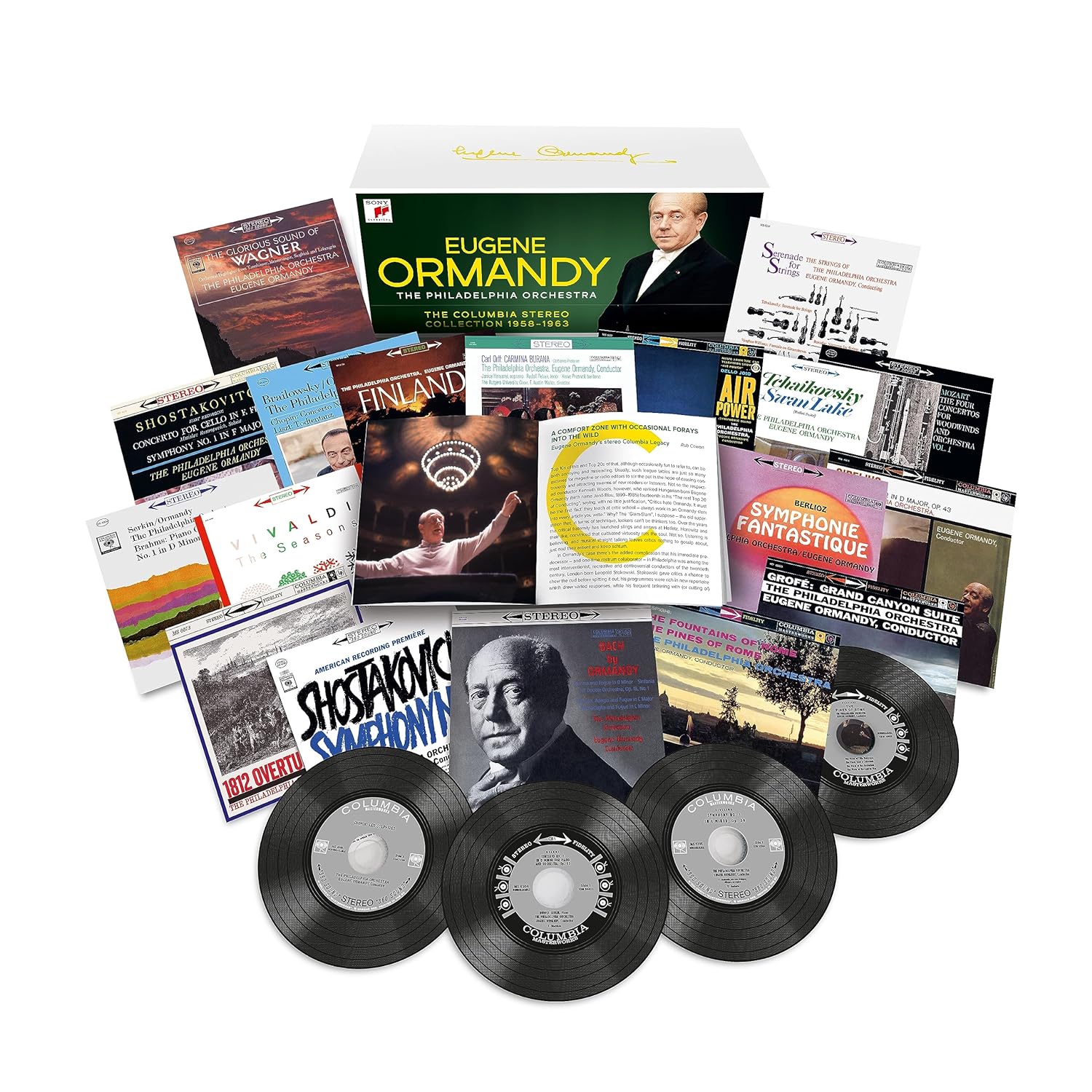
    Here it comes! Two years after my euphoric reception of Sony Classical’s mega-box of mono recordings by Eugene Ormandy and the Philadelphia Orchestra comes news of the first installment of presumably multiple boxes of the partnership’s legendary stereo recordings.

    Of course, now we’re getting into duplication territory, as a fair number of these have been reissued countless times and form the core of the Ormandy/Philadelphia legacy. HOWEVER, they will all be remastered, presumably (if following the blueprint of the earlier set) individually filed in sleeves reproducing the original album notes and cover art, and interleaved with a number of dimly-recollected curiosities from the LP era, some of them never revived in any form.

    Release date: November 17. I placed my pre-order earlier this week. You can shop around for the lowest price. I’m locked in at $170, and for 88 CDs and the luxury packaging, I consider it a steal.

    https://www.sonyclassical.com/releases/releases-details/eugene-ormandy-the-stereo-collection-1958-1963

    I’m projecting there will be four of these boxes in all: the mono set, this stereo release of recordings from 1958-1963, a second stereo set covering 1964-1968, and a stereo set embracing the later RCA years. Last year, there was an Ormandy/Minneapolis set of mono recordings predating his Philadelphia years. I already have a fair amount of that material, but it’s only 11 CDs, so maybe I should take a closer look to be sure it’s not something else I should invest in. But it’s really Philadelphia I want. Including maybe a Robin Hood Dell set!

    In case you missed it, here’s my enthusiastic reception of the “Eugene Ormandy: The Columbia Legacy” boxed set from May 2020.

    The actual press release on Sony Classical’s website is cut-and-pasted with no paragraph breaks and no indication of the actual disc-by-disc content. Here’s a better indication from a secondary source. Still, no mention of the soloists.

    https://www.importcds.com/eugene-ormandy-and-philadelphia-orch-columbia-coll/194399774328

    Okay, Sony, so maybe you’re not the best when it comes to promoting your reissues. Just keep producing sets of the quality of the original Ormandy box, and you can keep taking my money!

  • Ormandy’s China Tour: An American Overture

    Ormandy’s China Tour: An American Overture

    When Eugene Ormandy took the Philadelphia Orchestra to China for its first concert there, 50 years ago today, he was sure to include, alongside Mozart and Brahms, some music from the American Heartland.

    Roy Harris (1898-1979) was born in a log cabin, in Lincoln County, Oklahoma, on Lincoln’s birthday. If that doesn’t imbue a composer with a sense of destiny, I don’t know what will. Harris went on to became one of our great American symphonists. In particular, his Symphony No. 3 of 1939 has been much beloved and frequently performed. Unfortunately, we don’t hear all that much of his music anymore. And that’s a damned shame.

    Philadelphia would be the first American orchestra to perform in China (the London and Vienna Philharmonic Orchestras had appeared earlier the same year), having received an invitation in response to Nixon’s historic visit in 1972. According to first-hand accounts, audience reactions to the performances were difficult to decipher. On the street, people were curious, but stand-offish. Red banners and likenesses of Mao, Lenin, and Stalin festooned Tiananmen Square. The local orchestra played Western music (Beethoven), but only in rehearsal, for training purposes. In summer, musicians pruned trees.

    Here are some interesting, balanced impressions, from a diary kept by one of the Philadelphians:

    https://www.inquirer.com/arts/philadelphia-orchestra-china-tour-1973-mao-beijing-20190509.html?fbclid=IwAR18VHjKTjBIKdUQlKfwXOzcso2DIy8oDdtrGWd-ZjYUZt6h_9aS9peihuU

    In all, the orchestra played six concerts. This was the trip on which Philadelphia performed the notorious “Yellow River” Concerto, a piano concerto written by committee and overseen by Madame Mao herself. Interesting that a country that did its damnedest to suppress decadent Western influence would shamelessly pilfer from the Western Romantics. As an encore, the pianist played a set of variations on “Home on the Range,” apparently a concession to Nixon. According to the diarist, Madame Mao did not care for “The Pines of Rome.” Mao himself was a no-show.

    Also included on the programs were “The Stars and Stripes Forever” and the “Chinese Worker’s March.” Again, the Beijing audience seemed impassive. Performances were received with more enthusiasm in Shanghai.

    While I haven’t been able to locate any recordings of the Chinese concerts, here’s Ormandy and the Philadelphians playing Harris in Russia in 1958. Additional American offerings included Samuel Barber’s “Adagio for Strings” and George Gershwin’s “An American in Paris,” which were played alongside Igor Stravinsky’s “The Firebird.” You can hear the tepid applause in Russia, when following the link.

    The ”Yellow River” Concerto has been described as a first cousin to Richard Addinsell’s “Warsaw Concerto.” Prior to their departure, the Philadelphia Orchestra gave the U.S. premiere of the piece, one of the works requested by the Chinese to be performed on the impending tour. Daniel Epstein was the soloist at its Saratoga Springs debut. Epstein would accompany the orchestra to China and record the concerto with the the musicians on their return. The album was released on on RCA Records. For some reason, it was never reissued on CD, but is now available for purchase as an mp3.

    Diplomat Nicholas Platt, who accompanied Nixon to Beijing in 1972, and later traveled with and advised Ormandy, talks about some of the complications surrounding the Philadelphia Orchestra’s trip to China.

  • Rachmaninoff at 150 Anniversary Celebration

    Rachmaninoff at 150 Anniversary Celebration

    Sergei Rachmaninoff may have been born on April 1, but he was nobody’s fool. Frequently derided by critics, he knew just what the public wanted – good tunes and heart-on-the-sleeve emotion! His Piano Concertos Nos. 2 & 3, the “Rhapsody on a Theme of Paganini,” the Symphony No. 2, the “Vocalise,” and more solo piano works than I care to list, including the Prelude in C-sharp minor – so ubiquitous the composer himself came to hate it – have never been out of the active repertoire.

    Rachmaninoff has been my focus on “The Lost Chord” several times over the years – I devoted a show to his friendship with Nikolai Medtner and another to his achievements as a recitalist – but the program most easily referenced is the one that aired this past Sunday on WWFM – The Classical Network.

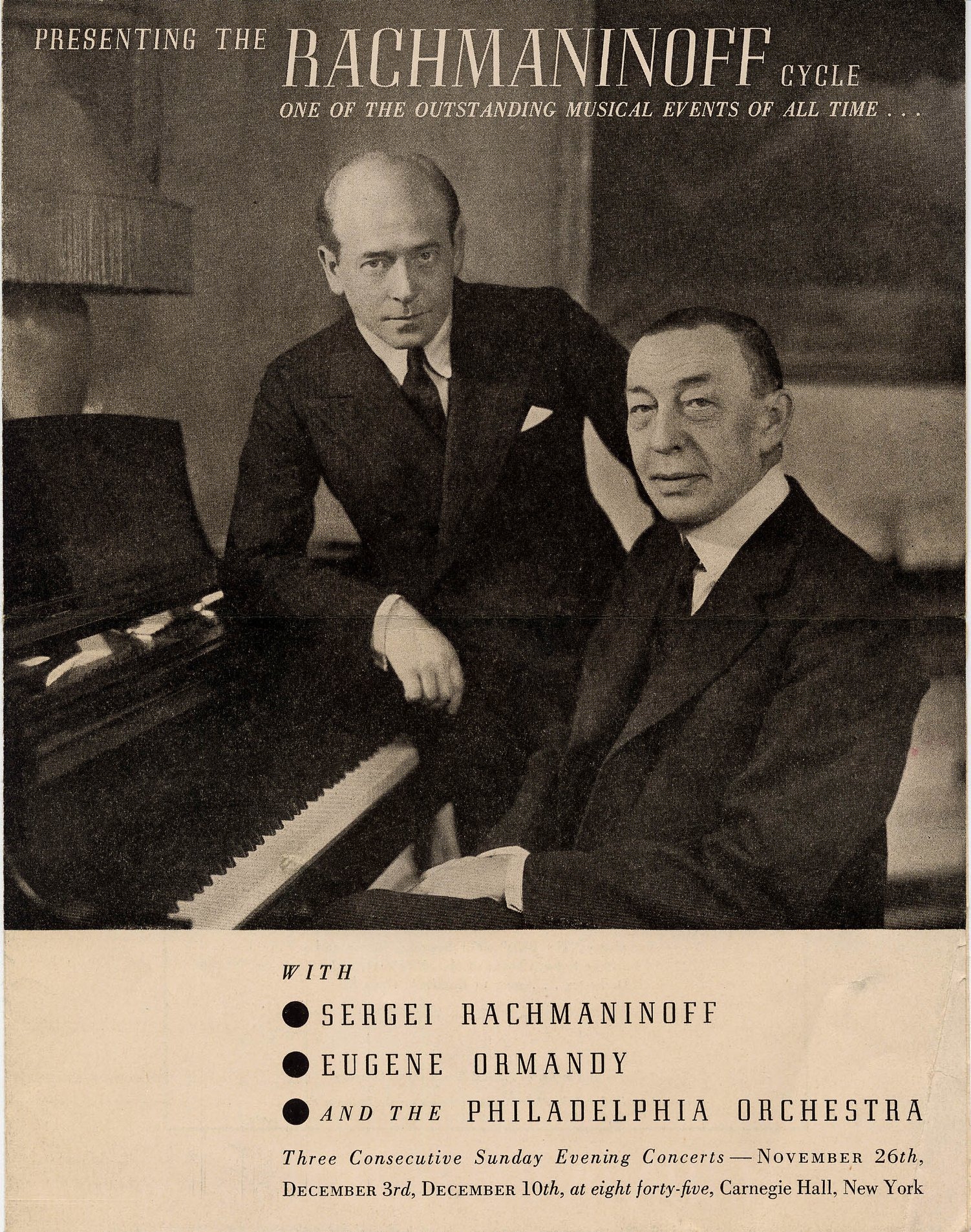
    For Rachmaninoff’s 150th birthday, enjoy an hour of vintage recordings of his music, including one of the composer playing his own “Symphonic Dances,” on the piano of Eugene Ormandy, in 1940. Also, Ormandy introduces – and conducts – the Philadelphia Orchestra in a memorial performance of “Isle of the Dead,” given only days after Rachmaninoff’s death in 1943. The hour concludes with a literal party piece, as Rachmaninoff tosses off the folk song “Bublichki,” or “Bagels,” in 1942.

    The recordings are taken from a 3-CD boxed set on the Marston Records label. Get a piece of the Rach! Enjoy the webcast by following the link and clicking on “listen.”

    https://www.wwfm.org/show/the-lost-chord-with-ross-amico/2023-03-24/the-lost-chord-march-26-rach-of-ages

    Happy 150, Sergei Rachmaninoff!

  • Rachmaninoff 150th Birthday Broadcast

    Rachmaninoff 150th Birthday Broadcast

    This Sunday night on “The Lost Chord,” get a piece of the Rach!

    With the impending sesquicentenary of the birth of Sergei Rachmaninoff on April 1, enjoy an hour of historic performances.

    We’ll hear Rachmaninoff play his own “Symphonic Dances” in a recently rediscovered, fly-on-the-wall recording, captured surreptitiously at the home of Eugene Ormandy in 1940. Then Ormandy will introduce – and conduct – the Philadelphia Orchestra, in a special memorial performance of Rach’s “Isle of the Dead,” given only days after the composer’s death, in 1943.

    We’ll round out the hour with a literal party piece – as Rachmaninoff tosses off the Ukrainian folk song, “Bublichki,” or “Bagels,” in 1942.

    The recordings are from a 3-CD boxed set issued by Marston Records, the record label of industry legend Ward Marston. Now based in West Chester, PA (he was born in Philadelphia in 1952), Marston is one of classical music’s most revered audio engineers. Incredibly, he has been blind since birth.

    Marston’s work in restoration and conservation of historic audio has been both miraculous and rapturously received. His acclaimed remasterings have appeared on the Andante, Biddulph, Naxos, Pearl, RCA, and Romophone labels. For more information and a complete catalogue of Marston Records releases, visit marstonrecords.com.

    Then join me for an hour of Sergei Rachmaninoff in vintage recordings. That’s “Rach of Ages,” for the 150th birthday of Sergei Rachmaninoff, this Sunday night at 10:00 EDT, on WWFM – The Classical Network and wwfm.org.

Tag Cloud

Aaron Copland (92) Beethoven (95) Composer (114) Film Music (123) Film Score (143) Film Scores (255) Halloween (94) John Williams (187) KWAX (229) Leonard Bernstein (101) Marlboro Music Festival (125) Movie Music (138) Opera (202) Philadelphia Orchestra (89) Picture Perfect (174) Princeton Symphony Orchestra (106) Radio (87) Ralph Vaughan Williams (85) Ross Amico (244) Roy's Tie-Dye Sci-Fi Corner (290) The Classical Network (101) The Lost Chord (268) Vaughan Williams (103) WPRB (396) WWFM (881)

DON’T MISS A BEAT

Receive a weekly digest every Sunday at noon by signing up here


RECENT POSTS