Tag: Ezra Pound

  • George Antheil Bad Boy Genius Rediscovered

    George Antheil Bad Boy Genius Rediscovered

    This week on “The Lost Chord,” Trenton’s Bad Boy makes good.

    George Antheil, self-proclaimed “Bad Boy of Music” (the title of his autobiography), sparked one of classical music’s great riots when his “Ballet Mécanique” was unveiled in Paris in 1926.

    The work made preposterous demands on performers and audience alike, with its battery of player pianos, sirens, bells, and airplane propellers – all difficult to coordinate, but worth it, if they were to transform concert halls into free-for-alls and secure Antheil’s status as enfant terrible. His notoriety earned him the respect, friendship, and envy of Paris’ artistic community. From the stage, he watched as Man Ray punched a heckler in the face, as Satie cheered, “Quel precision!,” and as Ezra Pound shouted, “Shut up, you are all stupid idiots!” Pound became one of Antheil’s most ardent champions, taking a break from poetry to publish an inflammatory book, “Antheil and the Treatise on Harmony.”

    Antheil speculated, perhaps facetiously, that his mechanistic nightmares may have been inspired by his having been born across the street from a noisy machine shop. In fact, a number of his works bear the boisterous imprint of the factories he knew in Trenton as a boy, including the “Airplane Sonata,” “The Death of Machines,” and the “Sonata Sauvage.”

    It was all rather forward-looking. Antheil was one of the first composers to search beyond conventional instruments for musical means. He not only presaged the alien soundscapes of Edgard Varèse, but also anticipated the stupefying repetitions of minimalism – though infusing his own compositions with enough violence to prevent them from ever becoming numbing. Stravinsky was his hero. He fed off the savagery of “The Rite of Spring,” then followed the master’s subsequent hairpin turn into neoclassicism. Both artists suffered a backlash from former idolaters who felt betrayed by what was perceived as a cowardly retreat into the past.

    In Antheil’s case, his reputation never recovered. The one-two punch of his Piano Concerto No. 2, transparently influenced by Bach, and the spectacular failure of his “Ballet Mécanique” to impress at its American premiere at Carnegie Hall (mostly due to faulty machinery) cast Antheil, rebel angel that he was, from the lofty heights of notoriety to the slag heap of has-beenery.

    But if it is true that the remainder of his career was indeed that of a has-been, we should all be so lucky.

    The composer of six symphonies, Antheil also wrote books on endocrinology and speculative war tactics, a murder mystery, a nationally syndicated column of advice to the lovelorn, and over 30 Hollywood film scores. With the actress Hedy Lamarr, he patented a torpedo guidance system that became the basis for modern Bluetooth, Wi-Fi, and cellular phone technology.

    I hope you’ll join me for music by this eccentric and multitalented figure, including “Ballet Mécanique,” in all its original, uncompromising glory; then selections from his neo-classical Piano Concerto No. 2, his wartime Symphony No. 4, and dance music from his score to the ballet film noir “Specter of the Rose.”

    That’s “Antheil Establishment” – three days before the composer’s birthday anniversary – on “The Lost Chord,” now in syndication on KWAX, the radio station of the University of Oregon!


    Clip and save the start times for all three of my recorded shows:

    PICTURE PERFECT, the movie music show – Friday at 8:00 PM EDT/5:00 PM PDT

    SWEETNESS AND LIGHT, the light music program – Saturday at 11:00 AM EDT/8:00 AM PDT

    THE LOST CHORD, unusual and neglected rep – Saturday at 7:00 PM EDT/4:00 PM PDT

    Stream them, wherever you are, at the link!

    https://kwax.uoregon.edu/


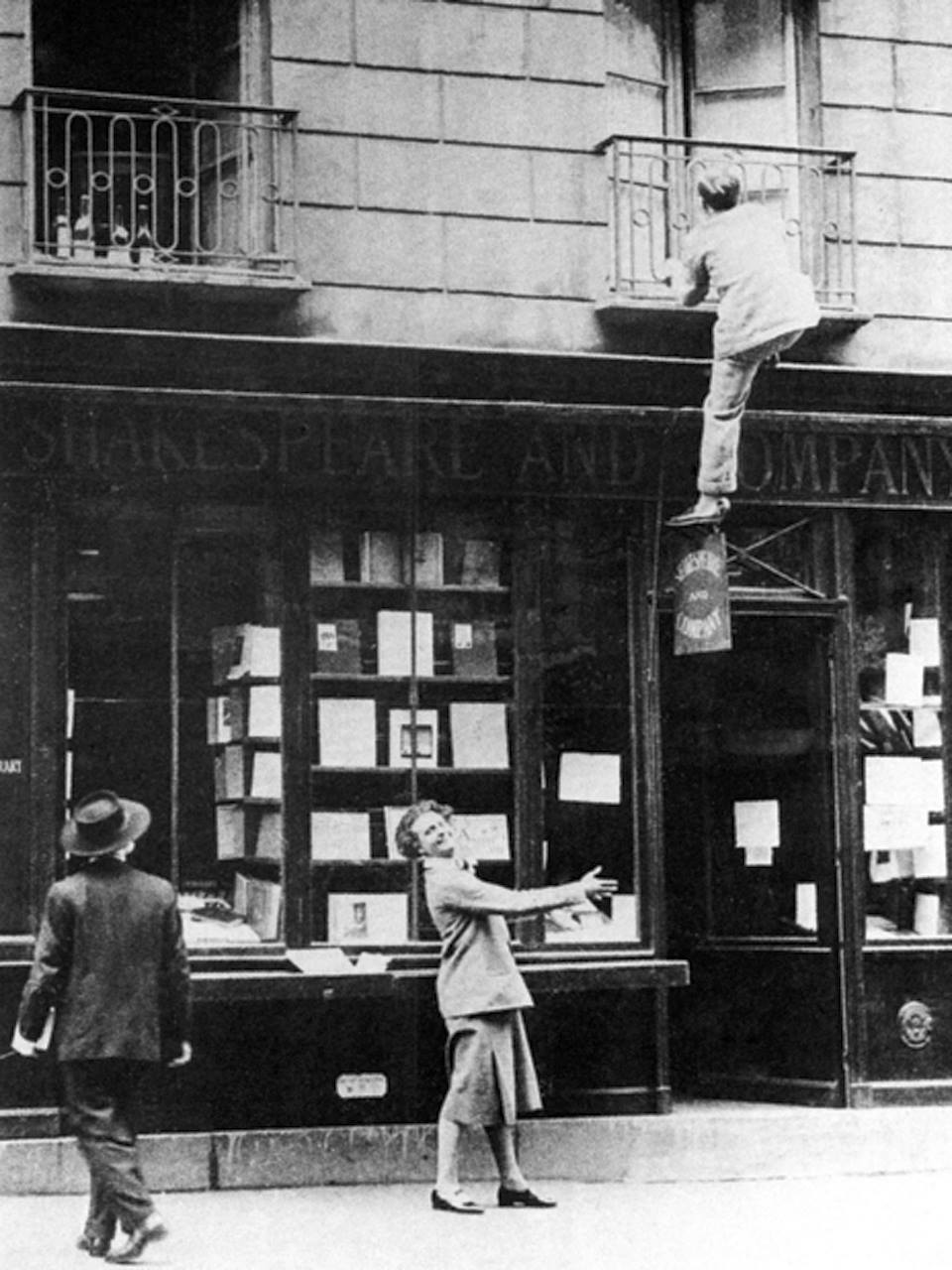
    PHOTO: Sylvia Beach acts as spotter as Antheil ascends to his second-story apartment, located above the legendary Parisian bookshop Shakespeare and Company

  • George Antheil Bad Boy of Music Birthday

    George Antheil Bad Boy of Music Birthday

    George Antheil, classical music’s original Trenton cracker, was born on this date in 1900.

    The self-proclaimed “Bad Boy of Music” (the title of his autobiography) had to travel all the way to Paris to make good. It doesn’t make my transcontinental exile to Eugene, Oregon seem so bad! I hope you’ll join me for “The Lost Chord,” now on KWAX, as we divvy up the nut bread for a musical celebration of Antheil’s birthday.

    Antheil’s “Ballet Mécanique” sparked one of classical music’s great riots when it was unveiled at the Théâtre des Champs-Élysées in 1926.

    The work made preposterous demands on performers and audience alike, with its battery of player pianos, sirens, bells, and airplane propellers – all difficult to coordinate, but worth it, if they were to transform concert halls into free-for-alls and secure Antheil’s status as enfant terrible. His notoriety earned him the respect, friendship, and envy of Paris’ artistic community. From the stage, he watched as Man Ray punched a heckler in the face, as Satie cheered, “Quel precision!,” and as Ezra Pound shouted, “Shut up, you are all stupid idiots.” Pound became one of Antheil’s most ardent champions, taking a break from poetry to publish an inflammatory book, “Antheil and the Treatise on Harmony.”

    Antheil speculated, perhaps facetiously, that his mechanistic nightmares may have been inspired by his having been born across the street from a noisy machine shop. In fact, a number of his works bear the boisterous imprint of the factories he knew in Trenton as a boy, including the “Airplane Sonata,” “The Death of Machines,” and the “Sonata Sauvage.”

    It was all rather forward-looking. Antheil was one of the first composers to search beyond conventional instruments for musical means. He not only presaged the alien soundscapes of Edgard Varèse, but also anticipated the stupefying repetitions of minimalism – though infusing his own compositions with enough violence to prevent them from ever becoming numbing. Stravinsky was his hero. He fed off the savagery of “The Rite of Spring,” then followed the master’s subsequent hairpin turn into neoclassicism. Both artists suffered a backlash from former idolaters who felt betrayed by what was perceived as a cowardly retreat into the past.

    In Antheil’s case, his reputation never recovered. The one-two punch of his Piano Concerto No. 2, transparently influenced by Bach, and the spectacular failure of his “Ballet Mécanique” to impress at its American premiere at Carnegie Hall (mostly due to faulty machinery) cast Antheil, rebel angel that he was, from the lofty heights of notoriety to the slag heap of has-beenery.

    But if it is true that the remainder of his career was indeed that of a has-been, we should all be so lucky.

    The composer of six symphonies, Antheil also wrote books on endocrinology and speculative war tactics, a murder mystery, a nationally syndicated column of advice to the lovelorn, and over 30 Hollywood film scores. With the actress Hedy Lamarr, he patented a torpedo guidance system that became the basis for modern Bluetooth, Wi-Fi, and cellular phone technology.

    I hope you’ll join me for music by this eccentric and multitalented figure, including “Ballet Mécanique,” in all its original, uncompromising glory; then selections from his neo-classical Piano Concerto No. 2, his wartime Symphony No. 4, and dance music from his score to the ballet film noir “Specter of the Rose.”

    The irony is blistering that Trenton’s own classical music station no longer hosts “The Lost Chord,” but you can still enjoy this celebration of Trenton’s (other) bad boy, thanks to the miracle of worldwide streaming. I hope you’ll be able to join me for “Antheil Establishment,” now in syndication on KWAX, the radio station of the University of Oregon!

    For more information, see below.


    Keep in mind, KWAX is on the West Coast, so there’s a three-hour difference for the Trenton-Princeton area. Here are the respective air-times of my recorded shows (with East Coast conversions in parentheses):

    PICTURE PERFECT, the movie music show – Friday on KWAX at 5:00 PACIFIC TIME (8:00 PM EDT)

    THE LOST CHORD, unusual and neglected rep – Saturday on KWAX at 4:00 PACIFIC TIME (7:00 PM EDT)

    Stream them here!

    https://kwax.uoregon.edu/

  • George Antheil Trenton’s Bad Boy of Music

    George Antheil Trenton’s Bad Boy of Music

    This Sunday night on “The Lost Chord,” Trenton’s Bad Boy makes good.

    George Antheil, self-proclaimed “Bad Boy of Music” (the title of his autobiography), sparked one of classical music’s great riots when his “Ballet Mécanique” was unveiled in Paris in 1926.

    The work made preposterous demands on performers and audience alike, with its battery of player pianos, sirens, bells, and airplane propellers – all difficult to coordinate, but worth it, if they were to transform concert halls into free-for-alls and secure Antheil’s status as enfant terrible. His notoriety earned him the respect, friendship, and envy of Paris’ artistic community. From the stage, he watched as Man Ray punched a heckler in the face, as Satie cheered, “Quel precision!,” and as Ezra Pound shouted, “Shut up, you are all stupid idiots.” Pound became one of Antheil’s most ardent champions, taking a break from poetry to publish an inflammatory book, “Antheil and the Treatise on Harmony.”

    Antheil speculated, perhaps facetiously, that his mechanistic nightmares may have been inspired by his having been born across the street from a noisy machine shop. In fact, a number of his works bear the boisterous imprint of the factories he knew in Trenton as a boy, including the “Airplane Sonata,” “The Death of Machines,” and the “Sonata Sauvage.”

    It was all rather forward-looking. Antheil was one of the first composers to search beyond conventional instruments for musical means. He not only presaged the alien soundscapes of Edgard Varèse, but also anticipated the stupefying repetitions of minimalism – though infusing his own compositions with enough violence to prevent them from ever becoming numbing. Stravinsky was his hero. He fed off the savagery of “The Rite of Spring,” then followed the master’s subsequent hairpin turn into neoclassicism. Both artists suffered a backlash from former idolaters who felt betrayed by what was perceived as a cowardly retreat into the past.

    In Antheil’s case, his reputation never recovered. The one-two punch of his Piano Concerto No. 2, transparently influenced by Bach, and the spectacular failure of his “Ballet Mécanique” to impress at its American premiere at Carnegie Hall (mostly due to faulty machinery) cast Antheil, rebel angel that he was, from the lofty heights of notoriety to the slag heap of has-beenery.

    But if it is true that the remainder of his career was indeed that of a has-been, we should all be so lucky.

    The composer of six symphonies, Antheil also wrote books on endocrinology and speculative war tactics, a murder mystery, a nationally syndicated column of advice to the lovelorn, and over 30 Hollywood film scores. With the actress Hedy Lamarr, he patented a torpedo guidance system that became the basis for modern Bluetooth, Wi-Fi, and cellular phone technology.

    I hope you’ll join me for music by this eccentric and multitalented figure, including “Ballet Mécanique,” in all its original, uncompromising glory; then selections from his neo-classical Piano Concerto No. 2, his wartime Symphony No. 4, and dance music from his score to the ballet film noir “Specter of the Rose.”

    Trenton’s “Bad Boy” makes good, on “Antheil Establishment,” this Sunday night at 10:00 EDT, on WWFM – The Classical Network and wwfm.org.

    Happy birthday, George Antheil (born July 8, 1900).


    Sylvia Beach acts as spotter as Antheil ascends to his second-story apartment, located above the legendary Parisian bookshop Shakespeare and Company
  • Ezra Pound’s Opera A Shocking UK Premiere

    Ezra Pound’s Opera A Shocking UK Premiere

    Did you know that Ezra Pound wrote an opera?

    As a blow against Debussy and the pernicious influence of “Pelleas,” Pound contrived to write music of such rhythmic complexity as to leave “Le sacre du printemps” in the shade. Characteristically, the freewheeling poet described his method as “improving a system by refraining from obedience to all its present ‘laws.’” In other words, he was a proud contrarian.

    In 1919, when Pound was 34 years-old, he conceived “Le Testament de Villon,” an operatic setting of François Villon’s poem of 1461. An ardent champion of Trenton’s own George Antheil from the composer’s early days in Paris, Pound enlisted Antheil’s help in developing a system of micro-rhythms the better to express the vitality of Villon’s Old French. The two worked at it in 1923. In 1924, Pound wrote a book titled “Antheil and the Treatise of Harmony,” a piece of hagiography so extravagant that it succeeded even in embarrassing the composer.

    Preview performances in 1924 and 1926 brought criticism from the performers of the utter impracticality of the score. There are no rests or breath marks. There are crushing dissonances. The work’s demands call for scratches, hiccoughs, and the use of human bones in the percussion part.

    Virgil Thomson praised the piece. “The music was not quite musician’s music,” he wrote, “though it may well be the finest poet’s music since Thomas Campion.” Pound’s colleague, the poet William Carlos Williams, described him thus: “…He knows nothing of music, being tone-deaf. That’s what makes him a musician.”

    Excerpts from Pound’s “Le Testament de Villon” will receive a rare performance at the London Contemporary Music Festival on December 15. It is being advertised as the work’s UK premiere in its original version for two tins and a washboard. The first complete performance, in Antheil’s arrangement for small orchestra, was given over BBC radio in 1933.

    Subsequently, Pound began work on two other operas. Neither was ever completed.

    More about the upcoming performance here:

    https://billetto.co.uk/lcmf-2015-15-december

    Anyone remember this out-of-print Philips LP?

Tag Cloud

Aaron Copland (92) Beethoven (95) Composer (114) Film Music (123) Film Score (143) Film Scores (255) Halloween (94) John Williams (187) KWAX (229) Leonard Bernstein (101) Marlboro Music Festival (125) Movie Music (138) Opera (202) Philadelphia Orchestra (89) Picture Perfect (174) Princeton Symphony Orchestra (106) Radio (87) Ralph Vaughan Williams (85) Ross Amico (244) Roy's Tie-Dye Sci-Fi Corner (290) The Classical Network (101) The Lost Chord (268) Vaughan Williams (103) WPRB (396) WWFM (881)

DON’T MISS A BEAT

Receive a weekly digest every Sunday at noon by signing up here


RECENT POSTS