Tag: Film Composers

  • Film Composers Go Classical on WPRB

    Film Composers Go Classical on WPRB

    It takes very little to get me going on a film music jag – especially classic film music. Tomorrow morning on WPRB, the program will be made up entirely of works by composers for the silver screen. However, the emphasis will be on their music for the concert hall. The way I figure, I will introduce each concert piece with an example of a composer’s film music, and then follow it up with a symphony, concerto, string quartet or aria from the same hand.

    I don’t know how many of these we’ll actually be able to get to, but I’ve compiled a box full of music by Elmer Bernstein (composer of “The Magnificent Seven”), Bruce Broughton (“Silverado”), Ernest Gold (“Exodus”), Jerry Goldsmith (“The Omen”), Bernard Herrmann (“Psycho”), Lee Holdridge (“The Beastmaster”), James Horner (“Titanic”), Maurice Jarre (“Lawrence of Arabia”), Laurie Johnson (“Dr. Strangelove”), Erich Wolfgang Korngold (“The Adventures of Robin Hood”), Jerome Moross (“The Big Country”), Ennio Morricone (“The Good, the Bad and the Ugly”), Rachel Portman (“Emma”), Nino Rota (“The Godfather”), Miklós Rózsa (“Ben-Hur”), Lalo Schifrin (“Dirty Harry”), Franz Waxman (“The Bride of Frankenstein”), and John Williams (“Star Wars”).

    This weekend, Daniel Spalding will conduct the New Jersey Capital Philharmonic Orchestra in a blockbuster program of “Cinematic Classics,” featuring works by Rózsa, Herrmann and William Walton, with Odin Rathnam the soloist in Korngold’s Violin Concerto. The concert will take place at the Trenton War Memorial on Saturday at 7:30 p.m. Spalding will be my guest tomorrow morning around 10:00.

    It’ll be buttered popcorn and Sno-Caps for breakfast, tomorrow from 6 to 11 EDT, on WPRB 103.3 FM and at wprb.com. We’ll be shattering all box office records, on Classic Ross Amico.

  • Film Composers Beyond the Screen

    Film Composers Beyond the Screen

    If after about three hours you find yourself getting played out on the Academy Awards– once Ennio Morricone finally wins his first competitive Oscar, that is (fingers crossed) – you might consider tuning in to “The Lost Chord.” We’ll both complement and enjoy counterprogramming to the ceremony by listening to concert works by composers better known for their work in film.

    Franz Waxman was a two-time Academy Award winner, honored with back-to-back Oscars, in 1950 and 1951, for his work on “Sunset Boulevard” and “A Place in the Sun.” Some of his other classic scores include those for “The Bride of Frankenstein,” “Rebecca,” “Rear Window,” “Peyton Place” and “The Nun’s Story.”

    In 1955, he was traveling from California to Zurich to conduct a new piece commissioned by Rolf Liebermann. When Waxman reached New York he was met with a request from Lieberman’s office for program notes for the impending premiere. Waxman was forced to admit he hadn’t yet begun work on the piece, which he had planned to write during the ocean voyage. Fortunately, he was accustomed from his experience in Hollywood to write very quickly. The result was his “Sinfonietta for String Orchestra and Timpani.”

    Five-time Academy Award winner John Williams – whose 50th nominated score, for “Star Wars: The Force Awakens,” is in contention tonight – is of course very well-known for his collaborations with George Lucas and Steven Spielberg. Over the years, he’s also accrued an impressive quantity of concertos. One of the more immediately attractive of these is his Tuba Concerto of 1985, written for the 100th anniversary of the Boston Pops.

    Finally, we’ll turn to three-time Academy Award winner Miklós Rózsa, honored for his work on Alfred Hitchcock’s “Spellbound” in 1945, the Ronald Colman thriller “A Double Life” in 1947, and “Ben-Hur” in 1959. He also composed quite a bit of concert music, including concertos for Jascha Heifetz, Gregor Piatigorsky, Janos Starker, Leonard Pennario and Pinchas Zukerman.

    Rózsa, Hungarian by birth, turned to film after a period of struggle as a young artist in Paris, where he learned from Arthur Honegger that he was able to pay the rent by supplementing his concert music with cinematic efforts. Rózsa’s “Theme, Variations and Finale,” Op. 13, of 1933, preceded the start of his film career by a few years. He revised the piece in 1943, by which time he had already completed his classic fantasy scores for Alexander Korda’s “The Thief of Bagdad” and “Jungle Book,” and was on the verge of becoming a leading composer of film noir.

    “Theme, Variations and Finale” received performances by Charles Munch, Karl Böhm, Georg Solti, and Eugene Ormandy. It was also one of the works that featured on the legendary concert that launched Leonard Bernstein with the New York Philharmonic, on November 14, 1943, when the young assistant conductor substituted at the last minute for an ailing Bruno Walter.

    I hope you’ll join me for an hour of concert music by composers better known for their work in film – “Against Type” on “The Lost Chord” – this Sunday night at 10 ET, with a repeat Wednesday evening at 6; or that you’ll listen to it later as a webcast at wwfm.org.


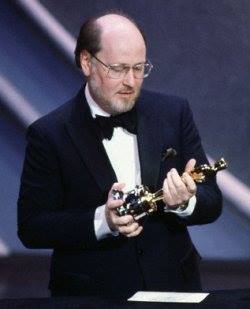
    PHOTOS: Has anyone here seen Kelly? (Clockwise from left) John Williams wins the Oscar for “Star Wars;” Franz Waxman and Miklós Rózsa receive their awards from the hands of Gene Kelly

  • Gloria Cheng Celebrates Film Composers on Piano

    Gloria Cheng Celebrates Film Composers on Piano

    Not what I was planning to post today, but I’m pressed for time. This nifty photo of Gloria Cheng, John Williams, Randy Newman and Don Davis is a promotion for Cheng’s new album, “Montage: Great Film Composers and the Piano.”

    Watch a clip (also featuring Alexandre Desplat) here:

    https://www.youtube.com/watch?v=52WrNa51E-0

    With a write-up at filmmusicsociety.org:

    http://www.filmmusicsociety.org/news_events/features/2015/020915.html

  • Film Composers Times Changing?

    Film Composers Times Changing?

    “Times sure have changed for film composers,” writes Allan Kozinn of the New York Times. I’m not so sure.

    Kozinn is of the opinion that film music is making massive strides in the concert halls. While it’s true that orchestras have embraced the profitability of performing film scores with showings of the actual movies, for the most part you’ll find music written for film relegated to pops concerts. And you’ll likely hear only the main themes. That’s not to say that all film music deserves to stand toe-to-toe with the world’s masterpieces. But judicious selections from the best would be at least as welcome as Berlioz or Liszt.

    Part of the problem is that many of the composers themselves weren’t thinking of posterity. They were just churning the stuff out against deadline and then chasing the next paycheck. But when you think about it, so was Mozart.

    Some of the music is derivative, certainly, but that can be gotten around. There is plenty of finely-crafted music from which to draw by composers with a strong, original voice. Miklós Rózsa, for instance.

    Another part of the problem is that because of the nature of the film business, many of the scores weren’t even preserved. So many modern recordings have taken place only after painstaking reconstruction. If the actual, widespread rehabilitation of classic film music ever catches fire, it could be the biggest business since the period instrument movement.

    Finally, it was comparatively seldom that film composers made usable concert arrangements, so that the music can be enjoyed separate from the images. There are notable exceptions: for instance, Bernard Herrmann’s “Psycho: A Narrative for String Orchestra.” Can you name another piece of orchestral music composed in 1960 that is as widely recognized as that written for the film’s shower scene? Herrmann’s suite contains 15 minutes of alternately driving, moody and chilling music.

    On the other hand, sometimes composers are not the best judge of their own material. I cringe whenever I hear John Williams’ concert arrangement, “Adventures on Earth,” drawn from his score to “E.T.,” which completely subverts the perfection he achieved when writing for the film. The music was so good, director Steven Spielberg told Williams to just go with it when conducting and he’d edit the images to suit the music. That’s a show of respect rarely bestowed on the film composer. Yet rather than allow the music to speak as it did so eloquently in the film’s final 15 minutes, Williams’ concert arrangement jumps all over the place, grabbing a little bit from here and a little bit from there. Even judging from a purely musical standpoint, the end result is a much weaker statement.

    Anyone who has ever listened to Sibelius’ incidental music to “The Tempest” understands the wisdom of taking the best moments and arranging them into concert suites. In the digital age, there are multiple recordings of the complete score for the curious. For the average symphony concert, I don’t propose programming the complete music from “King Kong,” say, any more than I would the complete incidental music to Mendelssohn’s “Oepidus at Colonus” (though I certainly believe there is a niche to be filled by some enterprising orchestra that would devote itself exclusively to just that – playing and preserving classic film scores in their entirety). Often the best bits are already in the concert suites, or even the overtures.

    There is at least one positive development, in terms of respectability. Kozinn reports that London’s Royal College of Music is offering a new scholarship named for the composer John Barry. Barry was the winner of five Academy Awards, including two for “Born Free,” and one each for “The Lion in Winter,” “Out of Africa” and “Dances with Wolves.” The John Barry Scholarship for Film Composition, established by the composer’s widow, Laurie Barry, covers tuition fees for a two year period, as well as a student’s living expenses.

    While this post has devolved into a rant about preservation and acceptance, what we really need in the present are educated film composers. I am so sick of Hans Zimmer.

    But if the music is going to get better, one hopes so will the films, or at least the conditions, so that the composer is able to write something good. Writing music takes time, and time is money. In Hollywood, there has always been a tension between art and commerce. Over the decades, however, the shift has been decidedly in favor of the latter. Can independent films afford the expense of recording with a symphony orchestra? The ball, sadly, appears to remain in Hollywood’s court.

    Here’s Kozinn’s article:

    PHOTO: John Barry accepts his Oscar for “Out of Africa.”
Tag Cloud

Aaron Copland (92) Beethoven (95) Composer (114) Film Music (120) Film Score (143) Film Scores (255) Halloween (94) John Williams (185) KWAX (229) Leonard Bernstein (100) Marlboro Music Festival (125) Movie Music (135) Opera (198) Philadelphia Orchestra (88) Picture Perfect (174) Princeton Symphony Orchestra (106) Radio (87) Ralph Vaughan Williams (85) Ross Amico (244) Roy's Tie-Dye Sci-Fi Corner (290) The Classical Network (101) The Lost Chord (268) Vaughan Williams (103) WPRB (396) WWFM (881)

DON’T MISS A BEAT

Receive a weekly digest every Sunday at noon by signing up here


RECENT POSTS