It is a truth universally acknowledged that a radio host in possession of a weekly film music show must be in want of a good theme. This week on “Picture Perfect,” we eschew the usual fare of Vikings, pirates, and dinosaurs, to enter the world Jane Austen, in anticipation of the 250th anniversary of her birth (on December 16, 1775).
We’ll hear Rachel Portman’s Academy Award winning score for “Emma” (1996), Patrick Doyle’s music for “Sense and Sensibility” (1995), and selections from two versions of “Pride and Prejudice,” with music by Dario Marianelli (2005) and Carl Davis (1995).
Not only do Austen adaptations sport amazing casts, the scores attract some of classical music’s star performers. Listen in for contributions by soprano Jane Eaglen, pianist Jean-Yves Thibaudet, and fortepianist Melvyn Tan.
A large income is the best recipe for happiness I ever heard of – at least according to “Mansfield Park.” The next best thing is a playlist assembled from Jane Austen movies. There’s an urgency for Regency this week on “Picture Perfect,” music for the movies, now in syndication on KWAX Classical Oregon!
——–
Clip and save the start times for all three of my recorded shows:
PICTURE PERFECT, the movie music show – Friday at 8:00 PM EST/5:00 PM PST
SWEETNESS AND LIGHT, the light music program – Saturday at 11:00 AM EST/8:00 AM PST
THE LOST CHORD, unusual and neglected rep – Saturday at 7:00 PM EST/4:00 PM PST
Stream them, wherever you are, at the link!
https://kwax.uoregon.edu/
——–
If you’re an Austenite, feel free to let me know which novel or film adaptation is your favorite!
Tag: Film Music
-

Jane Austen at 250 on “Picture Perfect”
-
See You in the Funny Pages on “Picture Perfect”
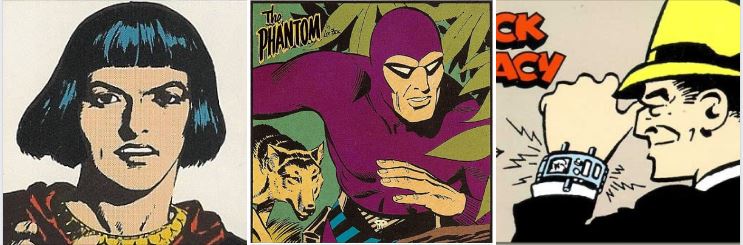
Get out your Silly Putty! There will be plenty of vibrant colors for you to enjoy this week on “Picture Perfect,” when the focus will be on comic adventurers – as in heroes from the funnies.
We’ll have music from movies inspired by the two-dimensional cliffhangers of newspaper favorites Prince Valiant, The Phantom, and Dick Tracy, as well as the longer-form, Golden Age adventures of Tintin.
“Prince Valiant” (1954) brings to life Hal Foster’s enduring Sunday strip about the exploits of a Viking prince at the court of King Arthur. Robert Wagner dons the signature page-boy haircut at the head of a hodge podge cast that also includes Janet Leigh, James Mason, Sterling Hayden, and Victor McLaglen (as Val’s Viking pal Boltar). The film also happens to feature one of Franz Waxman’s most rousing scores, clearly a prototype for the kind of music that later made John Williams a household name.
Then Billy Zane is “The Ghost Who Walks,” in a big screen adaptation of Lee Falk’s “The Phantom” (1996). Like Batman, The Phantom harnesses personal tragedy – in his case, the murder of his father – to a thirst for justice. He also happens to be part of an ancient lineage of Phantoms, who don the purple suit and fight crime from a secluded skull cave in a remote African country. The memorable, though somewhat monothematic, score is by David Newman, one of the sons of legendary Hollywood composer Alfred Newman.
Warren Beatty directs an amusing adaptation of Chester Gould’s “Dick Tracy” (1990), replete with primary color production design and meticulously applied prosthetic makeup, transforming some of the most respected actors of the day (including Al Pacino, Dustin Hoffman, and James Caan) into a live-action Rogue’s Gallery. Both design and makeup were recognized with Academy Awards, as was Stephen Sondheim, for his original song “Sooner or Later (I Always Get My Man),” sung in the film by Madonna. We won’t hear Sondheim’s song, but we will hear some of Danny Elfman’s underscore, which harkens back to Hollywood’s Golden Age.
Finally, we’ll turn from American newspaper strips to the comic albums of Belgian cartoonist Hergé, and his most famous creation, Tintin, an intrepid journalist whose stories seem always to embroil him in globetrotting adventures. Developed for the screen by Steven Spielberg and Peter Jackson, “The Adventures of Tintin” (2011) was shot as 3-D motion capture animation.
After 50 years in the business, during which he wrote music for all manner of films, in virtually every genre, John Williams finally got a crack at scoring an animated feature. The result was a double Academy Award nomination, as Williams had also written the music that year for Spielberg’s “War Horse.” Not bad for a then 79-year-old composer.
Unfortunately, “Tintin” never gained the kind of traction with the public that the filmmakers had hoped for, otherwise the score would certainly be much better known, as it is cut from the same cloth – and is of the same high quality – as those for the “Star Wars,” Indiana Jones, and Harry Potter series.
We’ll see you in the funny pages, this week on “Picture Perfect,” music for the movies, now in syndication on KWAX Classical Oregon!
——–
Clip and save the start times for all three of my recorded shows:
PICTURE PERFECT, the movie music show – Friday at 8:00 PM EST/5:00 PM PST
SWEETNESS AND LIGHT, the light music program – Saturday at 11:00 AM EST/8:00 AM PST
THE LOST CHORD, unusual and neglected rep – Saturday at 7:00 PM EST/4:00 PM PST
Stream them, wherever you are, at the link!
https://kwax.uoregon.edu/ -

Destination Movie Magic? Due North
Where has the magic of the movies gone? Are there any composers or filmmakers working today that would be capable of creating anything as beguiling as the love theme from “Spartacus?”
Its creator, musical mage Alex North, was born in Chester, Pennsylvania (just outside of Philadelphia), on this date in 1910. His journey took him from a working-class background, to the Curtis Institute of Music, the Juilliard School, and the Moscow Conservatory. He also studied with Aaron Copland and Ernst Toch.
He became involved with the Federal Theatre Project. He worked in ballet, especially with Martha Graham and Anna Sokolow. He accompanied the latter to Mexico, where he had an opportunity to study with Silvestre Revueltas. Perhaps not coincidentally, his three North American teachers, Copland, Toch, and Revueltas, had all worked in film.
North wrote his first film score as far back as the 1930s, around the time he met up with director Elia Kazan. North was drafted during the war, and put his talent to use writing music for the Office of War Information documentaries.
With the cessation of hostilities, he returned to the theater. He also composed some concert pieces. It was his incidental music for plays such as “A Streetcar Named Desire” that earned him an invitation to Hollywood, where he wrote the score for Kazan’s classic film adaptation. It would be the first time jazz would be fully integrated into the drama, forming the basis for the film’s underscore, as opposed to being simply diegetic, or “source music,” played by a band or on a turntable in the background of a given scene. Its success opened the door to a new film score sensibility, paving the way for composers like Elmer Bernstein, Henry Mancini, and North’s beloved Duke Ellington.
In all, North wrote 50 film scores, racking up 15 Academy Award nominations, yet never taking home the prize. In 1986, he received lifetime achievement recognition from the Academy, the first composer to be so honored.
There were times, during the course of his career, when his music took on an independent life, distinct from the films for which it was written. He scored major hits with “Unchained Melody” (originally written for the film “Unchained” and recorded some 500 times) and the love theme from “Spartacus.” The original soundtrack to “A Streetcar Named Desire” also sold extremely well.
His acclaimed contribution to “Spartacus” didn’t keep the film’s director, Stanley Kubrick, from rejecting North’s score for “2001: A Space Odyssey” – without bothering to tell him. North found out only after the lights went down at the film’s premiere. Director John Huston was more appreciative. Later in his career, North became Huston’s composer of choice, for films like “The Misfits,” “Under the Volcano,” “Prizzi’s Honor,” and “The Dead.”
It’s especially poignant, in 2025, to view North’s acceptance speech for his honorary Oscar. (You’ll find a link to the clip below.) At around the 4:50 mark, he says: “I would like to make a humble plea to all of us involved in the movies, and that is to encourage and convey hope, humor, compassion, and adventure, and love… as opposed to despair, synthetic theatrics, and blatant, bloody violence. And sex, sex, sex, by all means, indeed… but with a bit of mystery, a touch of charm and elegance, and lots of imagination.”
Amen to that. It’s a shame that it’s a plea that’s been almost wholly ignored. We would be in a better place today, psychologically, as morale colors everything, were we not buffeted by an aggressively crass and downbeat popular culture. Had filmmakers only heeded his advice.
Happy birthday, Alex North.
———
The Righteous Brothers sing “Unchained Melody”In the movie “Ghost”
Love theme from “Spartacus”
Cover by Yusef Lateef
“A Streetcar Named Desire”
Rejected score for “2001: A Space Odyssey”
Honorary Academy Award, presented by Quincy Jones, with an intro by Robin Williams
John Williams talks North, reedited to include extended musical examples
-
Once Upon a Time and Happily Ever After on “Picture Perfect”
This week on “Picture Perfect,” we’ll play on the inherent nostalgia of the holidays by recalling the magic of childhood, by way of our collective and personal interactions with the world of fairy tales.
George Pal’s “The Wonderful World of the Brothers Grimm” (1962) was filmed in Cinerama and features the producer-director’s trademark stop motion effects. Among the all-star cast are Laurence Harvey, Claire Bloom, Barbara Eden, Russ Tamblyn, and Buddy Hackett. The narrative incorporates a number of familiar Grimm tales, while relating the brothers’ “real-life” struggles.
The music is by Leigh Harline. Harline was an integral part of the Disney team that scored an earlier fairy tale adaptation, “Snow White and the Seven Dwarfs.” He would win two Academy Awards for his work on “Pinocchio,” including one for Best Original Song, for “When You Wish Upon a Star.”
“The Company of Wolves” (1984), one of Neil Jordan’s earlier films, explores the psychological underpinnings of the tale of “Little Red Riding Hood,” here presented as an allegory of adolescence and the loss of innocence. Angela Carter co-wrote the screenplay, based on a selection of her original short stories. The film features Angela Lansbury, any number of werewolves, and Terence Stamp as the Devil. The music is by George Fenton.
With the advent of computer animation, a snarkier, post-modern take on the fairy tale predominates, most notably with the “Shrek” series, beginning in 2001. The “Shrek” films were so successful, they led to a spin-off, centered on the character of “Puss in Boots” (2011).
Voiced by Antonio Banderas, Puss provides ample opportunity to vamp on the actor’s swashbuckler image, especially as portrayed in “The Mask of Zorro.” Likewise, the composer, Henry Jackman, chooses to rib James Horners’ “Zorro” score.
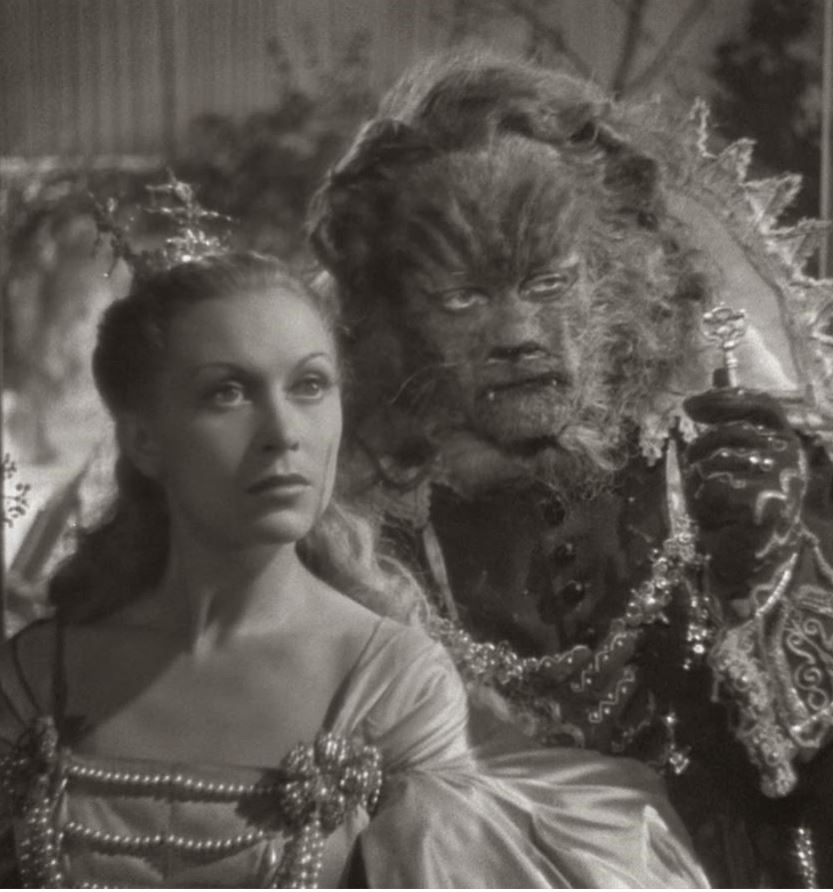
Finally, we’ll hear selections from perhaps the finest fairy tale ever committed to film, Jean Cocteau’s “La Belle et la Bête” – “Beauty and the Beast” (1946). Moody, atmospheric, dreamy, clever, hypnotic, funny, and romantic, and sporting production design that looks like something Gustav Doré might have dreamed up in a haze of Dutch Masters cigars, Cocteau’s masterpiece stars Jean Marais and Josette Day.
The alternately mysterious and majestic score is by Georges Auric. Cocteau, you’ll recall, was the one-man publicity machine that propelled Auric and his composer-colleagues, Francis Poulenc, Darius Milhaud, Arthur Honegger, Germaine Tailleferre, and Louis Durey, to fame in Paris, circa 1920, dubbing them “Les Six.”
I hope you’ll join me for an hour of once-upon-a-time and happily-ever-after, on “Picture Perfect,” music for the movies, now in syndication on KWAX, the radio station of the University of Oregon!
——–
Clip and save the start times for all three of my recorded shows:
PICTURE PERFECT, the movie music show – Friday at 8:00 PM EST/5:00 PM PST
SWEETNESS AND LIGHT, the light music program – Saturday at 11:00 AM EST/8:00 AM PST
THE LOST CHORD, unusual and neglected rep – Saturday at 7:00 PM EST/4:00 PM PST
Stream them, wherever you are, at the link!
https://kwax.uoregon.edu/ -
A Cinematic Birthday Cake for Aaron Copland
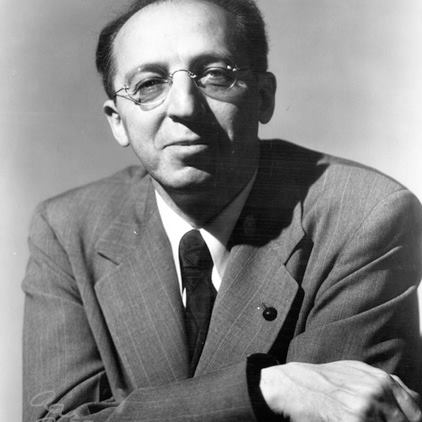
If you want to work in Hollywood, you’ve got to expect once in a while somebody’s going to mess with your things – even if you’re a Pulitzer Prize winner, lauded as the “Dean of American composers.”
Aaron Copland was not very happy when his music for “The Heiress” was chopped to ribbons, dialed down and rescored without his approval.
This week on “Picture Perfect,” on Copland’s birthday anniversary, we’ll hear a suite from “The Heiress,” with the main title music restored by Arnold Freed in 1990 to what the composer originally intended.
William Wyler (“Wuthering Heights,” “Friendly Persuasion,” “The Big Country,” “Ben-Hur”) was a brilliant director, but he had a tin ear. His films consistently sported the best scores of their era, and yet he mostly underappreciated, if not outright disliked them.
“The Heiress” was made fresh off Wyler’s runaway success with “The Best Years of Our Lives.” The film, based on Henry James’ “Washington Square,” was nominated for eight Academy Awards, winning four, including Oscars for Olivia De Havilland and for Copland’s score, which is so strong it manages to maintain its integrity despite all of the studio tinkering.
Wyler insisted Copland work the song “Plaisir d’amour” into the fabric of his music, which he artfully did in three cues. But that wasn’t good enough. Without his knowledge, the main title was replaced with a garish arrangement of “Plaisir,” which was also looped in for some of the love music. André Previn, in 1949 already one of Hollywood’s bright young talents, likened the return of Copland’s original thoughts following the interpolations to “suddenly finding a diamond in a can of Heinz beans.”
When Copland’s contribution was recognized by the Academy, it was the only instance up to that time of a score being honored after being shorn of its main title, the part of a score that generally makes the biggest impression. Copland never bothered to collect his award. “The Heiress” would be the last time he would work in Hollywood.
He did compose one more film score, however, for the 1961 independent film, “Something Wild,” which contains some of his most insistently non-commercial music. Occasionally brutal and often thrilling, its character is worlds away from the pastoral tranquility of “Appalachian Spring.” It’s a brilliant piece of work, yet it did not receive a commercial release until 2003.
Copland’s music for “Our Town” and “The Red Pony” is fairly well-known, thanks to the widely performed and recorded concert suites. We’ll focus on lesser-heard music from “The Heiress” and “Something Wild,” as well as from the controversial pro-Soviet film “The North Star,” and even a little bit from the 1939 World’s Fair documentary “The City.”
It’s a cinematic birthday cake for Aaron Copland, on “Picture Perfect,” music for the movies, now in syndication on KWAX, the radio station of the University of Oregon!
——–
Clip and save the start times for all three of my recorded shows:
PICTURE PERFECT, the movie music show – Friday at 8:00 PM EST/5:00 PM PST
SWEETNESS AND LIGHT, the light music program – Saturday at 11:00 AM EST/8:00 AM PST
THE LOST CHORD, unusual and neglected rep – Saturday at 7:00 PM EST/4:00 PM PST
Stream them, wherever you are, at the link!
https://kwax.uoregon.edu/
Tag Cloud
Aaron Copland (94) Beethoven (95) Composer (114) Film Music (149) Film Score (143) Film Scores (255) Halloween (97) John Williams (197) KWAX (232) Leonard Bernstein (105) Marlboro Music Festival (125) Movie Music (164) Mozart (91) Opera (215) Philadelphia Orchestra (90) Picture Perfect (174) Princeton Symphony Orchestra (110) Radio (90) Ross Amico (244) Roy's Tie-Dye Sci-Fi Corner (290) The Classical Network (101) The Lost Chord (269) Vaughan Williams (107) WPRB (397) WWFM (881)