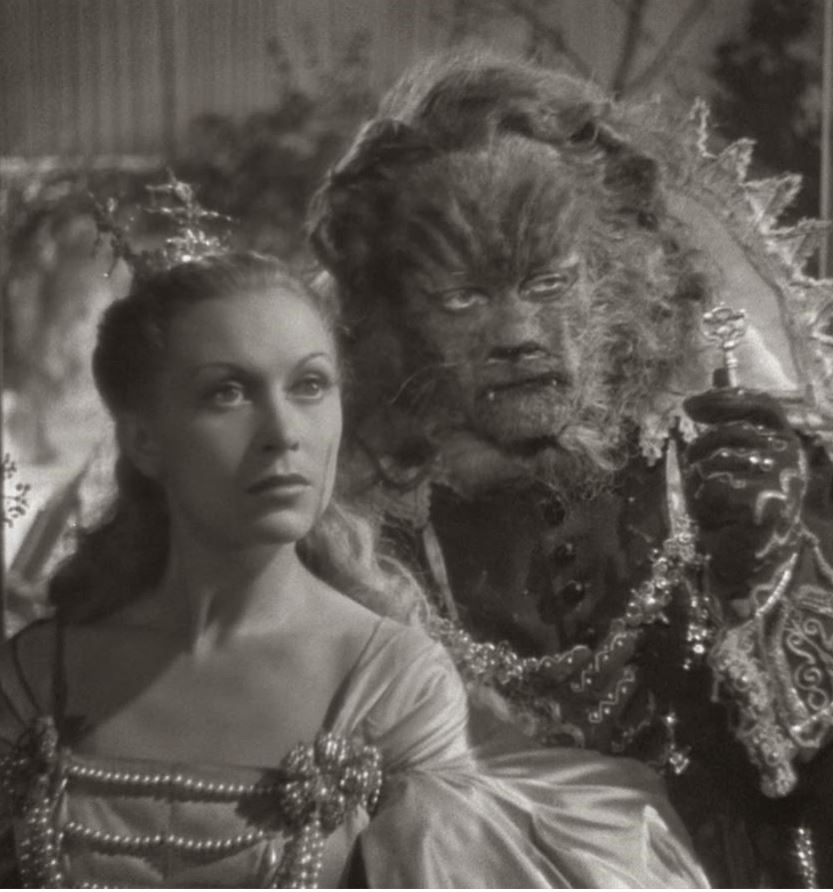
This week on “Picture Perfect,” we’ll play on the inherent nostalgia of the holidays by recalling the magic of childhood, by way of our collective and personal interactions with the world of fairy tales.
George Pal’s “The Wonderful World of the Brothers Grimm” (1962) was filmed in Cinerama and features the producer-director’s trademark stop motion effects. Among the all-star cast are Laurence Harvey, Claire Bloom, Barbara Eden, Russ Tamblyn, and Buddy Hackett. The narrative incorporates a number of familiar Grimm tales, while relating the brothers’ “real-life” struggles.
The music is by Leigh Harline. Harline was an integral part of the Disney team that scored an earlier fairy tale adaptation, “Snow White and the Seven Dwarfs.” He would win two Academy Awards for his work on “Pinocchio,” including one for Best Original Song, for “When You Wish Upon a Star.”
“The Company of Wolves” (1984), one of Neil Jordan’s earlier films, explores the psychological underpinnings of the tale of “Little Red Riding Hood,” here presented as an allegory of adolescence and the loss of innocence. Angela Carter co-wrote the screenplay, based on a selection of her original short stories. The film features Angela Lansbury, any number of werewolves, and Terence Stamp as the Devil. The music is by George Fenton.
With the advent of computer animation, a snarkier, post-modern take on the fairy tale predominates, most notably with the “Shrek” series, beginning in 2001. The “Shrek” films were so successful, they led to a spin-off, centered on the character of “Puss in Boots” (2011).
Voiced by Antonio Banderas, Puss provides ample opportunity to vamp on the actor’s swashbuckler image, especially as portrayed in “The Mask of Zorro.” Likewise, the composer, Henry Jackman, chooses to rib James Horners’ “Zorro” score.
Finally, we’ll hear selections from perhaps the finest fairy tale ever committed to film, Jean Cocteau’s “La Belle et la Bête” – “Beauty and the Beast” (1946). Moody, atmospheric, dreamy, clever, hypnotic, funny, and romantic, and sporting production design that looks like something Gustav Doré might have dreamed up in a haze of Dutch Masters cigars, Cocteau’s masterpiece stars Jean Marais and Josette Day.
The alternately mysterious and majestic score is by Georges Auric. Cocteau, you’ll recall, was the one-man publicity machine that propelled Auric and his composer-colleagues, Francis Poulenc, Darius Milhaud, Arthur Honegger, Germaine Tailleferre, and Louis Durey, to fame in Paris, circa 1920, dubbing them “Les Six.”
I hope you’ll join me for an hour of once-upon-a-time and happily-ever-after, on “Picture Perfect,” music for the movies, now in syndication on KWAX, the radio station of the University of Oregon!
——–
Clip and save the start times for all three of my recorded shows:
PICTURE PERFECT, the movie music show – Friday at 8:00 PM EST/5:00 PM PST
SWEETNESS AND LIGHT, the light music program – Saturday at 11:00 AM EST/8:00 AM PST
THE LOST CHORD, unusual and neglected rep – Saturday at 7:00 PM EST/4:00 PM PST
Stream them, wherever you are, at the link!
https://kwax.uoregon.edu/
Tag: Film Music
-
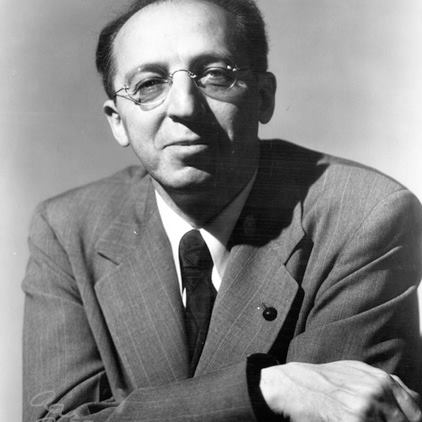
A Cinematic Birthday Cake for Aaron Copland
If you want to work in Hollywood, you’ve got to expect once in a while somebody’s going to mess with your things – even if you’re a Pulitzer Prize winner, lauded as the “Dean of American composers.”
Aaron Copland was not very happy when his music for “The Heiress” was chopped to ribbons, dialed down and rescored without his approval.
This week on “Picture Perfect,” on Copland’s birthday anniversary, we’ll hear a suite from “The Heiress,” with the main title music restored by Arnold Freed in 1990 to what the composer originally intended.
William Wyler (“Wuthering Heights,” “Friendly Persuasion,” “The Big Country,” “Ben-Hur”) was a brilliant director, but he had a tin ear. His films consistently sported the best scores of their era, and yet he mostly underappreciated, if not outright disliked them.
“The Heiress” was made fresh off Wyler’s runaway success with “The Best Years of Our Lives.” The film, based on Henry James’ “Washington Square,” was nominated for eight Academy Awards, winning four, including Oscars for Olivia De Havilland and for Copland’s score, which is so strong it manages to maintain its integrity despite all of the studio tinkering.
Wyler insisted Copland work the song “Plaisir d’amour” into the fabric of his music, which he artfully did in three cues. But that wasn’t good enough. Without his knowledge, the main title was replaced with a garish arrangement of “Plaisir,” which was also looped in for some of the love music. André Previn, in 1949 already one of Hollywood’s bright young talents, likened the return of Copland’s original thoughts following the interpolations to “suddenly finding a diamond in a can of Heinz beans.”
When Copland’s contribution was recognized by the Academy, it was the only instance up to that time of a score being honored after being shorn of its main title, the part of a score that generally makes the biggest impression. Copland never bothered to collect his award. “The Heiress” would be the last time he would work in Hollywood.
He did compose one more film score, however, for the 1961 independent film, “Something Wild,” which contains some of his most insistently non-commercial music. Occasionally brutal and often thrilling, its character is worlds away from the pastoral tranquility of “Appalachian Spring.” It’s a brilliant piece of work, yet it did not receive a commercial release until 2003.
Copland’s music for “Our Town” and “The Red Pony” is fairly well-known, thanks to the widely performed and recorded concert suites. We’ll focus on lesser-heard music from “The Heiress” and “Something Wild,” as well as from the controversial pro-Soviet film “The North Star,” and even a little bit from the 1939 World’s Fair documentary “The City.”
It’s a cinematic birthday cake for Aaron Copland, on “Picture Perfect,” music for the movies, now in syndication on KWAX, the radio station of the University of Oregon!
——–
Clip and save the start times for all three of my recorded shows:
PICTURE PERFECT, the movie music show – Friday at 8:00 PM EST/5:00 PM PST
SWEETNESS AND LIGHT, the light music program – Saturday at 11:00 AM EST/8:00 AM PST
THE LOST CHORD, unusual and neglected rep – Saturday at 7:00 PM EST/4:00 PM PST
Stream them, wherever you are, at the link!
https://kwax.uoregon.edu/ -

Howard Hanson Romantic Symphony & Film
I don’t know if I ever shared this before – from the Classic Ross Amico Cabinet of Curiosities, an inscribed photo of Howard Hanson.
For 40 years, Hanson was director of the Eastman School of Music, in which capacity he nurtured and championed innumerable American composers, giving literally thousands of premieres at the helm of the Eastman-Rochester Orchestra (an ensemble he founded). The lucky ones found their way onto records, issued on the Mercury label.
Hanson, of course, was himself a composer. He was awarded the Pulitzer Prize for Music in 1944, for his Symphony No. 4 “Requiem,” written in memory of his father. But his best-known music, unquestionably, is his Symphony No. 2 “Romantic,” composed in 1930.
A cassette tape of the piece must have been circulating in Hollywood, beginning in the late 1970s. It started turning up in the movies, either directly, as in the end credits to “Alien” (1979), or as thinly-veiled homage, as in the bicycle chase and finale of “E.T. The Extra-Terrestrial” (1982). More recently, Hans Zimmer cribbed it for “The Boss Baby” (2017).
I can understand the allure. The quintessential “Hanson sound” is one of heart-on-the-sleeve romanticism, characterized by glowingly nostalgic melodies. But the composer also had his severe side. As the offspring of Swedish immigrants in Wahoo, Nebraska, he was also inclined to a certain Nordic austerity, especially in his later works.
I never met Dr. Hanson myself, but he has all my respect and gratitude. Happy birthday, Howard Hanson!
Romantic Hanson, incongruously, in “Alien”
Hans Zimmer cribs for “The Boss Baby”
John Williams’ most glorious music, for the last 15 minutes of “E.T.,” would not have been the same without his influence
As it’s heard in the original
Romantic Symphony (complete)
Piano Concerto
“Elegy in Memory of Serge Koussevitzky”
Koussevitzky conducts Hanson’s Symphony No. 3 (in commemoration of the 300th anniversary of the first Swedish settlement in Delaware)
“Pastorale” for Oboe, Harp and Strings
-

Yo-Yo Ma at 70 Celebrating His Film Music
It’s very hard to believe, but the eternally youthful Yo-Yo Ma turned 70 on Tuesday. This week on “Picture Perfect,” we honor one of the most famous classical musicians in the world with music from three of his film projects.
Ma played cello solos in two scores by John Williams – those for “Seven Years in Tibet” (1997) and “Memoirs of a Geisha” (2005). Of course, Williams being Williams, both scores were nominated for Academy Awards.
But it was Ma’s contribution to Tan Dun’s “Crouching Tiger, Hidden Dragon” (2000) that struck Oscar gold. Dun’s music contributed to what might be termed “The Year of the Dragon,” as Ang Lee’s film received 10 Academy Award nominations, including one for Best Picture. “Crouching Tiger” would slink away with awards for Best Foreign Language Film, Best Art Direction, Best Cinematography, and of course Best Original Score.
In addition, Ma recorded a very popular album in 2004 of arrangements for cello and orchestra of film music by Ennio Morricone, with the composer conducting. We’ll round out the hour with one of these, from Morricone’s beloved score to “The Mission” (1986).
I hope you’ll join me, as we salute Yo-Yo Ma at 70, on “Picture Perfect,” music for the movies, now in syndication on KWAX, the radio station of the University of Oregon!
Clip and save the start times for all three of my recorded shows:
PICTURE PERFECT, the movie music show – Friday at 8:00 PM EDT/5:00 PM PDT
SWEETNESS AND LIGHT, the light music program – Saturday at 11:00 AM EDT/8:00 AM PDT
THE LOST CHORD, unusual and neglected rep – Saturday at 7:00 PM EDT/4:00 PM PDT
Stream them, wherever you are, at the link!
BONUS: Ma and Williams on “The Tonight Show,” playing a selection from “Memoirs of a Geisha”
-

Hitchcock’s Other Composers Beyond Herrmann
Alfred Hitchcock’s most celebrated musical collaborator was Bernard Herrmann. Herrmann scored just about every one of Hitch’s films over the span of a decade, enhancing the impact and memorability of such classics as “Vertigo,” “North by Northwest,” and “Psycho.” But Hitchcock also worked with a number of other notable composers.
This week on “Picture Perfect,” we’ll cast some light into Herrmann’s shadow with selections from “Rebecca” (Franz Waxman), “Strangers on a Train” (Dimitri Tiomkin), “Spellbound” (Miklós Rózsa), and “Family Plot” (John Williams).
Herrmann goes on hiatus, and the suspense is killing us, on “Picture Perfect,” music for the movies, now in syndication on KWAX, the radio station of the University of Oregon!
Clip and save the start times for all three of my recorded shows:
PICTURE PERFECT, the movie music show – Friday at 8:00 PM EDT/5:00 PM PDT
SWEETNESS AND LIGHT, the light music program – Saturday at 11:00 AM EDT/8:00 AM PDT
THE LOST CHORD, unusual and neglected rep – Saturday at 7:00 PM EDT/4:00 PM PDT
Stream them, wherever you are, at the link!
Tag Cloud
Aaron Copland (92) Beethoven (94) Composer (114) Film Music (116) Film Score (143) Film Scores (255) Halloween (94) John Williams (185) KWAX (228) Leonard Bernstein (99) Marlboro Music Festival (125) Movie Music (131) Opera (197) Philadelphia Orchestra (86) Picture Perfect (174) Princeton Symphony Orchestra (106) Radio (86) Ralph Vaughan Williams (85) Ross Amico (244) Roy's Tie-Dye Sci-Fi Corner (290) The Classical Network (101) The Lost Chord (268) Vaughan Williams (99) WPRB (396) WWFM (881)