Tag: Fisher Center

  • Bard’s Berlioz & His World: A Deep Dive

    Bard’s Berlioz & His World: A Deep Dive

    When the Bard Music Festival calls itself “[insert composer’s name here] and His World,” it does so with the aim of providing a diverse, expansive, and at times even exhausting exploration of the subject’s contemporaries, his influences, those he influenced, and his wider legacy. And by suggesting that it can wear you out, I am in no way implying that I don’t love it. If Bard can bring it, I can take it, and with gratitude.

    As you undoubtedly know by now, if you’ve been following my posts, this year’s focus is Berlioz. However, even with such a heavy helping of Hector as on the concert presented on Saturday night, featuring not only the composer’s titanic “Te Deum,” but also selections from his grand opera “Les Troyens” (“The Trojans”) and a mammoth setting of “La Marseillaise” that REALLY would have flabbergasted Major Strasser, there was also the inclusion of Gluck’s overture to “Iphigénie en Aulide” (Gluck, a composer who influenced Berlioz), in an arrangement by Wagner (a composer Berlioz in turn influenced) – ingenious programming, actually, but hardly surprising – AND the overture to Auber’s “Fra Diavolo” (Auber, a figure who undoubtedly influenced Berlioz, but about whom Berlioz could be rather ambivalent, feeling he pandered a little too much to what he perceived as shallow Parisian tastes).

    And you know what? For as popular as Auber’s overtures remain – for decades, staples of afternoon drive time on any classical music radio station – this may actually have been the first time I ever actually heard one in concert. How can that possibly be? Any one of them would make for a sparkling opener to an enjoyable evening of music-making. (Sorry, Berlioz!) As it is, he is yet another composer whose music I encountered live for the first time at Bard.

    So often with Berlioz, who at the far end of his large-scale works can be such a frankly draining composer, I am convinced he willed himself to greatness. What a genius he must have been to take the rudimentary tools he had at his disposal and create such monuments in sound. Unquestionably, he knew his way around an orchestra. And he was well-drilled by his teachers at the Paris Conservatory. Yet he was perhaps not so naturally inclined to the minute workings-out of formal musical procedures in the manner of a Haydn or a Mozart. If so, he was all the better for it, as there is only one Hector Berlioz. No one thought in orchestral terms quite like him. But at the other end of the scale, he was also a born composer of song.

    Earlier in the day, a Saturday morning panel discussion examined different aspects of the composer and his world through engaging and often fascinating talks and exchanges about revolution, the historical evolution of Paris in the 19th century, and even how Berlioz was received and interpreted by the droll caricaturists of his time.

    As is so often the case with Bard, the most shattering moments may have come during in the evening concerts, when the full forces of symphony orchestra and chorus were massed at the Fisher Center for the Performing Arts; but most of the quieter, more revelatory moments occurred in the more intimate space of Bard’s Olin Hall, at which song and chamber music prevailed.

    At the Fisher Center, Joshua Blue’s pleasing tenor voice lent considerably to the opening night rehabilitation of Berlioz’s “Lélio” (at least in terms of the work’s musical content). He returned on Saturday night not only as soloist in the “Te Deum,” but to share a love duet from “Les Troyens” with mezzo-soprano Megan Moore. He might have been the weekend’s greatest vocal discovery, if not for soprano Jana McIntyre. (Even so, those attending Bard this Sunday will have no complaints, as Blue will sing Berlioz’s Faust!)

    McIntyre, with her captivating voice, magnetic presence, and superhuman endurance, appeared frequently throughout the weekend and emerged as the most enchanting performer at Olin. Always radiant and communicative, she was in her element in French art song during her frequent afternoon appearances on the chamber concerts. But on Saturday night, she also demonstrated her ability to command a concert hall, even in Berlioz’s gargantuan arrangement of “La Marseillaise,” with its massed brass, winds, percussion, and chorus. She stood her ground – “the very embodiment of liberty,” as a fellow concertgoer memorably put it – dominating center stage in a brilliant red gown with her chin held high. Yes, coupled with the “Te Deum” AND selections from “Les Troyens,” AND the aforementioned overtures, by Gluck (arr. Wagner) and Auber, it proved to be a high-caloric evening!

    I can’t believe she had any voice at all left over for Sunday morning, yet there she was at 11 a.m., participating extensively in Byron Adams’ matinée musicale, where she continued to shine and, quite frankly, glow. What a talent! She easily stood out as the star of the festival’s first weekend, and she receives a respectful tip of the hat from Classic Ross Amico.

    As for the music itself, discoveries I will carry with me include the “Introduction and Variations on Bellini’s Opera ‘Norma’” by Elias Parish Alvars (known in his day as “the Liszt of the harp”), mesmerizingly played by Noël Wan, a String Quartet in C minor by Anton Reicha (who taught Berlioz counterpoint at the Paris Conservatory, previously known to me mostly from his woodwind music), affectionately performed by the Balourdet Quartet, and a languid, intoxicating song, “Adieux de l’hôtesse arabe,” by Georges Bizet (of “Carmen” fame), again sung by McIntyre, as part of Byron Adams’ exquisitely-curated program of French chansons, romances et mélodies on Sunday.

    Baritone Tyler Duncan, a Bard veteran, as always was a singer of commanding presence, but also expert at conveying the wry tone of a song like Saint-Saëns’ witty throwback to the manners of the ancien regime, “Marquise, vous souvenez-vous?” Also returning was mezzo-soprano Rebecca Ringle Kamarei. For as fine as she was in the afternoons, she was outstanding on Sunday evening in a virtuosic performance of an aria by Rossini from “L’italiana in Algeri.”

    I would be remiss not to credit the contributions of pianists Kayo Iwama and Erika Switzer, both with their own distinctive musical personalities, who not only accompanied but were sensitive collaborators with the aforementioned singers.

    I want to treat Sunday night’s treasurable presentation of Pauline Viardot’s fairy tale opera “Le dernier sorcier” (“The Last Sorcerer”), which concluded the opening weekend, in a separate post. So watch for it!

    The Bard Music Festival resumes today with a supplementary, already sold-out concert at Church of the Messiah in Rhinebeck, NY (with a second concert to be held there tomorrow afternoon), but Weekend Two really commences in earnest with a concert tomorrow night at the Fisher Center on Bard campus, featuring violist Luosha Fang and pianist Piers Lane in Franz Liszt’s transcription of Berlioz’s “Harold in Italy.” The program on Saturday night will include Louise Farrenc’s Symphony No. 3 and Joachim Raff’s Symphony No. 10 “Autumn.” Sunday will conclude with a complete performance of Berlioz’s “The Damnation of Faust.”

    “Berlioz and His World” continues, largely at Bard College in Annandale-on-Hudson, NY, through Sunday, August 18. For more information, visit https://fishercenter.bard.edu/whats-on/programs/bard-music-festival/

    Fisher Center at Bard

    Jana McIntyre sings Aminta in Richard Strauss’ rarely-heard “Die schweigsame Frau” (“The Silent Woman”) at Bard in 2022, at the link:


  • Bard Music Festival Encounters Fisher Center at Bard

    Bard Music Festival Encounters Fisher Center at Bard

    One of the great pleasures of attending the Bard Music Festival is not only the obvious enjoyment that comes from listening to and learning about the subject at hand (this year, Hector Berlioz), but also the sense of conviviality experienced in the company of likeminded music lovers from all walks of life.

    Here I am with my newest friend from Bard. No, not Berlioz. That’s Bill Osborne on the left. Bill is a retired organist who studied at Fontainebleau with the venerable pedagogue Nadia Boulanger. For over 40 years, he served as Distinguished Professor of Fine Arts at Denison University.

    In that capacity, he also directed the Denison Singers, which brought him to Princeton a couple of times to perform at Westminster Choir College and Princeton University Chapel. He adds impishly that some of their belongings were stolen at Princeton High School. But Bill, a true gentleman and a lovely raconteur, shares all his stories with a laugh and a twinkle in his eye.

    As a student in France, he also encountered legendary organist-composers Marcel Dupré and Olivier Messiaen. During one memorable lesson, he was caught on the bench between Boulanger and André Marchal, the celebrated blind organist of St. Germain des Pres, with their at times conflicting philosophies, trying his best to diplomatically serve two masters.

    Boulanger was notorious for her strict instruction and strong opinions. Bill observed that she was a stickler for punctuality in her students, yet she herself was always late for lessons. Once, he too was running behind, and he ran into her in the courtyard. Mademoiselle, as she was affectionately known, demanded to know why he wasn’t already at their lesson.

    Back in the United States, during the course of some research he was conducting in New York, he was put up in a penthouse at the Dakota. I probably don’t have to tell you about the Dakota. It’s one of the top-tier apartment buildings on Central Park West. Anyway, he got a big kick out of that. The building is so crammed with celebrities that whenever he peered over a balcony a paparazzo would snap his photo from the street, assuming he must be somebody famous.

    Once, he walked out of the building just as a limousine pulled up. Who should spring out of the back seat but Leonard Bernstein. In his classic effusive manner, Lenny walked up to Bill, who was agog, and enfolded him in a warm embrace. Lenny said, “So good to see you again,” assuming that, if he lived at the Dakota, he must have known him; but of course, Bill had never seen him before in his life.

    Bill was also responsible for introducing the organ works of Petr Eben to the United States, after receiving the scores from the hand of the composer during a tour of Czechoslovakia. He went on to record an album of Eben’s works for Crystal Records.

    What an interesting, affable fellow! I enjoyed chatting with him over several days. You never know who you’re going to meet at Bard.

    This year’s Bard Music Festival, “Berlioz and His World,” continues through August 18. For more information, follow the link.

    https://fishercenter.bard.edu/whats-on/programs/bard-music-festival/

    Fisher Center at Bard

  • Bard Music Festival Berlioz Weekend One

    Bard Music Festival Berlioz Weekend One

    I’ve got a good start on typing up my impressions of the first weekend’s concerts at the Bard Music Festival. “Berlioz and His World” is now in progress at Bard College in Annandale-on-Hudson, NY.

    Writing about opening night even now, but so as not to rush the process, I offer as a stopgap a few glimpses of this year’s merch-for-purch: the Berlioz t-shirt, the tie-in volume of scholarly essays, and so many Berlioz CDs, along with recordings of music by other figures of his circle.

    After a few days’ respite, two supplementary concerts will be held on Thursday and Friday afternoon at Church of the Messiah in nearby Rhinebeck. I can tell you from experience, those concerts fill up fast, so if you plan to go, definitely reserve in advance.

    Concerts at the Fisher Center for the Performing Arts and Bard’s Olin Hall will resume next weekend, beginning on Friday evening. That will give you a few days to work through any opium-induced nightmares.

    For more information, visit: https://fishercenter.bard.edu/whats-on/programs/bard-music-festival/

    Fisher Center at Bard

  • Bard Music Festival Vaughan Williams Photos

    Bard Music Festival Vaughan Williams Photos

    Over the coming days, I’ll be posting some photos from the Bard Music Festival, including a few with some surprise guests and of course plenty of RVW swag.

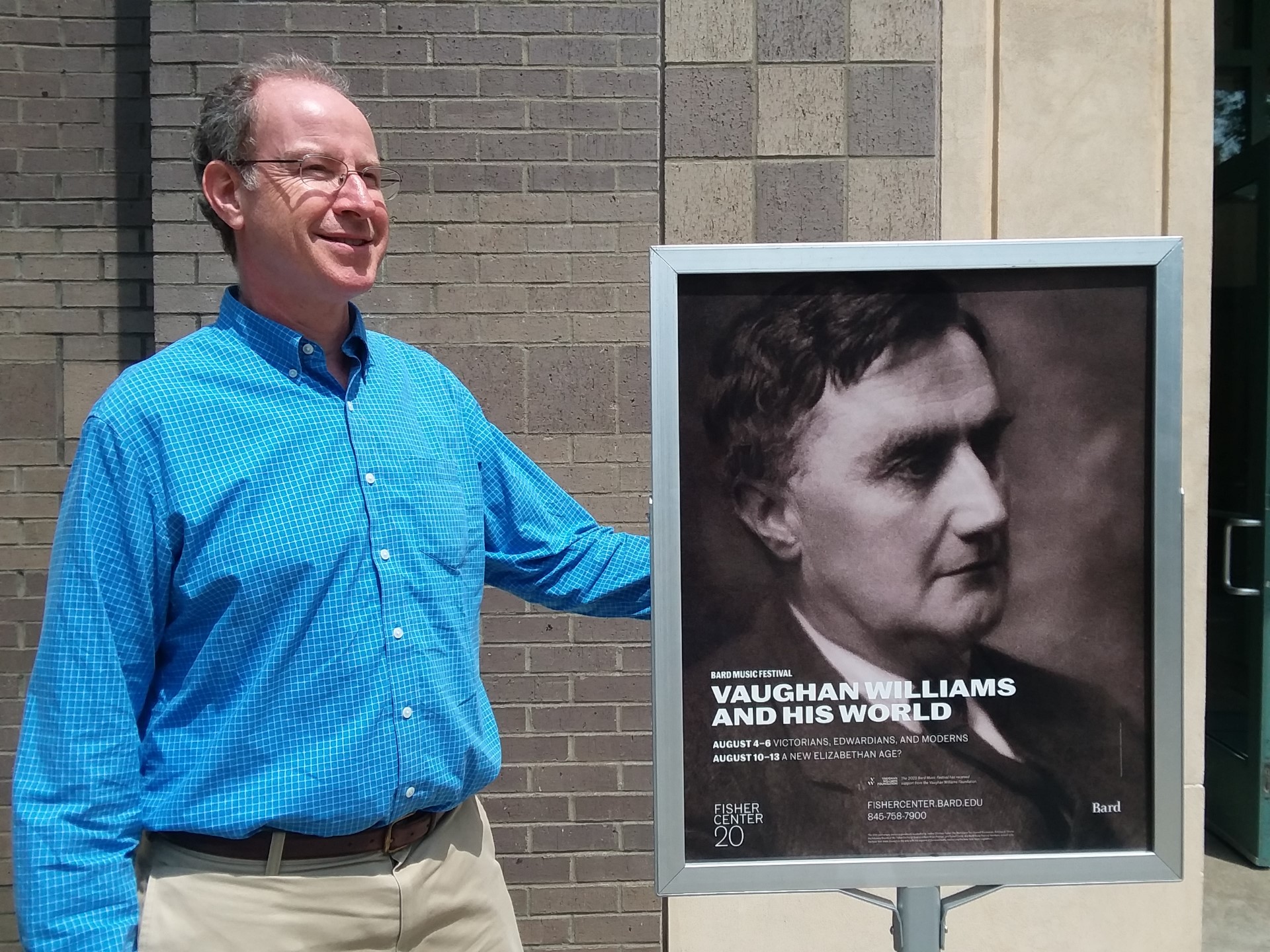
    Here I am with Ralph Vaughan Williams, outside the 400-seat Olin Hall, where daytime panels and chamber music concerts are held. Evening concerts are held across campus in the 800-seat Sosnoff Theater at the Fisher Center for the Performing Arts. Last night’s blockbuster program of “Job, A Masque for Dancing,” the Concerto for Two Pianos, and the Symphony No. 4 was a notable highlight, as was a gorgeous performance on Friday of the “Serenade to Music.”

    “Vaughan Williams and His World” will continue at Bard College in Annandale-on-Hudson, NY, through August 13. Select concerts are being livestreamed. Next weekend’s evening programs are especially strong. For streaming information, check here:

    https://fishercenter.bard.edu/whats-on/programs/upstreaming/?fbclid=IwAR1S5x_nXSMKozIRBMgY0NYP_dfMudQ9Ks2dA3G56MB-MQRhajoxrFpBxe8

    The complete schedule:

    https://fishercenter.bard.edu/whats-on/programs/bard-music-festival/

    Don’t begrudge me Bard, as it’s really my only vacation, albeit a working one. But you know what they say: do what you love, and you’ll never work a day in your life.

    Fisher Center at Bard

  • Dawson & Shostakovich Symphonies Stream Free

    Dawson & Shostakovich Symphonies Stream Free

    My pick for most awesome stream of the weekend? This double-bill from the Fisher Center at Bard College of knock-out mid-century symphonies by William Levi Dawson and Dmitri Shostakovich.

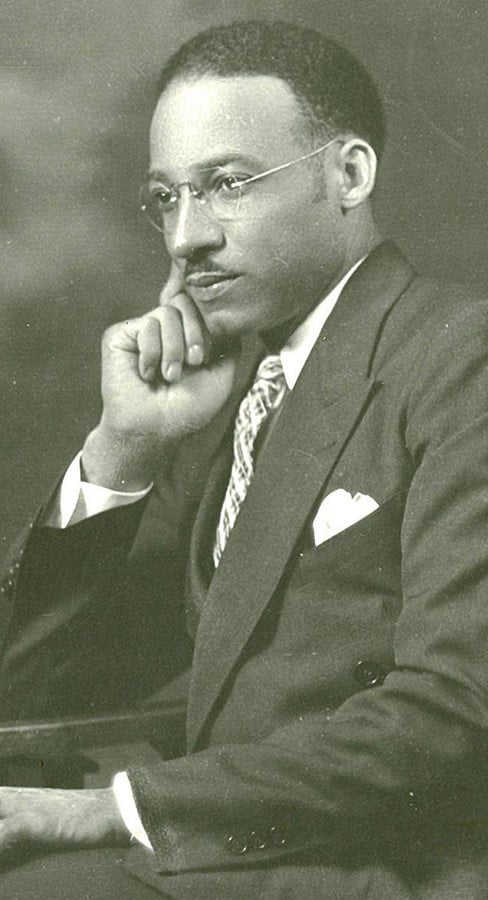
    Dawson’s “Negro Folk Symphony” was first performed by Leopold Stokowski and the Philadelphia Orchestra in 1934. The composer extensively revised the piece after a trip to West Africa in 1952. Stokowski was the first to record it, but chances to experience it in concert have been few.

    Shostakovich composed his Symphony No. 7, the “Leningrad,” as a display of hope and defiance during the Nazi siege of the city in 1941. The work was given its premiere in Moscow, by the Bolshoi Theatre Orchestra. It was next performed in the West, in London (by Henry Wood) and New York City (by Toscanini), after the score was smuggled out of the Soviet Union on microfilm, by way of Tehran!

    The symphony was finally performed in Leningrad itself on August 9, 1942, with the concert blasted on loudspeakers into the enemy lines after three thousand high-caliber shells had been lobbed into the Germans. Furthermore, Shostakovich employed a grotesque quotation from Hitler’s favorite operetta, “The Merry Widow,” to mock the Nazi “invasion.”

    The “Leningrad Symphony” enjoyed tremendous popularity during the war years, but in the decades since, its musical merits have tended to be overshadowed by its propagandistic origins.

    This weekend’s concerts will be played by The Orchestra Now (TŌN) under the direction of Leon Botstein. The concerts will take place on Saturday evening at 8 pm and Sunday afternoon at 2 pm EDT.

    Tickets are available in-house at the Fisher Center’s Sosnoff Theater. For those of us at home, the concert will stream free. Make your reservation here:

    Shostakovich & Dawson

Tag Cloud

Aaron Copland (92) Beethoven (95) Composer (114) Film Music (119) Film Score (143) Film Scores (255) Halloween (94) John Williams (185) KWAX (229) Leonard Bernstein (99) Marlboro Music Festival (125) Movie Music (134) Opera (198) Philadelphia Orchestra (87) Picture Perfect (174) Princeton Symphony Orchestra (106) Radio (87) Ralph Vaughan Williams (85) Ross Amico (244) Roy's Tie-Dye Sci-Fi Corner (290) The Classical Network (101) The Lost Chord (268) Vaughan Williams (102) WPRB (396) WWFM (881)

DON’T MISS A BEAT

Receive a weekly digest every Sunday at noon by signing up here


RECENT POSTS