Tag: Focal Dystonia

  • Leon Fleisher at 92 A Brahms Birthday Tribute

    Leon Fleisher at 92 A Brahms Birthday Tribute

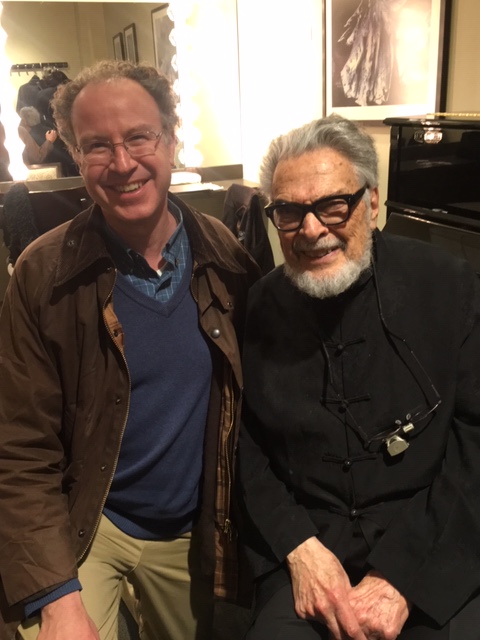
    Happy birthday, Leon Fleisher, a great artist and a lovely person, here playing a selection from Brahms’ First Piano Concerto – at the behest of Yo-Yo Ma, no less (follow the link below). Fleisher’s recordings of the Brahms concertos, set down with George Szell and the Cleveland Orchestra, over half a century earlier, remain benchmarks.

    Focal dystonia curtailed Fleisher’s career as a pianist not long after. But like a plant trimmed back that soon develops fresh tendrils, he then flourished as a conductor, as a champion of the left-hand piano repertoire (there’s much more to it than Ravel’s famous concerto), and especially as a teacher. He has taught at Baltimore’s Peabody Institute, among other places, and held master classes, since 1959.

    Thanks in part to Botox injections in his right hand, Fleisher has been able to return to performing two-handed repertoire, to some extent, and has continued to make critically acclaimed recordings. And yes, he also still performs recitals.

    Speaking with me in 2014, he expressed gratitude that things developed as they did. If he could do it all over again, he wouldn’t have it any other way.

    Many happy returns, Leon Fleisher, 92 years-old today!


    Impromptu performance of a passage from Brahms:

    Fleisher, the young lion:

    In 2014, in Brahms’ left-hand arrangement of the Bach Chaconne:

  • Leon Fleisher A Living Legend at 90

    Leon Fleisher A Living Legend at 90

    The appellation “Living Legend” has been perhaps too widely applied; but at the age of 90, pianist Leon Fleisher really is one. A former child prodigy, his is a direct line to Beethoven. He studied with Artur Schnabel, who studied with Theodor Leschetizky, who studied with Carl Czerny, who studied with the Master himself.

    When he performed with the New York Philharmonic under Pierre Monteux at the age of 16, Monteux called him “the pianistic find of the century.” Fleisher landed a recording contract with Columbia Records and began laying down benchmark recordings of Beethoven, Brahms, Schumann, Grieg and Rachmaninoff with George Szell and the Cleveland Orchestra.

    Then everything changed.

    Fleisher was diagnosed with focal dystonia in 1964. He gradually lost control of his right hand, and his career as a concert pianist was in jeopardy. His struggle with the affliction led to a period of soul-searching, and it forced him to diversify. He realized, as Schnabel had espoused, that music is music, regardless of the medium.

    Fleisher began channeling his energy into teaching and conducting. He has been a venerable presence at the Peabody Conservatory of Music in Baltimore, the Royal Conservatory of Music in Toronto, and the Curtis Institute of Music in Philadelphia.

    Fortunately, the left-hand piano repertoire is extensive, and Fleisher himself has added considerably to it, through commissioned works from contemporary composers or gifts from friends. His album, “All the Things You Are,” released a few years ago on Bridge Records, Inc., documents some of these. The album became a surprise hit, with The New Yorker’s Alex Ross lauding it as “one of his finest hours on record.”

    Fleisher is an extraordinary artist and individual. Not only has he fought hard to regain control of his right hand – and done so, thanks to experimental treatments with, of all things, Botox – he is quite possibly the most gracious and generous interview subject I’ve ever encountered.

    In honor of his milestone birthday, I’ve posted an unedited conversation we had four years ago for my radio program, “The Lost Chord.” In the version I whittled down for broadcast, selections were interspersed with performances from “All the Things You Are.” I realize there is a lot of extraneous material in the raw audio, but it’s all here for you to skim as you please:

    Then I hope you’ll join me this afternoon for an assortment of Fleisher’s recordings, which will be among the featured offerings from 4 to 7 p.m. EDT, on WWFM – The Classical Network and wwfm.org.

    PLEASE NOTE: Bill McGlaughlin will also be saluting Fleisher on “Exploring Music,” all this week at 7 p.m. I have glanced through the playlists; repertoire will not be duplicated.

    Happy birthday, Leon Fleisher!

  • Leon Fleisher A Legend’s Journey

    Leon Fleisher A Legend’s Journey

    At 86, Leon Fleisher is a living legend. A former child prodigy, his is a direct line to Beethoven. He studied with Artur Schnabel, who studied with Theodor Leschetizky, who studied with Carl Czerny, who studied with the master himself.

    When he performed with the New York Philharmonic under Pierre Monteux at the age of 16, Monteux called him “the pianistic find of the century.” Fleisher landed a recording contract with Columbia Records and began laying down benchmark recordings of Beethoven, Brahms, Schumann, Grieg and Rachmaninoff with George Szell and the Cleveland Orchestra.

    Then everything changed.

    Fleisher was diagnosed with focal dystonia in 1964. He gradually lost control of his right hand, throwing his career as a concert pianist into jeopardy. His struggle with the affliction led to a period of soul-searching, and it forced him to diversify. He realized, as Schnabel had espoused, that music came first, the piano second.

    Fleisher began channeling his energy into teaching and conducting. He has been a venerable presence at the Peabody Conservatory of Music in Baltimore, the Royal Conservatory of Music in Toronto, and the Curtis Institute of Music in Philadelphia.

    Fortunately, the left-hand piano repertoire is extensive, and Fleisher himself has added considerably to it, through commissioned works from contemporary composers or gifts from friends. His new album, “All the Things You Are,” issued by Bridge Records, documents some of these, alongside his performance of Brahms’ towering arrangement of the Bach Chaconne.

    The record has become a surprise hit. This week, according to Nielsen Soundscan data, the album ranked second, in terms of overall sales of classical records, in the United States. Billboard ranked it at number 11. The New Yorker’s Alex Ross lauded it as “one of [Fleisher’s] finest hours on record.”

    This Sunday night on “The Lost Chord,” I am honored to have Leon Fleisher as my guest. He will join me to talk a little bit about the album and share some of his reflections on music.

    Fleisher is an extraordinary individual. Not only has he fought hard to regain control of his right hand – and done so, thanks to experimental treatments with, of all things, Botox – he is quite possibly the most gracious and generous interview subject I’ve ever encountered. It pains me to have had to edit the conversation. But perhaps there will be a follow-up show, in which I’ll air his thoughts on Paul Wittgenstein, Franz Schmidt, Paul Hindemith, Federico Mompou and Erich Wolfgang Korngold.

    In the meantime, I hope you’ll join me for “In Good Hands,” this Sunday night at 10 ET, with a repeat Friday morning at 3. Remember, you can enjoy episodes of “The Lost Chord” later as a webcast, at http://www.wwfm.org.
Tag Cloud

Aaron Copland (92) Beethoven (95) Composer (114) Film Music (123) Film Score (143) Film Scores (255) Halloween (94) John Williams (187) KWAX (229) Leonard Bernstein (101) Marlboro Music Festival (125) Movie Music (138) Opera (202) Philadelphia Orchestra (89) Picture Perfect (174) Princeton Symphony Orchestra (106) Radio (87) Ralph Vaughan Williams (85) Ross Amico (244) Roy's Tie-Dye Sci-Fi Corner (290) The Classical Network (101) The Lost Chord (268) Vaughan Williams (103) WPRB (396) WWFM (881)

DON’T MISS A BEAT

Receive a weekly digest every Sunday at noon by signing up here


RECENT POSTS