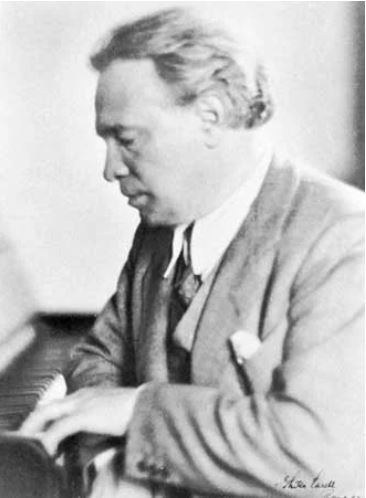
One of the unfortunate things about not having a live air shift anymore is that I no longer get a chance to play a lot of those wonderful, shorter pieces I used to work into my shows. On the birthday of Ottorino Respighi, I’m reminded of the composer’s “Adagio con variazioni” (“Adagio with Variations”), a lovely work for cello and orchestra that’s worlds away from the rafter-rattling tone poems that comprise his famous “Roman Trilogy.” I haven’t heard this since the last time I played it on the radio, which would have been before the pandemic. How many equally lovely pieces have fallen through the cracks now that I’m no longer sitting at the control board? At home, I don’t often go to my personal collection to pull out short pieces I once played fairly regularly, pieces like Oskar Nedbal’s “Valse triste” or Armstong Gibbs’ “Dusk.” No one in management considers how much the landscape will change once someone is shown the door and takes his record collection with him. Which is why you will no longer hear John Foulds’ “Keltic Lament” or Alexander Glazunov’s “Idyll” for horn and strings. Be that as it may, I hope you will take a few minutes to enjoy some Respighi you won’t often encounter.
Tag: Forgotten Music
-
Olympics Lost Arts Forgotten Games
Some things never change.
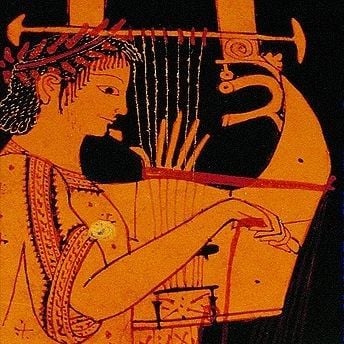
It was the vision of Pierre de Coubertin, in founding the modern Olympic Games, that his competition would uphold the classical ideal of all-around excellence. This meant not only in athletics, but also in music and literature. This is what would elevate his Games above all other sports championships.
Unfortunately, even in 1896, the concept proved to be a hard sell. In fact, it wasn’t until 1912, in Stockholm, that Coubertin’s original plan received any kind of traction. That’s the year Riccardo Barthelemy, Caruso’s pianist, received a gold medal for his “Marcia trionfale olimpica” (“Olympic Triumphal March”).
It was not only the committee that proved to be suspicious of this particular aspect of the competition. The world’s great composers also demonstrably shied away. While undoubtedly well-intentioned, those who initiated the event had little experience in the arts. They were accustomed to judging speed and distance, as opposed to compositional excellence. Furthermore, the musical submissions were expected to be in some way sports-oriented. Composers love awards as much as anyone, but this particular contest, initiated in the Titanic year of 1912, seemed like a recipe for disaster.
By 1924, for the Olympiad in Paris, the committee managed to assemble a panel of 43 judges, some of them very reputable indeed, including Igor Stravinsky, Béla Bartók, and Maurice Ravel. Unfortunately, with so many chefs, they couldn’t come to a consensus – or perhaps harbored reservations about the quality of the entries – and no medal was awarded.
In 1928, the best they could muster was a bronze for Rudolph Simonsen, who later became director of the Royal Danish Academy of Music.
The most famous composer to participate in these Olympic competitions was Josef Suk – pupil and son-in-law of Antonin Dvořák – and even he only merited a silver in 1932.
Eventually, to cloak the embarrassment of not generating enough medals, the ranking system was replaced with “Honorable Mention.” It was hoped the category would continue to be attractive to promising young composers, but it virtually killed the possibility of drawing any big names.
Arts competitions remained part of the Olympic Games until 1948. Other categories included architecture, literature, painting, and sculpture. Ultimately, these competitions were discontinued because of concerns about the artists being professionals, in contrast to the amateur status of the athletes. A non-competitive art and cultural festival has been presented in conjunction with the games since 1952. A vast majority of the music composed for these Olympic competitions has never been recorded.
Rudolph Simonsen, Symphony No. 2 “Hellas” (1928 Bronze Medal winner)
Josef Suk, “Towards a New Life” (1932 Silver Medal winner)
-
Forgotten Swiss Music Bloch & Huber
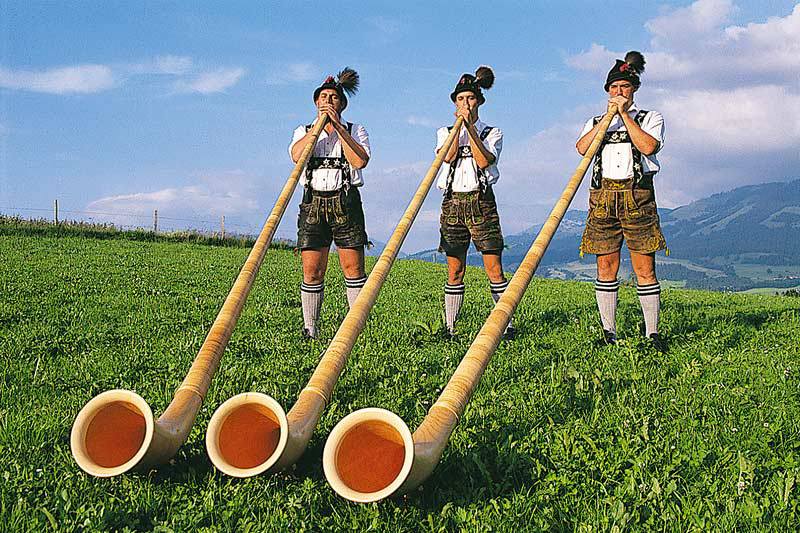
Enough with your jokes about alphorns and cuckoo clocks! This Sunday night on “The Lost Chord,” we listen to forgotten music from Switzerland.
Ernest Bloch, who is best known for his music on Jewish themes (such as his Hebraic rhapsody “Schelomo”), actually spent most of his life in the United States. He died in Portland, OR, in 1959, at the age of 78.
50 years earlier, while still in Switzerland, he composed his song cycle “Poèmes d’automne.” At the time, he was at work on his opera, “Macbeth,” but was sidelined when he made the acquaintance of a young poet by the name of Beatrix Rodès. He fell instantly in love with her, and set four of her poems within two months. Rodès would eventually become his mistress, though in the end Bloch chose to remain with his wife. It’s said that the texts, even in the original French, are of dubious literary quality.
The composer arranged them to form a kind of progression, in which a woman passes from sadness and desolation, to peace and love, to lamentation for the passing of her beauty, to an air of serenity as she becomes a priestess.
Okay, so it’s not his strongest work, but it is seasonal and interesting to listen to.
Hans Huber, who lived from 1852 to 1921, was the composer of nine symphonies (of which he acknowledged eight), five operas, and a number of concertos for various instruments. His four concertos for piano are somewhat unusual in that, like Brahms’ experiments in the form, they are made up of four movements, with the addition of a scherzo, as opposed to the customary three.
The Piano Concerto No. 3 first appeared on a concert in Basel, in February of 1899, which also included Beethoven’s “Leonore Overture No. 3” and Berlioz’s “Harold in Italy.”
It’s an unusual piece, for, among other things, presenting in the first movement the theme from the work’s finale as the underpinnings of a passacaglia.
I hope you’ll join me for an hour of forgotten music from Switzerland – “Swiss Missed” – this Sunday night at 10:00 EDT, on WWFM – The Classical Network and wwfm.org.
Tag Cloud
Aaron Copland (94) Beethoven (95) Composer (114) Film Music (149) Film Score (143) Film Scores (255) Halloween (97) John Williams (197) KWAX (232) Leonard Bernstein (105) Marlboro Music Festival (125) Movie Music (164) Mozart (91) Opera (215) Philadelphia Orchestra (90) Picture Perfect (174) Princeton Symphony Orchestra (110) Radio (90) Ross Amico (244) Roy's Tie-Dye Sci-Fi Corner (290) The Classical Network (101) The Lost Chord (269) Vaughan Williams (107) WPRB (397) WWFM (881)