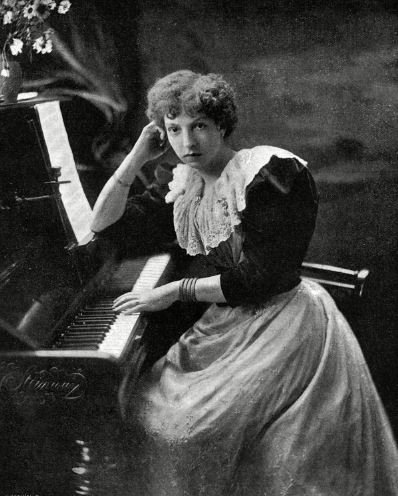
Cécile Chaminade, who shares her given name with the patron saint of music, was born on this date in 1857. Though assessed and recommended for study at the Paris Conservatory at the age of 10, her father forbade it, because he thought it beneath her class. He did, however, allow her to study privately. It was in this fashion that she continued with her piano lessons (her mother taught her when she was young), took up the violin, and studied composition with Benjamin Godard.
Georges Bizet, who heard her perform some of her own works before she was teenager, was among those who were impressed by her talents. Later, her pieces were championed by Isidor Philipp, head of the piano department at the Paris Conservatory.
In her early 20s, Chaminade began playing in a salon setting. This would be the prototype for her future appearances, at which she presented programs consisting solely of her own music.
She married a much older man, a music publisher, on the condition that they maintain separate residences. Due to her husband’s advanced age, it was rumored to have been a “marriage of convenience.” After he died, only six years later, Chaminade never remarried.
Her concerts in England were received with enthusiasm. If anything, she proved even more popular during a tour of the United States.
In 1901, she made gramophone recordings of seven of her compositions. She also made some piano rolls before and after World War I. She died in Monte Carlo in 1944.
For decades, then, she fell into obscurity, with the exceptions perhaps of her Concertino for Flute and Orchestra and whatever sheet music happened to turn up in Grandma’s piano bench.
Her reputation was revived largely through recordings, a trickle at first, but now appearing with more frequency.
Ambroise Thomas once commented, “This is not a composer who is a woman, but a woman who composes.” Chaminade said, “There is no sex in art. Genius is an independent quality. The woman of the future, with her broader outlook, her greater opportunities, will go far, I believe, in creative work of every description.”
In 1913, Chaminade was elected a Chevalier of the Légion d’honneur, a first for a female composer. Here’s some rare footage from the ceremony.
Happy birthday, Cécile Chaminade!
Concertino for Flute and Orchestra
Concertstück for Piano and Orchestra
Chanson, “Te souviens-tu?” (text by Benjamin Godard)
Piano works (linked individually in the information below the video)
He was expelled from the Paris Conservatory for being “the laziest student in the world.”
He maintained a filing cabinet filled with drawings of imaginary medieval buildings, the properties of which he would periodically put up for sale in local journals by way of anonymous ads.
He claimed to eat only foods that were white: eggs, sugar, shredded bones, the fat of dead animals, veal, salt, coconuts, chicken cooked in white water, moldy fruit, rice, turnips, sausages in camphor, pastry, cheese (only white varieties), cotton salad (whatever that is), and certain kinds of fish.
He founded his own church – Église Métropolitaine d’Art de Jésus Conducteur (Metropolitan Art Church of Jesus the Conductor) – of which he was the only member, and for which he promptly composed a mass.
He carried a hammer for protection.
When he died, his friends produced umbrella after umbrella after umbrella from his room.
Erik Satie was an artist whose life was full of enigmas and ambiguities. Often misclassified as an Impressionist, he was viewed by some (including Maurice Ravel) as a precursor to Debussy, even as he felt a greater affinity with the younger generation of composers who made up Les Six.
In practice, he elevated salon and cabaret music, of which he spoke slightingly. After he went back to school at mid-life in order to bone up on classical counterpoint, he stopped using bar lines in his manuscripts. He blazed trails later rediscovered by Morton Feldman and John Cage. He was a minimalist more than half a century before Minimalism.
Satie rejected the concept of musical development, believing it to be an unconscionable imposition on the public’s time. Yet he requested that his piano piece, “Vexations,” be put through 840 repetitions. A typical performance spans 18 to 24 hours. Of course, its single thematic cell is probably only about 50 seconds long. For him, brevity was the soul of wit.
He could be profoundly ironic. Many of his piano works bear titles like “Trois Morceaux en forme de poire” (“Three Pieces in the Shape of a Pear”), “Embryons desséchés” (“Desiccated Embryos”), and “Véritables préludes flasques pour un chien” (“Veritable Flabby Preludes for a Dog”).
A friend of Jean Cocteau, the two collaborated on the surrealist curio “Parade,” written for the Ballets Russes, with choreography by Léonide Massine and costumes and set design by Picasso. The scenario involves three circus acts trying to attract an audience to an indoor performance.
It was one of a number of works that were introduced in the ‘Teens that attempted to whip up a scandal by incorporating low-brow elements into what was perceived as a high-brow art form. Hoping for a strong reaction, Cocteau pushed for the inclusion of such provocative “instruments” as a typewriter, a foghorn, a siren, milk bottles, gunshots, and boots sloshing around in a wash tub. The work bore the subtitle “A Realist Ballet.” The opening night audience responded, as hoped, by rioting energetically.
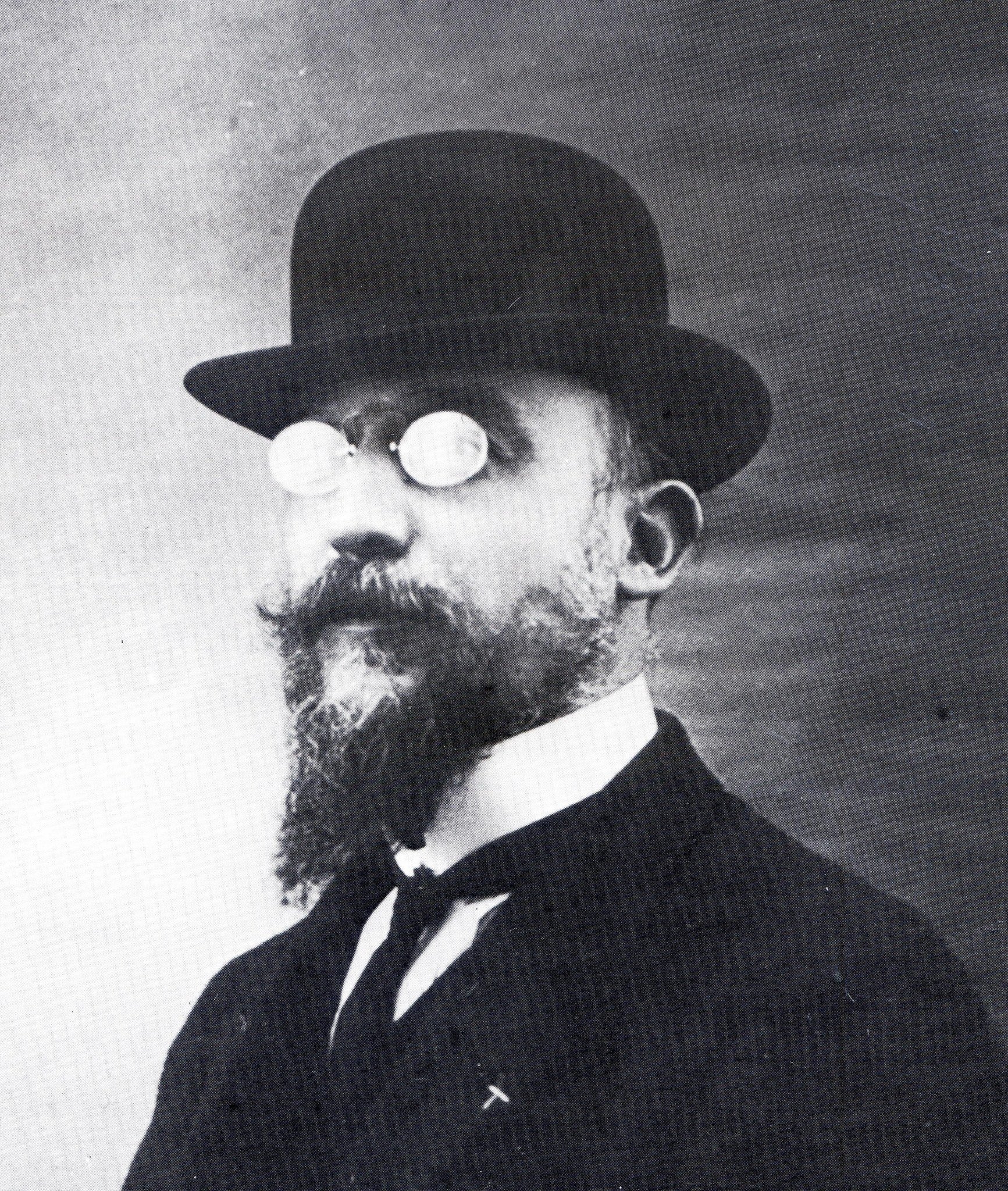
Politically, Satie was a radical socialist, who eventually teetered over into Communism. For a time, his wardrobe consisted of seven identical grey suits. During his quasi-religious phase, he went about in a priest-like habit. Then he became a “velvet gentleman.” Finally, during his communist period, he assumed the appearance of a bourgeois functionary, never to be seen without a bowler and an umbrella.
No one would have guessed that such an impeccable dresser would have lived out his life in clutter and squalor. When Satie died, his friends, who had never been invited back to his place in 27 years, were aghast at the piles of newspapers, the unending collection of umbrellas (100 in all), and most prominently, the stacked grand pianos, the uppermost of which had been used by the composer as a repository for papers and parcels. Among these, and in the pockets of Satie’s wardrobe, were discovered a number of manuscripts that the composer had believed long lost.
For anyone who ever wanted to see Satie fire a cannon, here’s the Velvet Gentleman himself, in trademark bowler and carrying an umbrella, with Francis Picabia. Picabia provided the scenario and designs for Satie’s ballet, “Relâche.” The film, titled “Entr’acte,” was made in 1924, the year before the composer’s death. As the title suggests, it was shown between the two acts of Satie’s ballet, with the cannon sequence used as prologue. The music, appropriately enough, is titled “Cinéma.”
Satie appears only in the first 90 seconds or so of the film, so it’s up to you how much beyond that you’ll want to watch. Marcel Duchamp and Man Ray play chess around 4-5 minutes in; there’s a bearded ballerina around the 7-minute mark; and you may chuckle at a falling SCTV-style dummy around 9:30. Somewhere along the way you may also spot composers Georges Auric and Darius Milhaud.
It certainly is a Dadaist romp. “Relâche,” by the way, is a word used on posters to indicate that a show is canceled or that the theater is closed.
“Je te veux” (“I want you”)
Selections from “Parade,” with the Picasso designs. Love the horse!
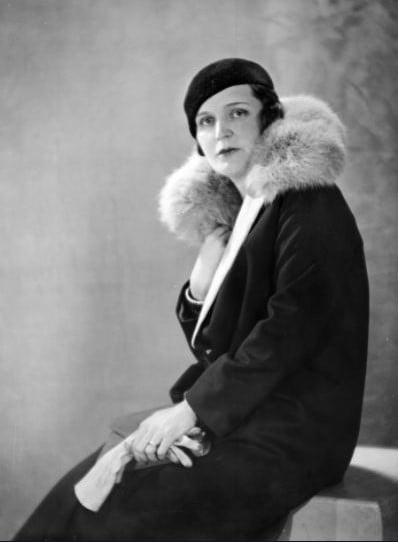
Germaine Tailleferre was the only female member of Les Six, that loose collective of composers that rose to prominence in Paris in the late Nineteen-Teens and ‘20s, under the guidance of Jean Cocteau. Her famous colleagues included Francis Poulenc, Darius Milhaud, Arthur Honegger, and Georges Auric. Louis Durey, a hard-line communist who went on to set poems by Ho-Chi Minh and Mao Zedong, is the one nobody remembers. (I wonder why.)
Tailleferre was strong-willed from the start. Her birth name was Taillefesse, but she changed it to spite her father, since the old man opposed her musical studies. However, she took piano lessons with her mother and was admitted into the Paris Conservatory. It was there that she met the rest of The Six and that the prizes began to pile up. She also earned the friendship and received the support of Maurice Ravel.
In 1925, she married Ralph Barton, the American caricaturist, and moved to New York. Two years later, the couple returned to France, then divorced. Her career thrived in the 1920s and ‘30s. With the outbreak of World War II, however, she beat it back to the United States, leaving most of her scores at her home in Grasse, and passed the war years in Philadelphia. (Please, if anyone knows anything about her Philadelphia years, message me!)
After the war, she again returned to France, where she resumed her career. As she got older, her pieces tended to be shorter, as she suffered from arthritis. She also wrote a lot for children and young pianists. She composed virtually right up until the time of her death in 1983, when she was 91 years-old. She wrote so much, in fact, that a lot of the music of her later years has never been published, and fresh discoveries from her output are being recorded all the time.
Here’s an interesting write-up about Tailleferre and her relationship with Barton. The quote that headlines the piece is not by Tailleferre, but by Germaine Greer!
Furthermore, I love that the video at the bottom of the page, of the composer’s “Six chansons françaises,” is age-restricted due to the fact that it’s illustrated with the painting of a nude. Mon Dieu!
Happy birthday, Germaine Tailleferre!
The Concertino for Harp and Orchestra (1927):
The lovely and wistful “Arabesque” for clarinet and piano (1972):
The Concerto for Piano and Orchestra (1924). The piece was given its U.S. premiere – in the presence of the composer – by Alfred Cortot and the Philadelphia Orchestra, conducted Leopold Stokowski.
Roll over, Beethoven! Camille Saint-Saëns died one hundred years ago today, and he’s telling Tchaikovsky the news!
One of classical music’s most astonishing enfants prodiges, Saint-Saëns composed his first piece before he was three-and-a-half years old. He made his public debut as an accompanist at the age of five. At ten, he performed his first solo recital – at the conclusion of which, he offered to play as an encore any of the Beethoven piano sonatas, from memory. He won top prizes, wrote his first symphony at 16, and was introduced to Franz Liszt, who would become a close friend.
Hector Berlioz quipped of the teen-aged composer, “He knows everything, but lacks inexperience.”
Saint-Saëns began as a musical radical, assimilating the influences of Liszt and Wagner and introducing their works to a France steeped in Bach and Mozart. However, he lived a very long life (86 years). By his final decades, he wound up an arch-conservative, railing against the musical crimes of Debussy and Richard Strauss.
When he began his career, in the 1840s, Chopin and Mendelssohn were in their prime. By the time of his death, Paris had entered the Roaring ‘20s – the Jazz Age. He died in 1921, eight years after the debut of “The Rite of Spring,” when composers like Francis Poulenc and Darius Milhaud were just beginning to make their mark.
He was said by Liszt to have been unequalled as a performer on the organ. He is also credited with having written the first original film score (for “The Assassination of the Duke of Guise,” in 1908).
Though stunningly prolific, Saint-Saëns is basically remembered for one masterpiece in just about every genre: the Symphony No. 3, the Piano Concerto No.2, the Violin Concerto No. 3, the Cello Concerto No. 1, the opera “Samson and Delilah.” Yet above all, perhaps, is he known for “The Carnival of the Animals,” a work brimful of charm and wit, yet one the composer deliberately tried to suppress, perhaps fearing what history has eventually borne out: his being perceived as a lightweight, less-than-wholly-serious composer.
Poor Saint-Saëns. Seemingly destined always to be France’s Mendelssohn.
But for today, we salute you!
Saint-Saëns composed his “Christmas Oratorio” in less than two weeks. It was completed ten days before the work’s premiere on Christmas Day, 1858. The composer was 23 years-old.
For Ludwig Van’s birthday, “Variations on a Theme of Beethoven” (1874)
“The Carnival of the Animals” (1886), performed by the Seattle Youth Symphony Orchestra, with fun images of all the critters. “The Swan” has the most famous music, but “Aquarium” can’t be far behind. Also, listen for a reeeeeeally slowed-down version of Offenbach’s “Can-Can,” the most incongruously frenetic music Saint-Saëns could think of, to characterize “Tortoises,” ponderous “fairy” music for “Elephants,” and a sly “meta” moment, a quotation from the composer’s own “Danse Macabre,” in “Fossils.” Each section is linked below the video.
I find it fascinating that Germaine Tailleferre waited out World War II in Philadelphia. And yet I can never seem to find out very much about what she did while in exile.
Tailleferre was the only female member of Les Six, that loose collective of composers that rose to prominence in Paris in the late ‘teens and 1920s, under the guidance of Jean Cocteau. Her famous colleagues included Francis Poulenc, Darius Milhaud, Arthur Honegger, and Georges Auric. Louis Durey, a hard-line communist who went on to set poems by Ho-Chi Minh and Mao Zedong, is the one nobody remembers. (I wonder why.)
Tailleferre was strong-willed from the beginning. Her birth name was Taillefesse, but she changed it to spite her father, since the old man opposed her musical studies. However, she took piano lessons with her mother and was admitted into the Paris Conservatory. It was there that she met the rest of The Six and that the prizes began to pile up. She also earned the friendship and received the support of Maurice Ravel.
In 1925, she married Ralph Barton, the American caricaturist, and moved to New York. Two years later, the couple returned to France, then divorced. Her career thrived in the 1920s and ‘30s. With the outbreak of World War II, however, she beat it back to the United States, leaving most of her scores at her home in Grasse, and, as I said, passed the war years in Philadelphia.
After the war, she again returned to France, where she resumed her career. As she got older, her pieces tended to be shorter, as she suffered from arthritis. She also wrote a lot for children and young pianists. She composed virtually right up until the time of her death in 1983, when she was 91 years-old. She wrote so much, in fact, that a lot of the music of her later years has never been published, and fresh discoveries from her output are being recorded all the time.
Happy birthday, Germaine Tailleferre! If anyone has any information about her activities in Philadelphia, I would be very curious to know.
The Concertino for Harp and Orchestra (1927):
The lovely and wistful “Arabesque” for clarinet and piano (1972):
The Concerto for Piano and Orchestra (1924). The piece was given its U.S. premiere – in the presence of the composer – by Alfred Cortot and the Philadelphia Orchestra, conducted Leopold Stokowski.