Tag: French Composer

  • Waldteufel Christmas Roses and Skaters Waltz

    Waldteufel Christmas Roses and Skaters Waltz

    Only days after the arrival of Krampus, the Christmas devil, comes the birthday of Emil Waldteufel. Waldteufel is German for “forest devil.” He was born on this date in 1837.

    Though Waldteufel had long been a mainstay of Paris society balls of the Second Empire, he was nearly 40 by the time he achieved international fame. It was the Prince of Wales – the future King Edward VII – who introduced him to London, and his music came to dominate Queen Victoria’s state balls at Buckingham Palace. One of his best-known works, “Les Patineurs” (“The Skaters’ Waltz”) was introduced there in 1882. Another of his most successful waltzes, from the other end of the decade, was “Roses de Noël” (“Christmas Roses”).

    The holidays are in bloom! Take some time to smell the roses with Emil Waldteufel.

    “The Skaters’ Waltz”

    “Roses de Noël”

  • Florent Schmitt Rediscovered French Composer

    Florent Schmitt Rediscovered French Composer

    Florent Schmitt was one of the most successful French composers of the early 20th century. However, as fashions changed, his characteristically opulent music became marginalized, only to experience something of a revival, in recent years, mostly on recordings.

    This Sunday night on “The Lost Chord,” we’ll mark the sesquicentenary of Schmitt’s birth (on September 28, 1870) with selections from his incidental music for a production of Shakespeare’s “Antony and Cleopatra” and his grandiose setting of “Psalm XLVII.”

    Schmitt entered the Paris Conservatory in 1889, where he studied with Gabriel Fauré, Jules Massenet, and Théodore Dubois. He was a winner of the Prix de Rome in 1900. He also befriended Frederick Delius, while Delius was in Paris, and prepared the vocal scores for a number of his operas.

    In addition, Schmitt was a music critic, who attained a degree of notoriety for shouting out his assessments from the audience. He was described by one music publisher as an irresponsible lunatic.

    The later neglect of his music may have been due, in part, to his willingness to go along with the Vichy regime during the Nazi occupation of France. But Schmitt is too fascinating a figure to be dismissed out-of-hand. Stravinsky was an early admirer, remarking that the composer’s “The Tragedy of Salome” gave him greater joy than any other he had heard in a long time. Certain elements of the ballet anticipate analogous experiments in Stravinsky’s own “The Rite of Spring.”

    Indeed, Schmitt’s appetite for overheated decadence and lurid orientalism seems to have been insatiable. There’s nothing on the menu tonight but overegged Florentine. I hope you’ll join me for “Schmitt Happens,” this Sunday night at 10:00 EDT, on WWFM – The Classical Network and wwfm.org.


    Exhaustive website devoted to all things Florent Schmitt: florentschmitt.com

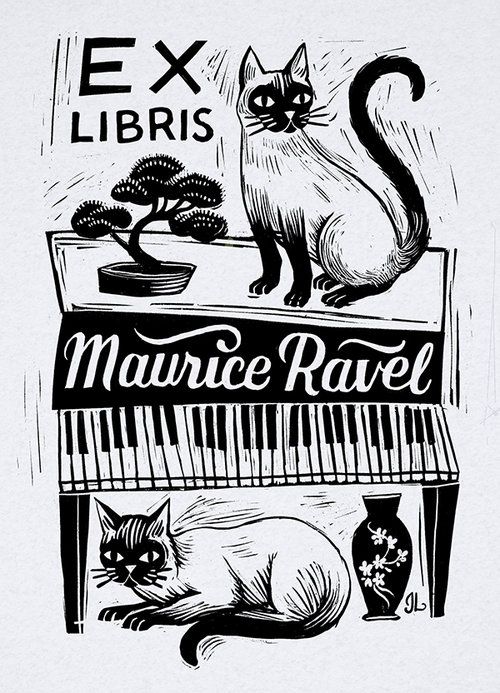
  • Ravel’s Cats & Bookplates A Birthday Tribute

    Ravel’s Cats & Bookplates A Birthday Tribute

    With all that I’ve been writing about bookplates recently, it’s very interesting that I would stumble across this today, the birthday of Maurice Ravel. Ravel was not only a masterful composer, he was also crazy for cats.

    Bon anniversaire, mon vieux!

  • Albéric Magnard Fiery French Composer

    Albéric Magnard Fiery French Composer

    To say that French composer Albéric Magnard had a fiery personality stands the risk of skirting bad taste.

    Magnard was born in Paris on this date in 1865. His father, François Magnard, was a notable author and the editor of Le Figaro. His family being rather well off, the younger Magnard exhibited an early determination to make his own way. (As a boy, he had been taunted by cries of “Le fils du Figaro” – the son of Figaro.)

    Following military service, he acquired his law degree. However he was destined never to practice. Instead he made a fateful trip to Bayreuth, where he fell under the spell of Richard Wagner and determined to become a composer.

    He was accepted into the Paris Conservatory, where he studied with Théodore Dubois, Jules Massenet, and Vincent d’Indy. He became particularly close to d’Indy, though he abhorred the latter’s anti-Semitism. (Magnard was outspokenly pro-Dreyfus.)

    Despite his son’s insistence on self-reliance, François helped the young man in whatever way he could, which for the most part meant publishing favorable notices of his son’s music in his influential journal. Magnard “fils” somewhat resented this – but he was also kind of grateful – so that he and his father shared a complicated relationship.

    Like Paul Dukas, who was born the same year, Magnard was highly self-critical, so that his output consists of only 22 works with opus numbers. The publication of most of these he paid for himself. The observation has been made that his symphonies in some respects prefigure those of Gustav Mahler, though others have referred to him as “the French Bruckner.” It’s probably more realistic to say Magnard caught his love of cyclic form from César Franck.

    Incidentally, I’ll be presenting music by some followers of Franck tomorrow night at 10:00 EDT on “The Lost Chord, on WWFM – The Classical Network. Tune in for music by Armand Marsick and Guillaume Lekeu. Curiously, I didn’t think to include Magnard.

    Unfortunately, the most striking feature of Magnard’s life was the manner of his death. In 1914, the composer, aged 59 and a civilian, refused to surrender his property to invading German forces. After sending his wife and two daughters out the back door, he opened fire on some trespassing soldiers and instantly killed one of them. In retaliation, the Germans set fire to his house, and Magnard is assumed to have perished in the conflagration. That said, his body was never discovered.

    Might it be possible that he spent a secret retirement in the company of Ambrose Bierce – who, curiously enough, also disappeared in 1914?

    https://en.wikipedia.org/wiki/Ambrose_Bierce

    Classic Ross Amico, you dog, that is brilliant.


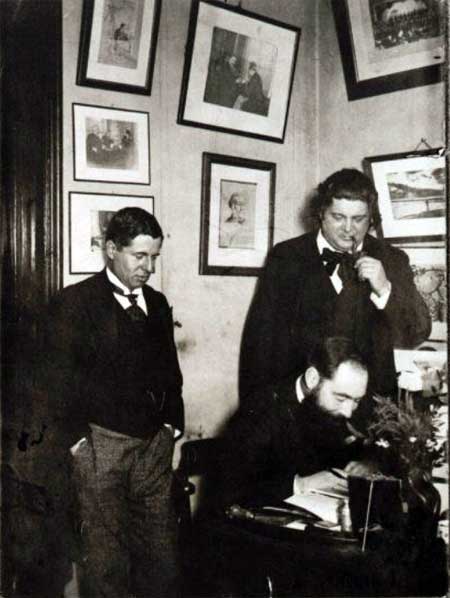
    PHOTO: Magnard (left) with famed Belgian violinist Eugène Ysaÿe (standing) and composer Guy Ropartz. Through a remarkable feat of memory, Ropartz, who had recently conducted Magnard’s opera, “Guercoeur,” was able to reconstruct the score, after it was partially destroyed in the fire that consumed Magnard’s home.

  • Charles Koechlin Sesquicentennial on WPRB

    Charles Koechlin Sesquicentennial on WPRB

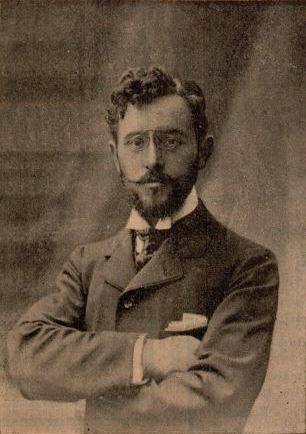
    The recordings of his music shall be as numerous as the strands of his beard. This Thursday morning on WPRB, we’ll celebrate the sesquicentennial of Charles Koechlin.

    Koechlin, the forgotten French composer who assisted Gabriel Fauré (his teacher) and Claude Debussy, was born on November 27, 1867. We’ll mark the anniversary in high style, with a five hour playlist of representative works – which won’t be easy, since Koechlin composed in such a wide variety of styles. His musical language encompassed impressionism, neo-classicism, polytonality, even quasi-serialism – occasionally within the same piece!

    His life was like his music, with many diverse interests jostling for primacy – medieval music, Bach, travel, stereoscopic photography, sports, politics, pantheism, the movies. He was especially interested in early film stars. He wrote works in tribute to Ginger Rogers, Douglas Fairbanks, Charles Chaplin and especially Lillian Harvey (who he basically stalked). Another source of endless fascination was Rudyard Kipling’s “The Jungle Book,” which inspired a series of orchestral works that span most of Koechlin’s creative life.

    For as much as he composed – he was very prolific – sadly, Koechlin has been relegated to a footnote in music histories, remembered, if at all, for his orchestrations for others, especially for Fauré’s “Pélleas and Mélisande” and Debussy’s “Khamma.” He also orchestrated Cole Porter’s ballet “Within the Quota.” (Porter was a Koechlin student.) In addition, he wrote a classic treatise on orchestration.

    We’ll hear Koechlin’s “Seven Stars Symphony,” each movement inspired by luminaries of the silver screen, complete with ondes martenot, as well as his orchestration of Schubert’s “Wanderer Fantasy,” among other oddities.

    Join me for music by the composer everyone forgot to remember, this Thursday morning from 6 to 11 EST, on WPRB 103.3 FM and wprb.com. We go kooky for Koechlin, on Classic Ross Amico.

Tag Cloud

Aaron Copland (92) Beethoven (95) Composer (114) Film Music (120) Film Score (143) Film Scores (255) Halloween (94) John Williams (185) KWAX (229) Leonard Bernstein (100) Marlboro Music Festival (125) Movie Music (135) Opera (198) Philadelphia Orchestra (88) Picture Perfect (174) Princeton Symphony Orchestra (106) Radio (87) Ralph Vaughan Williams (85) Ross Amico (244) Roy's Tie-Dye Sci-Fi Corner (290) The Classical Network (101) The Lost Chord (268) Vaughan Williams (103) WPRB (396) WWFM (881)

DON’T MISS A BEAT

Receive a weekly digest every Sunday at noon by signing up here


RECENT POSTS