Today is the 150th anniversary of the birth of French composer Charles Koechlin. If anyone can find even a single mention, anywhere on the internet, of an official sesquicentennial observance, I would be very curious to know. Alas, it would seem he is the very definition of a neglected composer.
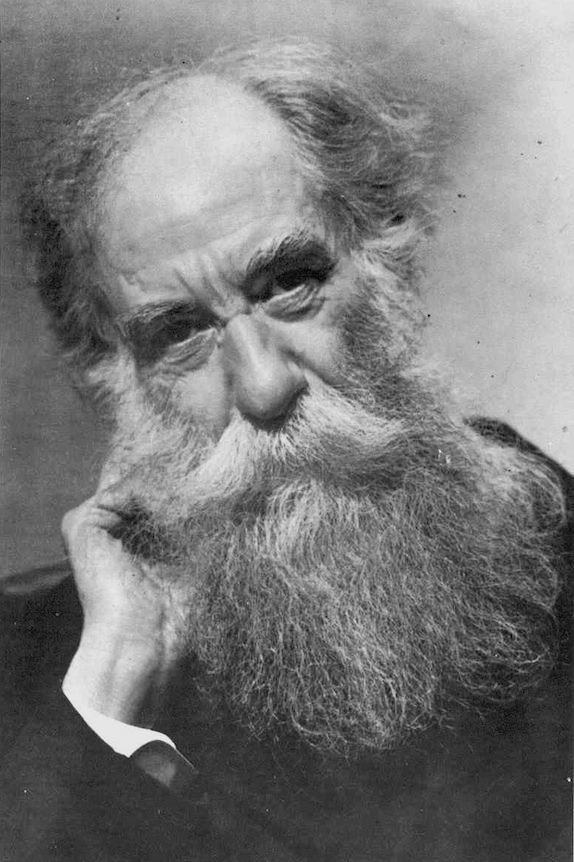
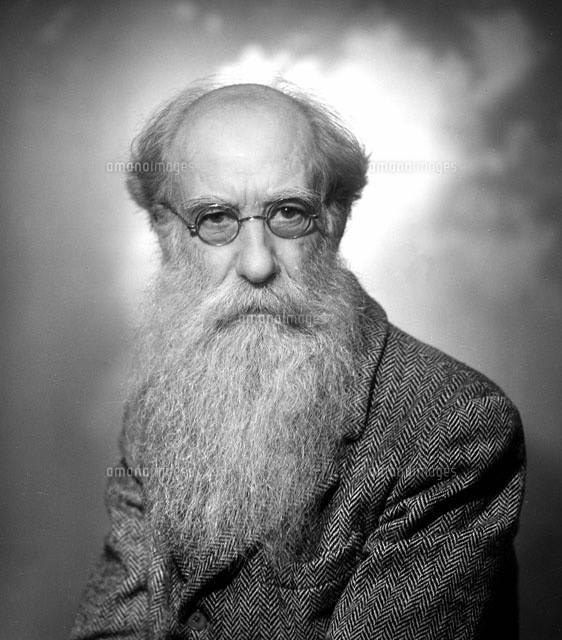
You can refer to my Saturday post on this fascinating polymath to learn more about his eclectic interests and his close associations with Gabriel Fauré and Claude Debussy. Things will only get more Koechlin-intensive as the week progresses and I pull out all the stops. (You certainly won’t catch me pulling at that beard.)
For today, I hope you will join me for a selection from Koechlin’s music inspired by Rudyard Kipling’s “The Jungle Book” and some of his very famous work as an orchestrator. The music will be recognizable, even if, apparently, the orchestrator is not.
We’ll be crushing on Koechlin, among our featured composers, this Monday from 4 to 7 p.m. EST, on WWFM – The Classical Network and wwfm.org.
Monday marks the 150th anniversary of the birth of the remarkable French composer Charles Koechlin – whose name, it turns out, I have been mispronouncing for years (as if the “oe” were the equivalent of an umlauted “o” and the “ch” sounded like “sh”). In reality, the “oe” is said like an accented “e” (é) and the “ch” is hard, like a “k.” Who knew? Chalk it up to the composer’s German ancestry. Everyone repeat after me, then: Kake-LAN.
Koechlin had many enthusiasms. He was interested in medieval music, Bach, travel, and stereoscopic photography. He was a communist sympathizer, a pantheist, and an athlete. He was also extraordinarily prolific, perhaps due to all the time he saved by not shaving. Koechlin had one of the most enviable beards in all of classical music. Children would ask him why he grew his beard so long, and he would respond, “Because I like it!”
He was especially interested in early film stars (he wrote works in tribute to Ginger Rogers, Douglas Fairbanks, Charles Chaplin and especially Lillian Harvey, who he basically stalked) and the “Jungle Books” of Rudyard Kipling. He wrote a series of orchestral works inspired by Kipling, which span most of his creative life. These were composed in a wide array of styles. Koechlin’s language could encompass impressionism, neo-classicism, polytonality and even quasi-serialism.
Despite being a figure of such energetic creativity, Koechlin is associated in most people’s minds with his orchestrations, especially those for Fauré’s “Pélleas and Mélisande” and Debussy’s “Khamma.” He also orchestrated Cole Porter’s ballet “Within the Quota.”
Naturally, I’ll be playing some of his original music on WWFM The Classical Network and wwfm.org, late Monday afternoon, to mark the big day, but it’s on Thursday morning that I’ll really be doing it up right, with FIVE HOURS of Koechlin’s music and orchestrations, on WPRB 103.3 FM and wprb.com. Curious to hear what he did with Schubert’s “Wanderer Fantasy?” Tune in then. We’ll also hear his wacky “Seven Stars Symphony” (like Messiaen, he had a weakness for the ondes martenot), and much more.
As for the pronunciation of his name, I’ll keep working on it. However, I can’t imagine that there’s that much “kake” in “Koechlin,” even if it is his 150th birthday.
He maintained a filing cabinet filled with drawings of imaginary medieval buildings, the properties of which he would periodically put up for sale in local journals by way of anonymous ads.
He founded his own church – Église Métropolitaine d’Art de Jésus Conducteur (Metropolitan Art Church of Jesus the Conductor) – of which he was the only member, and for which he promptly composed a mass.
He ate only white food: eggs, sugar, shredded bones, the fat of dead animals, veal, salt, coconuts, chicken cooked in white water, moldy fruit, rice, turnips, sausages in camphor, pastry, cheese (only white varieties), cotton salad (whatever that is) and certain kinds of fish.
When he died, his friends produced umbrella after umbrella after umbrella from his room.
Join me this afternoon on The Classical Network, as we celebrate the birthday of Erik Satie (1866-1925), an artist whose life was full of enigmas and ambiguities. Satie is often misclassified as an Impressionist. He was viewed by some (including Maurice Ravel) as a precursor to Debussy, even as he felt a greater affinity with the younger generation of composers who made up Les Six.
In practice, he elevated salon and cabaret music, of which he spoke slightingly. After he went back to school at mid-life in order to bone up on classical counterpoint, he stopped using bar lines in his manuscripts. He blazed trails later rediscovered by Morton Feldman and John Cage. He was a minimalist more than half a century before Minimalism.
Satie rejected the concept of musical development, believing it to be an unconscionable imposition on the public’s time. For him, brevity was the soul of wit. He could be profoundly ironic. Many of his piano pieces bear titles like “Trois Morceaux en forme de poire” (“Three Pieces in the Shape of a Pear”), “Embryons desséchés” (“Desiccated Embryos”), and “Véritables préludes flasques pour un chien” (“Veritable Flabby Preludes for a Dog”).
A friend of Jean Cocteau, the two collaborated on the surrealist curio “Parade,” written for the Ballets Russes, with choreography by Léonide Massine and costumes and set design by Picasso. The scenario involves three circus acts trying to attract an audience to an indoor performance.
It was one of a number of works that were introduced in the ‘Teens that attempted to create a scandal through the incorporation of low-brow elements into what was perceived as a high-brow art form. Hoping for a strong reaction, Cocteau pushed for the inclusion of such provocative “instruments” as a typewriter, a foghorn, a siren, milk bottles, gunshots, and boots sloshing around in a wash tub. The work bore the subtitle “A Realist Ballet.” The opening night audience responded by rioting energetically.
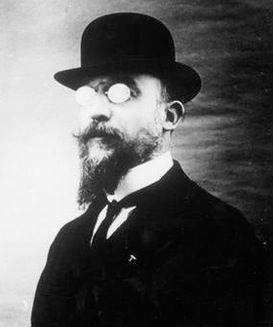
Politically, Satie was a radical socialist, who eventually teetered over into Communism. For a time, his wardrobe consisted of seven identical grey suits. During his quasi-religious phase, he went about in a priest-like habit. Then he became a “velvet gentleman.” Finally, during his communist period, he assumed the appearance of a bourgeois functionary, never to be seen without a bowler and an umbrella.
No one would have guessed that such an impeccable dresser would have lived out his life in clutter and squalor. When Satie died, his friends, who had never been invited back to his place in 27 years, were aghast at the piles of newspapers, the unending collection of umbrellas, and most of all the stacked grand pianos, the uppermost of which had been used by the composer as a repository for papers and parcels. Among these, and in the pockets of Satie’s wardrobe, were discovered a number of manuscripts which the composer had believed long lost.
We’ll be listening to Satie’s ballet “The Adventures of Mercury,” alongside works of Francis Poulenc, Werner Egk, Louis Spohr, Giacomo Puccini, Jon Vincent, Peter Mennin, and others today, between 4 and 7 p.m. EDT, on WWFM – The Classical Network and wwfm.org.
I find it fascinating that Germaine Tailleferre waited out World War II in Philadelphia. And yet I can never seem to find out very much about what she did while in exile.
Tailleferre was the only female member of Les Six, that loose collective of composers who rose to prominence in Paris in the late ‘teens and 1920s, under the guiding hand of Jean Cocteau. Her famous peers included Francis Poulenc, Darius Milhaud, Arthur Honegger, and Georges Auric. Louis Durey, a hard-line communist who went on to set poems by Ho-Chi Minh and Mao Zedong, is the one nobody remembers. (I wonder why.)
Tailleferre was strong-willed from the beginning. Her birth name was Taillefesse, but she changed it to spite her father, since the old man opposed her musical studies. However, she took piano lessons with her mother and was admitted to the Paris Conservatory. It was there that she met her future colleagues and that the prizes began to pile up. She also earned the friendship and received the support of Maurice Ravel.
In 1925, she married Ralph Barton, an American caricaturist, and moved to New York. Two years later, the couple returned to France, then divorced. Her career thrived in the 1920s and ‘30s. With the outbreak of World War II, however, she beat it back to the United States, leaving most of her scores at her home in Grasse, and, as I said, passed the war years in Philadelphia.
After the war, she again returned to France, where she resumed her career. As she got older, her pieces tended to be shorter, as she suffered from arthritis. She also wrote a lot for children and young pianists. She composed virtually right up until the time of her death in 1983, when she was 91 years-old. She wrote so much, in fact, that a lot of the music of her later years has never been published, and fresh discoveries from her output are being recorded all the time.
Happy birthday, Germaine Tailleferre! If anyone has any information on her activities in Philadelphia, I would be most curious to know.
The Concertino for Harp and Orchestra:
The lovely and wistful “Arabesque” for clarinet and piano:
He maintained a filing cabinet filled with drawings of imaginary medieval buildings, the properties of which he would periodically put up for sale in local journals by way of anonymous ads.
He founded his own church – Église Métropolitaine d’Art de Jésus Conducteur (Metropolitan Art Church of Jesus the Conductor) – of which he was the only member, and for which he promptly composed a mass.
He only ate white food: eggs, sugar, shredded bones, the fat of dead animals, veal, salt, coconuts, chicken cooked in white water, moldy fruit, rice, turnips, sausages in camphor, pastry, cheese (only white varieties), cotton salad (whatever that is) and certain kinds of fish.
When he died, his friends produced umbrella after umbrella after umbrella from his room.
Erik Satie (1866-1925) was an artist whose life was full of enigmas and ambiguities. He is often misclassified as an Impressionist. He was viewed by some (including Maurice Ravel) as a precursor to Debussy, even as he felt a greater affinity with the younger generation of composers who made up Les Six.
In practice, he elevated salon and cabaret music, of which he spoke slightingly. After he went back to school at mid-life in order to bone up on classical counterpoint, he stopped using bar lines in his manuscripts. He blazed trails later rediscovered by Morton Feldman and John Cage. He was a minimalist more than half a century before Minimalism.
Satie rejected the concept of musical development, believing it to be an unconscionable imposition on the public’s time. For him, brevity was the soul of wit. He could be profoundly ironic. Many of his piano pieces bear titles like “Trois Morceaux en forme de poire” (“Three Pieces in the Shape of a Pear”), “Embryons desséchés” (“Desiccated Embryos”), and “Véritables préludes flasques pour un chien” (“Veritable Flabby Preludes for a Dog”).
A friend of Jean Cocteau, the two collaborated on the surrealist curio “Parade,” written for the Ballets Russes, with choreography by Léonide Massine and costumes and set design by Picasso. The scenario involves three circus acts trying to attract an audience to an indoor performance.
It was one of a number of works that were introduced in the ‘Teens that attempted to create a scandal through the incorporation of low-brow elements into what was perceived as a high-brow art form. Hoping for a strong reaction, Cocteau pushed for the inclusion of such provocative “instruments” as a typewriter, a foghorn, a siren, milk bottles, gunshots, and boots sloshing around in a wash tub. The work bore the subtitle “A Realist Ballet.” The opening night audience responded by rioting energetically.
Politically, Satie was a radical socialist, who eventually teetered over into Communism. For a time, his wardrobe consisted of seven identical grey suits. During his quasi-religious phase, he went about in a priest-like habit. Then he became a “velvet gentleman.” Finally, during his communist period, he assumed the appearance of a bourgeois functionary, never to be seen without a bowler and an umbrella.
No one would have guessed that such an impeccable dresser would have lived out his life in clutter and squalor. When Satie died, his friends, who had never been invited back to his place in 27 years, were aghast at the piles of newspapers, the unending collection of umbrellas, and most of all the stacked grand pianos, the uppermost of which had been used by the composer as a repository for papers and parcels. Among these, and in the pockets of Satie’s wardrobe, were discovered a number of manuscripts which the composer had believed long lost.
Happy birthday, Erik Satie! I will have eggs for breakfast in your honor.
“Je te veux” (“I want you”):
Selections from “Parade,” with the Picasso designs. Love the horse!