They can’t all be Richard Strauss, Johann Strauss II, or Wolfgang Amadeus Mozart. In fact, it’s more often the case that they turn out to be Franz Xaver Mozart, Soulima Stravinsky, or Siegfried Wagner.
The latter were all musicians who strained to find their place in the sun, but in the end there was no escaping the enormous shadows of their old men.
You certainly couldn’t fault Siegfried Wagner for not trying. In his quest to continue the family business, he wrote no less than 18 operas. And the ones I have heard are not bad! Unfortunately, most of them seem to be in the tradition of Engelbert Humperdinck, whose most famous opus, of course, is “Hansel und Gretel.” But I happen to be easily charmed by fairy tale operas, so count me in!
“Der Bärenhäuter” (“The Bear-Skin Man”), “Der Kobold” (“The Goblin”), “Schwarzshwanenreich” (“Realm of the Black Swan”), and “An Halle ist Hütchen schuld” (“Hattie is to Blame for It All”) all contain fantastic or supernatural elements, but none of them bear the archetypal resonance of the “Ring Cycle,” much less push music into bold new harmonic territory like “Tristan und Isolde.” You have to admit, that’s a tough row to hoe, and none of Siegfried’s operas have entered the standard repertoire.
Of course, being a Wagner, everything was tied up with the old man. Siegfried was director of the Bayreuth Festival from 1908 to 1930. There is a delicious irony in the fact that Papa Wagner, an über-nationalist, anti-Semite, and all-around amoral satyr – whose bludgeoning music dramas fairly seethe with an obsessive focus on the redemptive power of women – would sire a child who would turn out to be homosexual. Perhaps he tempted fate by giving him such a butch name. A far cry from Wagner’s prototype of the he-man without fear, Siegfried became affectionately known to family as “Fidi.”
In the wake of a national scandal involving accusations of homosexual behavior among certain aristocrats in the Kaiser’s circle, the Wagners thought it was high time for Siegfried to take a bride. At the age of 45, he married 17 year-old Winifred Klindworth, who would later become a fanatical admirer of Adolf Hitler. She bore Siegfried four children. All of them would be closely involved with the workings of Bayreuth and uncomfortably close to the Nazi Party. The youngest of Siegfried’s children, Verena Wagner Lafferentz, died only weeks ago, at the age of 98.
Marriage did not “cure” Siegfried of his proclivity for the company of men. He died in 1930. At the very least, Nazism is one controversy he managed to avoid.
Happy birthday, Siegfried Wagner, on the 150th anniversary of your birth. You were certainly the nicest of the Wagners. You may not have been a chip off the old block, but in the Wagner family, to have been so would have been somewhat more than a mixed blessing.
The overture to “Der Bärenhäuter” (“The Bear-Skin Man”):
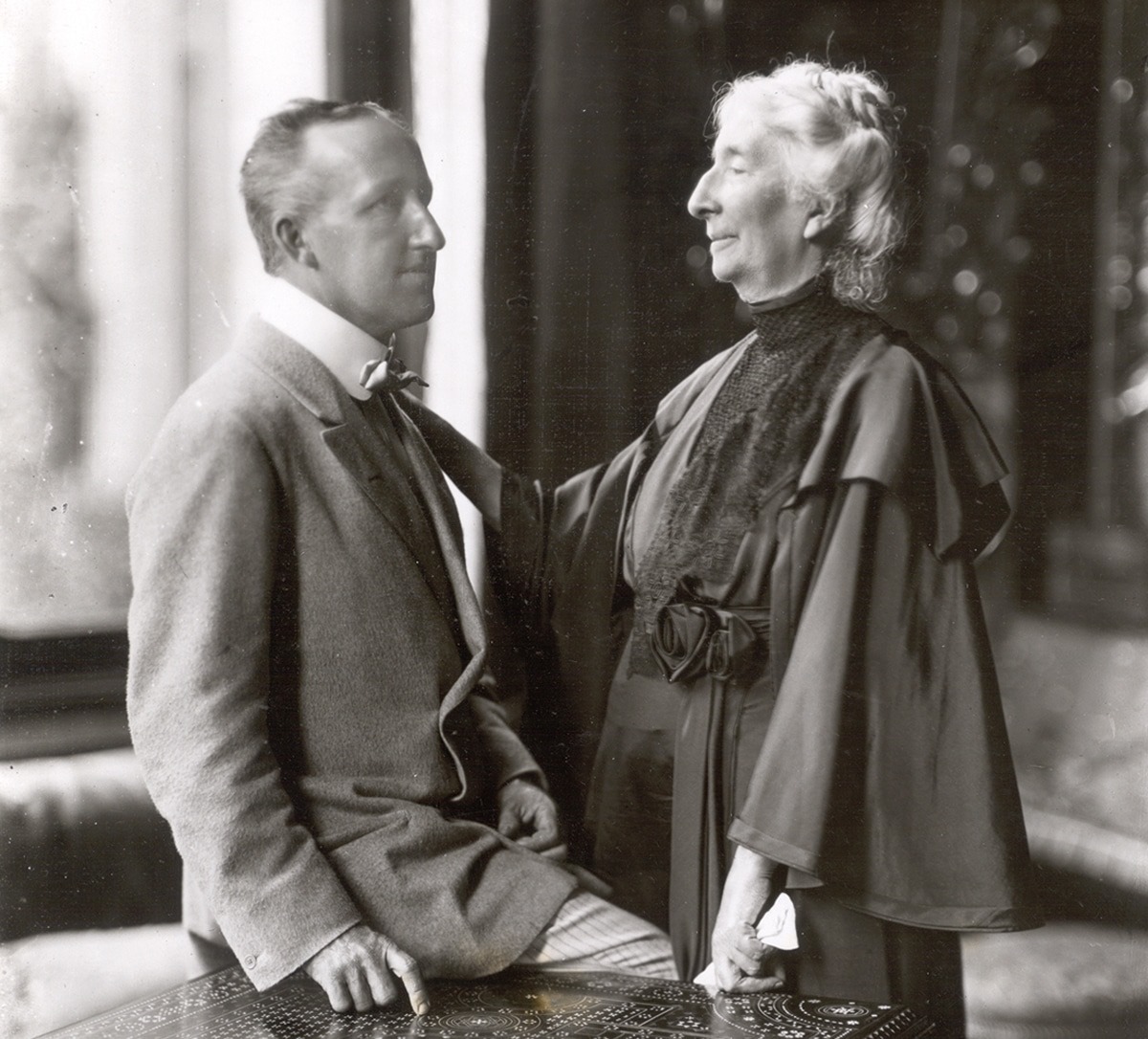
PHOTO: Siegfried Wagner, with his mother, Cosima