Tag: Goethe

  • Walpurgis Night Witches Music and Lore

    Walpurgis Night Witches Music and Lore

    When the sun sets this evening, we will be in the grip of Walpurgisnacht.

    Walpurgis Night, the eve of the feast day of Saint Walpurga, is a time when evil spirits are believed to roam the earth.

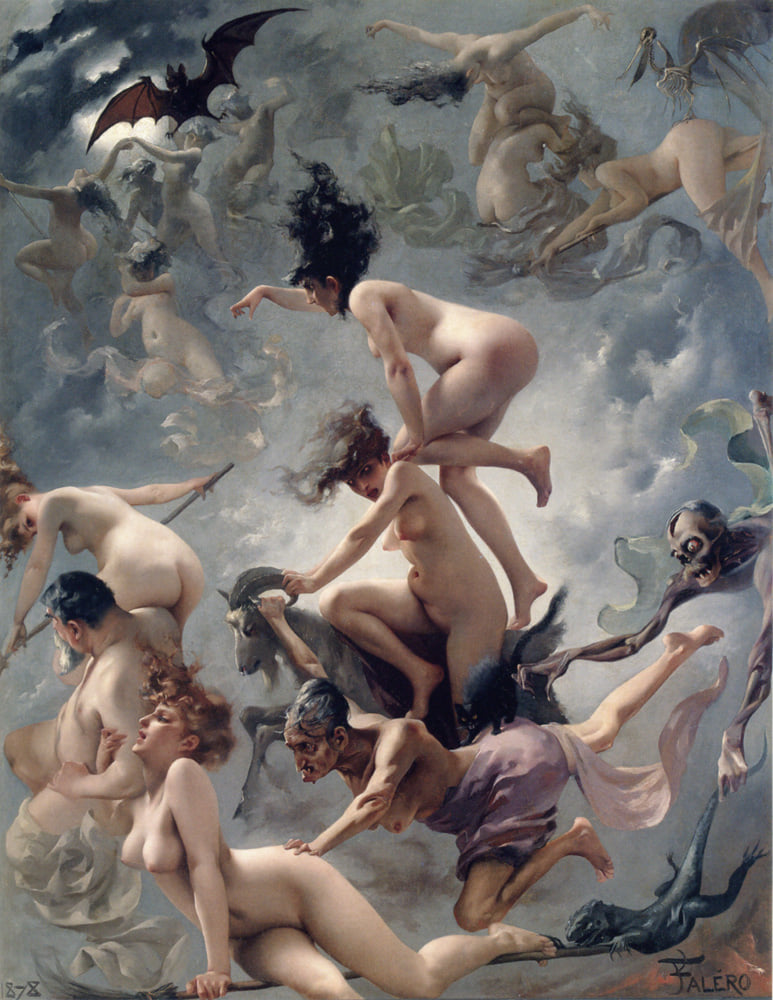
    Tradition holds that a witches’ sabbath and orgy of the damned are held atop the Brocken, the highest peak of the Harz Mountains in Central Germany. It’s the last blast of diablerie before May Day. In Goethe’s “Faust,” Mephistopheles guides his imperiled charge into a swirling cauldron of witches and demons so as to complete his moral degradation.

    Of course, “Faust” has inspired innumerable pieces of music – operas, symphonies, cantatas, piano works, and songs. Here, Samuel Ramey sings “Ecco il mondo” from the Walpurgis Night scene (Act II, Scene 2) of Arrigo Boito’s “Mefistofele.” Sadly, the clip doesn’t run to the end of the act.

    Another Goethe poem provides the basis for Felix Mendelssohn’s cantata “Die erste Walpurigisnacht” (“The First Walpurgis Night”), about a band of prankish Druids playing mind games with some superstitious Christians.

    Johannes Brahms wrote a song, “Walpurgisnacht,” on a text of Alexis Willibald (nom de plum of Wilhelm Häring), about a mother freaking out her daughter, telling her a thunderstorm is actually the sound of witches celebrating on the Brocken. As if that isn’t enough, she adds that she herself is a witch! Ha ha! So German.

    Walpurgis Night is an occasion for leaping over bonfires, vandalizing neighbors’ property, and rioting, all in the name of welcoming spring. It is not to be confused with St. John’s Eve (June 23), the night the demon Chernobog emerges from the Bald Mountain. More on that later, I’m sure.

    When this Brocken’s a-rockin’, don’t come a-knockin’! Cavort responsibly, everybody, and don’t forget to keep Walpurga in Walpurgisnacht!


    “The Goat of Mendes. The Devil himself!”

    See comments section for one of my treasured possessions: photo inscribed to Christopher Lee by Samuel Ramey!


    Luis Ricardo Falero, “Departure of the Witches” (a.k.a. “Witches Going to their Sabbath”), 1878

  • October Fantasy with Classical Music’s Dukas

    October Fantasy with Classical Music’s Dukas

    Classical music lends itself well to fantasy. And fantasy lends itself very well to October, the month of Halloween.

    Take the case of Paul Dukas, born on this date in 1865. Dukas composed an opera about Bluebeard and his sixth wife, and a so-called dance poem, “La Péri,” about a fatal encounter with a Persian fairy.

    But far and away his most famous work is “The Sorcerer’s Apprentice,” after Goethe, who based it on an ancient tale. It was that old wizard, Walt Disney, who did more for the piece than anyone else.

    The music is fantastic in more ways than one. Happy birthday, Paul Dukas!


    “La Péri”

    A production of “Ariane et Barbe-Bleue” from Lyon Opera

    https://www.arte.tv/en/videos/102815-000-A/dukas-ariane-et-barbe-bleue/

    The world’s most beloved vermin as “The Sorcerer’s Apprentice”

    https://video.disney.com/watch/sorcerer-s-apprentice-fantasia-4ea9ebc01a74ea59a5867853?fbclid=IwAR1YWAfXrDpearLdzRlxlpKC1Phe9aCh8D-Mxcz0sPkMP4rKPyEr2bTG_zs

  • Walpurgis Night: Witches, Music, and Mayhem

    Walpurgis Night: Witches, Music, and Mayhem

    Walpurgis Night, the eve of the feast day of Saint Walpurga, is a time when evil spirits are believed to roam the earth. Tradition holds that a witches’ sabbath and orgy of the damned are held atop the Brocken, the highest peak of the Harz Mountains in Central Germany. It’s the last blast of diablerie before May Day. In Goethe’s “Faust,” Mephistopheles guides his imperiled charge into a swirling cauldron of witches and demons so as to complete his moral degradation.

    Of course, “Faust” has inspired innumerable pieces of music – operas, symphonies, cantatas, piano works, and songs. Here, Samuel Ramey sings “Ecco il mondo” from the Walpurgis Night scene (Act II, Scene 2) of Arrigo Boito’s “Mefistofele.” Sadly, the clip doesn’t run to the end of the act.

    Another Goethe poem provides the basis for Felix Mendelssohn’s cantata “Die erste Walpurigisnacht” (“The First Walpurgis Night”), about a band of prankish Druids playing mind games with some superstitious Christians.

    Johannes Brahms wrote a song, “Walpurgisnacht,” on a text of Alexis Willibald (nom de plum of Wilhelm Häring), about a mother freaking out her daughter, telling her a thunderstorm is actually the sound of witches celebrating on the Brocken. As if that isn’t enough, she adds that she herself is a witch! Ha ha! So German.

    Walpurgis Night is an occasion for leaping over bonfires, vandalizing neighbors’ property, and rioting, all in the name of welcoming spring. It is not to be confused with St. John’s Eve (June 23), the night the demon Chernobog emerges from the Bald Mountain. More on that later, I’m sure.

    Don’t forget to keep Walpurga in Walpurgisnacht, everybody! Enjoy a socially-distanced sabbath and remember to cavort safely – in masks!


    “The Goat of Mendes! The Devil himself.”


    Luis Ricardo Falero, “Departure of the Witches” (a.k.a. “Witches Going to their Sabbath,”1878)

  • Goethe’s Walpurgis Night Music on The Classical Network

    Goethe’s Walpurgis Night Music on The Classical Network

    Goethe is king on Walpurgis Night.

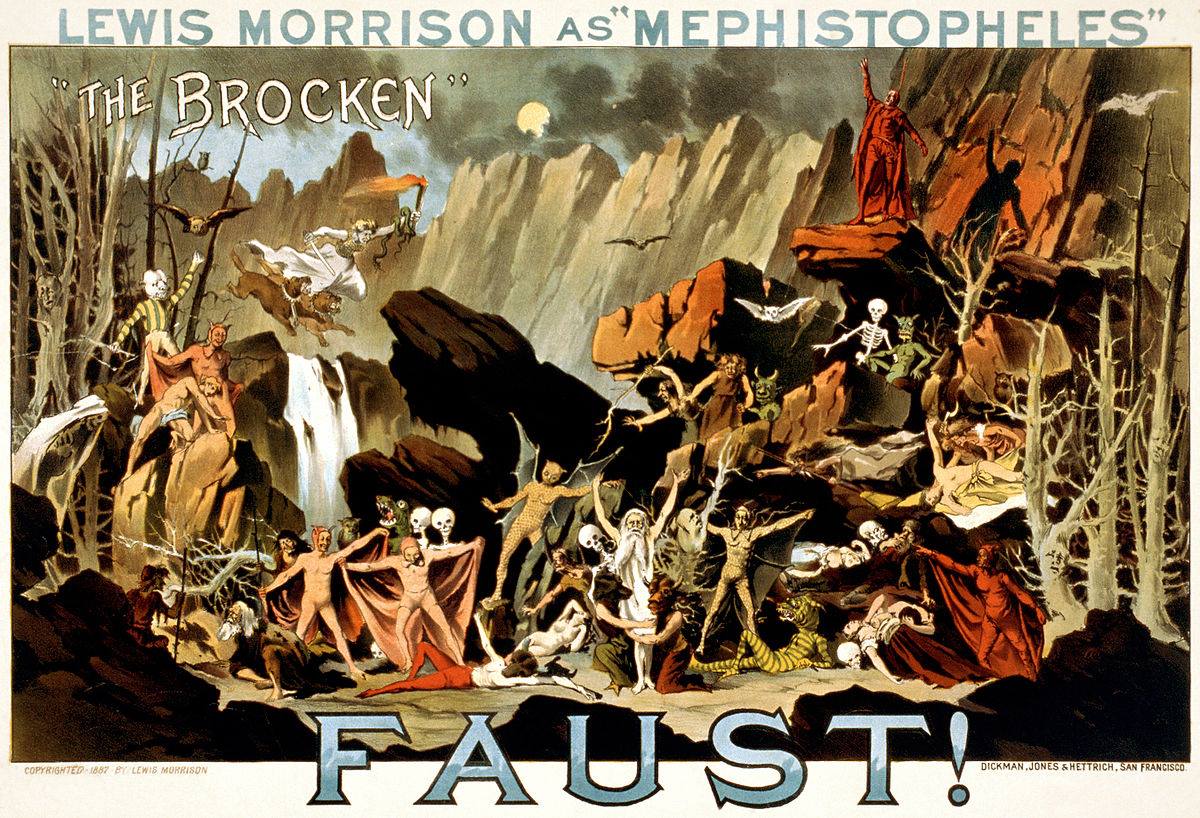
    Walpurgis Night, the eve of the feast day of Saint Walpurga, is a time when evil spirits are believed to roam the earth. Tradition tells of a witches’ sabbath and orgy of the damned held atop the Brocken, the highest peak of the Harz Mountains in Central Germany. It’s the last blast of diablerie before May Day. In Goethe’s “Faust,” Mephistopheles guides his imperiled charge into a swirling cauldron of witches and demons so as to complete his moral degradation.

    This Monday afternoon on The Classical Network, we’ll have some musical depictions of Faust and Mefistopheles. Luciano Pavarotti will sing the role of Faust in the Classical Walpurgis Night scene (no witches, but a romantic interlude with the shade of Helen of Troy, sung by Montserrat Caballé) from Arrigo Boito’s “Mefistofele.” We’ll hear the irresistible ballet music from Charles Gounod’s “Faust.” Then, clearly relishing his demonic laughter, Bryn Terfel will sing “Mephistopheles’ Serenade.”

    Felix Mendelssohn wrote a cantata, after Goethe’s “Die erste Walpurgisnacht” (“The First Walpurgis Night”), in which prankish Druids get the best of their superstitious occupiers. It ain’t “Faust,” but it will do.

    The afternoon will open with Wilhelm Stenhammar’s overture, “Excelsior!” The score is prefaced by a motto which begins, “Yet each in him may find a native longing/To rise and travel far and far away,” lifted from – you guessed it – “Faust.” As time allows, we’ll also hear Charles-Valentin Alkan’s “Quasi-Faust” from his “Grande Sonata,” Edward MacDowell’s “Hexentanz,” and Edmond Dédé’s “Mephisto Masqué” (complete with kazoo choir). To place a seal upon our musical pact, Carlos Paita will rock the Brocken with Hector Berlioz’s “Symphonie fantastique.”

    There’s plenty percolating for Walpurgis Night, this Monday from 4 to 7 p.m. EDT, on WWFM – The Classical Network and wwfm.org.


    More about Lewis Morrison, a remarkable figure who achieved world fame as Mephistopheles, here:

    http://www.blackpast.org/aah/morris-morris-w-lewis-morrison-1845-1906

  • WPRB’s Walpurgis Night Pledge Drive

    WPRB’s Walpurgis Night Pledge Drive

    You don’t have to sell your soul for great music, but we sure would appreciate your support.

    This Sunday morning on WPRB, I’ll be tossing my pointy hat into the ring – or pentagram, as the case may be – in an attempt to elicit your contributions, on the eve of Walpurgis Night. Walpurgis Night, the night before the feast day St. Walpurga, is a time when evil spirits are believed to roam the earth. There’s a memorable scene in Goethe’s “Faust,” with witches gathered for an orgy of the damned on the Brocken, the highest peak of the Harz Mountains. So don’t be surprised if there is a fair amount of witchery – and Goethe – reflected in my musical selections.

    Walpurgis Night also happens to be the eve of May Day. We’ll temper the horror with equally pagan cavortings around the May Pole, replete with mummers, hobby horses, and musical depictions of Robin and Marian. And, as if that weren’t enough, Sunday is also a full moon, so get ready for a cosmic convergence of lunatic proportions. Tobias Robison of “Masterclassics” (heard Tuesday mornings on WPRB) will be my sorcerer’s apprentice, as we venture to conjure your pledges.

    Remember that WPRB is independently owned and operated. The station relies on listener support for the bulk of its operating budget. When you make a financial commitment to WPRB, you not only support off-the-beaten-path classical music, you provide a variegated platform for stimulating programming in all genres, with on-air hosts fully engaged in putting together their own playlists and sharing the music they love. This makes for a uniquely rewarding radio experience.

    For the convenience of true believers everywhere (to say nothing of its staff), WPRB is adding a sustaining member option. For as low as $10 a month, you can make an ongoing commitment to the station by way of an automatic charge to your credit card. The commitment can be for whatever amount you decide, but $10 a month is the minimum. The donation will continue, in perpetuity, until you tell us to stop, which you may do at any time by emailing cancel@wprb.com. It’s that easy.

    A sustaining membership means you’ll never have to renew, and that WPRB can save time, paper, and postage on not having to remind you. Think about all that lost revenue at the end of a year, as memberships lapse. It could be weeks before the station secures a renewal. I mean, you’re going to renew anyway, right? The hassle is eliminated with a sustaining membership.

    WPRB has until May 4 to acquire 1000 unique pledges. Anyone who donates tomorrow morning between 7 and 10 EDT will be eligible for one of three prize drawings (one per hour), which could make you the winner of a fistful of lovingly curated CDs. That’s above and beyond any of the other loot to which you’re entitled for the amount of your pledge. Call 609-258-1033 or visit pledge.wprb.com.

    Toby and I will be raising hell and dancing around the maypole, this Sunday morning from 7 to 10 EDT, on WPRB 103.3 FM and wprb.com. Thank you for your ongoing support of Classic Ross Amico.


    Luis Ricardo Falero, “Departure of the Witches” (a.k.a. “Witches Going to their Sabbath,”1878)

Tag Cloud

Aaron Copland (92) Beethoven (95) Composer (114) Film Music (123) Film Score (143) Film Scores (255) Halloween (94) John Williams (187) KWAX (229) Leonard Bernstein (101) Marlboro Music Festival (125) Movie Music (138) Opera (202) Philadelphia Orchestra (89) Picture Perfect (174) Princeton Symphony Orchestra (106) Radio (87) Ralph Vaughan Williams (85) Ross Amico (244) Roy's Tie-Dye Sci-Fi Corner (290) The Classical Network (101) The Lost Chord (268) Vaughan Williams (103) WPRB (396) WWFM (881)

DON’T MISS A BEAT

Receive a weekly digest every Sunday at noon by signing up here


RECENT POSTS