Tag: Goyescas

  • Enrique Granados: A Spanish Musical Master

    Enrique Granados: A Spanish Musical Master

    Yesterday, I wrote about the untimely death of Enrique Granados in connection with his delayed return from the U.S., after being invited to the White House by Woodrow Wilson following the sensational debut of his opera “Goyescas” at the Metropolitan Opera. Granados’ ship was torpedoed in the English Channel by a German U-boat, and the composer drowned when attempting to save his wife.

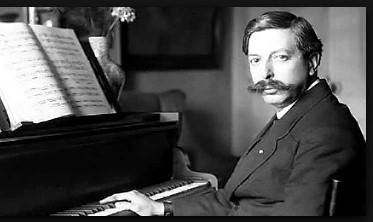
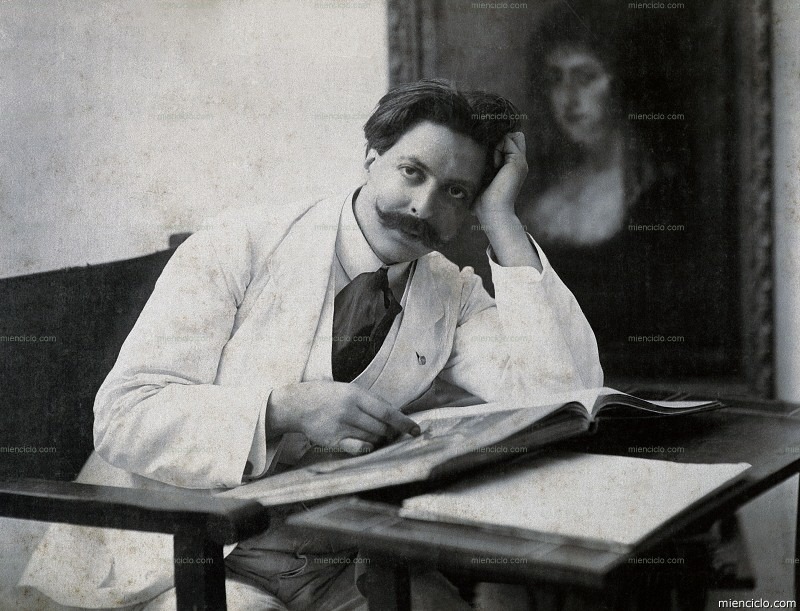
    Granados was born on this date in 1867. He is best-remembered, of course, for his delectable piano miniatures, which contain music of great beauty and sensitivity. He’s sometimes described as “the Spanish Chopin.” I prefer to think of him as “the Spanish Grieg.” And that is not in any way to damn him with faint praise. He may be my favorite Spanish composer.

    Here’s a pleasing recital by Pablo Matías Becerra (including “Valses poéticos,” Spanish Dance No. 2 “Oriental,” “El pelele,” Spanish Dance No. 7 “Arabesca,” “Allegro de concierto,” and “Escenas románticas”)

    Anyone looking to gain a more comprehensive overview of the scope of Granados’ compositional output could do worse than to seek out three volumes of his orchestral works recorded by Pablo González and the Barcelona Symphony Orchestra and National Orchestra of Catalonia, on the Naxos label.

    Also, a piece for piano, organ, and three choruses, called “Song of the Stars,” lost for nearly a century.

    None of the orchestral pieces rise to the level of the piano music, in my opinion, but they all contain some very charming, wholly neglected music. One of the volumes includes a half-hour symphonic poem, “Dante” (little charm here, perhaps, but plenty of drama), which will surely modify your view of the composer.

    Just before Granados’ fateful homeward journey from New York, he made some live-recorded player piano rolls for the Aeolian Company’s “Duo-Art” system. Here are two of them.

    Granados playing “The Maiden and the Nightingale” from “Goyescas”

    And the Spanish Dance No. 5 “Andaluza”

    In 1909, he began a piano concerto. This was interrupted by “Song of the Stars” and the operatic version of “Goyescas.” The concerto would be left unfinished at the time of Granados’ death.

    In 2011, the sketches were rediscovered and a realization undertaken. Keep in mind, the completed work is purely conjectural, the first movement built on two surviving fragments. The other movements were adapted from existing Granados works: the Spanish Dance No. 2 “Oriental” and “Capricho español” (for Movement II) and “Allegro de concierto” (for Movement III). Here’s a performance in concert.

    An ironic footnote: one of the Granados’ sons, also named Enrique, became a champion swimmer, who competed in the 1952 Summer Olympics.

    Happy birthday, Enrique Granados. And gracias.


    Alicia de Larrocha plays “Goyescas,” in its original guise

    The operatic version
  • Ernest Schelling: Jersey Boy and Granados’ Fate

    Ernest Schelling: Jersey Boy and Granados’ Fate

    You might say that Ernest Schelling was a Jersey boy who made good. He also happened to be responsible, in part, for the death of Enrique Granados.

    Schelling, a celebrated pianist who for a period of three years became the exclusive pupil of Ignacy Paderewski, was born in Belvidere, NJ on this date in 1876.

    A child prodigy, he made his debut at Philadelphia’s Academy of Music at the age of 4. At 7, he was admitted to the Paris Conservatory. Among the other notable musicians he worked with were Hans Huber, Moritz Moszkowski, and Theodor Leschetizky. Leschetizky was the pupil of Carl Czerny, who of course studied with Beethoven.

    As a conductor, Schelling became music director of the Baltimore Symphony Orchestra, which he led from 1935 to 1937. Well before Bernstein, he conducted the New York Philharmonic Young People’s Concerts, beginning in 1924. They were such a success, he took them on tour, with stops in Philadelphia, Los Angeles, London, and Rotterdam.

    Schelling gave the U.S. premiere of Granados’ piano cycle “Goyescas.” In fact it was he who encouraged the composer to craft the music into an opera. Granados liked the idea, and “Goyescas” was given its first performance at the Metropolitan Opera in 1916.

    It created such a sensation that Woodrow Wilson – former president of Princeton University and former governor of New Jersey – invited the composer to the White House, an offer Granados could hardly refuse. Granados postponed his homeward journey. A few weeks later, he was drowned in the English Channel, after his ship, the S.S. Sussex, was torpedoed by a German submarine.

    Thanks a lot, Ernest Schelling – and by the way, happy birthday.


    Schelling plays Liszt’s Sonata in B minor:

    Willem Mengelberg conducts Schelling’s “A Victory Ball:”

    A selection from Schelling’s “Suite Fantastique:”


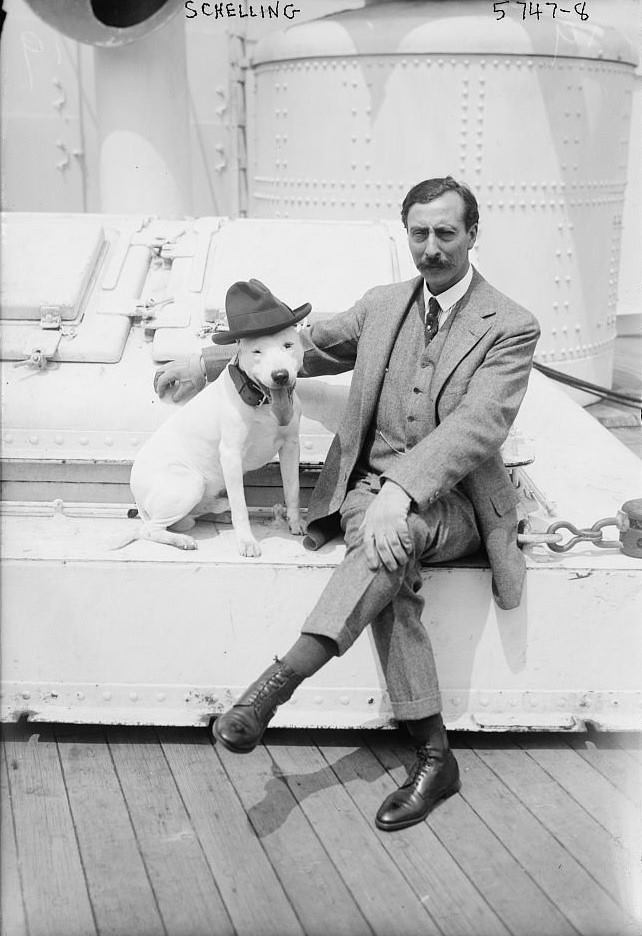
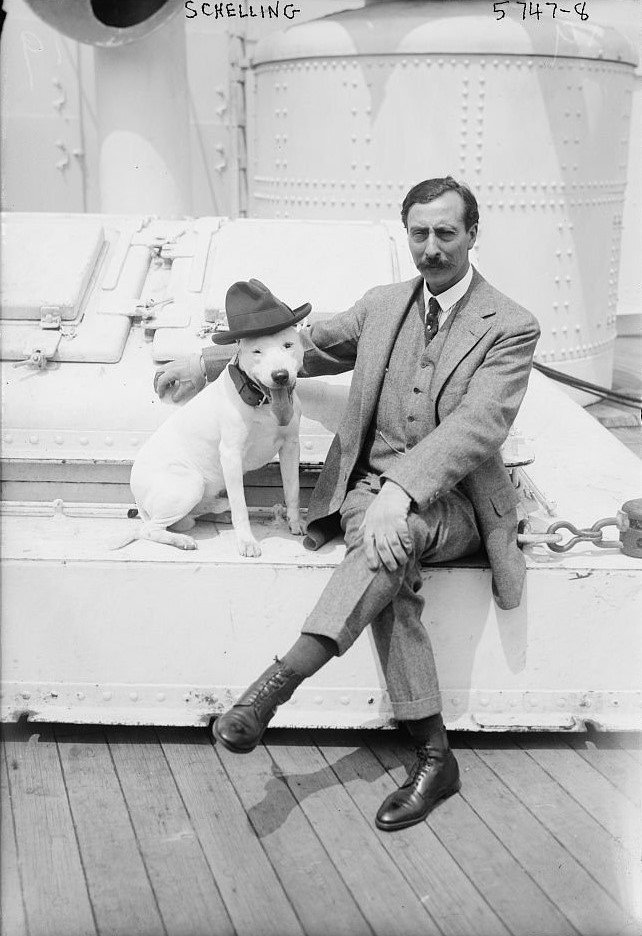
    PHOTO: Shipboard with Ernest Schelling and friend

  • Ernest Schelling A Jersey Boy’s Dark Legacy

    Ernest Schelling A Jersey Boy’s Dark Legacy

    You might say that Ernest Schelling was a Jersey boy made good. He also happened to be responsible, in part, for the death of Enrique Granados.

    Schelling, a celebrated pianist who for a period of three years became the exclusive pupil of Ignacy Paderewski, was born in Belvidere on this date in 1876. A child prodigy, he made his debut at Philadelphia’s Academy of Music at the age of 4. At 7, he was admitted to the Paris Conservatory. Among the other notable musicians he worked with were Hans Huber, Moritz Moszkowski, and Theodor Leschetizky. Leschetizky was the pupil of Carl Czerny, who of course studied with Beethoven.

    As a conductor, Schelling became music director of the Baltimore Symphony Orchestra, which he led from 1935 to 1937. Well before Bernstein, he conducted the New York Philharmonic Young People’s Concerts, beginning in 1924. They were such a success, he took them on tour, with stops in Philadelphia, Los Angeles, London and Rotterdam.

    Schelling gave the U.S. premiere of Granados’ piano cycle “Goyescas.” In fact it was he who encouraged the composer to craft the music into an opera. Granados liked the idea, and “Goyescas” was given its first performance at the Metropolitan Opera in 1916. It created such a sensation that Woodrow Wilson invited the composer to the White House, an offer Granados could hardly refuse. He postponed the date of his journey home, and was killed a few weeks later, after his ship, the S.S. Sussex, was torpedoed by a German submarine.

    Thanks a lot, Ernest Schelling – and by the way, happy birthday.


    Schelling plays Liszt’s Sonata in B minor:

    Willem Mengelberg conducts Schelling’s “A Victory Ball:”

    A selection from Schelling’s “Suite Fantastique:”


    PHOTO: Ernest Schelling (right) with friend. His ship didn’t sink.

  • Granados Premiere on WPRB for 150th Year

    Granados Premiere on WPRB for 150th Year

    Plenty of world premiere recordings this morning on WPRB, thanks to the Naxos label, as we celebrate the 150th anniversary of the birth of Spanish master Enrique Granados. Right now, we’re listening to his “Suite on Galician Songs,” a 30-minute, folk-inflected work for orchestra. In the 8:00 hour, we’ll hear his “Song of the Stars,” a masterpiece gone missing for nearly a century, scored for piano, organ and three choruses. We’ll also have songs, instrumental music, the complete one-act opera “Goyescas,” and the rarely-heard symphonic poem “Dante,” between now and 11 a.m. EDT. We subscribe to the maxim “No Spain, no gain,” on WPRB 103.3 FM and wprb.com.

  • Granados at 150 A Musical Celebration on WPRB

    Granados at 150 A Musical Celebration on WPRB

    Enrique Granados’ life may have been cut short in 1916, at the age of only 49, but his music continues to age well. Granados is widely celebrated for his evocative aural postcards of his native Spain, most notably his collections of piano miniatures, the “Spanish Dances,” and “Goyescas” (the latter inspired by paintings of Francisco Goya). But there was so much more to this remarkable composer.

    Join me this Thursday morning on WPRB, as we celebrate the 150th anniversary of Granados’ birth. We’ll get the day started with a full five hours of his music, including an assortment of his rarely-heard orchestral, choral and chamber works, and, yes, even a recording of his one-act opera “Goyescas,” which the composer cannily adapted from his popular piano pieces.

    Performers will include Ataulfa Argenta, the Barcelona Symphony Orchestra, Maria Bayo, the Beaux Arts Trio, Montserrat Caballe, Alicia de Larrocha, Victoria de los Angeles, Andres Segovia, Ramón Vargas and Granados himself.

    The playlist will also feature the rarely-heard symphonic poem “Dante,” and world premiere recordings of the “Suite on Galician Folk Songs,” “Song of the Stars,” and the lyric poem “Liliana,” as arranged by Granados’ friend and champion Pablo Casals.

    If you’re a fan of fandangos with a craving for castanets, you’ll want to join me, this Thursday morning from 6 to 11 EDT, on WPRB 103.3 FM and wprb.com. We’ll do it up grand for Granados, on Classic Ross Amico.

Tag Cloud

Aaron Copland (92) Beethoven (95) Composer (114) Film Music (123) Film Score (143) Film Scores (255) Halloween (94) John Williams (187) KWAX (229) Leonard Bernstein (101) Marlboro Music Festival (125) Movie Music (138) Opera (202) Philadelphia Orchestra (89) Picture Perfect (174) Princeton Symphony Orchestra (106) Radio (87) Ralph Vaughan Williams (85) Ross Amico (244) Roy's Tie-Dye Sci-Fi Corner (290) The Classical Network (101) The Lost Chord (268) Vaughan Williams (103) WPRB (396) WWFM (881)

DON’T MISS A BEAT

Receive a weekly digest every Sunday at noon by signing up here


RECENT POSTS