Tag: Hector Berlioz

  • Berlioz Smithson and a Symphony of Obsession

    Berlioz Smithson and a Symphony of Obsession

    You might say Hector Berlioz was a man easily governed by his passions.

    When denied by the object of his affection, the Irish Shakespearean actress Harriet Smithson, he responded by furiously scrawling his “Symphonie fantastique,” an opium-induced fever dream that imagines his own execution for her murder. She then reappears during the course of a witches’ sabbath to mock his corpse. Perhaps counterintuitively, Smithson went for this in a big way, and the two were married on this date in 1833. Franz Liszt was one of the witnesses. Hardly surprising, but the union would not be a happy one.

    Here’s a knock-out recording of “Dream of a Witches’ Sabbath,” from “Symphony fantastique,” led by Argentinean powder keg Carlos Païta:

    The witches’ sabbath quotes from the portentous “Dies irae,” a medieval plainchant still widely familiar thanks to its continued use in countless horror movies (including the opening credits of “The Shining”).

    Liszt also used this theme as the basis for a set of variations for piano and orchestra, which he titled “Totentanz” (“Dance of Death”). Marvel here at the mercurial György Cziffra, captured live in concert:

    Damn, if these Romantics weren’t so Halloween…

  • Viola Power on The Classical Network Today!

    Viola Power on The Classical Network Today!

    “Vioooooooooooola!”

    Once heard, the plaintive cries of Sergiu Celibidache are not easily forgotten.

    No doubt Celi would find solace, if only he could tune in for today’s Noontime Concert on The Classical Network, as Kristina Giles will perform selections from the 41 Caprices, Op. 22, by “the Paganini of the Viola,” Bartolomeo Campagnoli (1751-1827).

    The program is another presented by Gotham Early Music Scene, or GEMS. GEMS is a non-profit organization that supports and promotes artists and organizations in New York City generally devoted to Early Music.

    Giles’ recital was recorded at St. Bartholomew’s Church, 325 Park Avenue. Free concerts are held at St. Bart’s during the regular season on Thursdays at 1:15 p.m. For more information and a complete schedule of GEMS events, look online at gemsny.org.

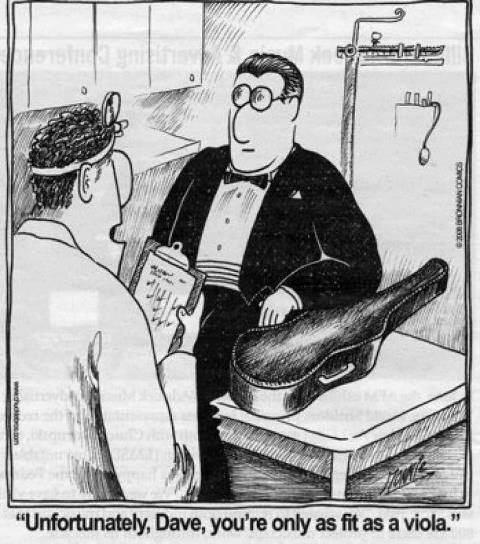
    It’s long been my ambition to do a viola show, so stick around following today’s concert broadcast for an afternoon of works written for this much-derided instrument that, as stated in Giles’ program notes, is “usually lost in the middle harmonies of orchestral and chamber music.”

    We’ll hear concertos, chamber music, and more by Margaret Brouwer, Paul Hindemith, Joseph Joachim, Peter Lieberson, Bohuslav Martinu, Wolfgang Amadeus Mozart, Georg Philipp Telemann, and Ralph Vaughan Williams.

    Of course, in my ideal world, between selections I would love to share your viola jokes. But even if I don’t (and I probably won’t), please feel free to leave them in the comments section below.

    You’ll find abundant prototypes at Viola Central:

    https://violacentral.com/best-viola-jokes/

    BONUS! Bill McGlaughlin will share selections from “Harold in Italy” – composed at the request of Niccolò Paganini, who wanted to show off his new viola – as part of his week-long survey of the works of Hector Berlioz on “Exploring Music,” tonight at 7.

    In the meantime, we’ll give the viola some love, from 12 to 4 p.m. EDT, on WWFM – The Classical Network and wwfm.org.

  • Berlioz Passion Madness & Rediscovered Mass

    Berlioz Passion Madness & Rediscovered Mass

    Hector Berlioz was a man easily swept away by his passions.

    When denied by the object of his affection, the Shakespearean actress Harriet Smithson, he furiously scribbled his “Symphonie fantastique,” an opium-induced fever dream that imagines his own execution for murdering her. She then reappears during the course of a witches’ sabbath to mock his corpse. Perhaps counterintuitively, Smithson went for this in a big way, and the two were married, though, perhaps unsurprisingly, not at all happily.

    Berlioz’s biography is full of crazy adventures . Whether in regard to his affairs of the heart, his musical education, or his notorious compositions, always he was driven by mercurial passions and excesses.

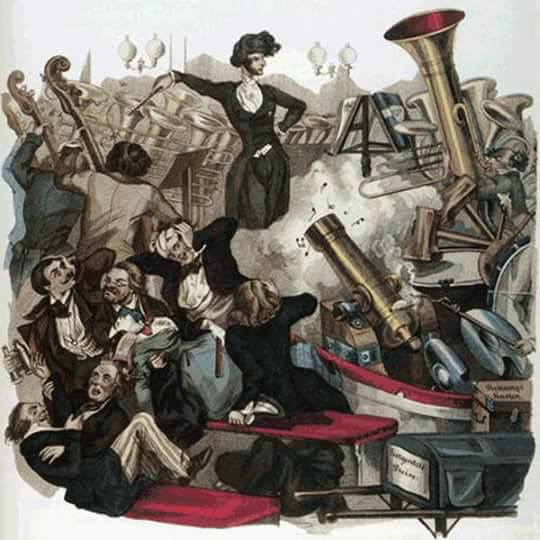
    He lived large, and he dreamed big music. One need only think of his Requiem, with its massive choir, antiphonal brass ensembles, and 16 timpani. The composer even suggested the orchestration could be doubled or tripled, depending on the size of the space. (However, in an uncharacteristic show of restraint, he recommended the chorus be kept to only 400 singers, except for some of the larger numbers.)

    Today is Berlioz’s birthday. It also happens to be the Christmas season, so naturally my thoughts gravitate to “L’enfance du Christ” – which, I must say, is not my favorite Berlioz work. Fortunately, he also composed a “Messe solennelle” in 1824, on virtually the same subject – the commemoration of the Feast of the Slaughter of the Holy Innocents by King Herod in his attempt to the snare the baby Jesus.

    Berlioz was only 20 years-old at the time, but he was already driven by his creative demons. If you are a fan of the composer, you must hear this piece, which teems with presentiments of many of his major works, including the “Symphonie fantastique,” “The Damnation of Faust,” “Benvenuto Cellini” (with its “Roman Carnival Overture”), and of course the Requiem.

    Berlioz himself played the tam-tam at the work’s premiere, and in his excitement gave it such a blow that it blew everyone back in their pews. The “Messe” was favorably received (unusual for this composer), but Berlioz decided he hated the piece and wound up burning the score.

    The work was believed lost for nearly 170 years, until it was rediscovered by a Belgian schoolteacher in an organ gallery in Antwerp in 1991. Sir John Eliot Gardiner conducted the first modern performance two years later, and directs the live recording we will hear this afternoon.

    I’ll preface that with a knock-out recording of the “Symphony fantastique,” led by the Argentinean powder keg Carlos Païta.

    First, today’s Noontime Concert will feature the Dolce Suono Ensemble. Artistic director and flutist Mimi Stillman will join David Osenberg for “Music in the Second Capital,” which explores the musical tastes of the Founding Fathers and Philadelphia musical culture in the last quarter of the 18th century. Featured composers will include Wolfgang Amadeus Mozart, Franz Joseph Haydn, Johann Christian Bach, Arcangelo Corelli, Antonio Vivaldi, and Francis Hopkinson. That begins at 12:00 EST.

    I’ll be along following the concert, around 1:40. Our celebration of Berlioz begins at 2:00. The passionate seething will continue unabated until 4:00, on WWFM – The Classical Network and wwfm.org.

  • Symphony or Concerto Genre Bending Music

    Symphony or Concerto Genre Bending Music

    Hector Berlioz’s “Harold in Italy” (viola and orchestra). Leonard Bernstein’s Symphony No. 2 “The Age of Anxiety” (piano and orchestra). Benjamin Britten’s Cello Symphony. These genre-bending works break all the rules. Are they symphonies or concertos?

    We won’t be hearing any of these this Thursday morning on WPRB, though we will be listening to a full playlist of “concertos” for orchestra and “symphonies” for orchestra with prominent part for solo instrumentalist.

    Generally speaking, the concerto for orchestra is a large-scale piece in which the various sections of an orchestra are each given an opportunity to shine. The symphonies with a prominent solo instrument? Well, there is really is no rule for that. Why Vincent d’Indy’s “Symphony on a French Mountain Air,” for piano and orchestra, is not a concerto is anyone’s guess, beyond the French custom, usually applied to organ works, of calling concertos symphonies. Call it Gallic contrarianism, if you will.

    Highlights of the morning will include music by one-time Classic Ross Amico guest Zhou Tian, whose Concerto for Orchestra has been nominated in the category of “Best Contemporary Classical Composition” for this year’s Grammy Awards; organ “symphonies” by Alexandre Guilmant and Aaron Copland; a concerto “symphonique” for piano and orchestra by Henry Charles Litolff; and a “symphony” for solo piano by Charles-Valentin Alkan.

    Prepare yourself for identity crises and plenty of disorientation, this Thursday morning from 6 to 11 EST, on WPRB 103.3 FM and wprb.com. Then, why should things be different this week from any other, on Classic Ross Amico?

  • Berlioz Love Passion and Revenge

    Berlioz Love Passion and Revenge

    Quite possibly, he is the quintessential Romantic composer, with a capital “R.”

    Hector Berlioz revolutionized art music, even as his personal life practically rolled off the rails with unbridled emotion. My favorite Berlioz anecdote concerns Harriet Smithson, the equally fiery Irish actress who resisted his advances. Then he wooed her with a symphony – the grandest of grand gestures – and they lived miserably ever after, at least for a time. Berlioz could not understand spoken English, and Smithson didn’t know French, but apparently they were both fluent in volcanic passion.

    They married in 1833. (Franz Liszt was a witness at the civil ceremony.) It would prove to be a tempestuous relationship between two strong-willed artists. The couple had a son, but then Berlioz found a mistress and Smithson began to drink. Eventually, they separated, but Berlioz continued to support Smithson until her death in 1854.

    Ostensibly both the “Symphonie fantastique” (1830) – with a program of unrequited love that drives an artist to attempt suicide through an overdose of opium (and the nightmarish visions he experiences as a result) – and its seldom-heard sequel, “Lelio, or The Return to Life” (1831) – in which the artist finds consolation in music and literature, especially Shakespeare – were inspired by Smithson. That was the official story endorsed by the composer.

    However, Berlioz being Berlioz, after writing the symphony, but before Smithson could hear it, he reacted to her indifference by entering into a rebound relationship. This resulted in a quick engagement. Then the composer went to Italy to study, having been awarded a Prix de Rome scholarship. While there, he learned that his recent fiancée, prompted by her mother, had made a more favorable match.

    Berlioz flew into a rage, and he was determined to have his revenge. His plan involved assuming the disguise of a woman and taking a coach back to Paris with a pair of double-barrel pistols in order to put an end to his inconstant lover, her new beau, her mother, and then himself. If the pistols happened to jam, he would poison everyone instead. As luck would have it, he left the costume in the side pocket of the carriage, and this gave him a chance to cool down.

    In his day, much of Berlioz’s music was deemed hopelessly avant-garde and met with confusion, if not outright hostility. We know better now. Right?

    Join me for selections by Berlioz, Miecyszlaw Karlowicz, and Elliot Carter, all birthday celebrants, this afternoon between 4 and 7 p.m. EST, on WWFM – The Classical Network and wwfm.org.


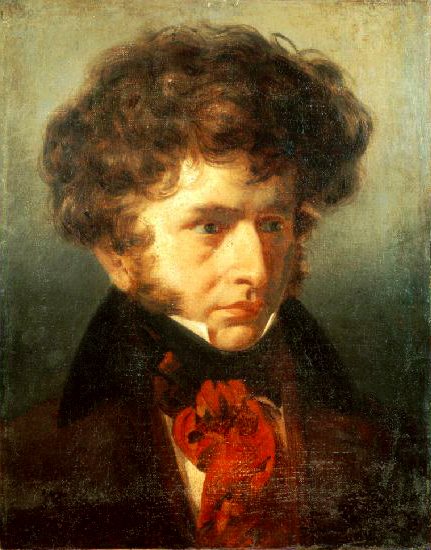
    Berlioz in 1832. Believe it or not, I once had hair like this.

Tag Cloud

Aaron Copland (92) Beethoven (95) Composer (114) Film Music (119) Film Score (143) Film Scores (255) Halloween (94) John Williams (185) KWAX (229) Leonard Bernstein (99) Marlboro Music Festival (125) Movie Music (134) Opera (198) Philadelphia Orchestra (86) Picture Perfect (174) Princeton Symphony Orchestra (106) Radio (87) Ralph Vaughan Williams (85) Ross Amico (244) Roy's Tie-Dye Sci-Fi Corner (290) The Classical Network (101) The Lost Chord (268) Vaughan Williams (102) WPRB (396) WWFM (881)

DON’T MISS A BEAT

Receive a weekly digest every Sunday at noon by signing up here


RECENT POSTS