Tag: Hedy Lamarr

  • George Antheil Bad Boy Genius Rediscovered

    George Antheil Bad Boy Genius Rediscovered

    This week on “The Lost Chord,” Trenton’s Bad Boy makes good.

    George Antheil, self-proclaimed “Bad Boy of Music” (the title of his autobiography), sparked one of classical music’s great riots when his “Ballet Mécanique” was unveiled in Paris in 1926.

    The work made preposterous demands on performers and audience alike, with its battery of player pianos, sirens, bells, and airplane propellers – all difficult to coordinate, but worth it, if they were to transform concert halls into free-for-alls and secure Antheil’s status as enfant terrible. His notoriety earned him the respect, friendship, and envy of Paris’ artistic community. From the stage, he watched as Man Ray punched a heckler in the face, as Satie cheered, “Quel precision!,” and as Ezra Pound shouted, “Shut up, you are all stupid idiots!” Pound became one of Antheil’s most ardent champions, taking a break from poetry to publish an inflammatory book, “Antheil and the Treatise on Harmony.”

    Antheil speculated, perhaps facetiously, that his mechanistic nightmares may have been inspired by his having been born across the street from a noisy machine shop. In fact, a number of his works bear the boisterous imprint of the factories he knew in Trenton as a boy, including the “Airplane Sonata,” “The Death of Machines,” and the “Sonata Sauvage.”

    It was all rather forward-looking. Antheil was one of the first composers to search beyond conventional instruments for musical means. He not only presaged the alien soundscapes of Edgard Varèse, but also anticipated the stupefying repetitions of minimalism – though infusing his own compositions with enough violence to prevent them from ever becoming numbing. Stravinsky was his hero. He fed off the savagery of “The Rite of Spring,” then followed the master’s subsequent hairpin turn into neoclassicism. Both artists suffered a backlash from former idolaters who felt betrayed by what was perceived as a cowardly retreat into the past.

    In Antheil’s case, his reputation never recovered. The one-two punch of his Piano Concerto No. 2, transparently influenced by Bach, and the spectacular failure of his “Ballet Mécanique” to impress at its American premiere at Carnegie Hall (mostly due to faulty machinery) cast Antheil, rebel angel that he was, from the lofty heights of notoriety to the slag heap of has-beenery.

    But if it is true that the remainder of his career was indeed that of a has-been, we should all be so lucky.

    The composer of six symphonies, Antheil also wrote books on endocrinology and speculative war tactics, a murder mystery, a nationally syndicated column of advice to the lovelorn, and over 30 Hollywood film scores. With the actress Hedy Lamarr, he patented a torpedo guidance system that became the basis for modern Bluetooth, Wi-Fi, and cellular phone technology.

    I hope you’ll join me for music by this eccentric and multitalented figure, including “Ballet Mécanique,” in all its original, uncompromising glory; then selections from his neo-classical Piano Concerto No. 2, his wartime Symphony No. 4, and dance music from his score to the ballet film noir “Specter of the Rose.”

    That’s “Antheil Establishment” – three days before the composer’s birthday anniversary – on “The Lost Chord,” now in syndication on KWAX, the radio station of the University of Oregon!


    Clip and save the start times for all three of my recorded shows:

    PICTURE PERFECT, the movie music show – Friday at 8:00 PM EDT/5:00 PM PDT

    SWEETNESS AND LIGHT, the light music program – Saturday at 11:00 AM EDT/8:00 AM PDT

    THE LOST CHORD, unusual and neglected rep – Saturday at 7:00 PM EDT/4:00 PM PDT

    Stream them, wherever you are, at the link!

    https://kwax.uoregon.edu/


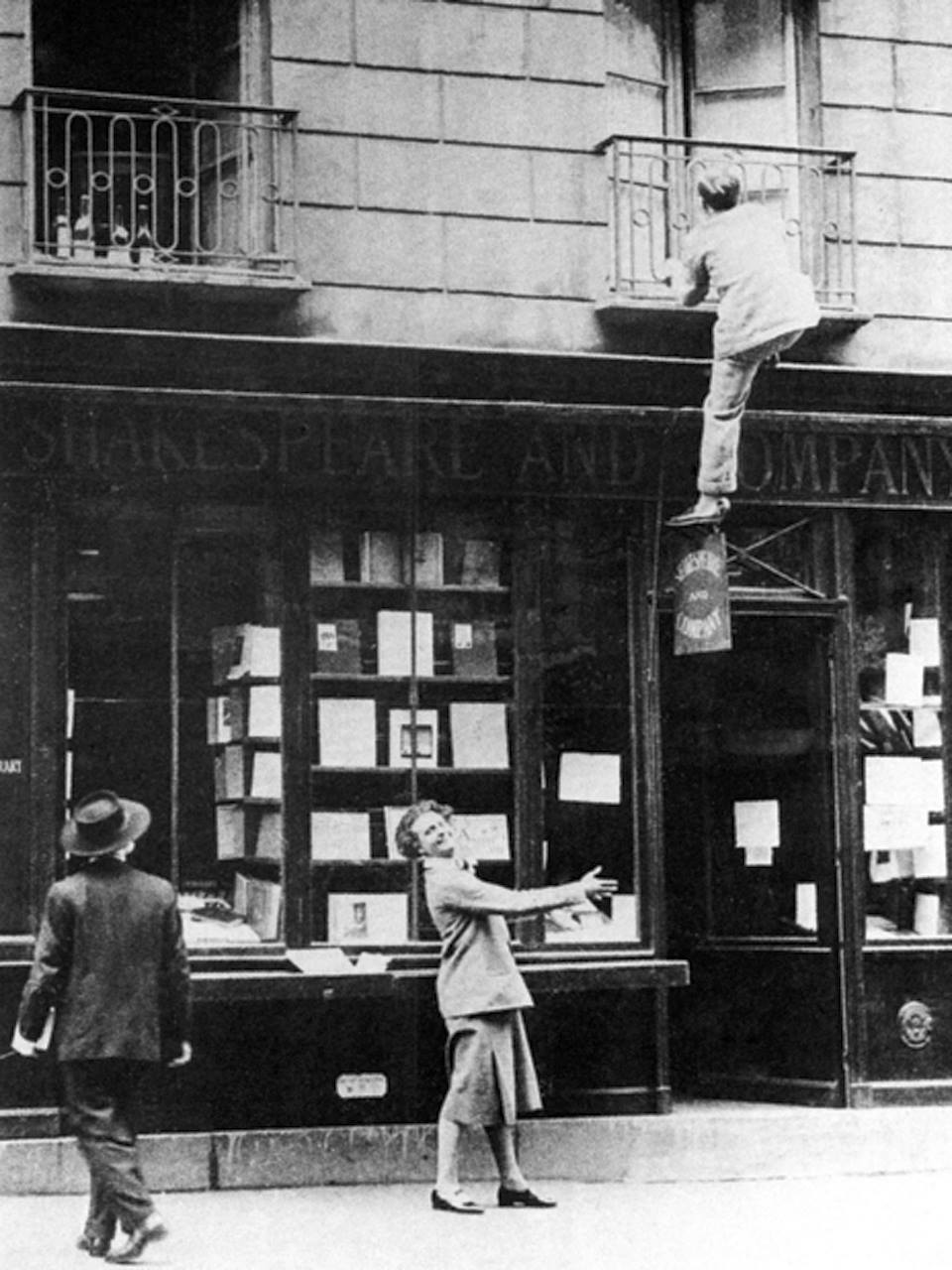
    PHOTO: Sylvia Beach acts as spotter as Antheil ascends to his second-story apartment, located above the legendary Parisian bookshop Shakespeare and Company
  • George Antheil Trenton’s Avant-Garde Genius

    Big doings with the @[100064825684990:2048:Rotary Club of Trenton, New Jersey] today, as I’ll be delivering a lunchtime talk about Trenton’s own George Antheil. Antheil was the avant-garde composer and super-pianist who put Paris on its ear in the 1920s. He then devoted himself to symphonies, ballets for Balanchine, and even Hollywood film scores. But he also did a lot of other things, including laying the groundwork, with actress Hedy Lamarr, for the kind frequency-hopping spread-spectrum technology that decades later would be employed for wireless phones, GPS, and Wi-Fi. Always fun to talk about Antheil, as he was such an eccentric and versatile character. I didn’t realize there would be a shout-out on the Rotary Club’s Facebook page, but here it is!

  • George Antheil Trenton’s Bad Boy of Music

    George Antheil Trenton’s Bad Boy of Music

    This Sunday night on “The Lost Chord,” Trenton’s Bad Boy makes good.

    George Antheil, self-proclaimed “Bad Boy of Music” (the title of his autobiography), sparked one of classical music’s great riots when his “Ballet Mécanique” was unveiled in Paris in 1926.

    The work made preposterous demands on performers and audience alike, with its battery of player pianos, sirens, bells, and airplane propellers – all difficult to coordinate, but worth it, if they were to transform concert halls into free-for-alls and secure Antheil’s status as enfant terrible. His notoriety earned him the respect, friendship, and envy of Paris’ artistic community. From the stage, he watched as Man Ray punched a heckler in the face, as Satie cheered, “Quel precision!,” and as Ezra Pound shouted, “Shut up, you are all stupid idiots.” Pound became one of Antheil’s most ardent champions, taking a break from poetry to publish an inflammatory book, “Antheil and the Treatise on Harmony.”

    Antheil speculated, perhaps facetiously, that his mechanistic nightmares may have been inspired by his having been born across the street from a noisy machine shop. In fact, a number of his works bear the boisterous imprint of the factories he knew in Trenton as a boy, including the “Airplane Sonata,” “The Death of Machines,” and the “Sonata Sauvage.”

    It was all rather forward-looking. Antheil was one of the first composers to search beyond conventional instruments for musical means. He not only presaged the alien soundscapes of Edgard Varèse, but also anticipated the stupefying repetitions of minimalism – though infusing his own compositions with enough violence to prevent them from ever becoming numbing. Stravinsky was his hero. He fed off the savagery of “The Rite of Spring,” then followed the master’s subsequent hairpin turn into neoclassicism. Both artists suffered a backlash from former idolaters who felt betrayed by what was perceived as a cowardly retreat into the past.

    In Antheil’s case, his reputation never recovered. The one-two punch of his Piano Concerto No. 2, transparently influenced by Bach, and the spectacular failure of his “Ballet Mécanique” to impress at its American premiere at Carnegie Hall (mostly due to faulty machinery) cast Antheil, rebel angel that he was, from the lofty heights of notoriety to the slag heap of has-beenery.

    But if it is true that the remainder of his career was indeed that of a has-been, we should all be so lucky.

    The composer of six symphonies, Antheil also wrote books on endocrinology and speculative war tactics, a murder mystery, a nationally syndicated column of advice to the lovelorn, and over 30 Hollywood film scores. With the actress Hedy Lamarr, he patented a torpedo guidance system that became the basis for modern Bluetooth, Wi-Fi, and cellular phone technology.

    I hope you’ll join me for music by this eccentric and multitalented figure, including “Ballet Mécanique,” in all its original, uncompromising glory; then selections from his neo-classical Piano Concerto No. 2, his wartime Symphony No. 4, and dance music from his score to the ballet film noir “Specter of the Rose.”

    Trenton’s “Bad Boy” makes good, on “Antheil Establishment,” this Sunday night at 10:00 EDT, on WWFM – The Classical Network and wwfm.org.

    Happy birthday, George Antheil (born July 8, 1900).


    Sylvia Beach acts as spotter as Antheil ascends to his second-story apartment, located above the legendary Parisian bookshop Shakespeare and Company

  • George Antheil Bad Boy of Music on WWFM

    George Antheil Bad Boy of Music on WWFM

    We’ll be breaking bad on today’s Noontime Concert on The Classical Network. I hope you’ll join me for music by Trenton’s own George Antheil.

    Antheil, the self-proclaimed “Bad Boy of Music,” was born in Trenton, NJ, in 1900. His “Ballet mécanique,” for synchronized player pianos, siren, electronic bells, xylophones and airplane propellers, caused a riot at its Paris premiere in 1926.

    We’ll hear a live concert performance of Antheil’s magnum opus, arranged for solo piano and eight loudspeakers, by Guy Livingston. Livingston, who makes his home in Paris, is one of the foremost authorities on Antheil and his music, having recorded the composer’s Piano Concerto No. 2, for New World Records, and an album of “The Lost Piano Sonatas,” for the Wergo label, from which we will also be sampling. In 2003, Livingston was artistic director of a George Antheil festival in Trenton.

    This performance took place at Tufts University in March, as part of a two-day festival, “The Film Music of George Antheil: The ‘Bad Boy’ in Paris and Hollywood.” The festival included the first American screening of a restored print of the experimental film “Ballet mécanique” by Fernand Léger and Dudley Murphy.

    At the time of the composer’s greatest success, Antheil and his wife lived in a one-bedroom apartment above Sylvia Beach’s Shakespeare & Company bookshop, a favorite haunt of Ezra Pound, Ernest Hemingway and James Joyce. Relishing his notoriety, Antheil carried a pistol, in a silk holster sewn into his jacket, which he would ostentatiously place on the piano prior to commencing a recital.

    Later, he was co-holder of a patent with actress Hedy Lamarr for a communications system based on frequency-hopping, as applied to radio-controlled torpedoes. Though the idea of spread spectrum became the basis for modern cell phone technology, neither Antheil nor Lamarr ever saw a dime for their invention.

    In his spare time, Antheil wrote a column of advice to the lovelorn for Esquire magazine, a couple of murder mysteries and a book on criminal endocrinology.

    It will be all-Antheil in the noon hour today. Then stick around for Ottorino Respighi’s rarely-heard lyric poem for soloists, chorus and orchestra, “La Primavera,” and Dame Ethyl Smyth’s “Serenade in D major,” among our featured works, from 12 to 4 p.m. EDT, on WWFM – The Classical Network and wwfm.org.

  • Hedy Lamarr Google Doodle Honors Trenton’s Antheil

    Hedy Lamarr Google Doodle Honors Trenton’s Antheil

    If Google is your search engine of choice, keep an eye out today for Trenton’s own George Antheil. Antheil makes an appearance in Google’s tribute to actress Hedy Lamarr on what would have been her 101st birthday.

    Not only was Lamarr marketed as the stunner she was, but she possessed a scientific curiosity decidedly at odds with her big screen persona. During WWII, she and Antheil devised a frequency-hopping system that would have prevented the Nazis from jamming radio-controlled Allied torpedoes.

    What this article doesn’t tell us is that Lamarr had initially approached Antheil, a neighbor, to discuss endocrinological matters (a noted polymath himself, Antheil had written books on the subject), in reference to increasing the size of certain of her “assets,” or that neither Lamarr or Antheil ever saw a cent for their patent, which went on to form the basis for modern wireless technology.

    Antheil, of course, was the self-proclaimed “Bad Boy of Music” (actually the title of his autobiography), who set Paris on its ear with his “Ballet Mécanique.” The work, conceived for 16 player pianos, 3 airplane propellers, 7 electric bells, and siren, instigated one of classical music’s most notorious riots. Later, the composer settled into a more conservative language to become one of America’s most performed composers.

    There was never anything romantic between Lamarr and Antheil. They were just two quirky, misunderstood, lonely, intelligent Americans looking to do their patriotic duty. Happy birthday, Hedy Lamarr, and thank you, Google, for acknowledging George Antheil.

    If you’re not a Google user, read more about it and see the animation here:

    http://www.cnn.com/2015/11/09/entertainment/hedy-lamarr-google-doodle-feat/

Tag Cloud

Aaron Copland (92) Beethoven (95) Composer (114) Film Music (123) Film Score (143) Film Scores (255) Halloween (94) John Williams (187) KWAX (229) Leonard Bernstein (101) Marlboro Music Festival (125) Movie Music (138) Opera (202) Philadelphia Orchestra (89) Picture Perfect (174) Princeton Symphony Orchestra (106) Radio (87) Ralph Vaughan Williams (85) Ross Amico (244) Roy's Tie-Dye Sci-Fi Corner (290) The Classical Network (101) The Lost Chord (268) Vaughan Williams (103) WPRB (396) WWFM (881)

DON’T MISS A BEAT

Receive a weekly digest every Sunday at noon by signing up here


RECENT POSTS