Tag: Irish

  • “Rood Awakening” on “The Lost Chord”

    “Rood Awakening” on “The Lost Chord”

    This week on “The Lost Chord,” it’s a Howard Ferguson Easter.

    Born in Belfast in 1908, Ferguson had ambitions to become a composer. To this end, he traveled to London, where he studied at the Royal College of Music with, among others, Ralph Vaughan Williams. He also met and befriended fellow student Gerald Finzi. He achieved early success with works like the Octet of 1933, and no less a personage than Jascha Heifetz recorded his Violin Sonata No. 1.

    Even so, over the decades his music has slipped from consciousness, no doubt helped by the fact that, by mid-life, he felt he had already said everything he had to say as a composer. He devoted his last four decades to musicological pursuits, editing and promoting works of Purcell, Schubert, and Finzi. In the 1990s, he also wrote a cookbook, “Cooking Solo.” Ferguson died in 1999, not long after his 91st birthday.

    Thankfully, he lived long enough to hear some fine recordings as part of a modest revival of his music in the 1980s and ‘90s. A number of his chamber works were released on the Hyperion label by fine musicians like Thea King and members of the Nash Ensemble; his Piano Concerto was recorded for EMI by Howard Shelley; and Richard Hickox conducted a disc of his orchestral works for Chandos.

    Also on the latter album is what turned out to be Ferguson’s last completed work, “The Dream of the Rood,” for chorus and orchestra, composed in 1958. After that, the composer embarked on a string quartet, but became frustrated by the lack of a fresh perspective and tore the thing up.

    “The Dream of the Rood” is based on an 8th century Anglo-Saxon poem that marries the Passion story with characteristics of the secular heroic tradition. The poem is framed by a narrator’s vision of a magnificent bejeweled tree. Upon closer inspection, however, he finds its jewels bespattered with blood. It becomes apparent that this tree is the very same upon which Christ was crucified.

    The middle portion of the poem is told from the tree’s perspective, with the tree being cut down and carried away for the purpose of the Crucifixion. The nails pierce the tree, yet man and tree endure, refusing to fall, bearing unimaginable pain for the sake of mankind. Just as Christ is resurrected, so is the Cross resurrected, now adorned with gold and silver. It is honored above all trees, just as Christ is honored above all men. The narrator gives praise to God, filled with hope at the prospect of eternal life and a desire to be nearer the glorious Cross.

    I hope you’ll join me for music by Howard Ferguson (you’ll get to hear the Octet too), on “Rood Awakening,” on “The Lost Chord,” now in syndication on KWAX Classical Oregon!

    ——–

    Clip and save the start times for all three of my recorded shows:

    PICTURE PERFECT, the movie music show – Friday at 8:00 PM EDT/5:00 PM PDT

    SWEETNESS AND LIGHT, the light music program – Saturday at 11:00 AM EDT/8:00 AM PDT

    THE LOST CHORD, unusual and neglected rep – Saturday at 7:00 PM EDT/4:00 PM PDT

    Stream them, wherever you are, at the link!

    https://kwax.uoregon.edu

    ——–
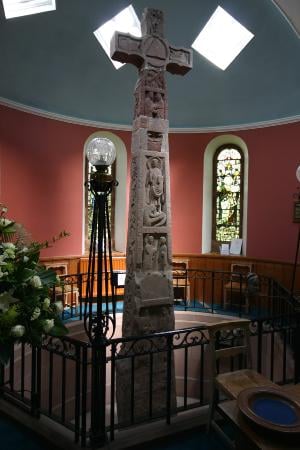

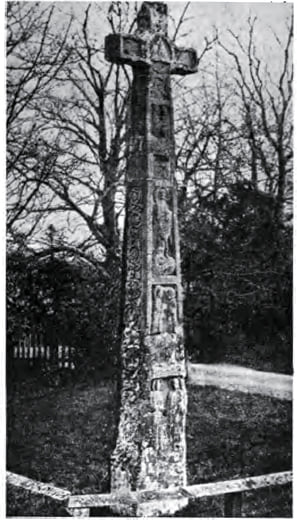
    PHOTOS: Portions of the poem are engraved on the 8th century Ruthwell Cross (top, as it appeared between 1823 and 1887; and bottom, at its current location at Ruthwell Church, Dumfriesshire, Scotland)

  • Farewell to Robert White

    Farewell to Robert White

    Unbelievable. Robert White, who could always be counted on to do a mean impression of Irish tenor John McCormack, died yesterday, the day after St. Patrick’s Day, at the age of 89. Dolores Cascarino and I had just written about him yesterday, in the comments section under my St. Patrick’s Day post. I suppose it’s hardly surprising, as White was always associated with Irish song.

    It’s amazing to contemplate that his career spanned eight decades, but already he was performing on the radio in 1942, celebrated as “the little John McCormack.” His repertoire would grow much more versatile than this monicker would suggest.

    In the late 1950s, he embarked on a career as a concert tenor. He performed with the New York Philharmonic and the Philadelphia Orchestra, but in the 1960s he also dipped a toe into what was then still considered arcane territory, when he embraced “early music.” Among other things, he sang in the U.S. premiere of Handel’s “Athalia.”

    But he also sang a lot of new music. He appeared in the first performance of Paul Hindemith’s “The Long Christmas Dinner” at Juilliard in 1963. Other prominent composers who wrote for him include Mark Adamo, William Bolcom, John Corigliano, Lukas Foss, Stephen Hough, Libby Larsen, Lowell Liebermann, Gian Carlo Menotti, Tobias Picker, Ned Rorem, and David Del Tredici.

    In the 1970s, White leaned into his success as an “Irish” tenor. He was actually born in the Bronx. He received his early training from his father and as a chorister at St. Jerome’s Church. At the age of 6, he made his radio debut as Bobby White. He recorded his first album, “Ring of Gold,” at the age of 7. His radio appearances teamed him with Bing Crosby, Frank Sinatra, and Humphrey Bogart.

    He undertook his formal studies at Hunter College, and then in Europe, where he attended, among other institutions, the American Academy at Fontainebleau, where he benefited from the guidance of Gérard Souzay and Nadia Boulanger.

    He later returned to Hunter College and Juilliard as a teacher. He also taught at Manhattan School of Music. He was twice invited to the White House, to perform for Presidents John F. Kennedy and Jimmy Carter.

    For years, whenever one of my air shifts happened to coincide with St. Patrick’s Day, I would play from White’s recording (with Ani Kavafian, Yo-Yo Ma, and Samuel Sanders) of Beethoven’s settings of Irish folk songs. White also made fine recordings for EMI, Virgin Classics, and Hyperion Records.

    R.I.P.


  • Raising a Pint to Barry Fitzgerald for St. Patrick’s Day

    Raising a Pint to Barry Fitzgerald for St. Patrick’s Day

    I try to watch “The Quiet Man” every year on St. Patrick’s Day, whether I need it or not. If, already a quarter of the way into the 21st century, this confirms that I am hopelessly out of touch, so be it. Someday, someone will pry this twee, politically-incorrect Irish fable from my cold dead hand.

    I’m working my way through the recent John Williams biography by Tim Greiving, and although I am having some major issues with it (the book, published by Oxford University Press, reads like a first draft, to put it kindly), it is obviously written with love and chock full of valuable information. I know Williams always speaks fondly of Victor Young, but it was interesting to learn that Young’s music for “The Quiet Man,” which Williams saw in the theater in 1953, was one of the first film scores that really made him sit up and take notice and made him consider the possibility of writing for the movies.

    I guess this makes sense, especially with having everything laid out chronologically in a biography. Progressions become clearer, and from the start Williams was always a gifted arranger. I mean, his first Academy Award was for his arrangements for Norman Jewison’s film of “Fiddler on the Roof,” and it was far from his first musical. Even apart from the movies, Williams was arranging for and accompanying Frank Sinatra, Vic Damone, Frankie Laine, and so many others. So he would have had a connoisseur’s appreciation of what Young achieved in his score for “The Quiet Man,” which positively overflows with inspiring arrangements of folk and popular song and sentimental ballads.

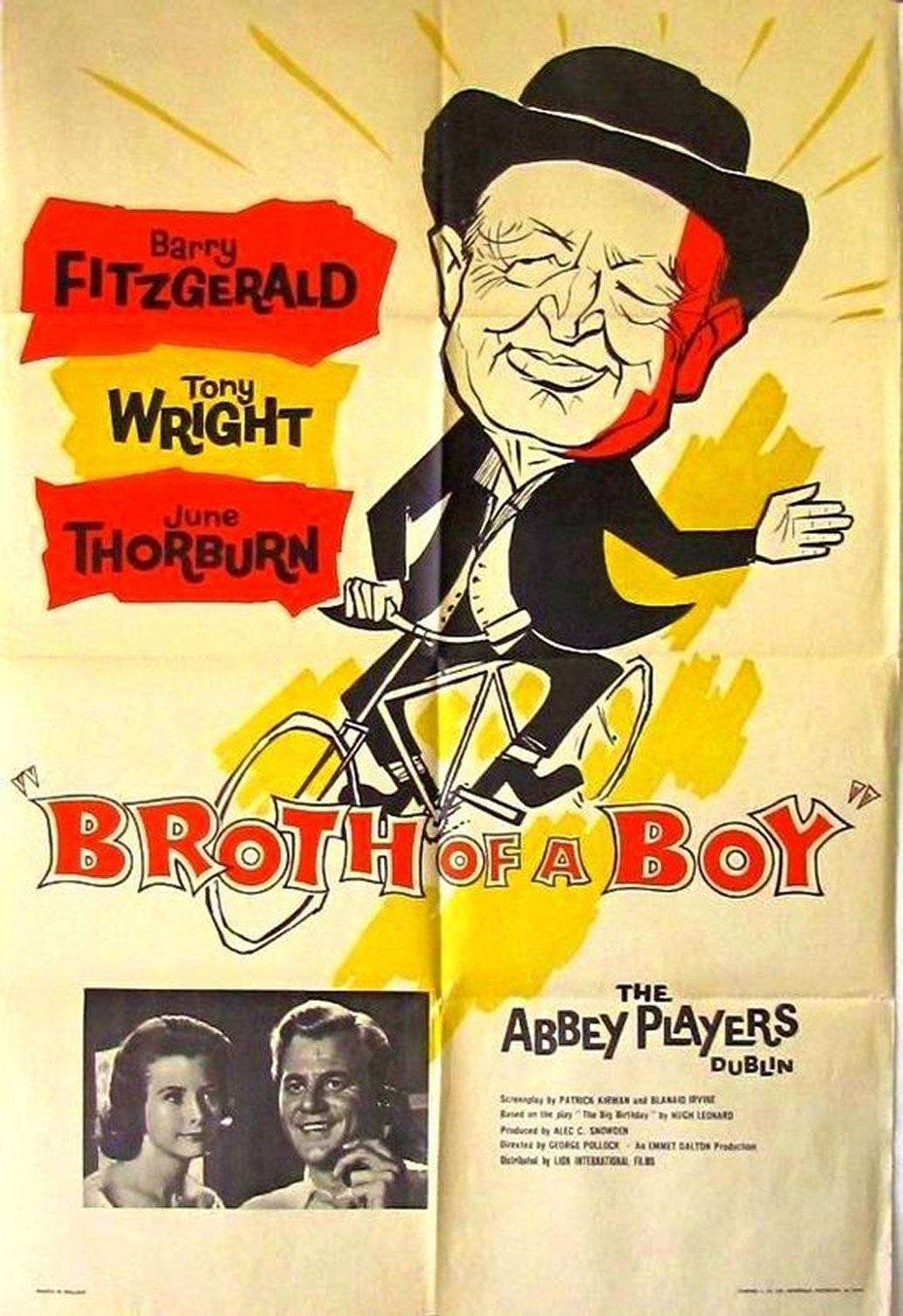
    On a related note, for a long time, after having run across some clips, probably on YouTube, I’ve wanted to see a film called “Broth of a Boy.” It stars Barry Fitzgerald (who plays the “Quiet Man’s” insatiably thirsty Michaeleen Oge Flynn) as the oldest man in the world. With that premise, how could it miss? Unfortunately, the film is seemingly unavailable in the United States – only intensifying my desire to see it – and the reviews I’ve read ranged from mildly charmed to middling. So I certainly knew not to expect a classic.

    Every year, around St. Patrick’s Day, I search for it, and what do you know, last night I found it on YouTube! The transfer is barely adequate, but you know how old movies are from the United Kingdom. Even the Alastair Sim version of “A Christmas Carol” (released in the U.K. as “Scrooge” in 1951 – a year before “The Quiet Man!”) looks like it was made in the 1930s. I don’t blame the technology; I blame post-war austerity.

    Anyway, “Broth of a Boy” looks older than its years, as for that matter, does Barry Fitzgerald. His character is supposedly 110. Fitzgerald died in 1961 at the age of 72. But here, in 1959, he looks tired. Or maybe he was just hammered the whole time.

    Be that as it may, if you’re a “Quiet Man” fan, I think you will find much to enjoy. The humor and characterizations are of the same cloth, and both films employ actors from Dublin’s Abbey Players – the National Theatre of Ireland – although, as far as I can tell, Fitzgerald is the only common denominator between the two.

    Alas, the screenplay isn’t as consistent or sharp, and the scenes are not always the most imaginatively captured. I sure do miss John Ford’s direction and Technicolor. The score, by Stanley Black, will never be mistaken for Victor Young. The film feels longer than its 77 minutes, but if you are a “Quiet Man” die-hard, you might want to give it a shot. Or have a few yourself, if you know what’s good for you.


  • Irish Ties Are Smiling on “The Lost Chord”

    Irish Ties Are Smiling on “The Lost Chord”

    “Oh! The praties they grow small over here…”

    Edward Joseph Collins (1886-1951) was born to Irish-American parents in Joliet, Illinois. Though he studied abroad with Max Bruch and Engelbert Humperdinck, it was in Chicago that he made his career. Nearly a generation older than Copland and Gershwin, he too found inspiration in African-American spirituals, cowboy songs, and jazz.

    Collins’ relationship to the Irish was a complex one. Nonetheless, he could not escape the pull of his heritage and its music. Join me this week, as the composer remembers the land of his forebears with three meditations on Irish folk song for St. Patrick’s Day.

    That’s “Irish Ties Are Smiling,” on “The Lost Chord,” now in syndication on KWAX Classical Oregon!

    ——–

    Clip and save the start times for all three of my recorded shows:

    PICTURE PERFECT, the movie music show – Friday at 8:00 PM EDT/5:00 PM PDT

    SWEETNESS AND LIGHT, the light music program – Saturday at 11:00 AM EDT/8:00 AM PDT

    THE LOST CHORD, unusual and neglected rep – Saturday at 7:00 PM EDT/4:00 PM PDT

    Stream them, wherever you are, at the link!

    https://kwax.uoregon.edu

Tag Cloud

Aaron Copland (92) Beethoven (95) Composer (114) Film Music (123) Film Score (143) Film Scores (255) Halloween (94) John Williams (187) KWAX (229) Leonard Bernstein (101) Marlboro Music Festival (125) Movie Music (138) Opera (202) Philadelphia Orchestra (89) Picture Perfect (174) Princeton Symphony Orchestra (106) Radio (87) Ralph Vaughan Williams (85) Ross Amico (244) Roy's Tie-Dye Sci-Fi Corner (290) The Classical Network (101) The Lost Chord (268) Vaughan Williams (103) WPRB (396) WWFM (881)

DON’T MISS A BEAT

Receive a weekly digest every Sunday at noon by signing up here


RECENT POSTS