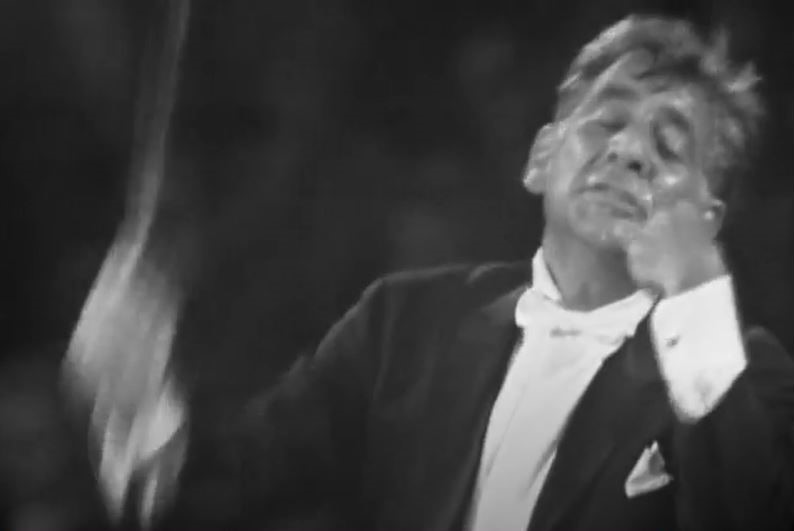
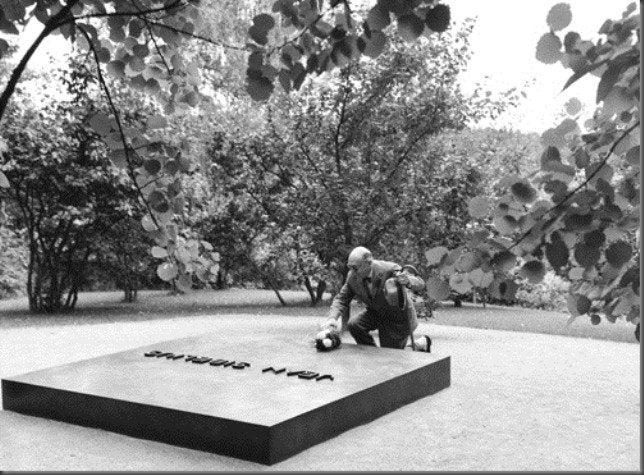
On his birthday anniversary, here’s Leonard Bernstein in 1966 to conduct probably my favorite symphony, the Symphony No. 5 by Jean Sibelius. I once heard him lead this glorious music at Carnegie Hall, around the time he made his Deutsche Grammophon recording with the Vienna Philharmonic. I’m happy to say, I never got over it. By 1987, Bernstein learned to really savor the nobility of the climactic “swan theme.”
Later, I nearly heard him conduct the Sibelius 1st in Philadelphia, with the student orchestra of the Curtis Institute of Music, but it was toward the end of his life, and sadly he had to cancel due to illness.
I’ve lost track of the Carnegie program, but I’m sure I’ve got it somewhere. Here’s a record of what else was on the concert.
At the root of the “Kalevala” is song. Not only were the myths and legends that comprise the Finnish national epic preserved and handed down by generations of peasant bards, song plays an important part in the actual narrative.
Everyone sings in this sorcerers’ tale. Objects, weather, and worlds are sung into existence. Duels are fought in song. Punishment is doled out. There is literally magic in song.
Little wonder, then, that this sparsely populated country would produce so many musicians. Every other Finn, it seems, is a conductor. So have Finland’s composers returned to the “Kalevala” as an enduring source of inspiration.
In the dim past of the far north, unlettered poets and songsmiths would entertain their listeners, through harsh weather and long evenings, with recitations of the exploits of steadfast wizard Väinämöinen, eternal blacksmith Ilmarinen, and rowdy and reckless Lemminkäinen.
Thus were these long narrative poems passed down, to be collected and compiled only in the early 19th century by Elias Lönnrot. Lönnrot, motivated by the cultural touchstones of Homer, traveled all over Finland and Karelia and into the northern reaches of Lapland in order to collate the tales from oral tradition. These relate the creation of the Earth, the loves, antagonisms, and retaliations of rival communities, and the forging, gifting, and attempted recovery of a mysterious invention called the Sampo, a machine that serves as both mill and mint.
With its belated publication, the epic resonated in Finland to an extent it may be difficult for foreigners to comprehend. Swedish had been the tongue of the country’s administration and education from time immemorial. Then Tsar Nicholas II attempted to instate Russian as the official language. The “Kalevala” affirmed a sense of Finnish identity. It became a lightning rod for Finnish nationalists, fundamentally formalizing the Finnish language and becoming a source of great national pride for a country that spent centuries under foreign domination. Cresting patriotic fervor led to Finland’s declaration of independence on the heels of the Russian Revolution in 1917.
The Finns hold the “Kalevala” in such high regard that every February 28 (the date on which Lonnrot signed his foreword to the work’s first edition in 1835) is celebrated as a national holiday. It has inspired the naming of cities and businesses and innumerable paintings, books, and pieces of music.
The composer Jean Sibelius was Kalevala-crazy. A significant portion of his output was influenced by this fount of Finnish lore, including “Four Legends from the Kalevala,” “Kullervo,” “Pohjola’s Daughter,” “Tapiola,” “The Origin of Fire,” and “Kyllikki.” Some of the symphonic poems had their roots in a projected opera, “The Building of the Boat,” which was never completed.
It’s interesting, having known this music intimately for so many years, to have finally experienced the source of inspiration in its entirety. I’d read passages of the “Kalevala” before, especially the part about Väinämöinen’s vain attempts to win the hand of Pohjola’s daughter. I have to say, Sibelius really had it down. I could totally feel the vibe, especially up through the first Väinämöinen tales. On the other hand, Sibelius clearly brought a lot of his own to Kullervo, whose story is lent a kind of tragic grandeur in the composer’s rendering that is absent from the matter-of-fact presentation in the original.
I’m also struck by how music makes this world seem so much more expansive and overflowing with adventure as compared to the actual telling, which to me seems more limited, especially as the bulk of the narrative, such that it is, concerns a repetitive cycle of retaliation between the people of the Kaleva District and those North Farm (Pohjola).
I was surprised to learn Pohjola’s daughter, who taunts Väinämöinen from atop her rainbow as he attempts to woo her, ultimately meets a gruesome end after crossing Kullervo! In between, we are made to feel genuine sympathy for her as she weds and leaves home for the first time, uncertain of what hardships await her in her husband’s household.
Of course, Ilmarinen, being an essentially nice guy, mourns her death. Then he attempts to mint a new wife out of gold and silver. He also forges a replacement sun and moon after they are stolen from the heavens and locked into a mountain by Louhi, the hag of North Farm. Come to think of it, Ilmarinen doesn’t have a great track record when it comes to forging things. He does, however, successfully construct a Sampo, a kind of horn of plenty that supplies unlimited food and wealth. So I suppose he’s entitled to a few misses.
In fact, one of the things I find so charming about the epic is that the characters are not infallible. They are heroic and often achieve amazing things, but they are also at times wrongheaded and prone to failure.
Previously, all the tales I’d known of Väinämöinen made him seem like something of a bumbler, always unlucky in love, and frequently unsuccessful in his quests. But frankly he is the most powerful and influential figure this side of the gods.
The other well-known hero is Lemminkäinen, who I always envisioned as a kind of swashbuckler. You can certainly hear it in Sibelius’ music. But what I didn’t realize is what a jerk and an ignoramus he is, often going out of his way to stir up trouble just because he’s bored. If Norway ever ran out of trolls, they surely could call on Lemminkäinen. He’s impetuous to a fault, and I have difficulty understanding his allure. I mean, he’s great in Sibelius, but I guess at this stage of my life, I’m much more of a Väinämöinen kind of guy. Especially as, in a pinch, Väinämöinen can swashbuckle with the best of them.
All the characters have personality, and with their foibles they are certainly memorable. You will also learn more than you will ever need to know about local wedding customs and charms against bears, charms against wizards, and charms against Jack Frost.
I don’t actually speak Finnish so, as is so often the case with these kinds of things, I did a lot of fretting beforehand over my choice of translation and between editorial practices. In this instance, I had two versions going.
One is a strict poetical translation by Keith Bosley for Oxford’s World’s Classics. Despite a noble attempt to closely mirror the original, I don’t think it’s very successful at conjuring the spirit of the piece.
By contrast, the translation by Francis Peabody Magoun, Jr., published by Harvard University Press – and which I’ve had in my possession now for 30 years – while sacrificing something in the way of slavish accuracy, to me much more successfully conveys what the “Kalevala” should be. It feels like a medieval epic, in the best possible sense, preserving the flavor of the original, without ever becoming stilted or sing-song. It’s a satisfying compromise between poetry and prose. And it manages to be quite readable, without being glaringly modern. There’s still some heft to it, which I prefer.
The tales themselves encompass a surprising array of moods: heroic, tragic, melancholy, humorous, bawdy. Realism and hyperbole exist side-by-side, nature and magic are siblings.
There’s no way Tolkien was not familiar with this. Väinämöinen is clearly one of the influences for Gandalf and the presentation has that archaic, song-laden feel of “The Lord of the Rings.” With a few notable lapses, Väinämöinen exudes wisdom and in the end leaves an almost Arthurian impression, as a kind of once and future king.
Väinämöinen is at the center of Sibelius’ symphonic poem “Pohjola’s Daughter” (1906), in which he attempts to woo the Daughter of the North, whom he espies seated atop a rainbow, weaving a cloth of gold. She agrees to marry him only if he is able to complete a series of impossible tasks. My favorite is tying an egg into invisible knots! Unfortunately, Väinämöinen wounds himself grievously with an axe while attempting to construct a boat from fragments of her distaff. You can hear Väinämöinen’s strivings in the work’s epic fanfares and perhaps the Daughter of the North’s mocking laughter in the slashing strings.
Equally evocative is Sibelius’ “Four Legends from the Kalevala” (1895-96, rev. 1897, 1900 & 1939). Its four movements are meant to evoke Lemminkäinen’s frollicking among the maidens of Saari; the “Swan of Tuonela” as it glides through the Realm of the Dead; the resurrection of Lemminkäinen, treacherously slain; and finally, Lemminkäinen’s homeward journey.
Early and epic, tragic-heroic “Kullervo” (1891-92): “Introduction;” “Kullervo’s Youth,” “Kullervo and His Sister;” “Kullervo Goes to War;” and “Kullervo’s Death.”
I’ve been dropping birthdays all over the place recently, and having to pass over some of them really bothers me, especially those of favorites like Carl Nielsen (June 9) and Edvard Grieg (June 15); but there are only so many hours in the day, and how much is one man expected to give, anyway?!!
That said, one can’t draw breath on June 17 and not pay respect to the great Igor Stravinsky, who here pays it forward to Jean Sibelius, of all people. Such radically different composers! I happen to adore Sibelius, so all the more respect to Stravinsky – who I don’t think in reality was all that fond of the Finnish master’s music.
However, Stravinsky’s amanuensis Robert Craft did recall an appreciative remark made during a visit to Helsinki in 1961, in which Stravinsky praised Sibelius’ “Canzonetta” from the incidental music to “Kuolema” (“Death”). You know, the play written by Sibelius’ brother-in-law, Arvid Järnefelt, that also yielded the ubiquitous “Valse triste.”
Stravinsky commented, “I like that kind of northern Italianate melodism – Tchaikovsky had it too – which was a part, and an attractive part, of St. Petersburg culture.”
Sibelius’ original is scored for strings. Stravinsky’s version is for two clarinets, four horns, harp, and double bass.
Stravinsky won the Wihuir-Sibelius Prize in 1963. His arrangement of the “Canzonetta” was premiered on March 22, 1964, by the Finnish Broadcast Company.
Happy birthday, Igor Stravinsky, from Sibelius’ No. 1 fan.
Frequently referred to as “the Finnish national epic,” the Kalevala, a disparate collection of long narrative poems set down from oral tradition in the early 19th century, tells of the creation of the Earth, the loves, antagonisms, and retaliations of its peoples, and the forging, theft, and attempted recovery of a mysterious talisman called the Sampo. Its fantastic and heroic tales informed the work of Finland’s greatest artists at a time when the country began its surge toward independence, after 700 years of Swedish rule, and another century as a duchy of the Russian Empire.
The Kalevala was instrumental in promoting a sense of Finnish national identity. Swedish had been the tongue of the country’s administration and education from time immemorial. Then Tsar Nicholas II attempted to instate Russian as the official language. The Kalevala became a lightning rod for Finnish nationalists. Cresting patriotic fervor led Finland to declare independence on the heels of the Russian Revolution in 1917.
The Kalevala resonated in Finland to an extent it may be difficult for foreigners to comprehend. It has inspired holidays, the naming of cities and companies devoted to banking, insurance, jewelry, asphalting, icebreaking, and dairy, and innumerable paintings, books, and pieces of music.
Finland celebrates its own separate Independence Day, on December 6, as it trumpets its freedom from the Russian Empire, but Kalevala Day, also known as Finnish Culture Day, is equally a time of deep national pride.
Fun fact: In the United States, a community founded by Finnish immigrants in Michigan is called Kalevala, and many of its street names are drawn from the epic. Better known is the fact that the poet Henry Wadsworth Longfellow was inspired by a German translation of the Kalevala in the crafting of his own “The Song of Hiawatha.”
The composer Jean Sibelius, fiercely patriotic, was Kalevala-crazy. A significant portion of his output was influenced by this fount of Finnish lore – “Four Legends from the Kalevala,” “Kullervo,” “Pohjola’s Daughter,” “Tapiola,” “The Origin of Fire,” and “Kyllikki,” to name a few. Some of the symphonic poems had their roots in a projected opera, “The Building of the Boat,” which was never completed.
I’ve done several radio shows, over the years, programmed around themes from the Kalevala. This one, “Epic Finnish,” last aired on Sunday, on “The Lost Chord,” on WWFM – The Classical Network.
The playlist includes “Aino” by Sibelius champion Robert Kajanus, the “Kalevala Suite” by Uuno Klami, and a Sibelius rarity, “A Song for Lemminkäinen.”
I am also appending, as a bonus, Leonard Bernstein and the New York Philharmonic with Sibelius’ “Pohjola’s Daughter.” I’m a little mixed on Bernstein’s recordings of the symphonies, but here I think he really excels. The performance is a wonder. Steadfast old Väinämöinen, the wizard, attempts to woo the Daughter of the North, whom he espies seated atop a rainbow, weaving a cloth of gold. She agrees to marry him only if he is able to complete a series of impossible tasks. (My favorite is tying an egg into invisible knots!) Unfortunately, Väinämöinen, always unlucky in love, wounds himself grievously with an axe while attempting to construct a boat from fragments of her distaff.
Also, quite simply, one of my favorite Sibelius recordings of all time: Eugene Ormandy conducts the Philadelphia Orchestra in “Four Legends from the Kalevala.” Its four movements are meant to evoke the swashbuckling Lemminkäinen and his adventures among the maidens of Saari; the Swan of Tuonela gliding through the realm of the dead; the resurrection of Lemminkäinen, treacherously slain; and finally, Lemminkäinen’s homeward journey.
Here’s a live performance, with the Turku Philharmonic (a Finnish orchestra) conducted by Leif Segerstam
The message to would-be occupiers: don’t start what you can’t Finnish! Happy Kalevala Day!
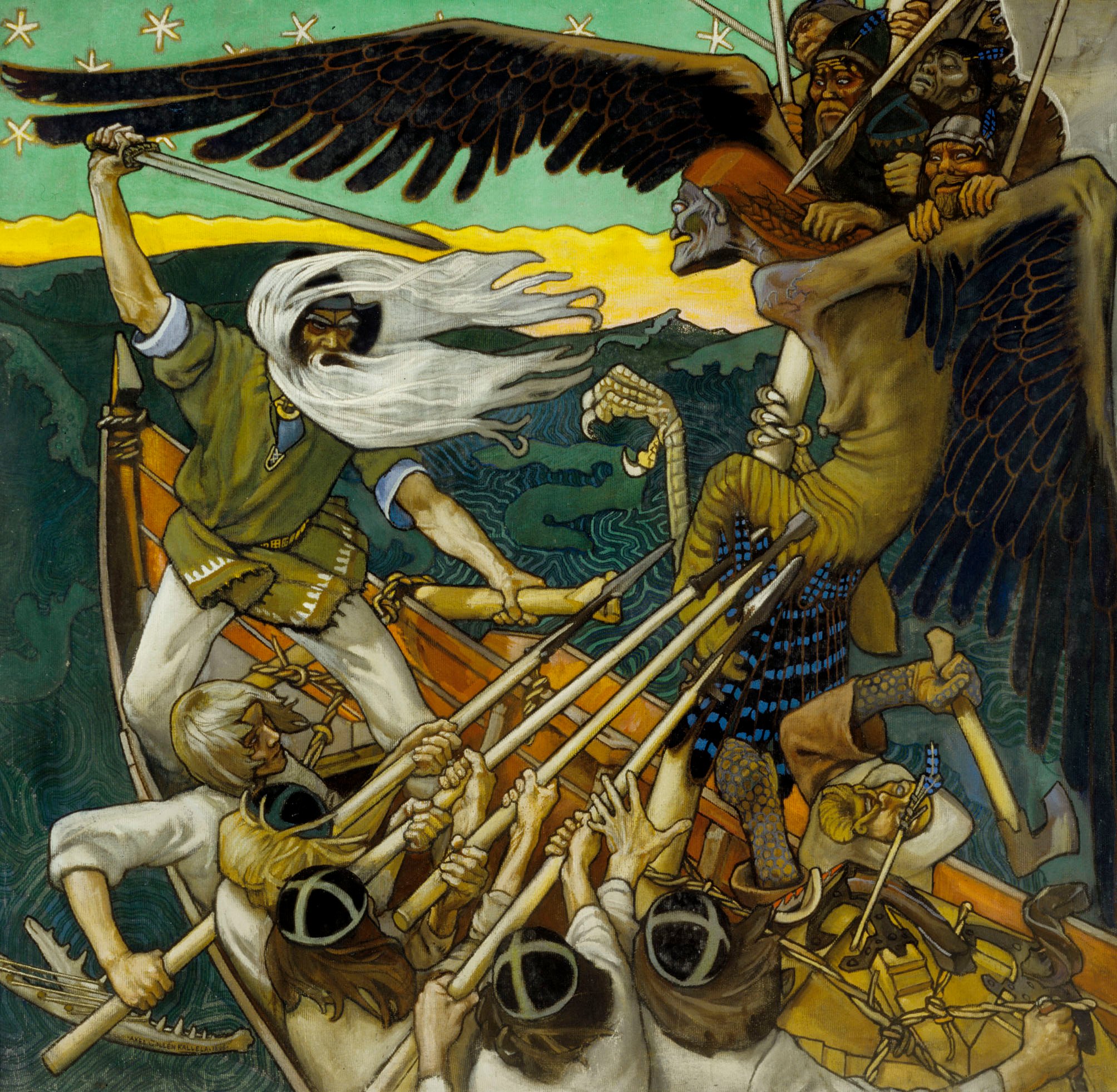
“The Defense of the Sampo” (1896), by Akseli Gallén-Kallela. Väinämöinen the wizard faces off against the evil witch Louhi
The Kalevala is frequently referred to as the Finnish national epic. Its fantastic and heroic tales informed the work of Finland’s greatest artists at a time when the country began its surge toward independence, after 700 years of Swedish rule and another century as a duchy of the Russian Empire.
This Sunday night on “The Lost Chord,” with Kalevala Day right around the corner (celebrated in Finland with great pride on February 28), we’ll have music inspired by this disparate collection of long narrative poems.
Robert Kajanus was the first great champion of Jean Sibelius. He conducted first performances of many of the composer’s major works and led the Helsinki Philharmonic for 50 years. He also wrote over 200 pieces himself. “Aino” was composed in 1885 for the Kalevala Society, to mark the 50th anniversary of the poem’s publication.
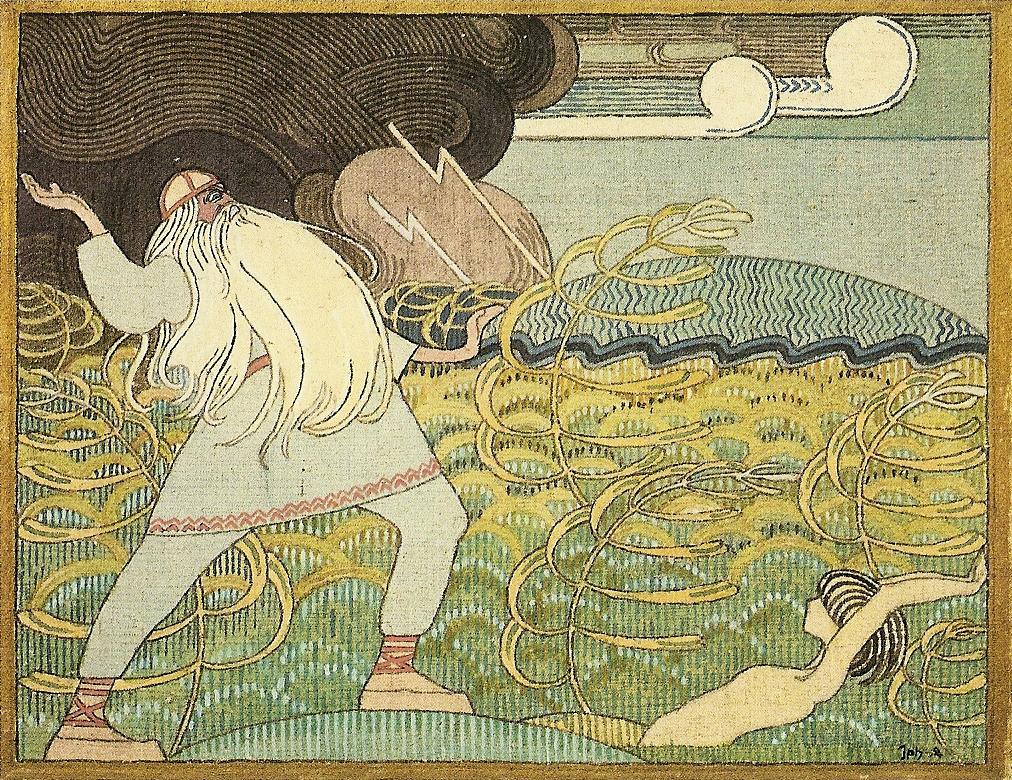
One of the Kalevala’s central figures, Väinämöinen the wizard, always seems to be plagued by bad luck. He wins a singing contest, plunging his rival, Joukahainen, into a swamp, but when the latter promises him his sister’s hand in marriage if he will save him from drowning, the sister, Aino, drowns herself rather than submit to this seemingly intolerable fate. She returns to taunt the grieving Väinämöinen in the form of a salmon.
Uuno Klami, one of the most important Finnish composers after Sibelius, brought a degree of French polish back from his studies in Paris, where he fell under the irreverent sway of Les Six. This led to the composition of an unusually anti-heroic take on the “Kalevala” legends, “Lemminkäinen’s Island Adventures.” Despite the Gallic influence on his music, Klami grew into one of Finland’s most respected composers. Sibelius recognized his talent and even lobbied for a small lifetime stipend for him from the Finnish government.
Unlike Sibelius’ better-known “Four Legends from the Kalevala,” Klami’s “Kalevala Suite” scrupulously avoids the more swashbuckling elements of the epic’s narrative. Klami opts instead to paint on a much broader canvas, with movements titled “The Creation of the Earth,” “The Sprout of Spring,” “Terhenniemi” (replete with the sounds of nature and the sunny bliss of a summer’s day), “Cradle Song for Lemminkäinen” (Lemminkäinen’s mother’s song sung over the body of her son, soon to be resurrected), and “The Forging of the Sampo” (a kind of talisman everyone seems to want).
Of course, no composer had more success drawing on the Kalevala legends than Sibelius himself. We’ll conclude the hour with a Sibelius rarity, “A Song for Lemminkäinen,” from 1896. This inspiring work for male chorus followed on the heels of the composer’s “Lemminkäinen Suite” (also known as “Four Legends from the Kalevala”), written earlier in the decade.
I hope you’ll join me in acquiring some “Epic Finnish.” That’s music inspired by the Kalevala, this Sunday night at 10:00 EST, on WWFM – The Classical Network and wwfm.org.
“Väinämöinen Sings Joukahainen into a Fen,” by Joseph Alanen (1885–1920)