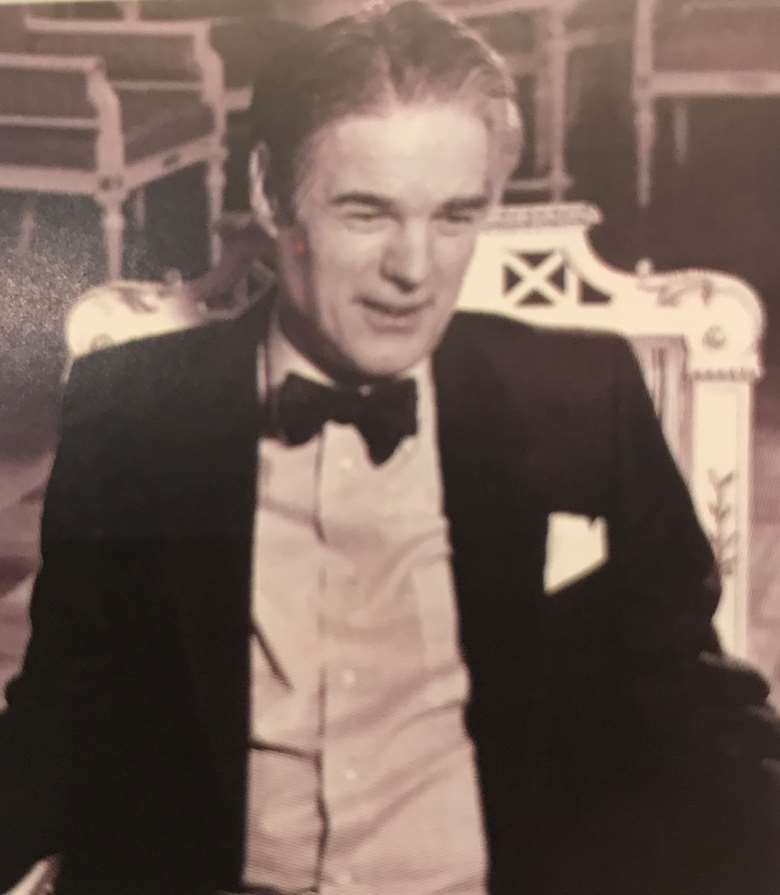
Another of the stable of truly great “Gramophone” critics is gone. Robert Layton was erudite, insightful, authoritative, articulate, and accessible in a kind of balance, I am sorry to say, that is no longer common. Layton’s name may also be familiar from his contributions to the “Penguin Guide,” the music-collector’s bible, updated annually. Layton’s involvement with the guide began in 1968.
His was an especially prominent voice in the field of Nordic music. His advocacy of Northern composers was extensive, with a particular emphasis on the life and works of Jean Sibelius, Edvard Grieg, and Franz Berwald.
In 1980, Layton pranked Stanley Sadie, editor of “Grove’s Dictionary of Music and Musicians,” by including a bio of a wholly fictitious Danish composer he’d concocted. Not sure how I feel about that, but he certainly possessed the expertise to convincingly pull it off!
His observations were both absorbing and enriching. He contributed greatly to the expansion of my musical knowledge.
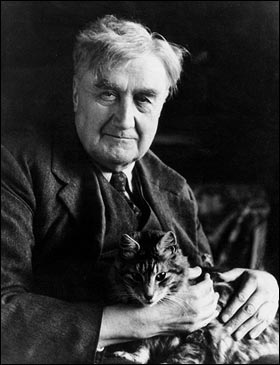
A good rainy day. The perfect time to hunker down with Ralph Vaughan Williams.
Here are links to two of his symphonies – the first, his most desolate, the Symphony No. 6, and the second, his most unambiguously hopeful, the Symphony No. 5. In common with the greatest classics, both exist outside of time – they are timeless – yet both speak perfectly to the present. Life in the time of Coronavirus
Vaughan Williams’ Sixth Symphony (1944-47) is full of tension, turbulent, bleak, with a few wistful passages that seem to reflect on a lost world. Though the composer denied any extramusical program, the last movement has been interpreted by many as an aural portrait of the world laid waste. Some have attributed the barren atmosphere as a response to the atomic bomb.
The Symphony No. 5 (1938-43), by contrast, is a balm for the soul. Though completed at the height of World War II, the symphony is a musical celebration of the endurance of humanity and tradition against an implacable enemy. The work shares much in common with Vaughan Williams’ passion project, the opera “The Pilgrim’s Progress,” which he had already been writing for 30 years. Not only does it quote some of the opera’s themes, it also reflects its spirit. The piece is brimming with solace, hope, and indescribable beauty.
Vaughan Williams dedicated the work to Jean Sibelius, “without permission and with the sincerest flattery.” When Sibelius heard the piece, he confided to the conductor Sir Adrian Boult, “This Symphony is a marvelous work… the dedication made me feel proud and grateful… I wonder if Dr. Williams has any idea of the pleasure he has given me?”
Keep calm and carry on. Pour youself a cuppa. Listen to Ralph Vaughan Williams, and find your strength.
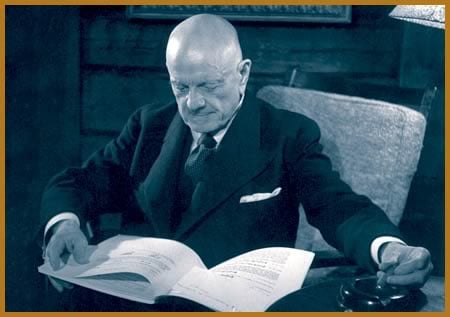
Jean Sibelius was the composer of seven numbered symphonies that stand like granitic monoliths at the heart of 20th century music. Less well known, perhaps, is the abundant music he wrote for the stage.
This Sunday night on “The Lost Chord,” we’ll mark the anniversary of Sibelius’ birth with a selection from his incidental music.
Born on this date in 1865, Finland’s most celebrated composer was known to agonize over every aspect of his large-scale compositions. He wound up burning the unfinished manuscript to what would have been his eighth symphony and composed nothing of consequence for the last three decades of his life.
Any opportunity to work in the theater must have come as an enormous relief. Here, Sibelius could act as a kind of sketch artist, setting scenes or creating moods in the most succinct fashion. Of course, he also would have written music for the entr’actes and interludes, which could have satisfied a desire for a bit more development.
His output for the stage was fairly substantial, and yet – with the exception of the ever-popular “Valse triste” (from the play “Kuolema,” or “Death”) and perhaps some selections from “Pelleas and Melisande” or “The Tempest” – it remains stubbornly unfamiliar. When is the last time anyone heard music from “The Lizard?”
In 1905, Hjalmar Procopé wrote a play on the subject of “Belshazzar’s Feast,” dramatizing the well-worn episode from the Book of Daniel, about a Babylonian tyrant who literally sees the writing on the wall. We’ll hear a 1932 recording of a selection from Sibelius’ music, conducted by the composer’s good friend and drinking buddy, Robert Kajanus.
“Jedermann” (or “Everyman”) was the product of Strauss librettist Hugo con Hofmannsthal, an updated version of a medieval morality play. Sibelius worked at his contributions to a 1915 production, alongside substantial revisions to one of his greatest works, the Symphony No. 5. We’ll sample from the world premiere recording of incidental music to “Jedermann,” conducted by Osmo Vänskä.
That’s “Sibelius, Incidentally” – Jean Sibelius treads the boards – this Sunday night at 10:00 EST on WWFM – The Classical Network and wwfm.org.
Happy birthday, Ralph Vaughan Williams, one of my favorite composers!
Thank you so much for the “Serenade to Music,” “The Lark Ascending,” the “Fantasia on a Theme by Thomas Tallis,” “Five Variants of Dives and Lazarus,” “The Wasps,” the “Norfolk Rhapsody No. 1,” the “English Folk Song Suite,” the “Fantasia on Christmas Carols,” “Five Mystical Songs,” the “Charterhouse Suite,” the “Concerto Grosso,” the “Old King Cole” ballet, “Household Music,” “Hugh the Drover,” “Sir John in Love,” and too many others to enumerate.
Of your nine symphonies, I certainly have my preferences. Each of them holds its own particular delight – even the ones that are served up harsh or leave us hanging, with big questions about their, and our, ultimate destinations. Collectively, they form a surprisingly disparate body of work, belying your reputation as a pastoralist.
That said, if I want to find solace or to be uplifted, I always gravitate to the Fifth.
For me, the facts surrounding the Fifth’s creation make it all the more moving. It’s frequently been remarked upon that the symphony shares a certain kinship with your opera, “The Pilgrim’s Progress,” which you worked at for decades and still remained incomplete.
At first, when you heard the symphony played by friends in its two-piano reduction, you had doubts as to its value. That’s a little ironic for a work that is so imbued with the power of faith. And by faith, I don’t mean religion. It’s well-known to most that in your maturity you embraced what you described as a “cheerful agnosticism” (downgraded from earlier assertions of atheism). When it was finally performed by an orchestra, you realized your reservations were unfounded.
You dedicated the work to Jean Sibelius, “without permission.” However, when Sibelius heard the piece, he too was delighted. He wrote to Adrian Boult, “This symphony is a marvelous work… the dedication made me feel proud and grateful… I wonder if Dr. Williams has any idea of the pleasure he has given me?”
The symphony was introduced in June of 1943, at the height of the blitz. German bombs rained down on London after dark, so the concert had to be held in the afternoon. We can only imagine what that must have been like – the nightly danger, the disruption of conveniences, the loss of life, the injuries, the rationing, the rubble, the noise, the fear – and then the power of this music, music of fortitude and optimism, and what affect it must have had on its first audiences. Here was assurance that everything was going to be all right. This too would pass. Beyond the bombs, beyond Hitler, England would endure, as would other things. Larger things. Immutable things.
Who knew that you, the cheerful agnostic, would turn out to be a prophet?
Here you are conducting, at the age of 80, your Symphony No. 5.
Jean Sibelius was the composer of seven authorized symphonies that stand like granitic monoliths at the heart of 20th century music. Less well known, perhaps, is the abundant incidental music he composed for the theater. Join me for an historic 1932 recording of selections written for the play “Belshazzar’s Feast,” with Robert Kajanus conducting, and a more recent, digital premiere of the complete incidental music composed for “Everyman,” made under the baton of Osmo Vänskä. Enjoy this neglected-but-worthwhile music on “Sibelius, Incidentally,” this Sunday night at 10 EDT on WWFM – The Classical Network and wwfm.org.