Tag: Jean Sibelius

  • Sibelius Footage & a Personal Connection

    Sibelius Footage & a Personal Connection

    A day late and a dollar short. The story of my life!

    The day after Jean Sibelius’ birthday anniversary, there’s plenty of cigar smoke in this six minutes of historic footage of the composer and his family, in and around their home, Ainola, located about 20 miles outside Helsinki.

    I had the good fortune to enjoy a friendship with one of the composer’s grandchildren, the son of Heidi (featured at the link), when he was living in Philadelphia and later, believe it or not, my hometown of Easton, PA!

    Anssi Blomstedt, a documentary filmmaker, now makes his home back in Helsinki. He also directed a feature film, “Axel” (1990), about Sibelius’ friendship with Axel Carpelan. It was Carpelan who suggested the name “Finlandia” for what became Sibelius’ most famous composition, and Sibelius dedicated his most frequently-performed symphony, the Symphony No. 2, to him.

    The film is based on a novel, “Axel,” by Bo Carpelan, who was the subject’s great-nephew. Come to think of it, Anssi gave me a copy of the book, and it occurs to me that I never read it. Perhaps I’ll add it to my January reading list.

    Speaking of “Finlandia,” if you’ve never seen this, you owe it to yourself to watch it. You won’t be sorry. In fact, it will probably make you want to move to Finland.
  • Sibelius, Time, and Feeling Unstuck

    Sibelius, Time, and Feeling Unstuck

    I don’t know what’s going on with me. First of all, it doesn’t feel like Christmas. I could blame it on the early start for Advent or the weather being too warm. The grass keeps greening here, and there’s still new growth. And now, suddenly, it’s the birthday of Jean Sibelius. So much for “8 Days of Sibelius,” as I have been known in past years to celebrate the composer in a series of daily posts starting at the beginning of the month. Whatever it is that has gotten into me, I seem to have become unstuck in time. And not like Vonnegut’s Billy Pilgrim, mind you.

    Be that as it may, so much of the wonder of music, especially long-form music, is how it plays with our perception of time. Symphonies are often narratives, even if there is no story. The internal logic of a piece creates the illusion of movement, a sense of connections being made, and even varying degrees of momentum.

    Sibelius was a master at manipulating time in works like his Symphony No. 5. The piece begins with a musical sunrise, the merest suggestion of the grandeur to come, with perhaps a meditation of the natural world stirring to life; and then somehow, before we know it, the ground is shifting seismically beneath our feet, and we’re in the middle of a scherzo. The effect is thrilling, yet, when executed properly (always a challenge for conductors), seems totally organic.

    And that ending! There is no other symphony like it in the repertoire. It’s as if the composer has mastered time itself, and brought everything to an abrupt halt, over six staggered, monolithic chords, leaving the listener suspended at the very peak of sublimity,.

    Sibelius worked hard to achieve his effects. The Symphony No. 5 was given its world premiere on his 50th birthday, December 8, 1915. A second version, which only partly survives, was unveiled the next year. The final version, the version we all know and love, was given its performance on November 24, 1919. To contemplate the level of objectivity he managed to attain in reshaping the raw material of his first thoughts is staggering. Like Beethoven, Sibelius worked very hard to realize his genius.

    Perhaps whenever I get to feeling unstuck, a healthy attitude would be to imagine myself, like someone listening to Sibelius’ Symphony No. 5, suspended between moments of sublimity.

    Happy birthday, Jean Sibelius.


    Symphony No. 5 (final version, 1919)

    Original version (1915, with some very notable differences)

  • Mahler Meets Sibelius A Composer Clash

    Mahler Meets Sibelius A Composer Clash

    In 1907, Gustav Mahler visited Helsinki, where he met Jean Sibelius. The two towering composers went for a walk in nature, when unsurprisingly the talk turned to shop.

    It was Mahler who lent an exclamation point, as they swapped observations on the symphony. Poor Sibelius was taken off-guard, as he was merely contemplating the nuts and bolts. “I admire its severity of form and profound logic,” he said. To which Mahler, seizing the advantage, replied, “A SYMPHONY MUST BE LIKE THE WORLD. IT MUST EMBRACE EVERYTHING!”

    If I know Sibelius, after that, his private thoughts were full of vodka and cigars.

    Happy birthday, Gustav Mahler, one intense S.O.B.

  • Finnish Birdsong Music This Sunday

    Finnish Birdsong Music This Sunday

    This Sunday night on “The Lost Chord,” in this season of bitter temperatures and falling snow, keep your spirits up with music inspired by Finland’s avian life.

    Einojuhani Rautavaara’s concerto for birdsong and orchestra, “Cantus Arcticus,” from 1972, incorporates tape recordings made by the composer on the bogs of Liminka, near the Arctic Circle. More than just a gimmick, the piece is an inspiring triptych that manages to transcend its potentially New Age conceit. The work falls into three movements: “The Bog,” “Melancholy,” and “Swans Migrating.” The final movement takes the form of a long crescendo for orchestra, and incorporates the songs of whooper swans.

    Jean Sibelius’ uplifting Symphony No. 5 culminates in a grand theme inspired by swans in flight around his home on the shores of Lake Tuusula in Järvenpää. The symphony is standard repertoire, but we’ll hear it as it was first performed in 1915, before it was substantially revised to become the masterwork we know today.

    Encountering the Fifth in its original guise illuminates the composer’s remarkable clarity of purpose, uncanny objectivity, and iron will in reshaping his raw materials to achieve a loftier, definitive vision. It’s not for nothing that Sibelius was described by one critic as “a great artist whose imagination has the wings of an eagle.”

    Take flight with Finnish music. Join me for “Snow Birds,” this Sunday night at 10:00 EST, on WWFM – The Classical Network and wwfm.org.

  • Sibelius Champion Kajanus Birthday

    Sibelius Champion Kajanus Birthday

    EIGHT DAYS OF SIBELIUS – DAY 2

    Yesterday, I mentioned Robert Kajanus’ recording of Sibelius’ Symphony No. 3, a performance that fatefully brought me together with the composer’s grandson. Now, only six days in advance of Sibelius’ birthday, December 8, it happens to be the anniversary of the birth of Kajanus, his good friend and first devoted champion.

    It was Kajanus who set down the first recording of Sibelius’ Third Symphony in 1932. It was he who commissioned the symphonic poem “En Saga.” “Pohjola’s Daughter” was also dedicated to him. In 1900, he toured with the Helsinki Orchestra (a group he founded), presenting programs that both he and Sibelius conducted. These concerts included performances of a number of Sibelius’ works heard for the first time outside of Finland.

    Later, Kajanus made premiere recordings of Sibelius’ Symphonies Nos. 1, 2, 3 & 5, and the composer’s crowning symphonic poem, “Tapiola.” The plan had been to record all the symphonies. Unfortunately, Kajanus died, in 1933, before he could complete the cycle.

    Kajanus himself was a composer. Here’s a recording of his Sinfonietta, dedicated to Sibelius:

    By coincidence, today is also the birthday of Sir John Barbirolli, the conductor Ralph Vaughan Williams memorably dubbed “Glorious John.” Barbirolli was another inspired interpreter of the music of Sibelius, with his recording of the composer’s Symphony No. 2 with the Royal Philharmonic one of the best I have ever heard. In fact, I am posting links to both the Kajanus and Barbirolli recordings of Sibelius’ most frequently-performed symphony, below. They are very different interpretations, both superb in their own ways.

    Kajanus, brisk, thrilling, and authoritative:

    Barbirolli, passionate and big-hearted:

    Happy birthday, Robert Kajanus and Sir John Barbirolli!


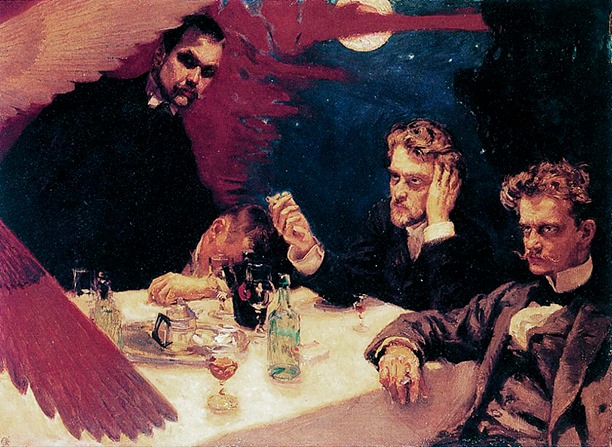
    Of course, Sibelius was fond of his drink, a weakness apparently shared by his friends and associates of “the Symposion.” In Akseli Gallén-Kallela’s painting “Kajustaflan,” we find pictured (from left to right) the artist, composer Oskar Merikanto (blacked out), Kajanus, and Sibelius.

    More about the Symposium, with the original version of Gallén’s painting – if possible, even more sordid – here:

    http://www.sibelius.fi/english/elamankaari/sib_symbosion.htm

Tag Cloud

Aaron Copland (92) Beethoven (95) Composer (114) Film Music (120) Film Score (143) Film Scores (255) Halloween (94) John Williams (185) KWAX (229) Leonard Bernstein (100) Marlboro Music Festival (125) Movie Music (135) Opera (198) Philadelphia Orchestra (88) Picture Perfect (174) Princeton Symphony Orchestra (106) Radio (87) Ralph Vaughan Williams (85) Ross Amico (244) Roy's Tie-Dye Sci-Fi Corner (290) The Classical Network (101) The Lost Chord (268) Vaughan Williams (103) WPRB (396) WWFM (881)

DON’T MISS A BEAT

Receive a weekly digest every Sunday at noon by signing up here


RECENT POSTS