Tag: John Williams

  • John Williams’ Olympic Royalties: How Much?

    John Williams’ Olympic Royalties: How Much?

    The Olympic royalties continue to pile up for John Williams, thanks to NBC’s perpetual use of “Olympic Fanfare and Theme” (written for the 1984 Los Angeles Games), “Summon the Heroes” (written for the 1996 Atlanta Games), and his synthesis of Leo Arnaud’s “Bugler’s Dream” (the quintessential Olympic music) with his own ’84 opus. These are heard incessantly as bumpers, as coverage fades to commercial, or to underscore segues between events.

    How much, exactly, does he make? According to an article in Variety, published in 2008, each prime time use could net between $500 and $2500.

    http://variety.com/2008/music/news/olympic-songs-snag-significant-sums-1117991375/

    Of course, that was eight years ago.

    Here’s an article on the official NBC Olympics website about Williams’ contribution to the Olympics:

    http://www.nbcolympics.com/news/john-williams-continues-score-sound-olympics

    Over the years, Williams has composed four original pieces for the games. In addition to his works for the ’84 and ’96 Olympics, he wrote “The Olympic Spirit” for the 1988 games in Seoul, South Korea, and “Call of the Champions” for the 2002 winter games in Salt Lake City.

    Though Arnaud’s fanfare embodies the Olympic spirit like no other, it was not actually written with the Olympics in mind. “Bugler’s Dream” was written as part of a larger suite for conductor Felix Slatkin, who commissioned it for his 1958 album, “Charge!” In 1968, the fanfare was picked up by ABC for use in its coverage of the Winter Olympics from Grenoble. It became embedded in the public consciousness as THE music for the Olympics.

    Like Williams, Arnaud worked in Hollywood for many years. A pupil of Maurice Ravel and Vincent d’Indy, he labored as an orchestrator on films ranging from “The Wizard of Oz” to “Ryan’s Daughter.”

    In this article, Williams’ Olympic fanfares are ranked. It includes musical examples, so you can decide for yourself:

    http://www.sportingnews.com/athletics/news/john-williams-best-olympic-themes-fanfare-music-ranked-nbc/1h2z6g0ovcgm518jx6fcvq1oj9


    PHOTO: Williams, looking hale at 84, as he appeared at Tanglewood last week, between Boston Symphony Orchestra principal trumpeter Tom Rolfs and Philadelphia Orchestra principal guest conductor Stéphane Denève (photo by BSO principal trombonist Toby Oft)

  • Olympic Music Fever on WPRB

    Olympic Music Fever on WPRB

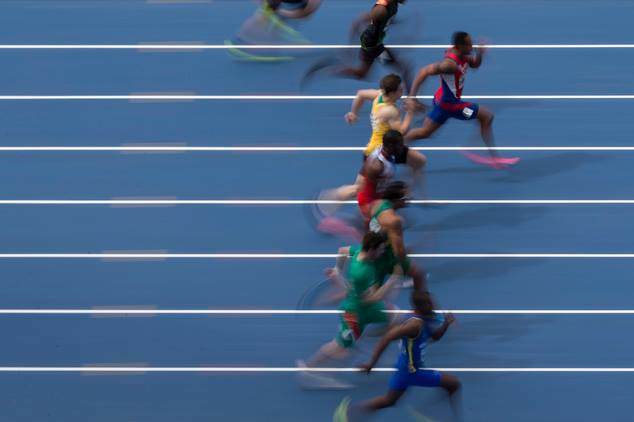
    This morning on WPRB, we are consumed by OLYMPIC FEEEEEEEEEEEE-VAH! Or maybe it’s just the Zika virus. It’s hard to tell, as we celebrate the Summer Games in Rio de Janeiro.

    We’ll hear Olympic fanfares and occasional music composed by Leo Arnaud, Angelo Badalamenti, Robin Frost, Philip Glass, Basil Poledouris, Richard Strauss (his notorious “Olympic Hymn” for the 1936 Berlin games), Mikis Theodorakis, and John Williams.

    We’ll also hear works by Brazilian composers Antônio Carlos Gomes , Camargo Guarnieri and Heitor Villa-Lobos, alongside music inspired by Brazil by smitten tourists Darius Milhaud, Ottorino Respighi, Martin Butler and David Gunn.

    Also featured will be Michael Torke’s “Javelin,” co- commissioned by the Atlanta Symphony Orchestra and the Atlanta Committee for the Olympic Games; John Harbison’s “Olympic Dances;” and bona fide medal-winning works by Olympic composers Josef Suk and Rudolph Simonsen.

    We’ll be testing positive for caffeine, from 6 to 11 EDT on WPRB 103.3 FM and at wprb.com. Our motto has always been “Citius, Altius, Fortius,” on “Classic Ross Amico.”

  • John Williams Home Serenaded Video Viral

    John Williams Home Serenaded Video Viral

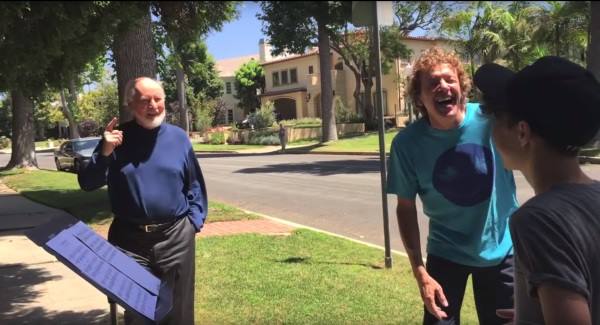
    This has been sweeping the internet for the past couple of days. For anyone who’s curious whether or not John Williams wears his signature turtleneck at home, here he is being serenaded by two young musicians (hopefully not in the middle of a nap).

    What a good sport. It’s also nice to see he lives in a real house, in an actual neighborhood!

  • Film Composers Beyond the Screen

    Film Composers Beyond the Screen

    If after about three hours you find yourself getting played out on the Academy Awards– once Ennio Morricone finally wins his first competitive Oscar, that is (fingers crossed) – you might consider tuning in to “The Lost Chord.” We’ll both complement and enjoy counterprogramming to the ceremony by listening to concert works by composers better known for their work in film.

    Franz Waxman was a two-time Academy Award winner, honored with back-to-back Oscars, in 1950 and 1951, for his work on “Sunset Boulevard” and “A Place in the Sun.” Some of his other classic scores include those for “The Bride of Frankenstein,” “Rebecca,” “Rear Window,” “Peyton Place” and “The Nun’s Story.”

    In 1955, he was traveling from California to Zurich to conduct a new piece commissioned by Rolf Liebermann. When Waxman reached New York he was met with a request from Lieberman’s office for program notes for the impending premiere. Waxman was forced to admit he hadn’t yet begun work on the piece, which he had planned to write during the ocean voyage. Fortunately, he was accustomed from his experience in Hollywood to write very quickly. The result was his “Sinfonietta for String Orchestra and Timpani.”

    Five-time Academy Award winner John Williams – whose 50th nominated score, for “Star Wars: The Force Awakens,” is in contention tonight – is of course very well-known for his collaborations with George Lucas and Steven Spielberg. Over the years, he’s also accrued an impressive quantity of concertos. One of the more immediately attractive of these is his Tuba Concerto of 1985, written for the 100th anniversary of the Boston Pops.

    Finally, we’ll turn to three-time Academy Award winner Miklós Rózsa, honored for his work on Alfred Hitchcock’s “Spellbound” in 1945, the Ronald Colman thriller “A Double Life” in 1947, and “Ben-Hur” in 1959. He also composed quite a bit of concert music, including concertos for Jascha Heifetz, Gregor Piatigorsky, Janos Starker, Leonard Pennario and Pinchas Zukerman.

    Rózsa, Hungarian by birth, turned to film after a period of struggle as a young artist in Paris, where he learned from Arthur Honegger that he was able to pay the rent by supplementing his concert music with cinematic efforts. Rózsa’s “Theme, Variations and Finale,” Op. 13, of 1933, preceded the start of his film career by a few years. He revised the piece in 1943, by which time he had already completed his classic fantasy scores for Alexander Korda’s “The Thief of Bagdad” and “Jungle Book,” and was on the verge of becoming a leading composer of film noir.

    “Theme, Variations and Finale” received performances by Charles Munch, Karl Böhm, Georg Solti, and Eugene Ormandy. It was also one of the works that featured on the legendary concert that launched Leonard Bernstein with the New York Philharmonic, on November 14, 1943, when the young assistant conductor substituted at the last minute for an ailing Bruno Walter.

    I hope you’ll join me for an hour of concert music by composers better known for their work in film – “Against Type” on “The Lost Chord” – this Sunday night at 10 ET, with a repeat Wednesday evening at 6; or that you’ll listen to it later as a webcast at wwfm.org.


    PHOTOS: Has anyone here seen Kelly? (Clockwise from left) John Williams wins the Oscar for “Star Wars;” Franz Waxman and Miklós Rózsa receive their awards from the hands of Gene Kelly

  • Classic Film Scores for Academy Awards Weekend

    Classic Film Scores for Academy Awards Weekend

    We’re heading into Academy Awards weekend. This week on “Picture Perfect” we’ll do our best to get you in the mood, with a baker’s dozen of classic film themes. We’ll hear music from “Gone With the Wind,” “Ben-Hur,” “The Lord of the Rings,” “Out of Africa,” “Exodus,” “Schindler’s List,” “The Adventures of Robin Hood,” “Around the World in 80 Days,” “The Godfather Part II,” “Tom Jones,” “Lawrence of Arabia,” “Titanic” and “E.T. The Extra-Terrestrial.”

    The 88th Academy Awards, need I say, will take place on Sunday night.

    Join me this evening at 6:00 ET, with a repeat tomorrow morning at 6; or listen to it later as webcast at wwfm.org. I’ll try to exert my influence to get the sound file posted by Sunday, if you’d like to call up the stream for a little pre-Oscar fun. Last week’s show, devoted to this year’s nominees, has already been posted.

    #AcademyAwards #Oscars #FilmMusic #FilmScores

Tag Cloud

Aaron Copland (93) Beethoven (95) Composer (114) Film Music (141) Film Score (143) Film Scores (255) Halloween (94) John Williams (195) KWAX (229) Leonard Bernstein (103) Marlboro Music Festival (125) Movie Music (156) Mozart (89) Opera (212) Philadelphia Orchestra (89) Picture Perfect (174) Princeton Symphony Orchestra (108) Radio (88) Ross Amico (244) Roy's Tie-Dye Sci-Fi Corner (290) The Classical Network (101) The Lost Chord (268) Vaughan Williams (103) WPRB (396) WWFM (881)

DON’T MISS A BEAT

Receive a weekly digest every Sunday at noon by signing up here


RECENT POSTS