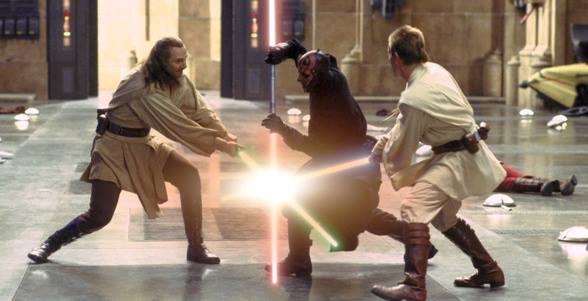
Tag: John Williams

  • Star Wars Music Return of the Jedi & Prequels

    Star Wars Music Return of the Jedi & Prequels

    This week on “Picture Perfect,” we conclude our multi-part retrospective of music from the “Star Wars” movies, in anticipation of the theatrical release of “Star Wars: The Force Awakens” on December 18.

    We spent the past two weeks listening to highlights from the finest of the scores, those for “Star Wars” (later subtitled “Episode IV: A New Hope”) and “The Empire Strikes Back.” This week, we’ll hear selections from “Return of the Jedi,” which rounded off the original trilogy in 1983, and music composed for the prequels, issued between 1999 and 2005.

    Already in 1983, there was, in some respects, an air of fatigue that hung about the third installment, “Return of the Jedi,” the most episodic of the original films that also seemed to recycle quite a bit of material from the first. The landspeeder was replaced by speeder bikes, the Wookie was usurped by teddy bear-like Ewoks, and the threat of the Death Star was replaced by – well, an even bigger Death Star.

    For one of the scenes, which occurs fairly early in the film, the score even recycled battle music heard the first time around, perhaps in homage, but also, from a practical standpoint, to get it in on deadline.

    That said, “Jedi” sported plenty of imaginative touches, fleshing out the villainous Emperor and giving us the belated onscreen debut of Jabba the Hutt. All told, while not quite on the same exalted level as its predecessors, the film got the job done and rounded off the trilogy in satisfying fashion.

    Unfortunately, George Lucas couldn’t let well enough alone, and 16 years later, as if against our will (how could we help ourselves?), we were propelled back to a galaxy far, far away. The “Star Wars” prequels generated some pretty impressive box office, but also a fair amount of controversy. The films were criticized by some for their overreliance on computer generated imagery, inane dialogue peppered with impenetrable jargon, and wooden performances, with some particularly painful love scenes.

    Though “Star Wars” composer John Williams crafted some lovely thematic interludes, the emphasis this time around seemed to be on epic bombast and ponderous premonitions of a date with destiny that the story and visuals required. Because everything in the film could be manipulated digitally and reedited virtually right up until the moment of release, the scores suffered through excessive tinkering in post-production.

    I’ve selected just over a half an hour worth of cues from the prequel trilogy – “Episode I: The Phantom Menace,” “Episode 2: Attack of the Clones,” and “Episode 3: Revenge of the Sith” – which I’ve assembled into an extended suite. Williams indulges in nearly ten minutes of unabashed sentiment during the end credits of “Sith,” recalling some of the most beloved “Star Wars” themes and pushing things completely over the top by evoking the pomp of Sir William Walton to provide a euphoric coda to the series.

    At the time, it was thought this would be the last of the “Star Wars” films, so who could blame him? Of course, we now know that not to be the case…

    I hope you’ll join me this Friday evening at 6, with a repeat Saturday morning at 6, for a conclusion to our “Star Wars” retrospective; or that you’ll listen to it later as a webcast at wwfm.org.

  • Empire Strikes Back Score A Retrospective

    Empire Strikes Back Score A Retrospective

    The Force was strong with this one.

    The second installment in our retrospective of the “Star Wars” scores will focus exclusively on music for the first of the sequels, “The Empire Strikes Back,” released in 1980. For many, this is the best in the series so far, the “Godfather Part II” of space fantasy movies.

    Both George Lucas and composer John Williams succeeded in developing and deepening material from the first film, yet managed to avoid becoming too heavy-handed by ramping up the creativity and maintaining a spirit of adventure.

    You could ignore the jargon, let the back story glide over you, and still have fantastic time. Beloved characters from the original film, fun and familiar, were joined by instant “Star Wars” pop cultural icons, Lando Calrissian, Boba Fett, Emperor Palpatine, and of course Yoda.

    How could you take an invasion by elephantine Imperial Walkers, or riding patrol atop stop motion tauntauns too seriously anyway? One of the leads was played by a Muppet with the voice of Miss Piggy, for crying out loud.

    Williams came up with themes or motives for all of these, alongside the first appearance of “The Imperial March” and a love theme for Han and the Princess, arguably managing to top the achievement of his seemingly untoppable original score. His work on “The Empire Strikes Back” earned him his 15th Academy Award nomination.

    Last week, I discussed the merits of the original soundtrack albums, with their re-edited material providing a satisfying home listening experience, versus the current trend of releasing the music note-complete and chronological, as it’s heard in the film.

    With “The Empire Strikes Back,” it’s a very tough call, since of all the scores, this one perhaps holds up the best when heard complete from beginning to end. That said, with less than an hour to touch on the highlights, it’s much easier to accomplish when sampling from the original two-LP set.

    This is a challenge, since only material from one of the two records has ever made it to compact disc, at least in this country (on Polydor 825 298-2, released in 1985). Selections from the other are reconstructed on this week’s show, using the film mix, as it appears on the 4-CD “Star Wars Anthology” (issued as a box set on 20th Century Fox Film Scores 07822-11012-2, released in 1993).

    How fanboy is that? I even tossed on the 20th Century Fox fanfare, for good measure.

    I hope you’ll JOIN ME* for this week’s “Picture Perfect,” tonight at 6 ET, with a repeat tomorrow morning at 6, or that you’ll listen to it later as a webcast at wwfm.org.

  • Star Wars Music Retrospective Original Soundtrack

    Star Wars Music Retrospective Original Soundtrack

    A disconcerting thought occurred to me the other night, as I was driving up to my folks’ late Wednesday, after having completed production work on this week’s “Picture Perfect.” We are now as far away from the original “Star Wars” (released in 1977), as “Star Wars” was from “Gone With the Wind” (released in 1939)! I am always thinking thoughts like that, and it’s like getting my brain pinched in a collapsed telescope. It would have been possible, then, in 1977, that Clark Gable and Vivien Leigh, had they lived, could have come back for a belated sequel to one of the most beloved classics in American cinema.

    I’m not saying I would have wanted that, but it is something to ponder, with the impending release of “Star Wars: The Force Awakens” on December 18. Can this film possibly live up to the hype? Of course, the bar has been set pretty low after the prequels. But come on, the Millennium Falcon is back, John Williams is doing the music, and George Lucas is in no way involved. Who doesn’t want to see a 70 year-old Han Solo brandish a sidearm at least one more time?

    Clearly, this could rapidly degenerate into obsessive geekdom, so allow me merely to point out the fact that this week on “Picture Perfect,” we will begin a multi-part musical retrospective of the “Star Wars” movies. Part one will focus on the film that started it all.

    “Star Wars,” as it was known when it was first released in theaters on May 25, 1977 (later to be retitled “Star Wars Episode IV: A New Hope”) provided a fun and fantastic escape to a long time ago, in a galaxy far, far away. Things became a lot more serious and jargon-heavy as the saga progressed. We’ll try to shrug off some of that ponderousness and remember what it was like to first encounter the wonder of John Dykstra’s Oscar-winning special effects (before they were replaced, retroactively, with CGI), and John Williams’ fresh and heroic music, credited with singlehandedly reviving the fortunes of the orchestral film score. “Star Wars” went on to become the best-selling orchestral soundtrack of all-time.

    Now, there are two options when it comes to listening to a classic soundtrack originally released during this era. The first is to enjoy it in the form it was originally issued, in which composer and music editor took cues from different parts of the movie and arranged them into musically satisfying sequences on the album. The second is to listen, as many prefer today, when soundtracks are released note-complete, to everything presented chronologically, even if some of the cues are mere fragments, as it is heard in the film. Fortunately, because of the continued interest in “Star Wars,” the music has been reissued several times, so that it can be enjoyed either way.

    Since I personally first obtained this soundtrack on vinyl, I have a preference for the form in which I first encountered it (though I’m certainly happy to own the complete score, as well). The double-LP contents no longer seem to be commercially available. Therefore, I am happy to present this rare opportunity to enjoy the music as countless did when the album was released, back in 1977.

    Williams’ Academy Award-winning score, while adored by millions, has been criticized by some for its at times derivative nature, with suggestions of Holst, Prokofiev, Stravinsky, Korngold, Dukas and Walton, among others. I tend to think of it as being brilliantly post-modern, hand-in-glove with Lucas’ cinematic approach, which draws on any number of western, swashbuckler, war, and samurai motifs. Influences abound – intentionally, I think – but at no time can the composer be mistaken for anyone other than John Williams.

    I hope you’ll join me as we listen to the London Symphony Orchestra, having the time of its life, on the original soundtrack to “Star Wars,” tonight at 6 ET, with a repeat tomorrow morning at 6; or that you’ll listen to it later as a webcast at wwfm.org.
  • Yo-Yo Ma at the Movies Celebrating 60 Years

    Yo-Yo Ma at the Movies Celebrating 60 Years

    It’s very hard to believe, but the eternally youthful Yo-Yo Ma will be 60 on October 7. This week on “Picture Perfect,” we honor one of the most famous classical musicians in the world with music from three of his film projects.

    Ma played cello solos in two scores by John Williams – those for “Seven Years in Tibet” (1997) and “Memoirs of a Geisha” (2005). Of course, Williams being Williams, both scores were nominated for Academy Awards.

    Ma actually hit pay dirt with “Crouching Tiger, Hidden Dragon” (2000). Tan Dun’s music contributed to what could be termed “The Year of the Dragon,” as Ang Lee’s film accumulated 10 Academy Award nominations, including one for Best Picture. In the end, “Crouching Tiger” was honored with awards for Best Foreign Language Film, Best Art Direction, Best Cinematography, and of course Best Original Score.

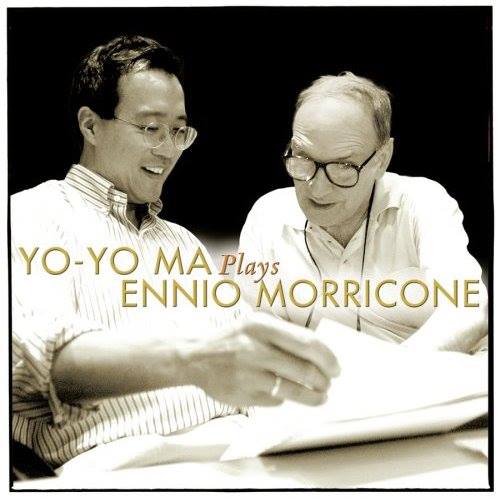
    In 2004, Ma recorded a very popular album of arrangements for cello and orchestra from the film scores of Ennio Morricone, with the composer conducting. We’ll round out the hour with some of Morricone’s beloved music from “The Mission” (1986).

    I hope you’ll join me, as we salute Yo-Yo Ma at the movies, tomorrow evening at 6 ET, with a repeat Saturday morning at 6; or that you’ll listen to it later as a webcast at wwfm.org.

  • Horse Racing Movie Music Perfect Picture

    Horse Racing Movie Music Perfect Picture

    It’s a rare horse race where everyone comes out a winner. This week on “Picture Perfect,” we beat the odds. We’ll have beautiful and rousing music from films about horses and horse racing.

    “The Black Stallion” (1979), based on the classic novel by Walter Farley, depicts the bonding of a shipwrecked boy and an Arabian stallion, whose shared destiny takes them to the race track. Mickey Rooney’s uncharacteristically subdued performance as the former trainer who finds a new lease on life earned him an Academy Award nomination for Best Supporting Actor.

    Francis Ford Coppola executive produced the film, and his father, Carmine Coppola, wrote the music. Reportedly the unsung Shirley Walker, who had been hired as an orchestrator, wound up contributing a fair amount to it, when the composer was put off by requests from director Carroll Ballard that portions of the music be rewritten.

    “The Reivers” (1969), after William Faulkner’s Pulitzer Prize winning novel, is a coming-of-age story about a boy swept into automobile theft and illicit horse racing in the American south. Mark Rydell directed, and Steve McQueen starred as the rakish Boon Hogganbeck. The narration was by Burgess Meredith, who reprises his role in the recording we’ll hear, with John Williams conducting his own music.

    For the film, Williams provided an alternately wistful and carefree Americana score. It’s said that the music for “The Reivers” is what moved Steven Spielberg to hire him to write the music for his first theatrical feature, “The Sugarland Express.” The Spielberg association brought Williams to “Jaws,” and the first of his truly iconic film scores. He also worked with Mark Rydell again, on “The Cowboys” (1972), “Cinderella Liberty” (1973), and “The River” (1984).

    It was inevitable that the nonfiction bestseller “Seabiscuit: An American Legend” would be given the big Hollywood treatment. The miraculous ascent of the real-life dark horse who became a symbol of hope during the Great Depression seemed tailor-made for dramatization.

    Though it presses all the right buttons, “Seabiscuit” (2003) is not to be confused with a superior documentary that was shown on PBS around the same time. Nonetheless, the film, which starred Tobey McGuire, Jeff Bridges and Chris Cooper, was nominated for seven Academy Awards, including Best Picture. Randy Newman wrote the music.

    Finally, we turn to “Hidalgo” (2004), also allegedly based on a true story, though the source material – the memoir of distance rider Frank T. Hopkins – has also inspired a fair degree of skepticism. In 1890, Hopkins became the first American invited to compete in a centuries-old 3000-mile survival race across the Arabian Desert.

    Viggo Mortensen plays Hopkins, and Omar Sharif is the sheik who asks him to put up or shut up, over the claim made by Buffalo Bill’s Wild West Show that he and his horse are the greatest distance runners in the world. The music is by James Newton Howard.

    It’s a sure thing, so place your bets on “Picture Perfect” this week, for music from films about horse racing – this Friday evening at 6, with a repeat Saturday morning at 6; or listen to it later as a webcast at wwfm.org.

Tag Cloud

Aaron Copland (93) Beethoven (95) Composer (114) Film Music (141) Film Score (143) Film Scores (255) Halloween (94) John Williams (195) KWAX (229) Leonard Bernstein (103) Marlboro Music Festival (125) Movie Music (156) Mozart (89) Opera (212) Philadelphia Orchestra (89) Picture Perfect (174) Princeton Symphony Orchestra (108) Radio (88) Ross Amico (244) Roy's Tie-Dye Sci-Fi Corner (290) The Classical Network (101) The Lost Chord (268) Vaughan Williams (103) WPRB (396) WWFM (881)

DON’T MISS A BEAT

Receive a weekly digest every Sunday at noon by signing up here


RECENT POSTS