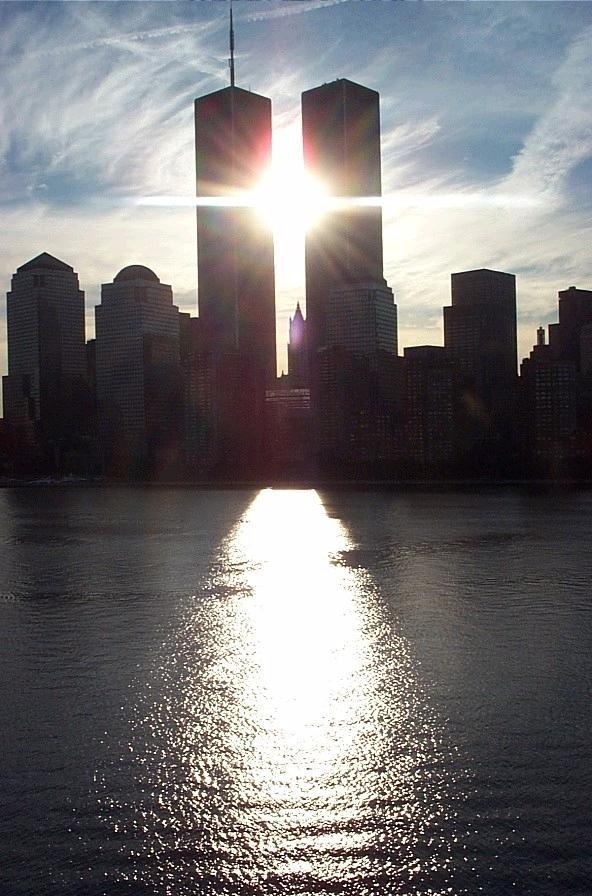
The day after 9/11, I’m sure we’re all ready to put it behind us. But 25 years is a landmark, and I didn’t have a show yesterday on which I could share some appropriate music. There’s only so much one can do with a film music program!
The anniversary is especially sobering this year, as I realize that we are now as far away from the World Trade Center attacks as my birth was from Pearl Harbor. That’s the perspective from which younger generations now perceive 9/11. It’s something that happened a long time ago.
While I understood that abstractly, it only really registered a year or two ago, when I noticed all these irreverent 9/11 posts on social media. Now, I can be as irreverent as the next guy, but these are obviously people who were not old enough to remember 9/11. There are still plenty of folks out there, who aren’t all that old, who experienced the terror first hand or continue to suffer loss, debilitating illness, or even lasting trauma just from having witnessed it on TV. All of us are living now with the legacy of 9/11. The world was forever changed that day, and not for the better. September 11, 2001 was the dawn of a new century of anxiety and dark uncertainty. We are living in unkinder times.
There’s really very little I can add to the countless memorials and reflections surrounding the surreal, unforgettable events of that September morning – a morning that, for those of us old enough to have lived through it, still feels like yesterday. But I’m a radio host, and I have a platform, and I would like to use it to try to encourage some reflection and maybe even offer a little solace. To this end, this Saturday on “The Lost Chord,” I will be presenting an hour of music of remembrance and consolation.
Pulitzer Prize winner Kevin Puts addresses the horrendous imprint of the attacks in his Symphony No. 2, which in a single movement traces an emotional arc from comparative innocence of an almost cinematic benignity, shocked by a sudden, violent upheaval, from which emerges a more reflective epilogue of uncertainty and fluctuating hope. It certainly does not leave one feeling uncompromisingly desolate in the manner of Ralph Vaughan Williams’ Symphony No. 6, the last movement of which some have compared to a world laid waste by atomic warfare.
Philadelphia composer Robert Moran wrote his “Trinity Requiem” to mark the tenth anniversary of the attacks. Moran rises to the occasion to provide an ethereal masterpiece, a 30-minute journey into paradise worthy to stand alongside the transcendent Requiem of Gabriel Fauré.
“Trinity Requiem” received its first performance in 2011 at Trinity Wall Street, the so-called “Ground Zero church” in Lower Manhattan. Miraculously, a hundred-year-old sycamore tree preserved the church’s St. Paul Chapel, constructed in 1766, from destruction by debris from the World Trade Center, including what would have been a direct hit from a falling I-beam. A recording of Moran’s work was released on the Innova label, featuring the Trinity Youth Chorus and members of the Trinity Wall Street Choir under the direction of Robert Ridgell.
“Trinity Requiem” is scored for treble voices, four cellos, organ, and harp. Handbells are employed in the “Pie Jesu.” And, following in the steps of Fauré, Moran includes a setting of “In Paradisum,” emphasizing a desire to attain peace at last.
Listen for a remarkable moment that occurs in the “Offertory” – the fourth movement (built on a bass line employed by Johann Pachelbel in his famous Canon) – when a siren appears. It was not written into the score, but rather actual street noise that bled into the recording session – an eerie bit of serendipity, unavoidably conjuring memories of the horror that unfolded outside the venue a decade before. But it is horror recollected in tranquility.
I hope you’ll join me for “The Persistence of Memory,” music of remembrance and consolation to mark the 25th anniversary of 9/11, on “The Lost Chord,” now in syndication on KWAX Classical Oregon.
———-
Clip and save the start times for all three of my recorded shows:
PICTURE PERFECT, the movie music show – Friday at 8:00 PM EDT/5:00 PM PDT
SWEETNESS AND LIGHT, the light music program – Saturday at 11:00 AM EDT/8:00 AM PDT
THE LOST CHORD, unusual and neglected rep – Saturday at 7:00 PM EDT/4:00 PM PDT
Stream them, wherever you are, at the link!
https://kwax.uoregon.edu/
Tag: Kevin Puts
-
Music of Remembrance and Consolation for the 25th Anniversary of 9/11 on “The Lost Chord”
-
Princeton Symphony: Time for Three Shines
If you can find time to squeeze it in before your Oscar party, and if you’ve got the energy after losing an hour’s sleep due to the time change, it would be worth your while to try to catch the second performance of this weekend’s concerts of the Princeton Symphony Orchestra.
The program includes suites from the ballets “The Fire Dancer” (1938-40) by Bulgarian composer Marin Goleminov (in what music director Rossen Milanov claims is the work’s first U.S. performances) and “Romeo and Juliet” (1935-36) by Sergei Prokofiev.
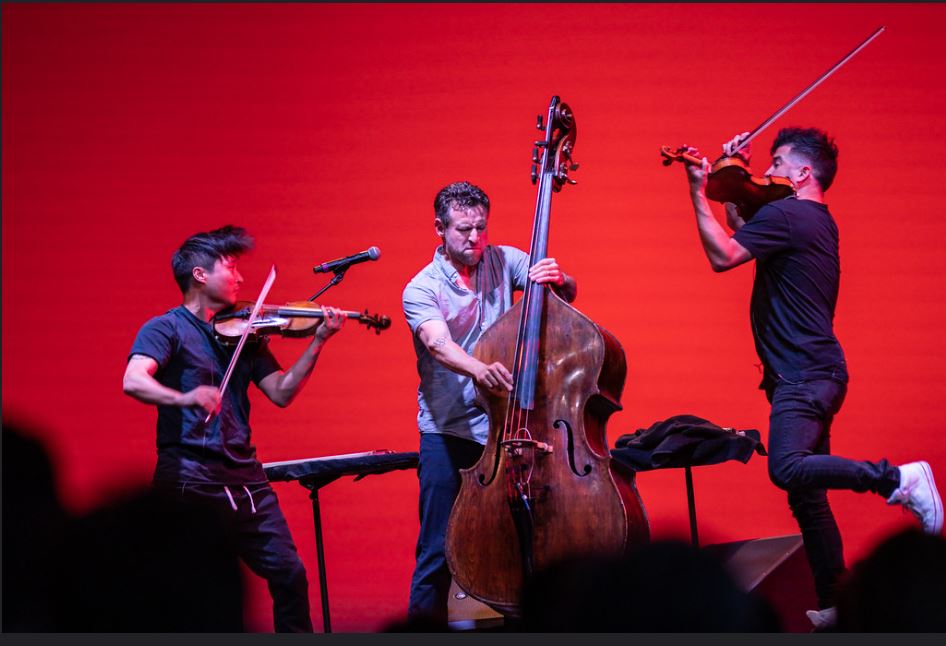
However, for as enticing as these offerings are, the real highlight is “Contact” (2022), a recent triple concerto by American composer Kevin Puts (Pulitzer Prize winner in 2012 for his opera “Silent Night”). The work, which is cinematic in the best possible sense, was written for the loosey-goosey, genre-hopping trio Time for Three (violinists Nick Kendall and Charles Yang and double-bassist Ranaan Meyer). These guys have been like overcaffeinated squirrels from the time I used to watch them improvising in Philadelphia’s Rittenhouse Square while still students at the Curtis Institute of Music. You won’t be able to take your eyes off the soloists, even as you’re alternately caressed, shaken and stirred by the music.
When “Romeo and Juliet” is the concert’s standard repertoire, you know the program has to be an exceptionally challenging one for the musicians, but last night you could see they were totally transfixed, charmed, and energized by their kinetic guests.
There was plenty of crackle in the hall for that piece and for the encore, as the trio presented a cover of the R&B classic “Stand by Me.” I don’t know that I’ve ever heard an audience react like that to a classical music concert in Richardson Auditorium. The level of energy was outstanding.
Today’s concert begins at 4 p.m. Admittedly, it is a long program, cresting two hours, but of course there is an intermission, and you’d be guaranteed to be out before 6:30. Grab a coffee ahead of time, have the fridge stocked in advance, and it’s possible you’ll be back in time for the start of the Oscars broadcast. You can always record the trashy red carpet prelude, if it means that much to you.
Or ditch the Prokofiev, if you must, and take off at intermission. Of course, you’d be missing some fantastic music. Also, if you love John Williams, it’s an added pleasure to be able to spend time with a composer who was clearly one of his biggest influences.
I apologize for not providing more advance notice for this extraordinary concert, but I had a lot of deadlines this week, and really, I didn’t think anything about it until yesterday! Do yourself a favor, if you can, and make time for Time for Three.
For tickets and information, visit princetonsymphony.org.
PHOTO: As seen at last summer’s The Princeton Festival
-

Time for Three Shines at Princeton Festival
At last night’s opening concert of The Princeton Festival, Time for Three affirmed its strong musical bond. The musicians have been playing together since their student days at the Curtis Institute of Music. In 2023, they became Grammy Award winners.
Left to their own devices, the trio presents an eclectic and electric blend of classical, Americana, and modern pop. This was their second appearance at the Princeton Festival, and the crowd was clearly energized.
In March, the group will return to perform with the Princeton Symphony Orchestra, as soloists at Richardson Auditorium in Pulitzer Prize winner Kevin Puts’ triple concerto, “Contact.” Time for Three was recently honored with a Grammy for the Deutsche Grammophon release, “Letters for the Future,” which includes a recording of the work and that of another concerto by Philadelphia composer (and Pulitzer winner) Jennifer Higdon.
The Princeton Festival, which runs through June 25, will continue tonight at 7:00 with Drama Desk Award nominee Capathia Jenkins and a tribute to the “Queen of Soul,” Aretha Franklin. The concert will feature three-time Grammy-nominated artist Ryan Shaw, with the Princeton Symphony Orchestra led by its former assistant conductor, John Devlin (now music director of the Wheeling Symphony Orchestra of Wheeling, WV). The program will include such Franklin favorites as “Respect,” “Think,” “A Natural Woman,” and “Chain of Fools.”
Then tomorrow afternoon, something completely different, as internationally-acclaimed pianist Christopher Taylor will perform a recital of contrasting works by Sergei Rachmaninoff, Nikolai Kapustin, Sofia Gubaidulina, and Sergei Prokofiev. That concert will take place at 4:00.
Further festival events will encompass opera (Rossini’s “The Barber of Seville”), chamber music, musical theater, contemporary dance, a klezmer “good vibes explosion,” and a special family concert, all presented on the grounds of Morven Museum & Garden at 55 Stockton Street (Route 206).
Vibrant Baroque music and an intimate program for guitar and cello will be offered across the way at Trinity Church Princeton, at 33 Mercer Street.
The festival’s “big top,” an 11,000 square-foot, clear-span (no poles or obstructed views), open-sided performance pavilion, allows for easy access to refreshments, ample picnicking opportunities, a garden stroll, or the simple enjoyment of a late-spring/early-summer evening.
The Princeton Festival is the premier summer arts program of the Princeton Symphony Orchestra. For complete listings and ticket information, visit princetonsymphony.org/festival.
And if you haven’t had a chance to take a look at it yet, here’s my preview in the Princeton weekly U.S. 1 Newspaper – PrincetonInfo.
Photo by Carolo Pascale
-
Kevin Puts at 50 Pulitzer Winner & Composer’s Career
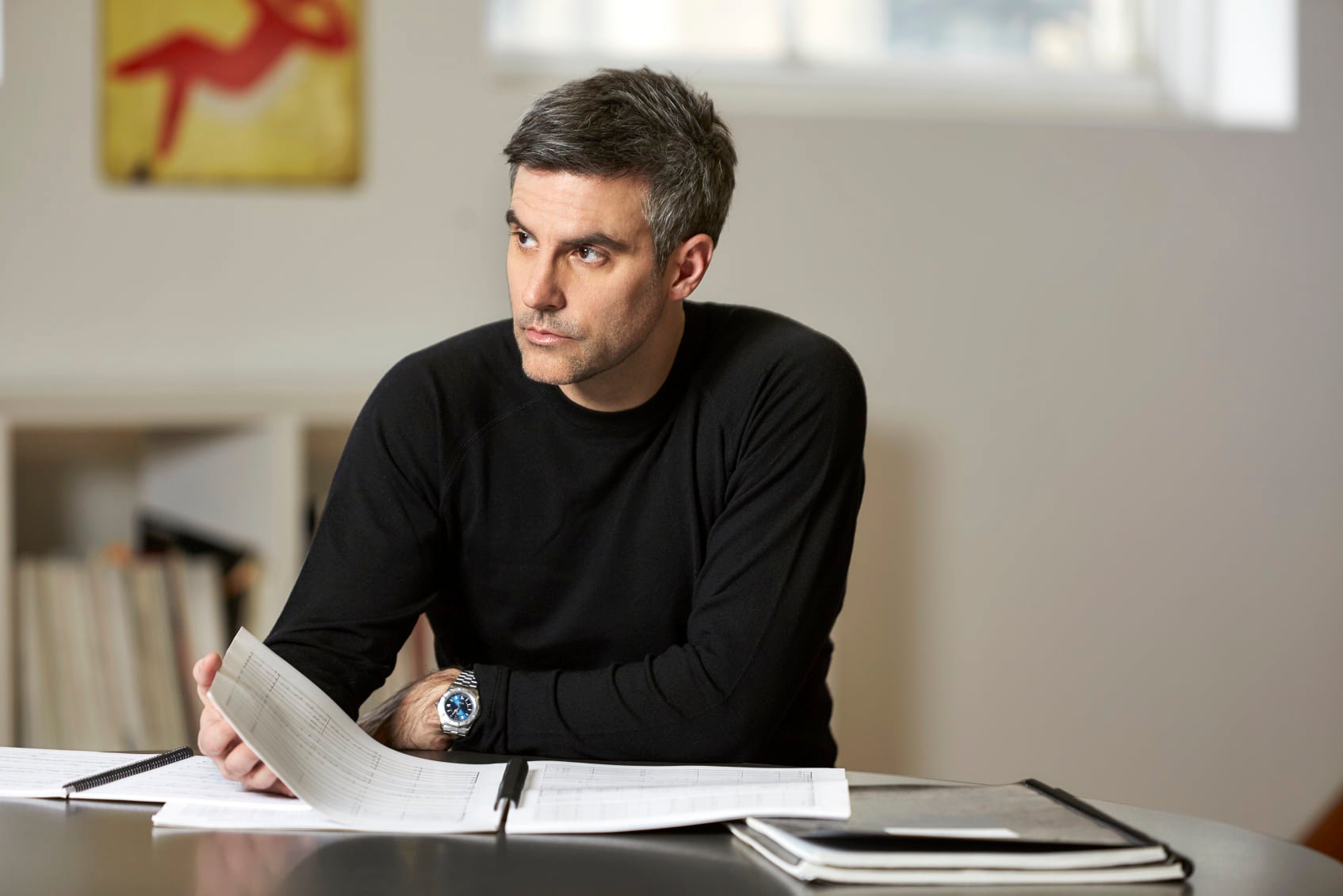
Kevin Puts is 50 today. Puts was the recipient of the Pulitzer Prize for Music in 2012 for his opera “Silent Night,” about the real-life, unsanctioned 1914 Christmas truce between Scottish, French, and German troops on the Western Front. It’s a poignant story, in whatever form. (It was also dramatized in the 2005 film “Joyeux Noël.”) The opera beautifully captures the transcendent moments of humanity, like shafts of sunlight piercing clouds, during one of the costliest and most violent conflicts in the bloody history of warfare. The work was given its world premiere by Minnesota Opera in 2011. I was lucky enough to catch Opera Philadelphia’s production in 2013.
Puts’ latest opera, “The Hours,” co-commissioned by the Philadelphia Orchestra and the Metropolitan Opera, was projected to be unveiled at the Met in 2022. It looks like it’s been pushed back to next season. In the meantime, two concert performances will be given by the Philadelphia Orchestra, on March 18 & 20, with Yannick Nézet-Séguin conducting. The cast for the Met debut was to have included Renée Fleming, Kelli O’Hara, and Joyce Di Donato as Virginia Woolf. For the Philadelphia performances, Fleming and O’Hara will be joined by Jennifer Johnson Cano.
I’ve never heard anything by this composer that hasn’t been direct, beautiful, and worthwhile. He’s a contemporary artist who has had the good fortune to be rewarded for his courage to remain true to himself, avoiding the pitfall of gussying up what he wishes to express with a lot of extraneous modernist effects, in order to maintain his street cred, as some composers of a clearly romantic bent had done in the previous generation. Nor is he a post-modernist hipster, a keyboard noodler, an overweening pop artist, or a soft-headed, wannabe film composer.
Puts’ language is romantic, but it is not the lingua franca of the 19th century. In embracing tonality and melody, he honors the most fundamental purpose of music, which is not simply to express, but to communicate, and he does so intelligently, in a manner that is capable of reaching a wide audience without cheapening his art.
Furthermore, at 50, he still has a long career ahead of him.
Many happy returns, Kevin Puts.
“Inspiring Beethoven” (with disturbing slideshow)
The Flute Concerto, which flirts with Mozart in its second movement
The Symphony No. 2, a response to the events of 9/11
“Dona nobis pacem” from “Silent Night”
-

9/11 Reflection Music and Remembrance
9-11: A morning for reflection. It may have been 19 years ago today, but everything about it is still so vivid.
When my telephone rang around 9:00 that morning, I was already at work, at home, on my computer, oblivious to the news. I picked up. A friend was on the line. She said a plane had crashed into the World Trade Center. I imagined the Empire State Building and the B-25 accident, back in the 1940s. I’m thinking maybe a piper. Terrible in itself, but accidents do happen. Then she said one of the towers “fell over.” That was what propelled me to the TV.
Nothing could have prepared us for the spectacle and terror of that morning. Nothing would ever be the same.
I was one of the lucky ones. My parents happened to be in the air at that time, on the way to China. They were traveling west across Pennsylvania. At 10:03, United States Airlines Flight 93 crashed near Shanksville, southeast of Pittsburgh. The phone lines were jammed. Nobody owned a cell phone. It was a long day until I learned that my parents’ flight had been grounded in Pittsburgh.
My heart goes out to those who died senselessly, and for their survivors, for whom the day remains vivid and painful, I’m sure.
Here’s a work of solace and consolation: Robert Moran’s “Trinity Requiem” (2011), named for Trinity Wall Street, the so-called “Ground Zero church” in Lower Manhattan, composed to mark the attacks’ tenth anniversary:
The horror and surreality of the day are perfectly reflected in Gloria Coates’ String Quartet No. 8 (2001-02), with its eerie approximations not only of plane engines but also a kind of emotional instability. I know it gives me a sinking feeling, and that’s pretty much how it was to experience 9/11. If you’re looking for solace, do not go here:
Kevin Puts processes expectancy, uncertainty, and hope in his Symphony No. 2 (2002):
Dona nobis pacem.
Tag Cloud
Aaron Copland (94) Beethoven (95) Composer (114) Film Music (149) Film Score (143) Film Scores (255) Halloween (97) John Williams (197) KWAX (232) Leonard Bernstein (105) Marlboro Music Festival (125) Movie Music (164) Mozart (91) Opera (215) Philadelphia Orchestra (90) Picture Perfect (174) Princeton Symphony Orchestra (110) Radio (90) Ross Amico (244) Roy's Tie-Dye Sci-Fi Corner (290) The Classical Network (101) The Lost Chord (269) Vaughan Williams (107) WPRB (397) WWFM (881)