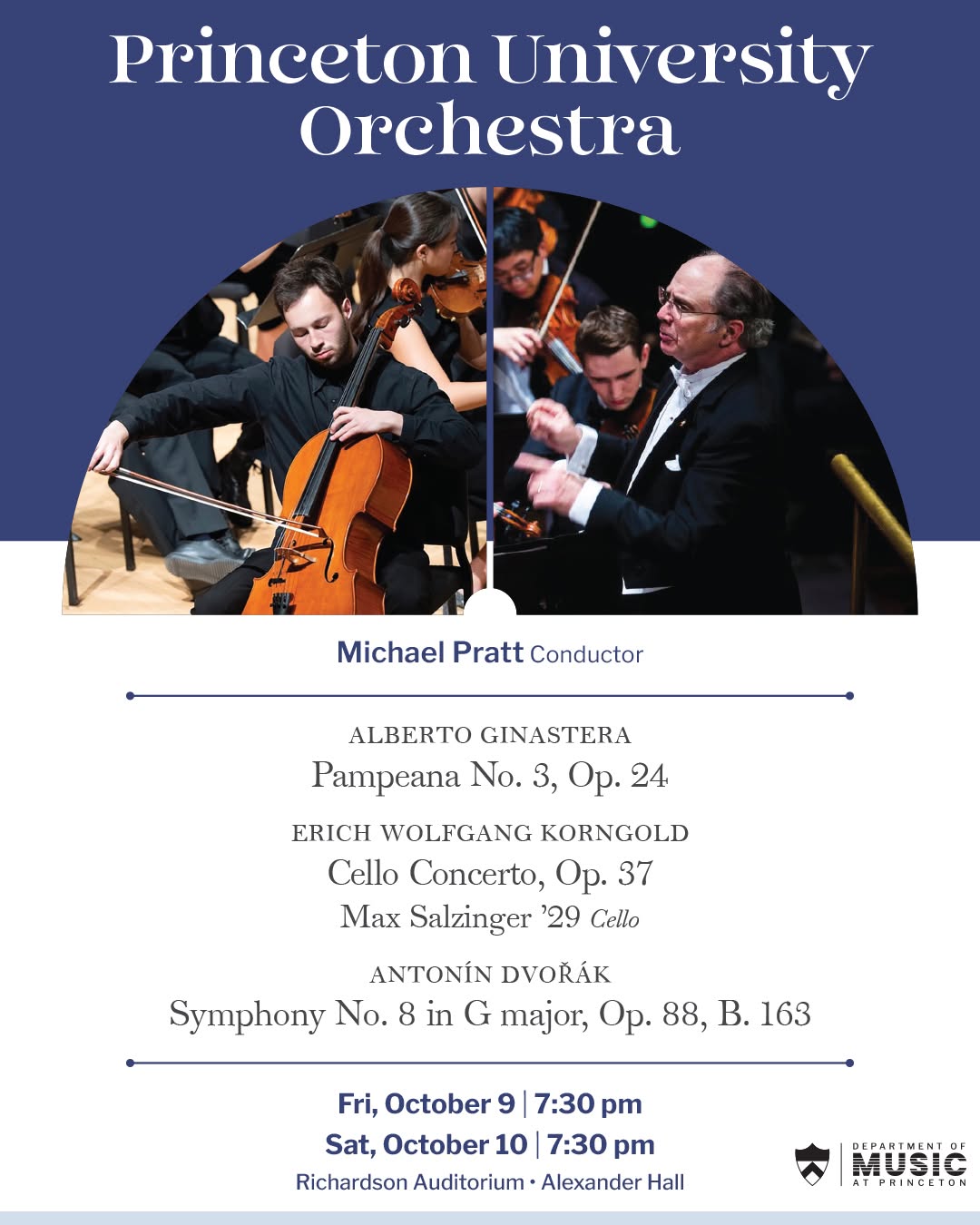
And suddenly, for me, the 2026-27 concert season gets underway. I know performing arts organizations have been busy for the past few weeks, but this weekend is the first that my dance card is on fire. How could I resist this program by the Princeton University Orchestra? Ginastera, Korngold, and my favorite Dvořák symphony!
Conductor Michael Pratt, the orchestra’s music director since 1977, is a genius at getting his students – few of whom are actual music majors (most of them are pursuing degrees in astrophysics, bioengineering, computer science, linguistics, sociology, philosophy, and other pointy-headed Princeton fields) – to play the most demanding repertoire. I’ve heard them perform “Ein Heldenleben,” the complete “Daphnis and Chloé,” several Mahler symphonies, and “The Dream of Gerontius,” among others. They’re always very good, and sometimes they even excel themselves. Furthermore, they play in Princeton’s intimate and historic Richardson Auditorium. Yowzers!
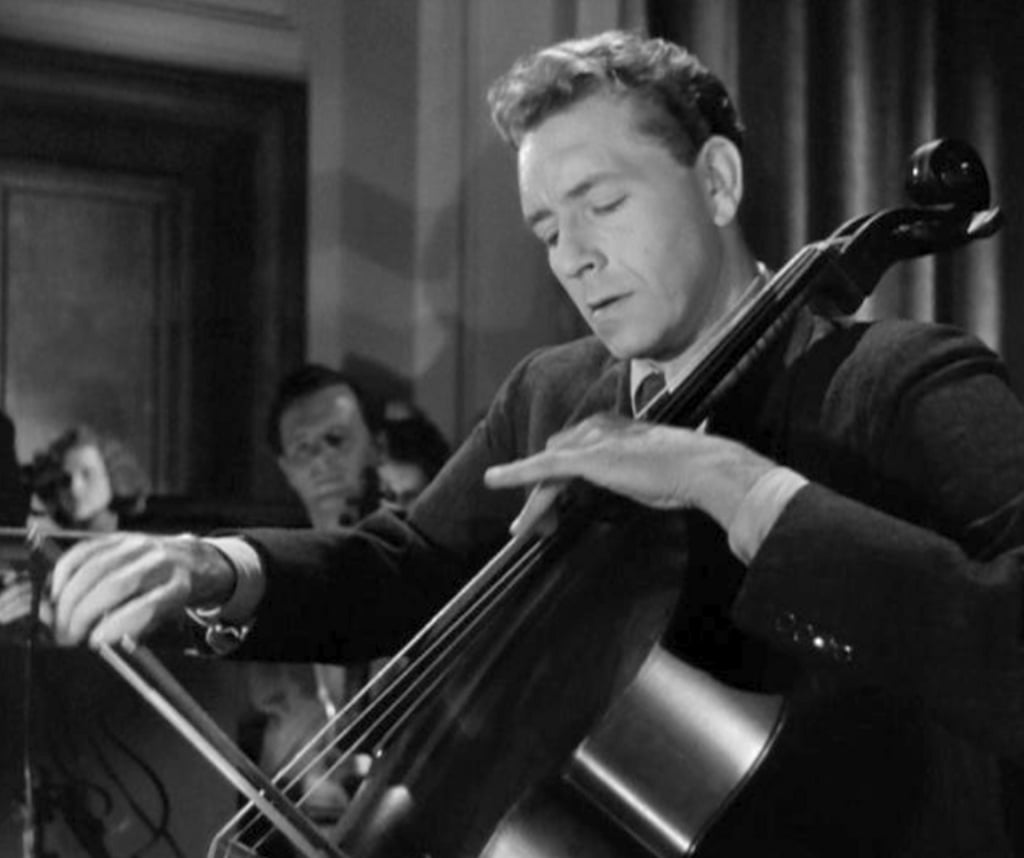
The cello soloist in the Korngold concerto is Max Salzinger (’29), winner of this year’s orchestra concerto competition. Korngold wrote the concerto for the 1946 Bette Davis-Claude Rains music-noir “Deception.” In the film, Paul Henreid (Casablanca’s Victor Laszlo) appears to play the solo part, but really he’s just making facial expressions, as in the closer shots, his hands are actually tied behind his back. Two professional cellists crouch behind him, one of their arms in either sleeve of a specially designed coat to give the actor’s pantomimed performance greater verisimilitude.
The cellist on the film’s soundtrack, the one that’s actually heard, is Eleanor Aller, the wife of Felix Slatkin (concertmaster of the 20th Century Fox studio orchestra and founder of the Hollywood String Quartet) and mother of conductor Leonard Slatkin. She was pregnant with her other son, Frederick Zlotkin, at the time. Zlotkin also grew up to be a professional cellist.
I’ve only ever heard the concerto performed live in concert once before. Naturally, I am very much looking forward to hearing it again, as Korngold is also one of my favorite composers.
Right here in my own backyard, too!
The Princeton University Orchestra program will be presented at Richardson Auditorium on both Friday and Saturday at 7:30 p.m.
For more information, visit:
https://music.princeton.edu/events/2026/princeton-university-orchestra-ginastera-korngold-dvořák
The other night? Why, Dalia Stasevska conducts the Philadelphia Orchestra in Sibelius’ “Pohjola’s Daughter” and Respighi’s “Pines of Rome,” with Gil Shaham the soloist in Saint-Saëns’ Violin Concerto No. 3, at Philadelphia’s Kimmel Center for the Performing Arts. I’m a lucky boy!
Tag: Korngold
-
Korngold in Princeton
-

Stranger Things 4: Jumped the Shark, Still Good
Season 4 of “Stranger Things” breathtakingly jumped the shark in innumerable ways. And yet somehow it remained compellingly watchable. Once I was able to get into it, that is. And I have to say, all the classical music on the soundtrack was a very nice bonus.
I’m aware that the latest season dropped on Netflix some time ago (in two “volumes,” on May 27 and July 1), but after watching the underwhelming first episode – which, for me, ventured a little too eyerollingly into CW Network-style teen angst – I wound up taking a prolonged break. I tune in to “Stranger Things” for the calculated ‘80s nostalgia and monsters from the Upside-Down, thank you.
Fortunately, at the urging of friends, I finally took it up again in earnest, and sure enough, yet again I found myself caught up in its icky tendrils. It’s been the pattern with this series that there’s been a kind of slow burn at the start that belies the relentless insanity to come. Hats off to the Duffer Brothers, the show’s creators, for their willingness to gamble big, because for as ludicrous as the whole thing has become, they’ve managed to take the series in some truly unexpected directions, while remaining true to its core.
If you’re unfamiliar with the series, one of its most charming characteristics is the way it raids the pop culture of the 1980s (Steven Spielberg, Stephen King, Dungeons & Dragons and, this season especially, “A Nightmare on Elm Street” and “Poltergeist” ) and rearranges it in fresh ways. Actor Robert Englund, Freddy Krueger himself, has a pivotal cameo.
The episode that allows everything that’s been presented in the first three seasons to be viewed in a totally different light (from multiple perspectives, even) is a knockout. But I always go in for that sort of thing when it’s done well. Admittedly, not everyone does. I was one of the few who was delighted with the topsy-turvy “Back to the Future Part II.”
Tonally, Season 4 is all over the place, but that’s kind of become a “Stranger Things” hallmark. Even as the stakes are impossibly high, it’s not afraid to go goofy. For most of its 13-hour running time, the show kept me engaged and laughing.
And what do you know, in this series driven by demons, conspiracy theory, and the paranormal, the KORNGOLD VIOLIN CONCERTO gets a major showcase in Episode 6, when the gang shows up in Salt Lake City to enlist a computer hacker. Her household turns out to be a mash-up of the kinds of theatricals once staged by the Bronte siblings and the March sisters. Wild children cavort with swords and bows-and-arrows and ruffed collars and pasted-on mustaches, while on a portable record player on the floor spins an LP of Korngold’s concerto.
According to the show’s timeline (set in 1985), it would have to be either the Heifetz or Perlman recordings, since I believe those were the only performances available then. But I’m skeptical as to whether or not the creative team was so scrupulous as not to employ a recording of more recent vintage. Of course, now the concerto is in the repertoire of every major violinist.
Erich Wolfgang Korngold, a former prodigy from Vienna, came to Hollywood in the 1930s, where he achieved wider popularity with his swashbuckling film scores for Errol Flynn classics like “Captain Blood,” “The Adventures of Robin Hood,” and “The Sea Hawk.”
For the average viewer, Kate Bush, Metallica, and Ella Fitzgerald will probably leave the biggest impressions, but Season 4’s soundtrack also sports selections by Verdi, Puccini, Bach, Debussy, Tchaikovsky, and Philip Glass, with Paisiello’s opera “Nina” a major influence on the plot that few will catch. These days, you can’t get much stranger than that!
Heifetz plays the last movement of Korngold’s Violin Concerto
-
Movies About Music Fellini Corigliano Korngold
This week on “Picture Perfect,” get ready for an exercise in postmodern self-reflexivity, as we enjoy music from movies about music and musicians.
Federico Fellini’s “Orchestra Rehearsal” (1978) is a mock-documentary that presents the symphony orchestra as a metaphor for the human condition. Full of political overtones, the film explores the joys, sorrows, frustrations and triumphs of the musicians, who struggle with the concepts of individual liberty, tyranny and the collective good. The project would mark the final collaboration between Fellini and Nino Rota. The two artists first came together in 1952 on Fellini’s “The White Sheik.” They would go on to create such classics as “La Strada,” “Nights of Cabiria,” “La dolce vita” and “8 ½.”
We’ll also hear music from the Canadian art house hit “The Red Violin” (1998). The film traces the history of the fictional title instrument from its creation in 17th century Cremona to the present day. The violin passes through the hands of a child prodigy, into those of a romantic virtuoso in the Paganini mold; then to China during the Cultural Revolution; and finally to a Canadian auction house. John Corigliano wrote the Academy Award-winning music, which is performed on the soundtrack by violinist Joshua Bell.
Finally, we’ll turn to a classical music film noir from Hollywood’s Golden Age. “Deception” (1946) tells the tale of a dangerous love triangle between Bette Davis, Paul Henreid and Claude Rains. Much of the plot hinges on the premiere of a new cello concerto by a celebrated – though fictional – composer, played by Rains, who puts a fragile cellist, his rival in love, played by Henreid, through the psychological ringer. The music, which serves as both underscore and crux of the story, is by Erich Wolfgang Korngold. The composer subsequently published the on-screen concerto as his Op. 37.
All aboard the musical ouroboros! Join me for music from movies about music and musicians, this Saturday evening at 6:00 EDT, on WWFM – The Classical Network and wwfm.org.
The overheated trailer for “Deception”
PHOTO: Henreid wore a special jacket to accommodate the arms of two professional cellists who stood behind him as he emoted. On the film’s soundtrack the concerto was performed by Eleanor Aller Slatkin, mother of Leonard Slatkin.
-

Korngold From Vienna to Hollywood
One of classical music’s most astonishing composer prodigies – springing fully formed from the head of Zeus, as it were – Erich Wolfgang Korngold became the toast of Vienna. His opera “Die tote Stadt” was probably his greatest success, receiving double-premieres in Hamburg and Cologne. It became one of the most popular operas by a living composer during the 1920s.
With the rise of the Nazis, Korngold and his family found refuge in Hollywood, where he wrote film scores for Warner Brothers, including those for some of my personal favorites: “The Adventures of Robin Hood,” (1938) “The Private Lives of Elizabeth and Essex” (1939), “The Sea Hawk” (1940), and “Kings Row” (1942).
Also during this period, he composed a “Passover Psalm,” on a commission from Rabbi Jacob Sonderling, founder of Fairfax Temple in Los Angeles. While ethnically Jewish, Korngold was not a particularly religious man. His only other sacred work, “Prayer,” was also composed for Sonderling.
Korngold swore he would produce no new concert music until Hitler was removed from power. He made those two exceptions for Fairfax Temple. Here is Korngold’s “Passover Psalm” (1941):
https://www.youtube.com/watch?v=5cpvsi4TFto
Chag aviv sameach!
By coincidence, Korngold is also the subject of today’s “Composer’s Datebook.” Listen here:
https://www.yourclassical.org/programs/composers-datebook/episodes/2021/03/28
-
Wittgenstein’s Lost Chord Left-Hand Legacy
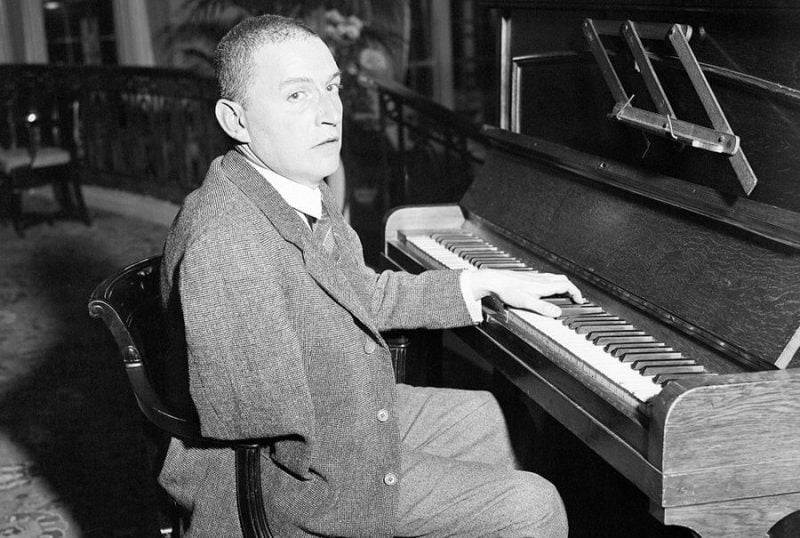
Concert pianist Paul Wittgenstein lost his right arm during the First World War. Rather than abandon his career, he commissioned works for the left hand from some of the great composers of his day, including Benjamin Britten, Sergei Prokofiev, Richard Strauss, and of course Maurice Ravel.
This Sunday night on “The Lost Chord,” we’ll highlight two of Wittgenstein’s lesser-known commissions.
In 1922, Wittgenstein approached Paul Hindemith – at 27, a rising star of German modernism, indeed the radical avant-garde – to produce his “Klaviermusik mit Orchester.”
Wittgenstein’s reaction to the piece is unknown, although we can easily surmise. He never played the work in public. Furthermore, since he had secured exclusive performance rights, he wouldn’t allow anyone else to play it, either.
Following the pianist’s death in 1961, his widow relocated to a farmhouse in Bucks County, Pennsylvania, where for decades she kept all of her husband’s belongings in a single room. When the estate was finally catalogued in 2002, a copy of the Hindemith concerto was discovered among Wittgenstein’s effects, along with other scores, correspondence, and items of interest, including locks of both Beethoven’s and Brahms’ hair.
It was Leon Fleisher who gave the belated premiere of the concerto, some 80 years after it was written, with the Berlin Philharmonic, conducted by Sir Simon Rattle. I was present at the U.S. East Coast premiere, with Fleisher and the Curtis Symphony Orchestra, conducted by Christoph Eschenbach. Listen carefully to see if you can hear me applauding, in a recording made at Philadelphia’s Verizon Hall, at the Kimmel Center for the Performing Arts, on April 27, 2008.
As a rule, Wittgenstein gravitated toward composers of a more Romantic bent. Erich Wolfgang Korngold was one of music’s most astounding prodigies, a Viennese wunderkind and celebrated opera composer, who later achieved world fame in Hollywood. There, he produced over a dozen classic scores, for films like “Captain Blood,” “The Adventures of Robin Hood,” and “The Sea Hawk.”
His greatest operatic success was “Die tote Stadt,” given its debut in 1920. Korngold was 23 years-old. In 1922, he became the first composer approached by Wittgenstein for a left-hand piano concerto. (It was the same year, by the way, that Wittgenstein enlisted Hindemith.) The result was the Piano Concerto in C-sharp. Tonight, Marc-André Hamelin will be the soloist, an outstanding virtuoso figuratively playing with one hand tied behind his back.
Interestingly, Wittgenstein much preferred this piece to Ravel’s Concerto for the Left Hand. It was the Ravel, commissioned in 1929, that would secure his place in music history, but he must have felt Korngold’s Romanticism and sense of struggle played more to his strengths. For whatever reason, Korngold became a Wittgenstein favorite. In the few minutes remaining at the end of the hour, Leon Fleisher will return to the keyboard for a performance of the “Lied,” the ardent slow movement of Korngold’s Suite for Two Violins, Cello and Piano Left-Hand.
I hope you’ll join me for “What’s Left?” – rarely-heard commissions by Paul Wittgenstein – on “The Lost Chord,” this Sunday night at 10:00 EST, on WWFM – The Classical Network and wwfm.org.
Tag Cloud
Aaron Copland (94) Beethoven (95) Composer (114) Film Music (148) Film Score (143) Film Scores (255) Halloween (97) John Williams (196) KWAX (232) Leonard Bernstein (105) Marlboro Music Festival (125) Movie Music (163) Mozart (91) Opera (215) Philadelphia Orchestra (90) Picture Perfect (174) Princeton Symphony Orchestra (110) Radio (90) Ross Amico (244) Roy's Tie-Dye Sci-Fi Corner (290) The Classical Network (101) The Lost Chord (269) Vaughan Williams (107) WPRB (397) WWFM (881)