Tag: KWAX

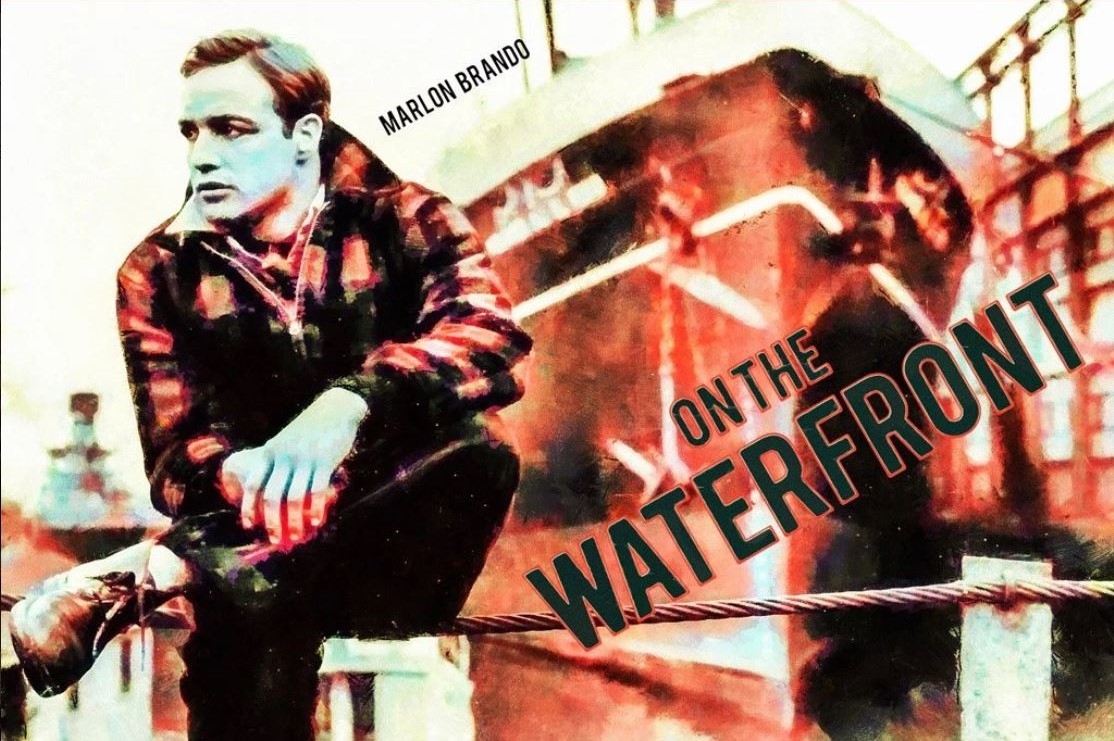
  • Bernstein’s Waterfront A Hollywood Contender

    Bernstein’s Waterfront A Hollywood Contender

    “I coulda had class. I coulda been a contender. I coulda been somebody – instead of a bum, which is what I am.”

    We’ve all had those kinds of days, haven’t we?

    Yet Leonard Bernstein’s score for “On the Waterfront” (1954) was always a contender, even if at times the composer found himself on the ropes.

    “On the Waterfront” was the only original film score composed by Bernstein (the screen adaptations of his stage musicals were adapted by other hands). Narrative film, of course, is a collaborative effort, in which music is usually the last to the table and the first to go. Bernstein’s score was edited and dialed down to suit the overall needs of the film.

    Unused to such rough treatment, Bernstein found his brush with Hollywood to be dispiriting, to say the least. He arranged his music into a concert suite, over which he had complete control, and the work has gone on to become one of his better-known pieces. That said, what can be heard in the film remains a powerful statement, and one of the great film scores.

    The original recordings, as they appear in the film, were long believed to have been lost. However, in the course of restoration of “On the Waterfront” for release on BluRay, it was discovered that audio had been preserved on acetate discs used for playback during the original recording sessions. Material from these were issued for the first time in 2014, on the Intrada label.

    Bernstein’s music would be nominated for an Academy Award, one of twelve total nominations for the film. “On the Waterfront” would win in eight categories, including Best Picture, Best Actor (Marlon Brando), and Best Director (Elia Kazan). Bernstein may have lost out to Dimitri Tiomkin for his work on “The High and the Mighty.” However, like Brando’s Terry Malloy, his score to “On the Waterfront” proves itself a champion.

    We’ll hear selections, alongside some of Aaron Copland’s music for “The Red Pony” (1949), once again, from the film’s original elements; dances from the only film score ever to be awarded the Pulitzer Prize for Music, “Louisiana Story” (1948), by Virgil Thomson; and the music that lends “Picture Perfect” its signature tune, “They Came to Cordura” (1959), by Elie Siegmeister.

    It’s an hour of New York composers in Hollywood this week, on “Picture Perfect,” music for the movies, now in syndication on KWAX, the radio station of the University of Oregon!


    Clip and save the start times for all three of my recorded shows:

    PICTURE PERFECT, the movie music show – Friday at 8:00 PM EDT/5:00 PM PDT

    SWEETNESS AND LIGHT, the light music program – Saturday at 11:00 AM EDT/8:00 AM PDT

    THE LOST CHORD, unusual and neglected rep – Saturday at 7:00 PM EDT/4:00 PM PDT

    Stream them, wherever you are, at the link!

    https://kwax.uoregon.edu/

  • Bernstein and Dvořák’s Graceful Exits

    Bernstein and Dvořák’s Graceful Exits

    With summer winding down and Leonard Bernstein’s birthday right around the corner (on August 25), this week on “The Lost Chord,” I thought it would be a good time to enjoy a program of valedictory works by two complementary composers.

    Bernstein’s autobiographical “Arias and Barcarolles” (1988) was winnowed from its original conception for four singers to a leaner combination of mezzo-soprano, baritone, and piano duet. The texts of the eight-movement song cycle, personal reflections on the nature of familial love, in all its layered harmonies and discords, are mostly by Bernstein himself. One of them, “Little Smary,” is a bedtime story his mother told him when he was a child. Others are propelled by witty repartee and amusing inside jokes.

    The title is taken from a humorous episode Bernstein liked to recount, stemming from a meeting with President Eisenhower in 1960. After a performance at the White House, Eisenhower remarked, “I liked that last piece you played. It’s got a theme. I like music with a theme, not all them arias and barcarolles.”

    The work was subsequently orchestrated, with the composer’s consent, by Bright Sheng, but personally, I think it works much better in this earlier form. It’s nimbler and more intimate, and the words land more cleanly.

    Another composer whose influence on American music was incalculable was Antonin Dvořák. While director of the National Conservatory of Music in New York from 1892 to 1895, the revered Czech master was impressed by the character and individuality of what he heard all around him as only an outsider could be. He became intoxicated with the sounds of a diverse, vibrant culture, and was astonished that few had noticed what was so clearly evident – that the foundation of a nationally-identifiable school of music was not be achieved in emulating European models, but rather in assimilating the great American melting pot, through folk song, Native American elements, and especially what was then termed Negro spirituals. He led by example, composing works such as the “American” String Quartet and the “New World” Symphony.

    Following his academic and administrative sojourn, Dvořák returned to Bohemia, where in his later years, he focused on opera and symphonic poems based on some astonishingly dark fairy tales. An exception was his final orchestral utterance, “A Hero’s Song” (1897). Admittedly, there is a somewhat sobering, somber interlude at its core, but this only serves to emphasize the swaggering exuberance of the 22-minute work’s outer, swashbuckling sections. It’s astonishing and gratifying to hear Dvořák go out in such a blaze of glory!

    I hope you’ll join me for “Graceful Exits” – final works of Bernstein and Dvořák – on “The Lost Chord,” now in syndication on KWAX, the radio station of the University of Oregon!


    Clip and save the start times for all three of my recorded shows:

    PICTURE PERFECT, the movie music show – Friday at 8:00 PM EDT/5:00 PM PDT

    SWEETNESS AND LIGHT, the light music program – Saturday at 11:00 AM EDT/8:00 AM PDT

    THE LOST CHORD, unusual and neglected rep – Saturday at 7:00 PM EDT/4:00 PM PDT

    Stream them, wherever you are, at the link!

    https://kwax.uoregon.edu/


    PHOTOS: Dvořák receiving an honorary doctorate from Cambridge in 1891 (left); Bernstein letting it all hang out in Fairfield, CT, in 1988

  • Insect Songs Celebrate Summer on Sweetness and Light

    Insect Songs Celebrate Summer on Sweetness and Light

    This week on “Sweetness and Light,” celebrate the season of the cricket and the katydid! Put your legs together for an hour of insect “song.”

    We’ll enjoy works by Ralph Vaughan Williams, Paul Lincke, Ernest Bucalossi, Dmitri Shostakovich, Nikolai Rimsky-Korsakov, Frank Loesser, Billy Mayerl, Frederic Cowen, and Fred L. Moreland.

    Tune in for a wasps’ overture, a glow worm’s idyll, a grasshopper’s dance, a gadfly’s romance, a bumble-bee’s flight, an inchworm’s measure, some insect oddities, a butterfly’s ball, and a doodle-bugs’ parade.

    We’ll be buzzing from the start on “Sweetness and Light,” this Saturday morning at 11:00 EDT/8:00 PDT, exclusively on KWAX, the radio station of the University of Oregon!

    Stream it, wherever you are, at the link:

    https://kwax.uoregon.edu/


    IMAGE: Ernst Kreidolf, “Les petits habitants des fleurs” (1924)

  • Tall Ships Movie Music Picture Perfect on KWAX

    Tall Ships Movie Music Picture Perfect on KWAX

    Summer vacation may be winding down, but it’s never too late to run away to sea. This week on “Picture Perfect,” we listen to music from movies featuring tall ships.

    Though Gregory Peck cuts a dashing figure as “Captain Horatio Hornblower” (1951), the movie itself is a bit episodic, adapted as it was from three of C.S. Forester’s Hornblower novels. Canadian-born master of British light music Robert Farnon wrote the music, lending another dimension to this nautical adventure.

    Alan Ladd and James Mason engage in a battle of wills in “Botany Bay” (1953). Ladd plays a doctor wrongly accused of a crime, being transported to a penal colony in New South Wales on a ship under the harsh command of Mason. In perhaps the film’s most memorable sequence, Mason has one of his charges keelhauled. Franz Waxman wrote the score.

    If it all sounds a mite familiar, it’s because the story was by Charles Nordhoff and James Norman Hall, authors of “Mutiny on the Bounty.” The classic film version dates from 1935, with Clark Gable butting up against Charles Laughton’s Captain Bligh. The 1962 version bears a certain notoriety, mostly for Marlon Brando’s eccentric performance, which turns Fletcher Christian into a fop, and the fact that he essentially directed all his own scenes himself. The film was colossal failure, earning back only $13 million of its $19 million budget. Nonetheless, it managed to inspire Bronislau Kaper to compose one of his most monumental scores.

    Finally, we’ll hear music from a release on Sepia Records of the soundtrack to “Windjammer” (1958), the only film shot using the Cinemiracle process. The film documents the round-trip, transatlantic journey of a Norwegian vessel from from Oslo to the Caribbean to New York to Portsmouth, New Hampshire, and then back home again. Morton Gould wrote the evocative score, which alternates dance rhythms and sea shanties with a recurring melody suggestive of the sweeping romance of the high seas.

    Join me as we recommission these tall ships on “Picture Perfect,” music for the movies, now in syndication on KWAX, the radio station of the University of Oregon!


    Clip and save the start times for all three of my recorded shows:

    PICTURE PERFECT, the movie music show – Friday at 8:00 PM EDT/5:00 PM PDT

    SWEETNESS AND LIGHT, the light music program – Saturday at 11:00 AM EDT/8:00 AM PDT

    THE LOST CHORD, unusual and neglected rep – Saturday at 7:00 PM EDT/4:00 PM PDT

    Stream them, wherever you are, at the link!

    https://kwax.uoregon.edu/

  • Celebrating Albert Ketèlbey Light Music Luminary

    Celebrating Albert Ketèlbey Light Music Luminary

    He helped bring “light” into the world.

    This week on “Sweetness and Light,” we mark the sesquicentenary of the birth of Albert Ketèlbey.

    Along with Eric Coates, 11 years his junior, Ketèlbey was one of the foremost British light music luminaries. In fact, it’s been said that at his peak, in the 1920s, there was no more successful composer in England. His music was played by palm court orchestras at grand hotels, at luxurious restaurants, in tea shops and cinemas, on municipal orchestra concerts, and on recordings and radio.

    Nowadays, his music is much less frequently heard. Coates has his infectious marches and “By the Sleepy Lagoon,” while Ketèlbey often strays to exotic fairy lands, dabbling in a kind of “orientalism” that is now decidedly out-of-fashion – though for some reason, it doesn’t prevent us from enjoying works like Rimsky-Korsakov’s “Scheherazade.”

    Even in his day, Ketèlbey withstood the brickbats of jealous rivals and indignant critics. It must have been doubly exasperating when he became England’s first composer to earn a million dollars. Unquestionably, there is a certain “kitsch” factor to his output. His works have been described as both “reprehensibly demeaning” and “delightfully tacky.” But there’s also an element of naiveté, which can still charm those of us lulled by a nostalgia for our grandparents’ enthusiasms.

    And face it, he DID always have an ear for a good tune.

    It’s unlikely in our more culturally sensitive age that Ketèlbey’s music will ever make a huge comeback, but these twee picture postcards offer fascinating glimpses into simpler times in the world of musical entertainment. I hope you are able to set aside your cynicism and sophistication for an hour, as we salute Albert Ketèlbey on the 150th anniversary of his birth, on “Sweetness and Light,” this Saturday morning at 11:00 EDT/8:00 PDT, exclusively on KWAX, the radio station of the University of Oregon!

    Stream it wherever you are at the link:

    https://kwax.uoregon.edu/

Tag Cloud

Aaron Copland (92) Beethoven (94) Composer (114) Film Music (116) Film Score (143) Film Scores (255) Halloween (94) John Williams (185) KWAX (228) Leonard Bernstein (99) Marlboro Music Festival (125) Movie Music (131) Opera (197) Philadelphia Orchestra (86) Picture Perfect (174) Princeton Symphony Orchestra (106) Radio (86) Ralph Vaughan Williams (85) Ross Amico (244) Roy's Tie-Dye Sci-Fi Corner (290) The Classical Network (101) The Lost Chord (268) Vaughan Williams (99) WPRB (396) WWFM (881)

DON’T MISS A BEAT

Receive a weekly digest every Sunday at noon by signing up here


RECENT POSTS