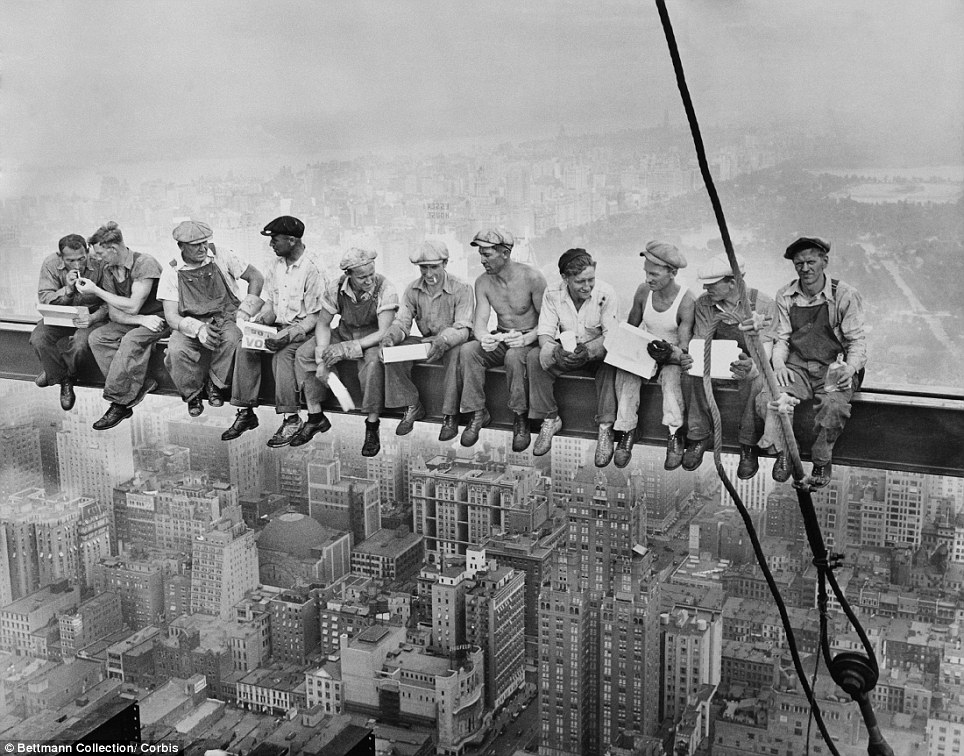
For Labor Day, here’s an effective transcription of John Alden Carpenter’s construction worker ballet, “Skyscrapers” (1926). On Saturday, I included the orchestral version on a playlist of labor-related works for my radio show, “Sweetness and Light.” This arrangement, by Yukiko Nishimura, was performed at Temple University by pianists Sara Davis Buechner & Charles Abramovic and percussionists Alyssa Resh & Andrew Malonis.
Tag: Labor Day
-

Labor Day Music Marathon on Sweetness and Light
How laborious it was to put together this morning’s “Sweetness and Light!” Which I suppose is only appropriate, since today’s theme is music for Labor Day.
It’s not uncommon when producing a show that the running time can come up a little long. I try to avoid it, but when it happens, it’s usually remedied with a few snips. But this week I was a full 90 seconds over, which meant trimming my commentary to the bone. It can take a while to whittle it all down.
In the end, I was still 30 seconds over. The rock was high and Classic Ross Amico was so small!
So I had to swap out Aaron Copland’s rarely-heard “John Henry” (at 4 minutes) for something decidedly more “Common” (at about 3:30). If you’re at all familiar with the composer and his output, I think you can deduce what that is.
Another casualty was my fine encapsulation of the essence of John Alden Carpenter’s construction worker ballet “Skyscrapers.” There’s an awful lot of color in that score to convey a few sentences!
“The scenario involves workers in overalls, who struggle to bring order to a confusion of girders and flashing red lights; all around them the hustle and bustle of the city. Eventually the whistle blows. There’s a diverting side-trip to a Coney Island-type amusement park, with its crowds and attractions and popular dance rhythms. Again the whistle blows, and the laborers return to work.”
The music is still there, but I wind up basically saying “here it is.”
Life is full of frustration, folks, but it still beats digging ditches.
I hope you’ll join me for a program that will also include works by George Frideric Handel, Nikolai Medtner, Michael Torke, and Eric Coates, with Princeton’s own Paul Robeson singing Earl Robinson’s labor classic “Joe Hill.” How that’s sweet OR light, I have no idea, but I’m playing it.
As always, I earn my bread by the sweat of my brow. Just in time for breakfast, I’ll be bringing home the bacon, on “Sweetness and Light,” this Saturday morning at 11:00 EDT/8:00 PDT, exclusively on KWAX, the radio station of the University of Oregon!
Stream it wherever you are at the link:
IMAGE: One of ten dynamic panels from Thomas Hart Benton’s mural, “America Today” (1930-31). You can click through thumbnails of all of them here:
-

Labor Day Road Trip American Music
Labor Day weekend. Road trip!
This week on “The Lost Chord,” I hope you’ll join me for summer’s last hurrah, as we burn rubber with an hour of quintessentially American music about travel by car.
Frederick Shepherd Converse’s “Flivver Ten Million” celebrates the Ford Motor Company’s affordable assembly line automobile, from its creation in a Detroit factory to the manifest destiny of America’s roadways.
John Adams’ “Road Movies” has nothing to do with Bob Hope and Bing Crosby, alas; what it is, however, is a violin sonata written firmly within the American tradition, with a special affinity at its core with Copland’s Violin Sonata.
Virgil Thomson’s “Filling Station,” written for Leon Kirstein’s Ballet Caravan, may have the distinction of being the only ballet set at a gas station. The work’s success gave Copland the confidence to follow through on a Caravan commission which resulted in “Billy the Kid.”
Finally, we’ll hear one of Michael Daughtery’s most performed works, the exuberant “Route 66,” inspired by the storied “Main Street of America.”
Put the pedal to the metal. American composers hit the road for Labor Day, on “The Last Roads of Summer,” on “The Lost Chord, now in syndication on KWAX, the radio station of the University of Oregon!
Clip and save the start times for all three of my recorded shows:
PICTURE PERFECT, the movie music show – Friday at 8:00 PM EDT/5:00 PM PDT
SWEETNESS AND LIGHT, the light music program – ALL NEW! – Saturday at 11:00 AM EDT/8:00 AM PDT
THE LOST CHORD, unusual and neglected rep – Saturday at 7:00 PM EDT/4:00 PM PDT
Stream them, wherever you are, at the link!
-

Labor Day Music on Sweetness and Light
How laborious it was to put together this morning’s “Sweetness and Light!” Which I suppose is only appropriate, since today’s theme is music for Labor Day.
It’s not uncommon when producing a show that the running time can come up a little long. I try to avoid it, but when it happens, it’s usually remedied with a few snips. But this week I was a full 90 seconds over, which meant trimming my commentary to the bone. It can take a while to whittle it all down.
In the end, I was still 30 seconds over. The rock was high and Classic Amico was so small!
So I had to swap out Aaron Copland’s rarely-heard “John Henry” (at 4 minutes) for something decidedly more “Common” (at about 3:30). If you’re at all familiar with the composer and his output, I think you can deduce what that is.
Another casualty was my fine encapsulation of the essence of John Alden Carpenter’s construction worker ballet “Skyscrapers.” There’s an awful lot of color in that score to convey a few sentences!
“The scenario involves workers in overalls, who struggle to bring order to a confusion of girders and flashing red lights; all around them the hustle and bustle of the city. Eventually the whistle blows. There’s a diverting side-trip to a Coney Island-type amusement park, with its crowds and attractions and popular dance rhythms. Again the whistle blows, and the laborers return to work.”
The music is still there, but I wind up basically saying “here it is.”
Life is full of frustration, folks, but it still beats digging ditches.
I hope you’ll join me for a program that will also include works by George Frideric Handel, Nikolai Medtner, Michael Torke, and Eric Coates, with Princeton’s own Paul Robeson singing Earl Robinson’s labor classic “Joe Hill.” How that’s sweet OR light, I have no idea, but I’m playing it.
As always, I earn my bread by the sweat of my brow. Just in time for breakfast, I’ll be bringing home the bacon, on “Sweetness and Light,” this Saturday morning at 11:00 EDT/8:00 PDT, exclusively on KWAX, the radio station of the University of Oregon!
Stream it wherever you are at the link:
IMAGE: One of ten dynamic panels from Thomas Hart Benton’s mural, “America Today” (1930-31). You can click through thumbnails of all of them here:
-

Labor Day Movie Music Working Stiff Cinema
Heigh-ho! This week on “Picture Perfect,” we celebrate Labor Day with music from movies about the working stiff.
“The Molly Maguires” (1970), set in and around the anthracite mines of Pennsylvania, illustrates the unfair labor practices imposed on immigrant workers there, which triggered violent strikes and acts of sabotage. Sean Connery is the ringleader and Richard Harris the Pinkerton detective brought in to infiltrate the gang.
The film was directed by Martin Ritt, a number of whose projects deal with labor, corruption, and intimidation, and his own experiences living through the era of the Hollywood blacklist – among these, “Edge of the City,” “The Front,” and “Norma Rae.”
The music is by Henry Mancini, a far cry from his work on “The Pink Panther,” “Peter Gunn,” and “Breakfast at Tiffany’s,” with a decidedly Celtic lilt.
Charlie Chaplin was a brilliant comedian, of course, but his perfectionism often resulted in uncomfortably close supervision over every aspect of his films. The young David Raksin found this out the hard way, when he accepted the job of assisting Chaplin in the writing of the score to “Modern Times” (1936).
Chaplin, a violinist and cellist himself, would whistle tunes and then stand over Raksin’s shoulder as he figured out how to make them fit the action. Alfred Newman, a much more seasoned hand, resented the micromanagement and stormed out of the film’s recording sessions. Raksin was actually fired once, after only a week and a half, but he was quickly rehired. Despite the creative friction, Chaplin and Raksin became friends, and Raksin recollected his work on “Modern Times” as some of the happiest days of his life.
The film begins with an iconic factory scene, Chaplin working an assembly line at an increasingly hectic pace, literally being put through the gears of the machinery. He suffers a breakdown, goes berserk, and throws the entire mechanized dystopia into chaos.
Speaking of dystopias, few can match the OSHA-flouting nightmare of Fritz Lang’s “Metropolis” (1927). One of the landmarks of silent cinema, “Metropolis,” unfortunately, is eerily prescient of a world divided between the haves and the have-nots. Once seen, the subterranean hell of the workers’ hive is not soon to be forgotten.
Lang’s vision continues to resonate in more ways than one, with its iconography shamelessly recycled by dewy-eyed fans and film students down the generations. Similarly, Gottfried Huppertz’s influential, Straussian score led the way for the opulent symphonic canvases of Max Steiner, Erich Wolfgang Korngold, and John Williams.
Finally, we’ll accept a helping hand – as well as claw, tail, beak, and tongue – from the benevolent woodland creatures of “Snow White and the Seven Dwarfs” (1937). Frank Churchill and Larry Morey’s songs are justifiably immortal.
The “picks” are all “mine” for Labor Day. Whistle while you weekend, on “Picture Perfect,” music for the movies, now in syndication on KWAX, the radio station of the University of Oregon!
Clip and save the start times for all three of my recorded shows:
PICTURE PERFECT, the movie music show – Friday at 8:00 PM EDT/5:00 PM PDT
SWEETNESS AND LIGHT, the light music program – ALL NEW! – Saturday at 11:00 AM EDT/8:00 AM PDT
THE LOST CHORD, unusual and neglected rep – Saturday at 7:00 PM EDT/4:00 PM PDT
Stream them, wherever you are, at the link!
Tag Cloud
Aaron Copland (92) Beethoven (95) Composer (114) Film Music (120) Film Score (143) Film Scores (255) Halloween (94) John Williams (185) KWAX (229) Leonard Bernstein (100) Marlboro Music Festival (125) Movie Music (135) Opera (198) Philadelphia Orchestra (88) Picture Perfect (174) Princeton Symphony Orchestra (106) Radio (87) Ralph Vaughan Williams (85) Ross Amico (244) Roy's Tie-Dye Sci-Fi Corner (290) The Classical Network (101) The Lost Chord (268) Vaughan Williams (103) WPRB (396) WWFM (881)