Tag: Labor Day

  • Happy Labor Day galley slave

    Happy Labor Day galley slave

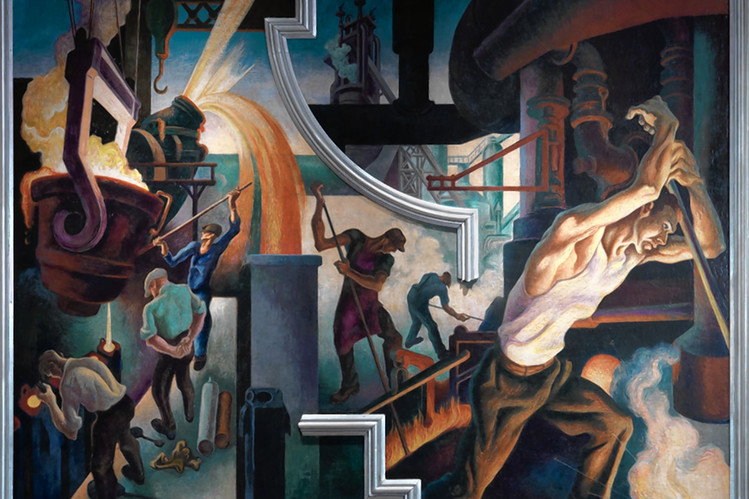
    Happy Labor Day. Sadly I’m still chained to the galley. Spare a thought for me at your cookout.

  • Labor Day Lost Chord Medtner Rosenthal Carpenter

    Labor Day Lost Chord Medtner Rosenthal Carpenter

    This week on “The Lost Chord,” it’s a working weekend, as we salute the laborer for Labor Day.

    Nikolai Medtner, classmate and friend of Sergei Rachmaninoff, wrote an awful lot of music for the piano. Alas, comparatively little of it is heard with any frequency. Pianists are said to adore his music, but for those in charge of concert venues the composer remains a tough sell. Medtner’s curiously titled triptych, “Three Hymns in Praise of Toil,” from 1926-27, consists of three movements: “Hymn Before Work,” “At the Anvil,” and “Hymn After Work.”

    Manuel Rosenthal’s original compositions have been eclipsed by his arrangements for the runaway success, “Gaité Parisienne.” Rosenthal wrote music for the stage, orchestral pieces, pieces for voice and chorus, and instrumental works, but none of them have attained anywhere near the recognition of his Offenbach ballet, on which his name, if it appears at all, does so in rather small print. He did enjoy a successful career as one of France’s most prominent conductors. Interestingly, he was also the third and last pupil of Maurice Ravel.

    We’ll hear Rosenthal’s “Les petits métiers” (“The Little Trades”), from 1933, ten deft orchestral sketches, including “The Farrier,” “The Herbalist,” “The Puppeteer,” “The Night-Watchman,” “The Postman Déodat,” “The Barber,” “The Cornet-seller,” “The Grinder,” “The Nanny,” and “The Little Telegraph-Boy.” If you don’t know what a farrier is, it’s a specialist in equine foot care!

    According to the composer, “In this score, I have put my memories of the urchin I once was in the streets of Paris. They were full of songs of the trades-people, glazier, knife-grinder and so on. But I did not forget the wet-nurses who fed the new-born children of richer families, the soldiers or the little telegraph-boys, urchins of 12 or 13 years-old, who carried telegrams by bicycle. In short, all those little trades that favored exchange between people and contributed to a very French and very cheerful atmosphere.”

    Speaking of horse feet, we’ll also enjoy a brief part-song by Gustav Holst, called “The Song of the Blacksmith,” a folk song arrangement from 1917. Holst later included the melody in his Second Suite in F for military band, with a lively part for anvil!

    Finally, American composer John Alden Carpenter’s ballet “Skyscrapers,” from 1924, is set against the backdrop of a big city, with workmen in overalls exerting themselves amidst the haste and confusion of urban life. A whistle blows. There’s a side trip to an amusement park, with suggestions of carousels and raucous dance bands. These are interrupted, briefly, by a flashback to the idea of work, the workmen swinging their hammers and preparing to rivet. Then a reversion to play, with sailors, flappers and midway types performing a succession of colorful dances. The whistle blows again, and the laborers are summoned back to the job at hand.

    Pull up a girder and get out your Stanley thermoses. I’ll be doing the heavy lifting as we punch the clock for Labor Day with “Labor Intensive” on “The Lost Chord,” now in syndication on KWAX, the radio station of the University of Oregon!


    Remember, KWAX is on the West Coast, so there’s a three-hour difference for the Trenton-Princeton area. Here are the respective air-times of my recorded shows (with East Coast conversions in parentheses):

    PICTURE PERFECT, the movie music show – Friday on KWAX at 5:00 PACIFIC TIME (8:00 PM EDT)

    THE LOST CHORD, unusual and neglected rep – Saturday on KWAX at 4:00 PACIFIC TIME (7:00 PM EDT)

    Stream them here!

    https://kwax.uoregon.edu/

  • Remembering the Jerry Lewis MDA Telethon

    Remembering the Jerry Lewis MDA Telethon

    For those of a certain era, it was never Labor Day without the Jerry Lewis MDA Labor Day Telethon. The show, presented as a benefit for the Muscular Dystrophy Association, was a star-studded endurance test, with celebrities ranging from Sinatra to Charo to Don Rickles to Midori giving their all, the whole while with a toll-free number superimposed at the bottom of the screen.

    The show began on Sunday evening and ran through late Monday afternoon. Jerry would emcee in varying degrees of sleep-deprived dishevelment. By the end, the bowtie was undone and the rumpled shirt unbuttoned, as he wrung out the final dollars and maybe even a few tears from a captivated television audience.

    The telethon ran for 44 years, from 1966 to 2010, raising billions for MD research. For a good deal of its existence, it was broadcast from Las Vegas, with Ed McMahon serving as cohost. A super infusion of old-school showmanship – a glitzy, schmaltzy, backslapping, in-jokey exercise, turned to the service of a good cause – there really was nothing like it. It had an inexplicable magnetism, easy to make light of, but hard to look away.


    Jerry opens the show in 2006 by conducting Leonard Bernstein’s “Candide Overture.”

    Charo

    Reunion with Dean Martin

    Jerry brings it home with “You’ll Never Walk Alone”

    There’s a whole channel devoted to this stuff on YouTube

    https://www.youtube.com/c/MDATelethon

    And another one here

    https://www.youtube.com/user/thetelethonyears

  • Labor Day Road Trip American Music

    Labor Day Road Trip American Music

    Labor Day weekend. Summer’s last hurrah.

    It may be the first weekend of September, but there’s still time for one more summer road trip.

    This Sunday night on “The Lost Chord,” it’s an hour of quintessentially American music about travel by car.

    Frederick Shepherd Converse’s “Flivver Ten Million” traces the Ford Motor Company’s affordable assembly line automobile, from its creation in a Detroit factory to the manifest destiny of America’s roadways.

    John Adams’ “Road Movies” has nothing at all to do with Bob Hope and Bing Crosby, alas. What it is, however, is a violin sonata written firmly within the American tradition, with a special affinity at its core with Aaron Copland’s Violin Sonata.

    Virgil Thomson’s “Filling Station,” written for Leon Kirstein’s Ballet Caravan, may have the distinction of being the only ballet set at a gas station. The work’s success gave Copland the confidence to follow through on another Caravan commission, which resulted in “Billy the Kid.”

    Finally, we’ll hear one of Michael Daughtery’s most performed works, the exuberant “Route 66,” inspired by the storied “Main Street of America.”

    Put the pedal to the metal. American composers hit the road for Labor Day, on “The Last Roads of Summer,” this Sunday night at 10:00 EDT, on WWFM – The Classical Network and wwfm.org.

  • “Cradle Will Rock”: Welles & Blitzstein’s Labor Day Coup

    “Cradle Will Rock”: Welles & Blitzstein’s Labor Day Coup

    For Labor Day, Marc Blitzstein and Orson Welles stick it to the Man – or Mr. Mister, as the case may be – with “The Cradle Will Rock.”

    The Philadelphia-born Blitzstein is probably best remembered for two things: for supplying the fine English translation/adaptation of Kurt Weill and Bertolt Brecht’s “The Threepenny Opera;” and for being the composer of this incendiary entertainment.

    Not long before “Cradle”s scheduled premiere, on June 16, 1937, the Brechtian, pro-labor musical was shut down by the Works Progress Administration, allegedly due to budget cuts. However, the padlocks on the theatre, the security guards, and the unwillingness to release props or costumes seemed to bolster assertions that the play was censored for being too radical.

    One must never toss a bone like that to Orson Welles. Welles turned it into a publicity coup by leading a 21-block march to a much larger theatre, where “The Cradle Will Rock” skirted union restrictions by scrapping the orchestra and having the actors perform their parts from the audience, while Welles and Blitzstein presided from the stage.

    The stunt worked so well that the show was able to secure a private backer and all subsequent performances were done in the same manner, with the actors in the audience. The producer, John Houseman, was elated that such a practical solution should prove to be the key to the show’s success.

    “There has always been the question of how to produce a labor show so the audience feels like it is a part of the performance,” he commented. “This technique seems to solve that problem and is exactly the right one for this particular piece.”

    The success of “The Cradle Will Rock” led Welles and Houseman to form the Mercury Theatre.

    But don’t take my word for it. Blitzstein tells the story himself in this reminiscence of the first performance of “The Cradle Will Rock.”


    PHOTO (left to right) Blitzstein, Welles, and Lehman Engel in 1937

Tag Cloud

Aaron Copland (92) Beethoven (95) Composer (114) Film Music (120) Film Score (143) Film Scores (255) Halloween (94) John Williams (185) KWAX (229) Leonard Bernstein (100) Marlboro Music Festival (125) Movie Music (135) Opera (198) Philadelphia Orchestra (88) Picture Perfect (174) Princeton Symphony Orchestra (106) Radio (87) Ralph Vaughan Williams (85) Ross Amico (244) Roy's Tie-Dye Sci-Fi Corner (290) The Classical Network (101) The Lost Chord (268) Vaughan Williams (103) WPRB (396) WWFM (881)

DON’T MISS A BEAT

Receive a weekly digest every Sunday at noon by signing up here


RECENT POSTS