Tag: Leopold Stokowski

  • Leopold Stokowski Birthday & Hollywood

    Leopold Stokowski Birthday & Hollywood

    Today is the birthday of Leopold Stokowski.

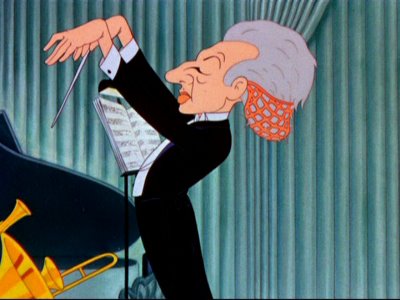
    And since the comments section is bound to be filled with gasps of “LEOPOLD,” we may as well get this out of the way right now. (Then read on!)

    The snapping of the baton is a little bit of an in-joke, since Stokowski made it a point to lead not with a stick, but rather using his expressive, mesmerizing hands.

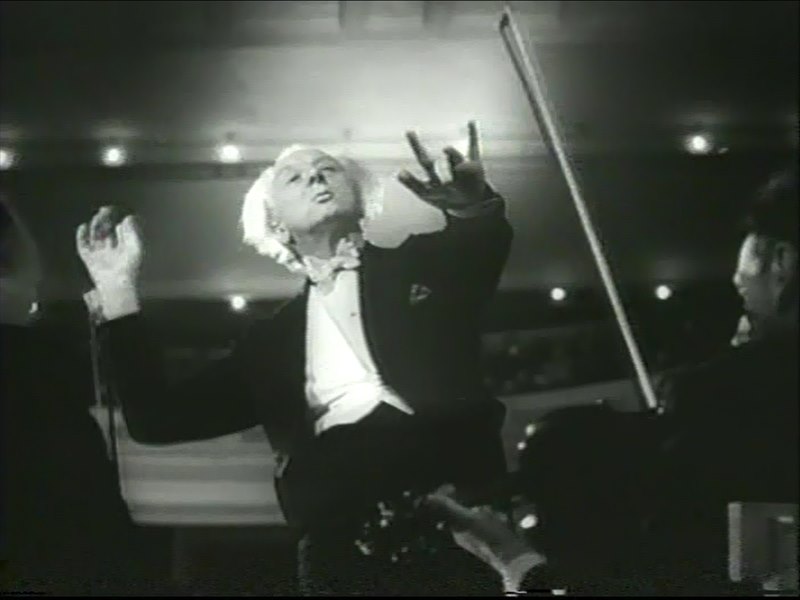
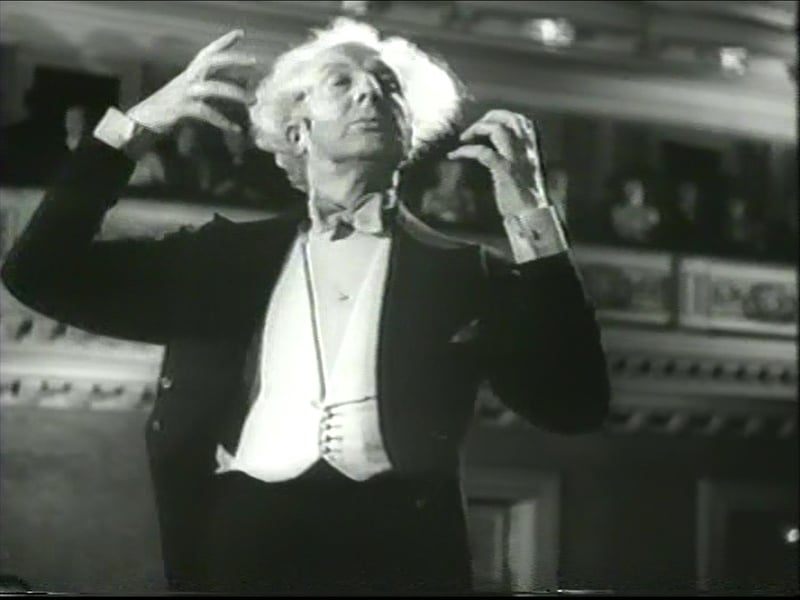
    Here he is in “Carnegie Hall” (1947), real junk food for the classical music lover. Forget about the plot, which is total hokum – a brash young American pianist turns the classical music world on its ear with the debut of his corny “jazz” concerto (with Harry James, no less, playing trumpet obbligato) – the main draw is a parade of real-life classical music superstars.

    The director Edgar G. Ulmer, emerged from German Expressionist cinema (he claimed to have worked on “Metropolis” and “M”), to direct atmospheric Hollywood films like “The Black Cat” and “Detour.”

    The experience obviously prepared him for this showcase of Stokowski, who in the film’s best sequence conducts a movement from Tchaikovsky’s Symphony No. 5. The camera angles are striking, the lighting dramatic, and Stoky’s hair just keeps getting bigger… and bigger… and bigger.

    Stokowski also shared screen time with Deanna Durbin in “One Hundred Men and a Girl” (1937). In case you’re curious, Charles Previn, credited as associate musical director, was the second-cousin of Andre Previn. Stokowski conducts the finale of the same Tchaikovsky symphony. Also, Deanna Durbin sings from “La Traviata.”

    Naturally, there’s the obligatory shot of a bored husband (character actor Eugene Pallette) dozing in the audience, and a boy-next-store shouting from a balcony, just to keep it all comfortably “regular guy.”

    But it goes without saying that the most enduring artifact of Hollywood’s romance with Stoky was the conductor’s work on Walt Disney’s “Fantasia” (1940), including this iconic handshake with Mickey Mouse:

    Stokowski recorded the soundtrack in experimental stereo, captured by 33 microphones and three million feet of sound film, at Philadelphia’s Academy of Music in 1939. Stokowski served as the Philadelphia Orchestra’s music director from 1912 to 1938. Here he directs Bach’s “Toccata and Fugue in D minor,” from a Spanish print of the film:

    Finally, Stokowski talks about his experiences in Hollywood, most specifically his work on “Fantasia,” in an interview given in the 1960s:

    https://www.youtube.com/watch?v=RCGdRntUJ0M

    Notoriously, the accent is totally phony baloney. Stokowski’s grandfather was Polish, but he himself was a second-generation Londoner. But Stoky always did have a whiff of P.T. Barnum about him. He may have been a visionary, but, first and foremost, he knew how to captivate an audience.

    I hope you’ll join me tonight for “The Lost Chord,” as I’ll be highlighting some of Stokowski’s early Wagner recordings with the Philadelphia Orchestra. The program, “Magic Fire,” will air at 10:00 EDT on WWFM – The Classical Network and wwfm.org.
  • Khachaturian Resolve Amidst Anxious Times

    Khachaturian Resolve Amidst Anxious Times

    Anxious about current events?

    This Sunday night on “The Lost Chord,” join me for Leopold Stokowski’s rarely-heard recording of Aram Khachaturian’s Symphony No. 2.

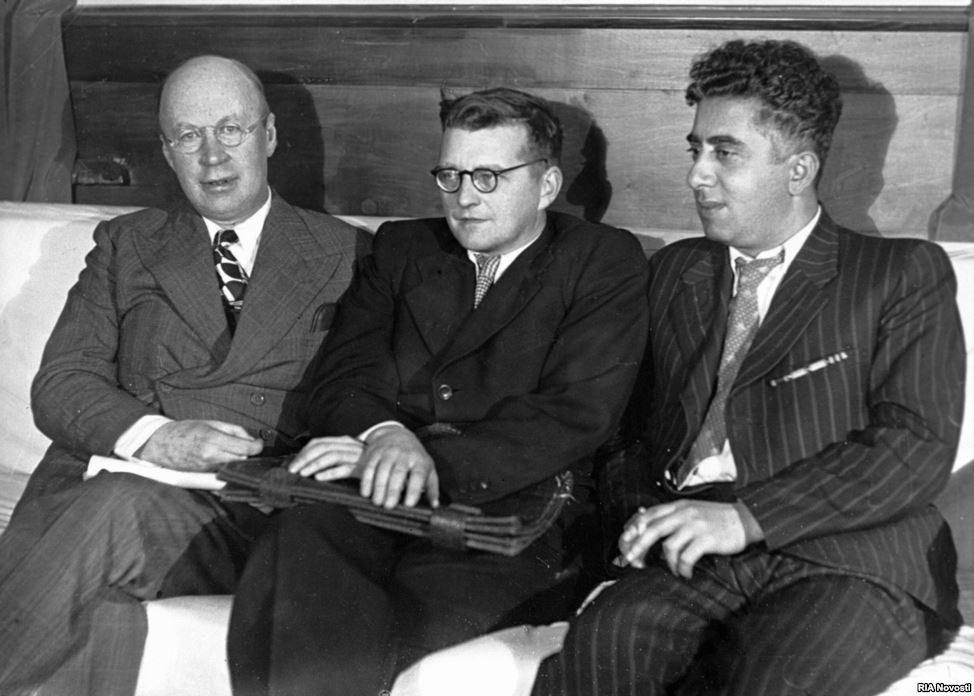
    Khachaturian composed the work in 1943, the height of World War II, while holed up at a Composers Union retreat with Shostakovich, Prokofiev, Miaskovsky, and Glière. He described the piece as “a requiem of protest against war and violence.” Its nickname, “The Bell,” alludes to a kind of alarm that opens and closes the work. Overall, the tone is one of unshakable resolve in the face of tragedy.

    Stokowski’s recording, long unavailable, was originally issued on United Artists Records in the late 1950s. It reappeared briefly on compact disc, on the EMI label, in 1994, and again in 2009, as part of a 10-disc box set of entrancing Stokowski performances.

    Alas, the master tapes have not weathered the years well, so there are moments of distortion, but the power of the work under Stokowski’s direction transcends any technical limitations.

    To round out the hour, we’ll hear Russian-born pianist Nadia Reisenberg in a selection from her 1947 Carnegie Hall recital, Khachaturian’s most famous piano piece, the “Toccata.” Reisenberg studied at Philadelphia’s Curtis Institute of Music under Josef Hoffman.

    I hope you’ll join me for music by Khachaturian other than the “Sabre Dance.” That’s “Khach as Catch Can,” this Sunday at 10:00 EST, on WWFM – The Classical Network and wwfm.org.

    “Sabre Dance” at the Bolshoi, with Khachaturian conducting:

    Khachaturian singing about the glories of Armenian wine!

    https://www.youtube.com/watch?v=vtKHrg7w3_o


    PHOTO: Troika! (Right to left) Khachaturian with Shostakovich and Prokofiev

  • Fantasia at 80 Disney’s Bold Experiment

    Fantasia at 80 Disney’s Bold Experiment

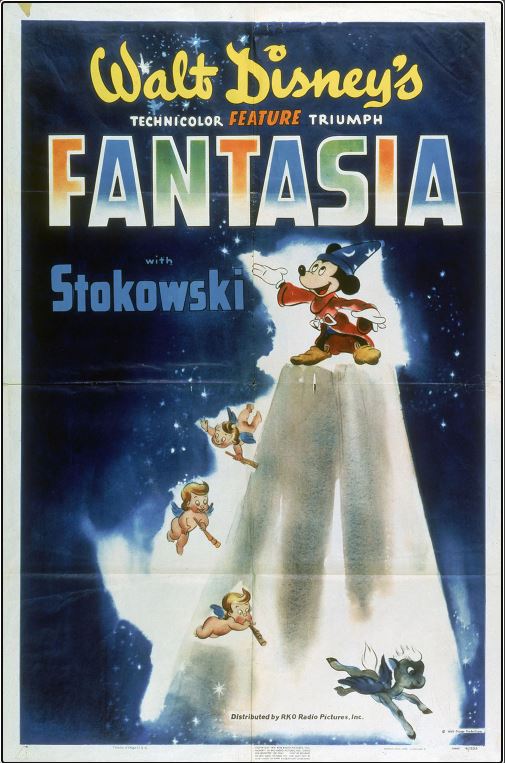
    Walt Disney’s “Fantasia” was released into theaters for the first time 80 years ago today.

    Giddy with the success of “Snow White and the Seven Dwarfs” (1937), which became a surprise hit – the highest grossing feature up to that time (soon to be supplanted by “Gone with the Wind”) – and hoping to reinvigorate the popularity of house brand Mickey Mouse, Disney spared no expense in the creation of this bold, beautiful, mind-bending, slightly pretentious, occasionally kitschy experimental enterprise, engaging Leopold Stokowski and the Philadelphia Orchestra to record the film’s soundtrack and, on its initial run, displaying it in special road show productions, featuring souped-up, “Fantasound” surround audio. This was the first feature film to be released in stereo. It ran in one venue in New York for a solid year. At a point, Disney even toyed with the idea of pumping different scents into the theater, but he must have realized it was all becoming a little too Scriabinesque.

    Eventually reality caught up. “Fantasia” was a money-loser from the start. The war in Europe cut off any possibility of overseas revenue, and it became apparent that the film would have to be reissued, with cuts, in standard format, in regular theaters, if the studio hoped to make any of its money back. As it was, it didn’t turn a profit until 1969. I suspect it was the same crowd that was buzzing to “2001: A Space Odyssey” that finally pushed “Fantasia” into the black. It is now the 24th highest-grossing film in the United States. There aren’t any studios, and very few classical record companies, that would make that kind of investment in the future anymore.

    I venture to guess most people who were lucky enough to see “Fantasia” in the cinema, back in the days before home video brought an end to its regular theatrical reissues, were charmed to see Stokowski shake hands with Mickey Mouse. Even so, this is the moment that became seared into many an impressionable memory. And I know I loved it.

    Apologies for posting it in two parts, but “Fantasia” was reissued and “restored” a number of times over the years. This one I know sports Stoky’s original audio.

  • Warner Bros Classic Hollywood Cartoon

    Warner Bros Classic Hollywood Cartoon

    I always loved when Warner Brothers took a break from Bugs Bunny to do these types of one-offs. This one’s a dream for classic movie buffs – with another lampoon of Leopold Stokowski outside of the famous “LEOPOLD!” episode. He’s introduced by Bing Crosby at around the 3:30 mark.

    http://www.youtube.com/watch?v=xOFG_qmoH8I&t=0m16s

    You might have to pause it in order to get some of the group shots. If you still think you missed some of the references, somebody else with a lot of time on his hands has done a breakdown.

    https://www.listal.com/list/cartoon-verzions-classic-hollywood-stars

    Garbo as the cigarette girl is hilarious.

  • Leopold Stokowski Birthday Carnegie Hall & More

    Leopold Stokowski Birthday Carnegie Hall & More

    LEOPOLD! HAPPY BIRTHDAY!!

    Has anyone seen the film “Carnegie Hall?” Sure, it sports a corny plot about a young American pianist who turns the classical music world on its ear by becoming a jazz artist. Of course, the debut of his “avant garde” concerto (with Harry James as soloist) seems positively quaint from today’s perspective, as I’m sure it would have been even in 1947.

    The main draw is the parade of real-life classical music superstars, including Jascha Heifetz, Gregor Piatigorsky, Arthur Rubinstein, Lily Pons, Rise Stevens, Jan Peerce, Ezio Pinza, Bruno Walter and Fritz Reiner, among others, all of whom get to perform.

    The film was directed by Edgar G. Ulmer, who emerged from the German Expressionist movement (he claimed to have worked on “Metropolis” and “M”) to direct atmospheric Hollywood films like “The Black Cat” and “Detour.”

    That experience obviously prepared him for this showcase of Leopold Stokowski, who in the film’s best sequence conducts a movement from Tchaikovsky’s Symphony No. 5. The camera angles are striking, the lighting dramatic, and Stoky’s hair just keeps getting bigger and bigger.

    While we’re at it, here’s Stoky conducting his own transcription of music by Johann Sebastian Bach at the age of 90.

    And since the comments section is bound to be filled with shouts of “LEOPOLD…”

    That’s some hare!

Tag Cloud

Aaron Copland (93) Beethoven (95) Composer (114) Film Music (143) Film Score (143) Film Scores (255) Halloween (94) John Williams (195) KWAX (229) Leonard Bernstein (104) Marlboro Music Festival (125) Movie Music (158) Mozart (90) Opera (212) Philadelphia Orchestra (89) Picture Perfect (174) Princeton Symphony Orchestra (108) Radio (88) Ross Amico (244) Roy's Tie-Dye Sci-Fi Corner (290) The Classical Network (101) The Lost Chord (269) Vaughan Williams (105) WPRB (397) WWFM (881)

DON’T MISS A BEAT

Receive a weekly digest every Sunday at noon by signing up here


RECENT POSTS