Tag: Leopold Stokowski

  • Rachmaninoff’s Piano Concerto No. 4 Debut

    Rachmaninoff’s Piano Concerto No. 4 Debut

    It was on this date 90 years ago that the Sergei Rachmaninoff gave the debut of his Piano Concerto No. 4, from the keyboard, with Leopold Stokowski and the Philadelphia Orchestra. It had been 18 years since his previous concerto (which he had unveiled in New York). In the meantime, he had weathered the Russian Revolution and the personal, perpetual obligation of earning a living as a concert pianist.

    The original version of the Fourth Concerto was much longer than the one heard at the 1927 premiere. Even so, the work failed to engage either critics or audience. The composer, ever sensitive to criticism (the failure of his Symphony No. 1 plunged him into a depression so profound that it could only be alleviated through hypnotherapy, from which he emerged to write his Piano Concerto No. 2, ecstatically received), prepared a final, authoritative version of the Concerto No. 4 for performance with the Philadelphia Orchestra, this time under Eugene Ormandy, in 1941. The work has never caught the imagination of concert-goers to anywhere near the same extent as the Concertos Nos. 2 & 3.

    The original version was released by the Rachmaninoff Estate only in the year 2000. It has since been recorded in this form several times. It’s a very interesting piece. One wonders if the work would have fared better had Rachmaninoff simply stuck to his guns?

    The original version of Rachmaninoff’s Piano Concerto No. 4:


    PLEASE NOTE: Eric Lu will perform Rachmaninoff’s Piano Concerto No. 3, with the Bravura Philharmonic Orchestra conducted by Chiu-Tze Lin, at Rutgers University’s Nicholas Music Center in New Brunswick, tonight at 7:30 p.m.


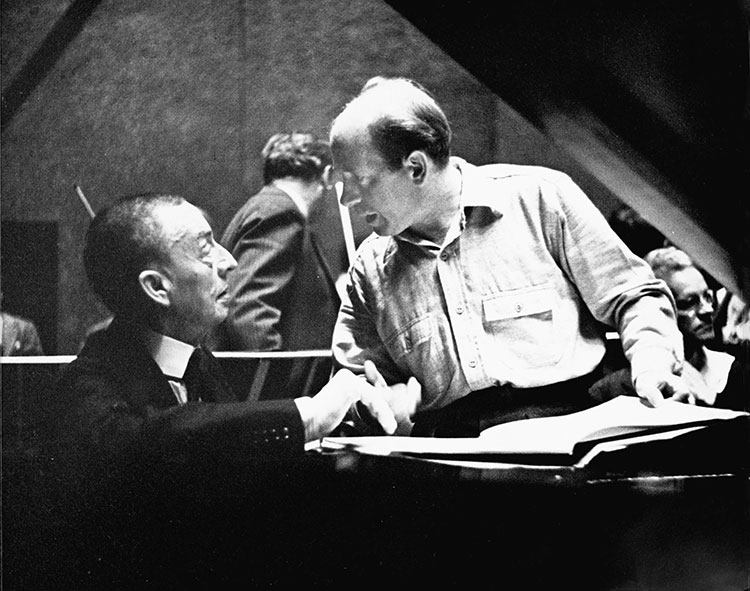
    PHOTO: Rachmaninoff and Ormandy in 1938

  • Jerome Lowenthal Celebrates 85 Years

    Jerome Lowenthal Celebrates 85 Years

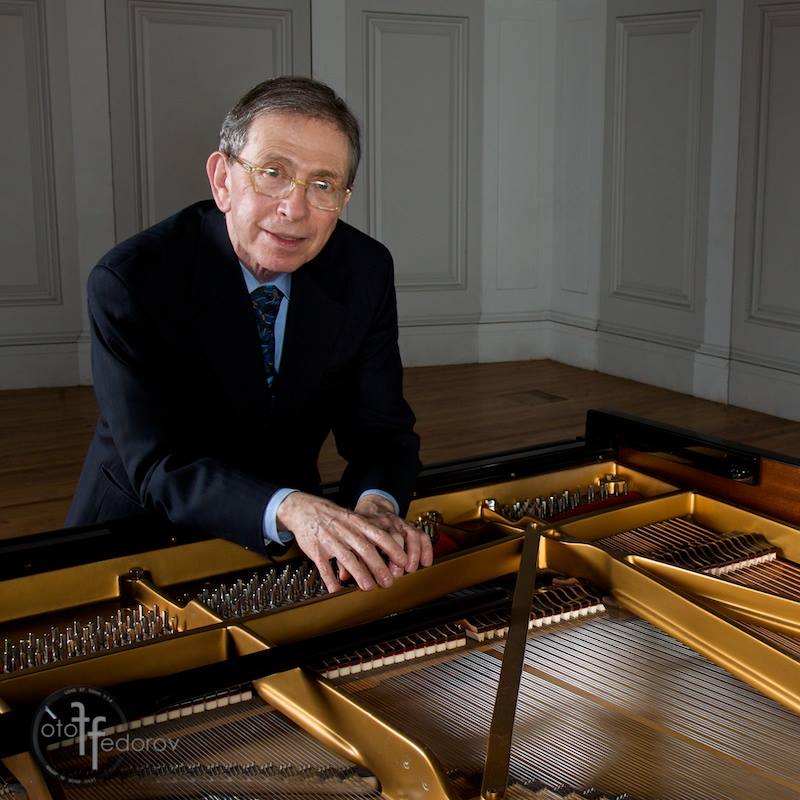
    Today is the 85th birthday of Philadelphia-born pianist Jerome Lowenthal. Now chair of the piano department at the Juilliard School, here he is in 1968 with Leopold Stokowski, rehearsing Rachmaninoff’s “Rhapsody on a Theme of Paganini.”

    And in a more recent interview:

    https://www.livingtheclassicallife.com/26-jerome-lowenthal/2015/10/16/episode-26-jerome-lowenthal#comments-56207791e4b0b077de882b14=

  • Khachaturian’s Lost Symphony Rediscovered

    Khachaturian’s Lost Symphony Rediscovered

    You know Aram Khachaturian, right? The guy who wrote that frenetic tune that makes you want to spin plates on the tops of sticks? The one that is used to usher in the elephants at the circus?

    This Sunday night on “The Lost Chord,” we’ll be listening to Leopold Stokowski’s rarely-heard recording of Khachaturian’s Symphony No. 2, sometimes called “The Bell.”

    Khachaturian wrote the work in 1943, the height of World War II, while he was holed up at a Composers Union retreat with Shostakovich, Prokofiev, Miaskovsky and Gliere. He said of the piece, “The Second Symphony is a requiem of wrath, a requiem of protest against war and violence.”

    The symphony’s nickname alludes to a kind of alarm that opens and closes the work. Overall, the tone is one of resolve in the face of tragedy.

    Stokowski’s recording, long unavailable, was originally issued on United Artists Records in the late 1950s. It reappeared briefly on compact disc, on the EMI label, in 1994, and again in 2009, as part of a 10-disc box set of entrancing Stokowski performances.

    The master tapes have not weathered the years well, alas, so there are moments of distortion, but the power of the piece transcends any technical limitations. There is certainly nothing wanting in the performance.

    To round out the hour, we’ll hear the Russian-born pianist, Nadia Reisenberg, in a selection from her 1947 Carnegie Hall recital, Khachaturian’s most famous piano work, the “Toccata.” Reisenberg studied at Philadelphia’s Curtis Institute of Music under Josef Hoffman.

    Join me for these Khachaturian rarities, “Khach as Catch Can,” tonight at 10 EDT, on WWFM – The Classical Network and at wwfm.org.


    Here’s the composer, highly-decorated, conducting his “Concerto-Rhapsody,” with Mstislav Rostropovich:

    Music for spinning plates, Liberace style:

    A rare document of Khachaturian singing about the glories of Armenian wine!

    https://www.youtube.com/watch?v=vtKHrg7w3_o

    PHOTO: The composer getting ready for his big day

  • Fikret Amirov Rediscovered Azerbaijani Composer

    Fikret Amirov Rediscovered Azerbaijani Composer

    Collectors of a certain vintage (and musical archaeologists who haunt used record shops) may remember Leopold Stokowski’s recording, with the Houston Symphony Orchestra, of “Azerbaijan Mugam” by Fikret Amirov. Its native title is “Kyurdi Ovshari.”

    That language barrier may in part explain Amirov’s relative obscurity in the West. Even taking into account the more accessible title, what exactly is a mugam? It turns out it is a highly rhapsodic and improvisatory form, alternating between song and dance episodes, characteristic of Azeri music. But you see what I mean.

    It is that very exoticism which makes Amirov difficult to market, yet at the same time, it is what makes him so interesting. In these multicultural times, when such a high-profile musician as Yo-Yo Ma traverses the Silk Road, perhaps Amirov’s day has finally come.

    This Sunday night on “The Lost Chord,” we’ll hear two works by Amirov (1922-1984), winner of the Stalin Prize in 1949, honored as People’s Artist of the USSR in 1965, and recipient of the USSR State Prize in 1980.

    His “Six Pieces for Flute and Piano,” of 1970, consists of “Song of the Aushug,” “Lullaby,” “Dance,” “In the Azerbaijan Mountains,” “At the Spring,” and “Nocturne.” If Amirov’s music at times reminds one of Khachaturian, one need only remember that Azerbaijan shares a border with Armenia. Without getting too much into politics, relations between the two countries are tense, to say the least. His music also bears the influence of other neighboring and nearby countries – Turkey, Russia, and Iran.

    This is something to bear in mind when approaching his full-length ballet, “The Arabian Nights.” The work, given its premiere in 1979, is one of the rare adaptations to come out of a region which gave us the original stories that make up “A Thousand and One Nights.” The world famous adventures of Sinbad, Ali Baba and Aladdin are enshrined in these tales, and each of them make an appearance in the ballet’s second act.

    Tonight, however, we’ll hear selections from Act I, which sets up the framing device, the unfaithful wife Nurida, the Sultan’s declaration of vengeance against all womankind, and the introduction of Scheherazade, the vizier’s daughter who enthralls the Sultan with her wit and creativity and finally restores his ability to love.

    I hope you’ll join me for “Azerbaijani Come Lately” – late works by Fikret Amirov – this Sunday night at 10 EDT, with a repeat Wednesday evening at 6; or that you’ll listen to it later as a webcast at wwfm.org.


    Stokowski conducts “Azerbaijan Mugam”:

  • Ives’ Symphony No. 4: Stokowski’s 1965 Premiere

    Ives’ Symphony No. 4: Stokowski’s 1965 Premiere

    It was on this date in 1965 that Leopold Stokowski gave the world premiere of Charles Ives’ Symphony No. 4. The performance took place at Carnegie Hall with the American Symphony Orchestra and the Schola Cantorum of New York. At the time, the work’s complex, kaleidoscopic tempos and layered, shifting meters required multiple conductors, and Stokowski enlisted the aid of David Katz and a young Jose Serebrier (pictured).

    The piece was composed between 1910 and the mid-1920s. Given the source, it’s hardly surprising that the music was decades ahead of its time. The first two movements had been performed by members of the New York Philharmonic under the direction of Eugene Goossens in 1927. This was the only occasion on which Ives would hear any of the music from the Fourth Symphony performed live by an orchestra. The composer died in 1954.

    Bernard Herrmann conducted an arrangement of the lovely third movement, the simplest and most conservative of the four (why, then, the need for an arrangement?), in 1933. The music as Ives wrote it was not heard until the complete performance in 1965.

    The composer’s biographer, Jan Swafford, describes the work as “Ives’ climactic masterpiece.”

    Stokowski recorded the symphony a few days after the premiere and led a televised studio performance, which can be seen here:

    Stokey kicks off twenty minutes of spoken introductory material (including commentary from producer John McClure) at the 4:30 mark. The symphony proper begins 25 minutes in.

    When’s the last time you saw anything like this on television?

Tag Cloud

Aaron Copland (92) Beethoven (95) Composer (114) Film Music (119) Film Score (143) Film Scores (255) Halloween (94) John Williams (185) KWAX (229) Leonard Bernstein (99) Marlboro Music Festival (125) Movie Music (134) Opera (198) Philadelphia Orchestra (86) Picture Perfect (174) Princeton Symphony Orchestra (106) Radio (87) Ralph Vaughan Williams (85) Ross Amico (244) Roy's Tie-Dye Sci-Fi Corner (290) The Classical Network (101) The Lost Chord (268) Vaughan Williams (102) WPRB (396) WWFM (881)

DON’T MISS A BEAT

Receive a weekly digest every Sunday at noon by signing up here


RECENT POSTS