Tag: Liszt

  • Liszt and Friends Collaborative Classics

    Liszt and Friends Collaborative Classics

    Sometimes even Romantic geniuses can use an extra hand.

    This Sunday night on “The Lost Chord,” on the eve of the anniversary of the birth of Franz Liszt (born October 22, 1811), we’ll have several works in which Liszt was aided and abetted by his peers.

    While it’s true that, early on, Liszt possessed a degree of insecurity over his ability to orchestrate – after all, he had been largely a “keyboard” composer, enlisting the aid of pupils like Joachim Raff and Franz Doppler during his years as a conductor in Weimar – Liszt quickly mastered the art himself and set about revising every bar of his earlier orchestral compositions, stamping them very much with his own distinctive voice.

    The story behind Liszt’s “Concerto in the Hungarian Style,” however, is quite a different matter.

    German pianist Sophie Menter studied with Liszt in Weimar, from 1869. Her gift was such that Liszt dubbed her “the greatest pianist of her day.” He admired her “singing hand” and called her his “only legitimate daughter as a pianist.” George Bernard Shaw compared her favorably to Paderewski. She was by Liszt’s side in Bayreuth when he died in 1886.

    Menter taught at the St. Petersburg Conservatory between 1883 and 1887. There, she became friendly with Tchaikovsky and convinced him to orchestrate a piano concerto she said she had written to showcase her talents as a performer. Tchaikovsky did so and also dedicated the orchestral score of his own “Concert Fantasy” to her.

    What he didn’t realize – and what is now widely believed (according to Menter, who confided it to a friend and fellow Liszt pupil, Vera Timanoff) – is that the piece was actually written, at least in part, by Liszt himself. Had Tchaikovsky known, he may very well have torn up the manuscript. He had come to loathe Liszt, and was particularly disgusted by Liszt’s transcription of the Polonaise from “Eugene Onegin.” But the truth – if truth it be – didn’t emerge, for nearly a hundred years, and Tchaikovsky conducted the first performance of the work in Odessa in 1893.

    Roll over Beethoven, tell Tchaikovsky the news…

    Alongside this colorful concerto by Menter’s mentor, we’ll also hear “The Black Gondola” (orchestrated by John Adams about a century after Liszt’s death); “Hexameron,” a titanic set of piano variations with contributions from six virtuoso superstars of the 1830s, including Liszt, Carl Czerny, Sigismond Thalberg, and Frederic Chopin; and a selection from the ballet “Apparitions,” engineered in 1936 by Constant Lambert and Gordon Jacob.

    Liszt gets by with a little help from his friends, on “An Assist for Liszt,” this Sunday night at 10:00 EDT, on WWFM – The Classical Network and wwfm.org.
  • Classic Ross Amico Anniversary

    Classic Ross Amico Anniversary

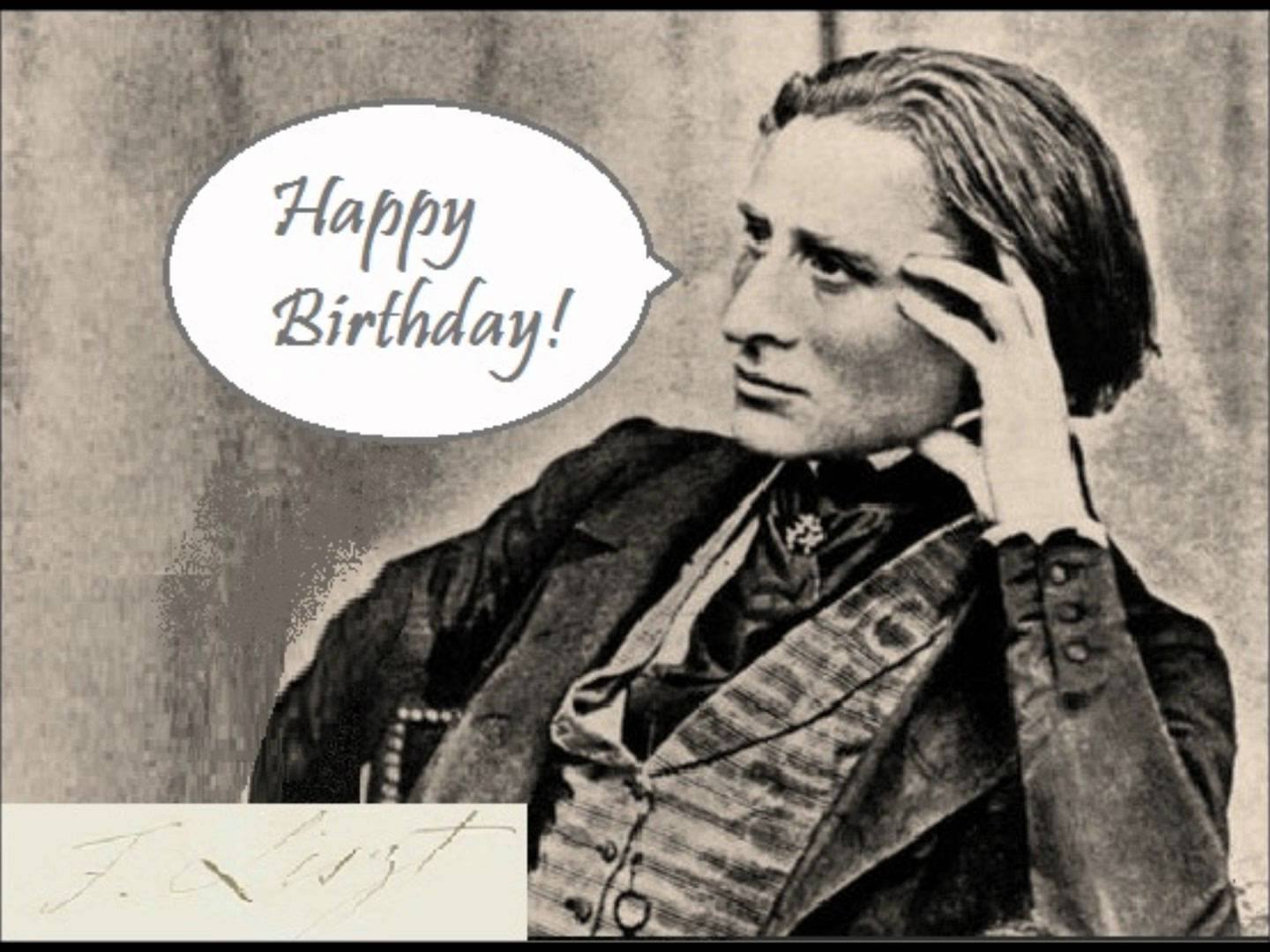
    By the beard of Rimsky-Korsakov! I just discovered, quite by accident, that today is the third anniversary of the creation of Classic Ross Amico. Thank you all for reading my page!


    PHOTO: So kind of you to remember, Liszt.

  • Liszt’s Christus A Christmas Weekend Listen

    Liszt’s Christus A Christmas Weekend Listen

    ADVENT CALENDAR – DAY 21

    I try to make it a point to listen to Franz Liszt’s oratorio, “Christus,” every year, whether I need it or not.

    It helps that I love Liszt, of course. Not all of his music – someone so prolific had to turn out a clunker now and then – but he was such a noble, well-intentioned guy. I’ve been a hardcore admirer ever since I read Alan Walker’s biography about 14 years ago. And hearing so many performances of his Piano Sonata certainly didn’t hurt.

    Liszt was one of the most original musical thinkers of the 19th century. In fact, I’d go so far as to say that, after Beethoven, Liszt was probably the most influential musician of the 1800s. There was likely no composer who didn’t at some point make a decision to follow or react against him. Liszt wrote a lot of wonderful music, and at least as much that might be construed as a little embarrassing. He was more successful as a musical thinker than he was a consistent executor of his ideas. But Wagner, to name just one, would have been a very different composer without Liszt. And we all know how influential Wagner was.

    Liszt’s flamboyance was legendary, but I think his reputation in that regard stemmed mostly from the overwhelming impressions he created in recital, and the crowds’ hysterical reactions to them. Liszt was also an introverted, thoughtful, pious man. He was so pious, in fact, that at one point he wound up taking minor orders and living in a cell in Rome, where he was known as the Abbé Liszt. So his religious works were not mere posturing.

    The incredible “Christus” is an oratorio in three parts that is really part oratorio, part loose collection of symphonic poems. Part I, the Christmas portion, contains two purely orchestral movements, which together comprise about half an hour. The concluding “March of the Three Holy Kings” is a corker. It’s also interesting in that one of the movement’s main themes is nearly identical to Wagner’s motif for Wotan. Which came first? Both “Christus” and “Das Rheingold” were written at just about the same time.

    I know it’s the last weekend before Christmas, so everyone is likely very busy, but if there is any time to listen to “Christus” it is on a weekend. Maybe you can block out three hours late on your Sunday afternoon. Kick back on the sofa with the Christmas lights on, enjoy the tree, and wallow in this ambitious, romantic music.

    Part I: https://www.youtube.com/watch?v=F_KWFIl_XR4
    Part II: https://www.youtube.com/watch?v=pcFd4m2wa1M
    Part III: https://www.youtube.com/watch?v=6hEdexzXqcI

    If you just can’t get enough, here’s Liszt’s “Christmas Tree Suite.”

    Some of the movements in the first half incorporate traditional carols (including “Adeste Fideles,” in yet another evocation of the Three Holy Kings). In the later movements, Liszt just kind of dreamily wanders into the future the way only Liszt can. All of the movement titles are listed on the page containing the video.

    PHOTOS: Liszt takes the cloth (left); Jesus gets frankincense and myrrh

Tag Cloud

Aaron Copland (92) Beethoven (94) Composer (114) Film Music (116) Film Score (143) Film Scores (255) Halloween (94) John Williams (185) KWAX (228) Leonard Bernstein (99) Marlboro Music Festival (125) Movie Music (131) Opera (197) Philadelphia Orchestra (86) Picture Perfect (174) Princeton Symphony Orchestra (106) Radio (86) Ralph Vaughan Williams (85) Ross Amico (244) Roy's Tie-Dye Sci-Fi Corner (290) The Classical Network (101) The Lost Chord (268) Vaughan Williams (99) WPRB (396) WWFM (881)

DON’T MISS A BEAT

Receive a weekly digest every Sunday at noon by signing up here


RECENT POSTS