Tag: Liszt

  • Alfred Brendel at 90: A Classical Music Titan

    Alfred Brendel at 90: A Classical Music Titan

    When Alfred Brendel was at his peak as a performer, the classical music industry was still going strong. In a happy coincidence, the compact disc appeared just as he had reached maturity, and allowed him to go back and document much of his core repertoire in clean, modern recordings.

    By extension, he was a regular presence on classical radio, and millions became familiar with him through his interpretations of Haydn, Mozart, Beethoven, Schubert, Schumann, Liszt, Brahms, and perhaps most interestingly, Schoenberg.

    Not always credited with being the most adventurous artist, he was invariably a thoughtful one. He made the first recording of Liszt’s “Weihnachtsbaum” (“Christmas Tree”), back in 1952, and unexpectedly, his first appearance on disc was as soloist in Prokofiev’s Piano Concerto No. 5. He was the first artist to record the complete piano works of Beethoven. He went on to document the complete sonatas no less than three times.

    Late in his career, he struggled against arthritis. When he retired in 2008, at the age of 78, he was at the top of his game, one of the few classical artists still guaranteed to pack halls. He appeared at Carnegie Hall no less than 81 times. Twice, he performed the complete Beethoven sonatas there.

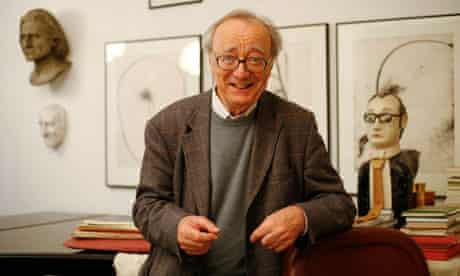
    Bespectacled, crowned with a disheveled widow’s peak, and improbably tall and lank, Brendel often looks all the world like an absent-minded professor. His interpretations have sometimes been criticized for being “cold” or “cerebral.” But the man, better-read than most, also possesses a keen sense of humor. He is a fan of Edward Gorey and Charles Addams and Gary Larson. He collects kitsch and newspaper bloopers. He has gone on record as stating that his favorite occupation is laughing.

    Alongside his many thoughtful essays on musical subjects (including at least one on humor in music), he published two volumes of epigrammatic poetry, “One Finger Too Many” and “Cursing Bagels.”

    Happy birthday, Alfred Brendel, 90 years-old today.


    PHOTO: Brendel, flanked by Liszt (left) and Eugene Jardin’s whimsical “Gipsbrendel”

  • Historical YouTube Classical Music Wishlist

    Historical YouTube Classical Music Wishlist

    One of this page’s followers, Jim Barclay Jr, has introduced to me the idea of Historical YouTube. This magical – though unfortunately wholly fictional – website would allow one to watch videos captured during any era of music history.

    The concept was introduced in the comments section under last week’s Carl Ditters von Dittersdorf birthday post, where Jim remarked it would be near the top of his personal list to be able to witness an actual performance by the string quartet made up of Dittersdorf, Joseph Haydn, Mozart, and Jan Křtitel Vaňhal. He then added a piano recital by Chopin or Liszt.

    I too would be eager to hear Liszt. I expanded the roster to include the premiere of “The Rite of Spring,” notorious for having sparked one of classical music’s greatest riots.

    Simon Mauer offered the legendary December 1808 marathon that introduced not only Beethoven’s 5th & 6th Symphonies, but also the 4th Piano Concerto, the Choral Fantasy, selections from the Mass in C, and more – an endurance test that left teeth chattering over a span of over four hours.

    It was not long after that Jim added a Schubertiade, one of those informal literary-musical salons at which a number of Schubert’s works were first heard. This was eagerly seconded by Simon.

    It was then suggested this might be a good idea for an expanded post – a contest, of sorts. So now I’m throwing it open to all of you. What storied classical music events would you most want to see on Historical YouTube™?

  • Beethoven’s 250th vs. 175 Years Ago

    Beethoven’s 250th vs. 175 Years Ago

    Remember when 2020 was supposed to be the big Beethoven year? Beethoven Beethoven Beethoven everywhere, the world wallowing in his music for the 250th anniversary of his birth – gorging itself to such a degree that no one could possibly stand to hear another note, until “Beethoven 300.”

    So how did all that work out?

    Before I cause any more tears, let’s look back to 1845 and “Beethoven 75.” The Master had been in the grave only 18 years, when a monument was unveiled in his hometown of Bonn, Germany, 175 years ago today. But it must have seemed like an eternity to the organizers.

    Although the idea had been circulated since 1828, the year after Beethoven’s death, getting anyone to actually do anything about it was like herding cats. A “Bonn Association for the Beethoven Monument” was formed, but without money, the entire enterprise was largely a symbolic gesture. Luigi Cherubini promised to conduct a benefit concert in Paris, but then backed out of it. Ignaz Moscheles succeeded in organizing one in London, but, despite the inclusion on the program of Beethoven’s “Ode to Joy,” it was poorly attended.

    In fact, there would have been no statue at all, if not for the efforts of Franz Liszt. When the total amount raised in France came to no more than 425 francs, Liszt donated 10,000 francs from his own pocket. Though only in his 30s at the time, Liszt had already retired from the concert stage, having amassed a considerable fortune and now ready to devote himself to other matters – conducting, teaching, and especially composing. But whenever there was a crisis or a disaster, Liszt could be counted on to emerge from seclusion to play in the largest hall he could find, and people would turn out to basically throw money. One of those concerts marked the last public appearance of Frederic Chopin, who shared the stage with Liszt in a recital of music for piano duo.

    In all, Liszt went to heroic lengths – more than any other figure – to see to it that Beethoven would be immortalized in bronze. His sole condition: that the sculptor be Lorenzo Bartolini. In 1840, Bartolini had created a marble bust of Liszt, of which Liszt must have particularly fond. But the committee overruled the proposal, preferring that the commission go to a German. It was Ernst Julius Hähnel who would ultimately receive the endorsement.

    As usual, Liszt took the disappointment well. A month before the unveiling, when it finally occurred to someone that there was no suitable venue to house the projected 30,000 attendees, guess who put up the money to build one? That’s right, Liszt financed what would become Beethoven Hall. The structure was erected, with contractors laboring around the clock, in just two weeks.

    Of course, Liszt was equally committed to the festivities themselves. He composed a new work, the “Festival Cantata for the Inauguration of the Beethoven Monument in Bonn,” which was heard twice. He also performed Beethoven’s “Emperor” Concerto and conducted the Fifth Symphony.

    He was in attendance at Bonn Cathedral when, on the eve of the monument’s unveiling, Louis Spohr conducted Beethoven’s “Missa Solemnis” and the Ninth Symphony, and the next morning, when the “Mass in C” was performed.

    At the ceremony was Hector Berlioz, Giacomo Meyerbeer, Ignaz Moscheles, Jenny Lind, Pauline Viardot, and other prominent musicians; also Queen Victoria and Prince Albert, King Frederick William IV of Prussia, and Archduke Friedrich of Austria.

    That afternoon, Liszt performed Beethoven, and Spohr conducted the “Coriolan Overture” and selections from “Christ on the Mount of Olives” and “Fidelio.” The day was capped with a glorious fireworks display.

    On Day 3, Liszt’s “Festival Cantata” was performed. Also, Beethoven’s “Egmont Overture,” a piano concerto by Carl Maria von Weber, arias by Beethoven and Mendelssohn, and Beethoven’s song “Adeleide.”

    Rounding out the festivities was a lavish banquet. Unfortunately, Lola Montez started dancing on a table and flirting with Liszt, which had the effect of generating an enormous scandal. The blame all came to roost on the festival’s greatest benefactor. 25 years later, for the Beethoven centennial celebrations in 1870, Liszt was not invited back.

    What have you done for us lately?
  • Beethoven Liszt Symphony 8 Piano

    Beethoven Liszt Symphony 8 Piano

    BEETHOVEN BIRTHDAY BASH

    Curve ball!

    As an exercise in deferred gratification and an addendum to that period instrument performance of the Symphony No. 8, by Frans Brüggen and the Orchestra of the 18th Century, we’ll hear Franz Liszt’s transcription of the 8th for solo keyboard.

    NOW PLAYING: Beethoven/Liszt – Symphony No. 8 in F major (Cyprian Katsaris, piano)

    From authenticity to audacity!

    Stick around, our concluding Beethoven symphony, the Symphony No. 9 – the beloved “Choral” Symphony – is on its way, in a powerhouse performance that’s bound to make an impression.

    We want to impress upon you that you’re the one who helps make it happen, when you call us with your contribution at 1-888-232-1212 or donate online at wwfm.org.

    Beethoven’s on our Liszt, on WWFM – The Classical Network and wwfm.org.


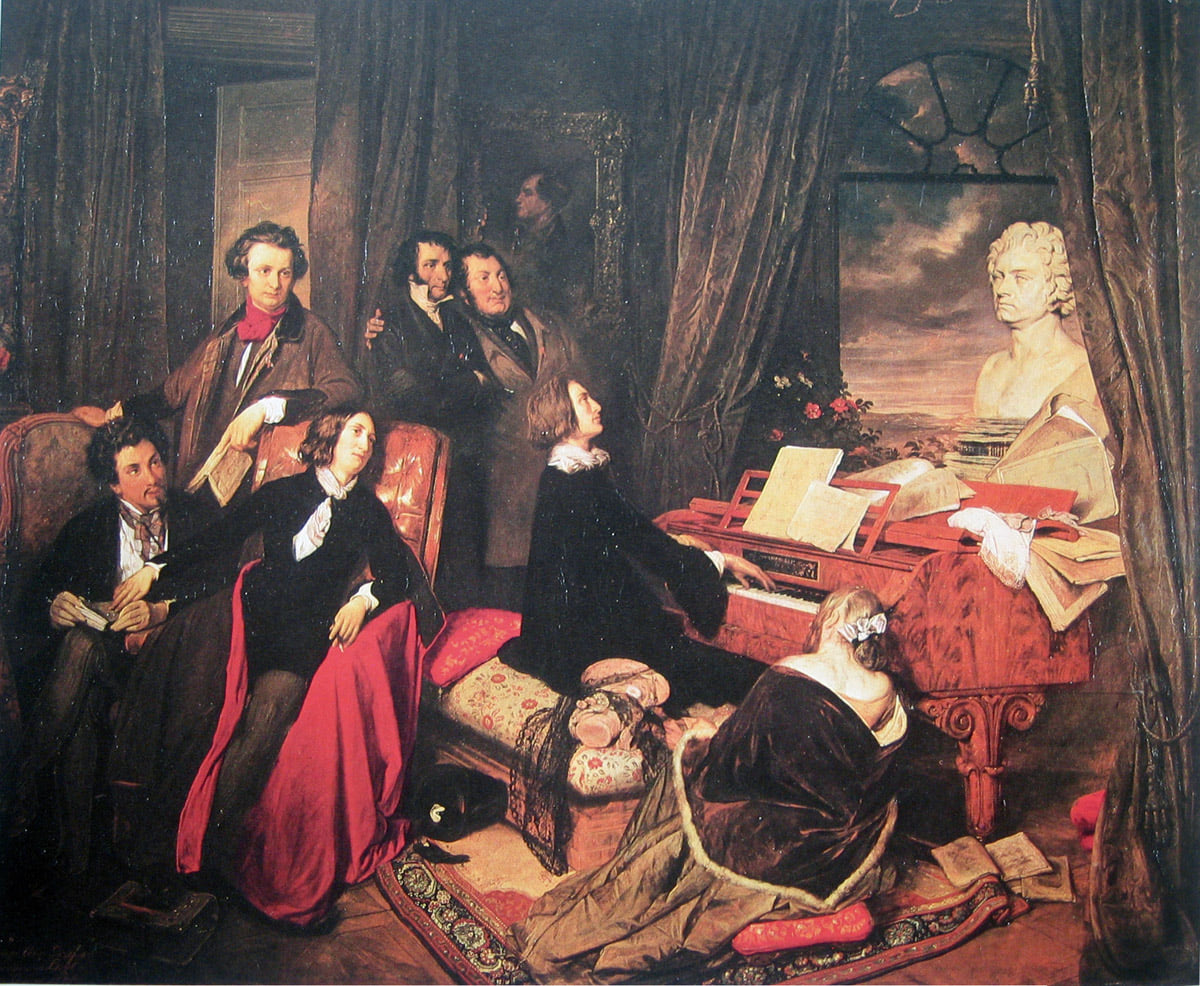
    “Franz Liszt Fantasizing at the Piano” (1840), Josef Danhauser

    Standing: Hector Berlioz, Niccolò Paganini, Gioachino Rossini

    Seated: Alexandre Dumas, George Sand, Liszt, Marie d’Agoult

    Bust: Beethoven

  • Walpurgis Night Faust Symphony on The Classical Network

    Walpurgis Night Faust Symphony on The Classical Network

    When the sun sets this evening, we will be in the grip of Walpurgisnacht!

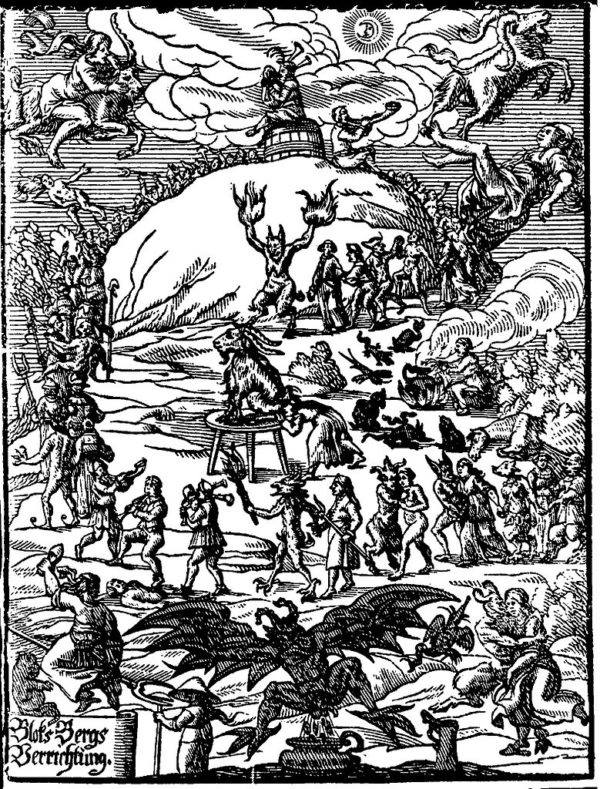
    Walpurgis Night, the eve of the feast day of Saint Walpurga, is a time when evil spirits are believed to roam the earth. Tradition holds that this is the night of a witches’ sabbath and orgy of the damned, held high atop the Brocken, the tallest peak of the Harz Mountains in central Germany. It’s the last blast of diablerie before May Day. In Goethe’s “Faust,” Mephistopheles guides his imperiled charge into a swirling cauldron of witches and demons so as to complete his moral degradation.

    This Tuesday afternoon on The Classical Network, we’ll anticipate the worst (or the best?), with Franz Liszt’s “A Faust Symphony.” That will be followed by another work inspired by Goethe, Felix Mendelssohn’s “Die erste Walpurgisnacht” (“The First Walpurgis Night”), in which prankish Druids get the best of their superstitious occupiers. It ain’t exactly “Faust,” but it will do.

    First, on today’s Noontime Concert, a ray of light, as we listen to Marianna Prjevalskaya – Concert Pianist, in recital from Merkin Hall at Kaufman Music Center,129 West 67th Street, in New York City. Merkin’s Tuesday Matinees present a new generation of critically acclaimed, extraordinary young performers in a concert hall known for its near-perfect acoustics.

    On Prjevalskaya’s program will be the Piano Sonata in A major, Op. 2, No. 2, by Beethoven; two Rhapsodies, Op. 79, by Johannes Brahms; and six selections from the two books of Preludes, by Claude Debussy.

    Then the Brocken, she’ll be rockin’. Join me, if you dare, from 12 to 4 p.m. EDT, on WWFM – The Classical Network and wwfm.org.

Tag Cloud

Aaron Copland (92) Beethoven (95) Composer (114) Film Music (123) Film Score (143) Film Scores (255) Halloween (94) John Williams (187) KWAX (229) Leonard Bernstein (101) Marlboro Music Festival (125) Movie Music (138) Opera (202) Philadelphia Orchestra (89) Picture Perfect (174) Princeton Symphony Orchestra (106) Radio (87) Ralph Vaughan Williams (85) Ross Amico (244) Roy's Tie-Dye Sci-Fi Corner (290) The Classical Network (101) The Lost Chord (268) Vaughan Williams (103) WPRB (396) WWFM (881)

DON’T MISS A BEAT

Receive a weekly digest every Sunday at noon by signing up here


RECENT POSTS