Tag: Liszt

  • Liszt’s Christus: A Christmas Oratorio You Need to Hear

    Liszt’s Christus: A Christmas Oratorio You Need to Hear

    I try to make it a point to listen to Franz Liszt’s oratorio, “Christus,” every year, whether I need it or not.

    It helps that I love Liszt, of course. Not all of his music – anyone as prolific as he was had to turn out a clunker now and then – but he was such a noble, well-intentioned guy. I’ve been a hardcore admirer ever since I read Alan Walker’s biography, now probably 23 years ago. The years, they do fly by! And having heard so many performances of his Piano Sonata certainly hasn’t hurt.

    Liszt was one of the most original musical thinkers of the 19th century. In fact, I’d go as far as to say that, after Beethoven, he was possibly the most influential musician of the 1800s. There was likely no composer who didn’t at some point make a decision to follow or to react against him.

    He was, admittedly, hit-and-miss. Liszt wrote a lot of astonishingly wonderful music, but also a fair amount that might charitably be described as slightly embarrassing. Arguably, he was more successful as a philosopher and an innovator than he was as a consistent executor of his ideas. Richard Wagner (who became Liszt’s son-in-law), to name only one, would have been a very different composer without Liszt. And we all know how influential Wagner was.

    Liszt’s flamboyance was legendary, but his reputation in that regard stemmed mostly from the overwhelming sensations he conjured in recital, and his audiences’ hysterical responses to them. He could also be introverted, thoughtful, and pious. He was so pious, in fact, that at a point he wound up taking minor orders and living in a cell in Rome, where he was known as the Abbé Liszt. His sacred works were not mere posturing.

    The magnificent “Christus” is an oratorio in three parts – spanning some three hours in length – that is really part oratorio, part loose collection of symphonic poems. Part I, the Christmas portion, contains two purely orchestral movements, which together comprise about half an hour. The concluding “March of the Three Holy Kings” is a corker. It’s also interesting in that one of the movement’s main themes is nearly identical to Wagner’s motif for Wotan. Which came first? Both “Christus” and “Das Rheingold” were written at just about the same time.

    I know it’s an extraordinarily busy time of year, but do yourself a favor: send your regrets to the office holiday party, seclude yourself in a quiet place with no distractions (a sofa, with the Christmas lights on, would do nicely), and marvel at this ambitious, romantic music.

    I own three recordings of the piece, and this one, conducted by Antal Dorati, is far and away the most satisfying.

    If you find you just can’t get enough, there’s also Liszt’s “Christmas Tree Suite.” Liszt dedicated the work to his granddaughter, Daniela von Bülow. Some of the early movements are reflections on familiar carols (including “Adeste Fideles,” in yet another evocation of the Three Holy Kings), but as the suite progresses, Liszt just kind of dreamily wanders off into the future the way only Liszt can. The suite was first performed on Christmas Day, 1881. All the movement titles are listed below the video at the link.

    What else is there to say, but Merry Liszt-mas!


    Liszt takes the cloth (left); Jesus gets frankincense and myrrh

  • Happy Birthday Liszt A Generous Musical Genius

    Happy Birthday Liszt A Generous Musical Genius

    It’s Franz Liszt’s birthday, and I usually give him a pretty good write-up, since on top of all his musical achievements – his innovations, his influence, and his transcendental technique – he also happened to be a pretty good guy, if not without his foibles. In particular, he was exceptionally generous, often engaged in charitable causes and championing the needy, whether they be pupils, colleagues, or anonymous victims of disaster, and he always did so quietly and with the greatest humility. In a lot of ways, he also basically changed music, though it was often the case that others implemented or assimilated his original ideas with greater success.

    Of course, as was the case with any Romantic virtuoso, there was also a whiff of diablerie about his reputation.

    If you want to check out some of my previous posts on the subject, you can search Facebook under “Classic Ross Amico Liszt.” If you have the option to click on “photos” under the search bar, it could bring many of them up in a conveniently browsable form. Then just click on the photos for the texts.

    Sadly, I’ve got a lot to do today, so I must sheepishly defer to a silly cartoon. I love Liszt, and that’s a fact.

    You can learn more about his “Mephisto Waltzes” here:

    https://en.wikipedia.org/wiki/Mephisto_Waltzes

    Jeffrey Swann was the first pianist to record all of them on a single record.

    Here, I made it easy for you to search the older posts.

    Happy birthday, Liszt!

  • Remembering André Watts Philadelphia’s Piano Icon

    Remembering André Watts Philadelphia’s Piano Icon

    I am very sorry to learn that André Watts has died. Watts was a familiar presence in Philadelphia for decades. Indeed, he was the soloist on the first Philadelphia Orchestra concert I ever saw, playing the Rachmaninoff Piano Concerto No. 2, at the Mann Center for the Performing Arts in Fairmount Park, on July 16, 1984, with Michael Tilson Thomas conducting.

    An army brat born in Nuremberg, Germany, to a Hungarian mother (a pianist) and an African American father (a non-commissioned officer), Watts moved to Philadelphia with his family at the age of 8. Prior to that, he had studied violin in Europe. His mom gave him his first piano lessons.

    Like most children, he disliked practicing. She captured his imagination by telling him about the young Franz Liszt and what he was able to achieve by applying himself and practicing faithfully.

    Watts would continue to find inspiration in Liszt throughout his career. He was a great champion of the composer. In fact, it was as soloist in Liszt’s Piano Concerto No. 1 that he rocketed to fame after a performance with the New York Philharmonic conducted by Leonard Bernstein, televised as part of one the orchestra’s Young People’s Concerts, in January 1963. Watts was 16-years-old.

    Later in the month, Glenn Gould fell ill, and Watts was invited back to play the Liszt concerto on an actual subscription concert. The performance generated such electricity that the hardboiled musicians of the Philharmonic joined the audience in a standing ovation. The performance was recorded and released on Columbia Masterworks, the thrill of the occasion preserved for posterity, as “The Exciting Debut of André Watts.”

    Watts studied at the Philadelphia Musical Academy (now part of the University of the Arts), and then at the Peabody Institute in Baltimore under Leon Fleisher. In the meantime, his dance card was filling up fast. By 1969, his concerts were being booked three years in advance. He signed an exclusive recording contract with Columbia on his 21st birthday.

    Alas, in more recent years, Watts suffered his share of health difficulties. In 2002, he underwent emergency surgery for a subdural hematoma. In 2004, a ruptured disc affected the use of his left hand. In 2019, he underwent surgery for further nerve damage.

    An inveterate cigar smoker, he was diagnosed with (possibly unrelated?) prostate cancer in 2016. The cancer went into remission in 2017, but would return to claim him.

    Despite his medical setbacks, Watts continued to perform. Personal illness did nothing to dampen his passion for playing in public, but the pandemic threw up some pretty steep barriers.

    For certain, with half a century of performances and recordings behind him, and a National Medal of the Arts, among other honors, Watts had nothing more to prove. But he was determined to do what he loved for as long as he possibly could.

    In an interview, he claimed that early on, what he really wanted to be was a writer. For Watts, communication with an audience – storytelling, if you will – was key.

    He will be missed. R.I.P.


    Introduced by Leonard Bernstein, then playing the stuffing out of Liszt

    Visiting “Mr. Rogers’ Neighborhood”

    Playing Mendelssohn with John Williams and the Boston Pops

    Rachmaninoff in New York

    Liszt’s etude after Paganini’s “La Campanella”

  • Beethoven Liszt Kiss A Musical Blessing

    Beethoven Liszt Kiss A Musical Blessing

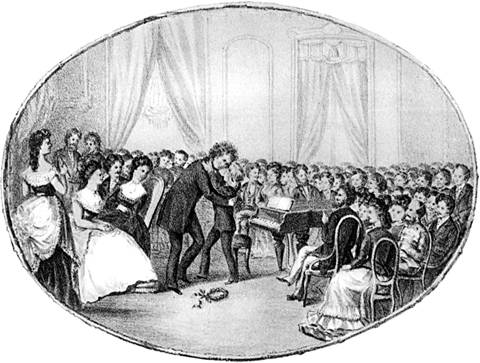
    Legend has it that, on this date 200 years ago, at the end of a concert at the Kleiner Redoutensaal of the Hofburg palace in Vienna, Beethoven spontaneously rose from the audience to plant a kiss on the brow of an 11-year-old Franz Liszt. The young pianist had just fulfilled an impromptu request from the composer for an improvisation on one of his themes.

    Unfortunately, according to Liszt, it never happened. Or rather it did, in a sense, just not on this occasion.

    It was actually a few days earlier, at Beethoven’s home, that Liszt received the “Weihekuss” – the “kiss of consecration” – after playing a movement from one of Beethoven’s concertos. Liszt would always remember it as a sort of artistic christening.

    He recalled it 52 years later, in 1875, when he was in his sixties, to one of his pupils, Ilka Horowitz-Barnay. The following translation is from Paul Nettl’s “Beethoven Encyclopedia.”

    “I was about eleven years of age when my venerated teacher Czerny took me to Beethoven. He had told the latter about me a long time before, and had begged him to listen to me play some time. Yet Beethoven had such a repugnance to infant prodigies that he had always violently objected to receiving me. Finally, however, he allowed himself to be persuaded by the indefatigable Czerny, and in the end cried impatiently, ‘In God’s name, then, bring me the young Turk!’ It was ten o’clock in the morning when we entered the two small rooms in the Schwarzspanierhaus which Beethoven occupied; I somewhat shyly, Czerny amiably encouraging me. Beethoven was working at a long, narrow table by the window. He looked gloomily at us for a time, said a few brief words to Czerny and remained silent when my kind teacher beckoned me to the piano. I first played a short piece by Ries. When I had finished Beethoven asked me whether I could play a Bach fugue. I chose the C minor Fugue from the Well-Tempered Clavier. ‘And could you also transpose the Fugue at once into another key?’ Beethoven asked me.

    “Fortunately I was able to do so. After my closing chord I glanced up. The great Master’s darkly glowing gaze lay piercingly upon me. Yet suddenly a gentle smile passed over the gloomy features, and Beethoven came quite close to me, stooped down, put his hand on my head, and stroked my hair several times. ‘A devil of a fellow,’ he whispered, ‘a regular young Turk!’ Suddenly I felt quite brave. ‘May I play something of yours now?’ I boldly asked. Beethoven smiled and nodded. I played the first movement of the C major Concerto. When I had concluded Beethoven caught hold of me with both hands, kissed me on the forehead and said gently. ‘Go! You are one of the fortunate ones! For you will give joy and happiness to many other people! There is nothing better or finer!’”

    Liszt told the preceding in a tone of deepest emotion, with tears in his eyes, and a warm note of happiness sounded in the simple tale. For a brief space he was silent and then said, “This event in my life has remained my greatest pride – the palladium of my whole career as an artist. I tell it but very seldom and – only to good friends!”

    Beethoven’s conversation book verifies the encounter. What the recollection doesn’t take into account is that by then the composer would have been completely deaf. But he could still feel the vibrations of the piano.

    One way or another, I venture to guess, Liszt didn’t wash that smacker off his forehead for quite some time.


    IMAGE: 1873 lithograph to mark the 50th anniversary of Beethoven’s Weihekuss

  • Three Kings Music Mystery Wagner Liszt

    Three Kings Music Mystery Wagner Liszt

    January 6. Feast of the Epiphany. The Three Kings are here to make sure you’re taking down your Christmas decorations!

    Part One (i.e. the Christmas portion) of Franz Liszt’s ambitious, three-hour oratorio “Christus” contains two purely orchestral movements, which together comprise roughly half an hour. The concluding “March of the Three Holy Kings” is a corker.

    It’s interesting to note that one of the movement’s main themes is nearly identical to the motif for Valhalla, castle of the gods, from the Ring Cycle, composed by Liszt’s son-in-law, Richard Wagner. Which came first? Both “Christus” and “Das Rheingold” were written around the same time.

    I imagine Liszt and Wagner showing up at the office holiday party wearing identical sweaters. AWK-ward!!

    Three Kings

    Valhalla

Tag Cloud

Aaron Copland (92) Beethoven (95) Composer (114) Film Music (123) Film Score (143) Film Scores (255) Halloween (94) John Williams (187) KWAX (229) Leonard Bernstein (101) Marlboro Music Festival (125) Movie Music (138) Opera (202) Philadelphia Orchestra (89) Picture Perfect (174) Princeton Symphony Orchestra (106) Radio (87) Ralph Vaughan Williams (85) Ross Amico (244) Roy's Tie-Dye Sci-Fi Corner (290) The Classical Network (101) The Lost Chord (268) Vaughan Williams (103) WPRB (396) WWFM (881)

DON’T MISS A BEAT

Receive a weekly digest every Sunday at noon by signing up here


RECENT POSTS