Tag: Maria Callas

  • Maria Review Angelina Jolie Can’t Save This Callas Biopic

    Maria Review Angelina Jolie Can’t Save This Callas Biopic

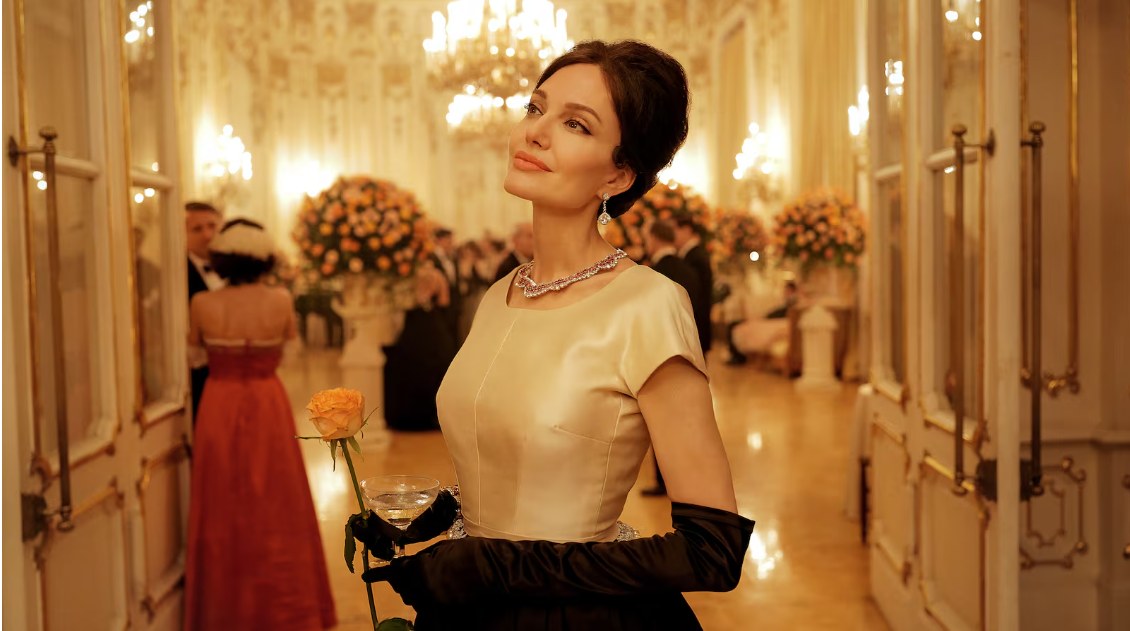
    “Maria” is a kind of film that might have been made in the 1960s. Ordinarily, I would mean that as a compliment. Unfortunately, anything that would have once been considered experimental about it was explored more successfully, iconically even, by Fellini and others, over a half century ago. (I just looked up the director, Pablo Larraín, and in 2012, for a poll conducted by Sight & Sound magazine, he named “8 1//2” as one of his favorite films.) In any case, it would have been impossible to make this particular picture back then, since its subject is the last week of the life of super-diva Maria Callas, who died on September 16, 1977. As it stands, it’s a film that too often trades in empty technical exercises and clichés. It doesn’t come across so much as homage as been-there, done-that.

    The pills, the ego, the faded glamor – we’ve seen it all before, only here it’s an opera singer, instead of a rock and roll legend. Elvis Presley died on August 16, exactly one month before Callas did. Most Callas portrayals tend to include something of her caustic manner and imperious nature (see Terence McNally’s “Master Class”). But was she really so much of a Norma Desmond figure? (“Sunset Boulevard” is another one of Larraín’s favorite films.)

    “Maria” has been described as the third in Pablo Larraín’s “Important Women Trilogy” (somebody has to come up with a better name), following “Jackie” (2016), about the grieving Jacqueline Kennedy – whose life, of course, intersected with Callas’, by way of her marriage to Aristotle Onassis – and “Spencer,” about Princess Diana (2021). None of these are straight bio-pics. Rather, they attempt to get at their subjects’ psychological states through artistic means.

    I can’t speak for the success of the others (which I have not seen), but “Maria” rings fairly hollow (not unusual, alas, for films about musicians). That said, Natalie Portman and Kirsten Stewart were both nominated for Oscars for their respective portrayals, which bodes well for Angelina Jolie. Hollywood loves its own, and here Jolie stretches far enough beyond audience expectation that she can’t help but be noticed.

    To be fair, the film does have some good performances (Jolie’s included, given the material she has to work with, her distracting lip injections aside). But it’s generally the quieter parts, the less-flashy ones, assumed by an international cast, that inspire the more satisfying turns. “Maria” is a coproduction of independent film companies in Italy, Germany, England, and the United States, with additional footage shot in Hungary and Greece. Remember when Hollywood used to actually produce these kinds of films?

    Pierfrancesco Favino and Alba Rohrwacher (both Italian) leave lasting impressions, especially the former, as Callas’ long-suffering butler and housemaid, respectively. Haluk Bilginer (Turkish) plays Aristotle Onassis; either that, or a lecherous George Burns. Anyway, he has a good death scene. Stephen Ashfield (Scottish) appears as conductor Jeffrey Tate, minus the spina bifida (perhaps the filmmakers feared blowback if they had attempted such a portrayal?), who I never realized until now bore such a likeness to Elton John. (He didn’t.) There’s also a fabricated conversation with JFK, played by Caspar Phillipson (Danish), all jaw, with a quasi-Kennedy coif, reprising his role from “Jackie.” (Callas did sing at Kennedy’s Madison Square Garden birthday reception in 1962, perhaps upstaged by Marilyn Monroe’s rendition of “Happy Birthday, Mr. President,” also depicted in the film.)

    Kodi Smit-McPhee (Australian) has the most thankless role as Mandrax (named for a drug Callas abuses), a journalist who follows Callas sporadically throughout the film with the conceit of filming a documentary about her. Except he’s an hallucination. The narrative is divided into three parts signified, with an unnecessary and self-reflexive flourish, by the clack of a clapperboard and digitally-added signs of wear and tear, manufactured artifacts of the celluloid era. It works in Alexander Payne’s “The Holdovers.” Not so much here. The whole meta conceit is eye-rollingly pretentious, more like something that would have been perpetrated by a film student as opposed to a director with ten previous films under his belt. The fantasy sequences are similarly trite and come across as the kinds of things that used to turn up in rock videos (for example, an orchestra playing fragile acoustic instruments in the pouring rain).

    I found some of the musical choices, when Callas isn’t on stage, more unconventional, a little peculiar even. I understand this is the world of opera, but often it seems as if the dramatic off-stage moments are somewhat randomly scored with familiar passages. The “Humming Chorus” from “Madama Butterfly” the “Anvil Chorus” from “Il trovatore,” the prelude to “Parsifal.” Yes, Callas sang in these operas, and I may be nitpicking, but she didn’t sing in the choruses, and in the case of “Parsifal,” though she performed a surprising amount of Wagner early in her career, she never sang Kundry after 1950. In any case, it’s not the repertoire that endures in most people’s memories as quintessential Callas. And what’s with the Brian Eno?

    Most unfortunate, the film never successfully manages to convey the Callas mystique. Lest there be any doubt, “Maria” concludes with a montage of genuine footage of Callas herself. She never speaks a word, yet it’s evident from her few minutes of screen time that the filmmakers were unable to capture her essence.

    Tom Volf’s documentary from a few years ago, “Maria by Callas” (2017), gives a much better sense of who she was, through actual performances, TV interviews, home movies, family photographs, private letters, and unpublished memoirs, most of which had never been shown to the public.

    Often during the last half hour or so of “Maria’s” 2 hour and 5 minute running time, I felt like surely it was about to end. Not out of boredom, necessarily. It just felt dramatically as if the film had run its course.

    And in the name of all that’s holy, what’s the deal with the heinous and pervasive practice of these streaming services cutting off their movies mid-credits? It’s bad enough that the movies aren’t given the respect of nationwide theatrical releases anymore (Netflix does its films a disservice in not presenting them in an environment in which a viewer can be totally immersed, as opposed to giving in to an ice cream craving or nodding off on the couch), but whatever immersion one is able to achieve at home is shattered by being jerked out of a sustained illusion of reality that’s been so painstakingly crafted over two or three hours. It’s a frustrating experience, and I am tired of railing against Netflix, Hulu, Tubi, etc., every time it happens.

    It’s especially frustrating in the case of “Maria,” as I was curious to see the microscopic music credits at the end. (No, they’re not listed on IMDB.) So I had to go back, start the movie, and fast-forward through the entire thing again. Thanks, Netflix.

    Anyway, you can add this to the mountain of classical music movies that just don’t get it. Too often “Maria,” the film, comes across as an exercise in style over substance, something that its subject, Callas the artist, never was.

    Watch the film’s trailer here:

    Then that for the superior “Maria by Callas”

  • Georges Prêtre A Centennial Celebration

    Georges Prêtre A Centennial Celebration

    The great French conductor Georges Prêtre would have been 100 years old today. I have to say, he had a pretty good run. He died on January 4, 2017, at the age of 92.

    Prêtre studied under André Cluytens, among others, at the Paris Conservatory. He made his conducting debut in Marseilles in 1946. He was director of the Opéra-Comique in Paris from 1955-59. There, he gave the premiere of “La voix humaine” by Francis Poulenc, a composer with whom he would become closely associated. He went on to conduct at the Royal Opera House, Covent Garden, New York’s Metropolitan Opera, and La Scala, Milan.

    He was a regular at the Lyric Opera of Chicago from 1959-71. He was music director of the Paris Opera for the 1970-71 season. He later became principal conductor of the Vienna Symphony, from 1986-91.

    Prêtre was invited to conduct the Vienna Philharmonic in its popular New Year’s Day concert twice, in 2008 and 2010. To date, he is the only French conductor to have done so.

    Among his other notable achievements, he conducted the world premiere of Joseph Jongen’s “Symphonie Concertante for Organ and Orchestra,” with Virgil Fox and the Paris Opera Orchestra, in 1959.

    I hope you find this as amusing as I do. Prêtre doesn’t waste a gesture when conducting this selection from Bizet’s “Carmen,” with Maria Callas.

    Joseph Jongen, “Symphonie Concertante”

    Florent Schmitt, “The Haunted Palace” (after Edgar Allan Poe)

    Albert Roussel, “The Spider’s Banquet”

    Accompanying Francis Poulenc and Jacques Février in Poulenc’s Concerto for Two Pianos

    New Year’s Concert in Vienna, 2010

    Merci, Maestro! Fondly remembering you on the 100th anniversary of your birth.


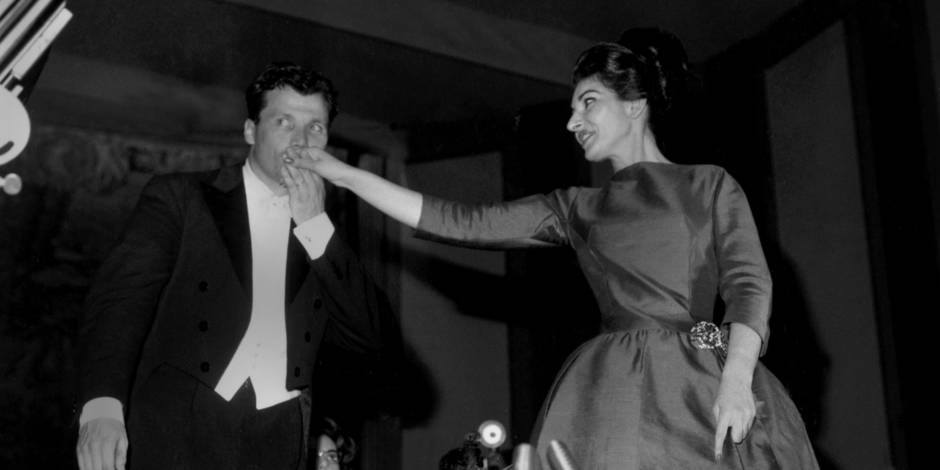
    PHOTO: Planting a smacker on La Divina

  • Maria Callas 100th: Incendiary Performances

    Maria Callas 100th: Incendiary Performances

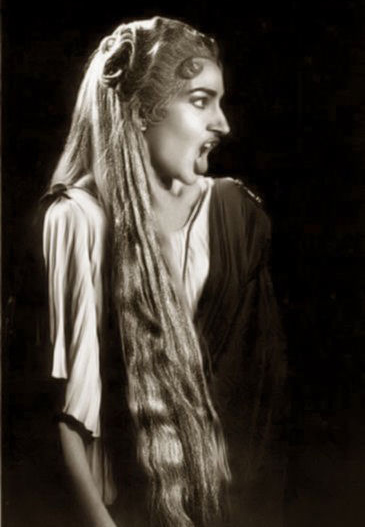
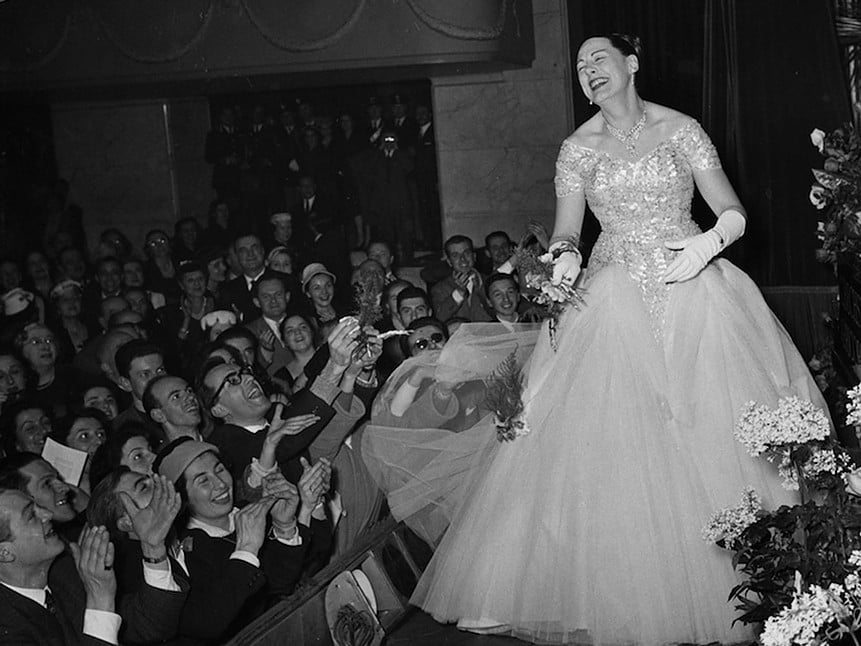
    Today is the 100th anniversary of the birth of Maria Callas. If you’re an opera buff, it’s possible you may already be suffering from Callas fatigue, with the voluminous coverage in print and hosannas on the radio and a major motion picture on the way starring Angelina Jolie.

    Even so, I’ve taken a little time the past couple of days to pull together some links to a few of her incendiary performances. Some of them smolder. Some of them flare. Some are like a volcanic eruption. It’s easy to forget how thrilling a great performance can be until you’re suddenly confronted by the real thing.

    The consensus seems to be that her voice was at its best in the 1950s; but in whatever era, Callas’ absorption and her total commitment to the drama of the moment can be stunning.

    Yes, she was flawed. She could be difficult. Controversial, even. She certainly had a sense of her own worth. But it’s not for nothing that she’s been dubbed the Soprano of the Century.

    Much of the proof is right there in the audio. It’s too late for us to be there in the house for a Callas performance. But listen to the near-hysteria of her audiences, in the “Aida” and “Anna Bolena” clips especially, to get an idea of what an electric night in the theater an evening with Callas must have been.

    Happy centenary, La Divina.


    Immortal “Tosca”

    “Vissi d’arte,” Paris 1958

    “Casta Diva,” Paris Opera debut 1958; Callas wearing a million dollars in jewelry!

    “Suicidio!” from Ponchielli’s “Gioconda”

    “O don fatale,” Verdi’s “Don Carlo”

    “Aida;” the audience explodes!

    “Carmen” Habanera

    I hope you find this as amusing as I do. Georges Prêtre doesn’t waste a gesture conducting this selection from Bizet’s “Carmen,” Covent Garden, 1962

    La Scala 1957, the mad scene from Donizetti’s “Anna Bolena.” The audience, at the 9:14 mark, sounds like they’re going to take the place apart.

    If Callas oversaturation is your thing, here’s 7 and a half hours of arias!

  • Tebaldi vs. Callas: An Opera Rivalry & My Barber

    Tebaldi vs. Callas: An Opera Rivalry & My Barber

    For years, the world of Italian opera was divided between two goddesses: Renata Tebaldi and Maria Callas. And from the evidence of YouTube, heated debate over their respective merits continues even to this day. So it was that the rivalry between post-war’s biggest divas drove a wedge between my barber and me.

    It was at the old Symphonic-Operatic Barber Shop on South 20th Street in Philadelphia, a two-chair establishment, with black-and-white photos and homemade dioramas of the great singers in a large display window. In the waiting area, Playboy magazines were available for the clientele. Reading material was especially important in those days before the smart phone, and this was unquestionably a step-up from my hometown barber, who had always provided his kids’ hand-me-down horror comics. On the sound system, naturally, was continuous opera.

    Unluckily for me, on this particular occasion, it happened to be a recording of Maria Callas. While I was aware of the cult of Callas and even understood on an abstract level the nature of her greatness, I had never quite been able to get around the timbre of her voice – the apple or whatever it was that was stuck in her throat.

    During one particularly ambrosial passage, my barber paused, mid-cut, to express his awe at Callas’ talent. Unfortunately, he happened to phrase it as a question, and it would have been better for me had I taken it as rhetorical. Instead, I asserted that I’ve always been more of a Tebaldi man myself. A chill settled over the place, and when he was finished, he coolly collected his fee. If he could have gotten away with it, I’m sure he would have slashed my throat.

    This all comes to mind on the occasion of the 100th anniversary of Tebaldi’s birth. At its peak, the flames of the Callas-Tebaldi rivalry were fanned by the media. Tebaldi was quoted as saying she had one thing Callas did not: a heart; and Time magazine reported that Callas quipped that comparing herself to Tebaldi was like comparing champagne to Coca-Cola. (She later assumed an air of innocence and claimed she had said cognac.)

    There could be friction between the singers, certainly. Tebaldi never forgot the time Callas came to hear her sing Aida and made a ruckus in her box as she sang “O patria mia.” And Callas was furious when Tebaldi violated a no-encore agreement during a dual tour of South America. But Callas had endured much worse, earlier in her career, including hisses from the gallery and vegetables hurled from the audience.

    “Opera is a battlefield,” she once remarked, “and it must be accepted.”

    But the singers themselves also shared a mutual admiration. It’s said that any friction there may have existed between them was resolved when Callas went backstage to congratulate Tebaldi following a 1968 performance of “Adriana Lecouvreur” at the Met. Of course, by then, Callas was no longer active as an opera singer.

    In regard to what distinguished them, Tebaldi observed that Callas always sang as the character, but she always sang as herself.

    The world is too variegated a place to be organized into simple dichotomies. What is it that drives us to insist on absolutes? Black and white, light and dark, good and bad? And most perversely, winner and loser? This impulse of human nature tends to turn grown people into infantile sports fans. For Callas’ acolytes, it’s the compulsion to fill YouTube with side-by-side comparisons, in order to expose the alleged shortcomings of Tebaldi’s “flat” voice when juxtaposed with Callas’ volcanic intensity.

    Whatever.

    The “feud” hurt neither the box office, nor the record sales. When devotees’ passions flare, the cash register is almost always the winner.

    Since the haircut debate/debacle, and with more exposure, I gradually got past what I perceived as Callas’ flaws to more fully appreciate her artistry. In fact, temperamentally, I think she and I are more alike.

    But Tebaldi’s career went on much longer, and her voice was so beautiful. Callas developed vocal issues early and died comparatively young, at 53. The candle that burns twice as bright burns half as long.

    Perhaps it was the composers themselves who did much of the heavy lifting. I was first exposed to Tebaldi through her gorgeous and moving Mimi in her classic 1959 recording of “La bohème.”

    By coincidence, she, “Manon Lescaut,” and “Bohème” were all born on February 1st. “Manon Lescaut” was first performed on this date in 1893. “Bohème” received its debut on February 1, 1896 (with Arturo Toscanini on the podium).

    Of course, it would be another half-century before Tebaldi appeared in either of these operas. But by then, she had already received Toscanini’s benediction, when he described hers as the “voice of an angel.”

    Angelic it might have been, but it wasn’t the only ticket to operatic heaven.

    Tebaldi and Callas. Can’t the two coexist? Can’t we all get along? Can’t I just get a haircut?

    As someone with a wave in his hair, I have always had a hard time finding a satisfactory barber, and the problem only worsened in the ‘90s, when I allowed it, at the peak of its lushness, to grow generous and curly. The only analogy I could have drawn for an opera-loving Italian barber would have been Hector Berlioz. And I’m guessing Italian barbers are not terribly interested in Berlioz’s operas.

    I turned forlornly from the door of the Operatic-Symphonic Barber Shop that day to continue my weary search, like a hirsute Flying Dutchman, for a permanent tonsorial roost.

    I hasten to add, there appears still to be an “Opera Barber Shop” at this location, but it bears little resemblance to the Old Philadelphia establishment it replaced. No plastic Pavarottis. No cigars. And as far as I know, no Playboy.

    If I had a time machine, I would go back and advise my younger self: never argue about any of the following – religion, politics, or opera!

    Happy centenary, Renata Tebaldi.


    It’s said that Tebaldi had the kind of voice that was impossible to document on record, given the technology of the day. On her studio recordings, she was instructed to turn her head away from the microphones every time a climactic blast approached. In a sense, recordings have been kinder to Callas, capturing her personality, even as they shortchanged Tebaldi’s presence and technique. Here are some live performances preserved on television and film.

    Tebaldi and Jussi Björling in “Bohème”

    https://www.youtube.com/watch?v=EZJqR_8uE9s

    As Desdemona

    https://www.youtube.com/watch?v=lQXgcB4GZSU

    As Butterfly

    From “Cavalleria Rusticana”

    https://www.youtube.com/watch?v=xLIRnkqg7wE

    “Adriana Lecouvreur”

    With Franco Corelli on “The Ed Sullivan Show”

    Providing the singing voice for Sophia Loren in a 1954 film version of “Aida”

  • Callas Carmen Prêtre Hilarious Conductor

    Callas Carmen Prêtre Hilarious Conductor

    I hope you find this as amusing as I did. Conductor Georges Prêtre, who died earlier this year at the age of 92, doesn’t waste a gesture, in this selection from Bizet’s “Carmen” (with Maria Callas).

Tag Cloud

Aaron Copland (92) Beethoven (95) Composer (114) Film Music (123) Film Score (143) Film Scores (255) Halloween (94) John Williams (187) KWAX (229) Leonard Bernstein (101) Marlboro Music Festival (125) Movie Music (138) Opera (202) Philadelphia Orchestra (89) Picture Perfect (174) Princeton Symphony Orchestra (106) Radio (87) Ralph Vaughan Williams (85) Ross Amico (244) Roy's Tie-Dye Sci-Fi Corner (290) The Classical Network (101) The Lost Chord (268) Vaughan Williams (103) WPRB (396) WWFM (881)

DON’T MISS A BEAT

Receive a weekly digest every Sunday at noon by signing up here


RECENT POSTS